Lab-grown neurons say "Hello, World!" — and attract new investment
Salt Lake City startup Intactis Bio Corp, backed by a new $250,000 investment from Nucleus Fund, has demonstrated living neurons performing math and language tasks — a key milestone toward ultra-efficient, biologically powered AI computing.
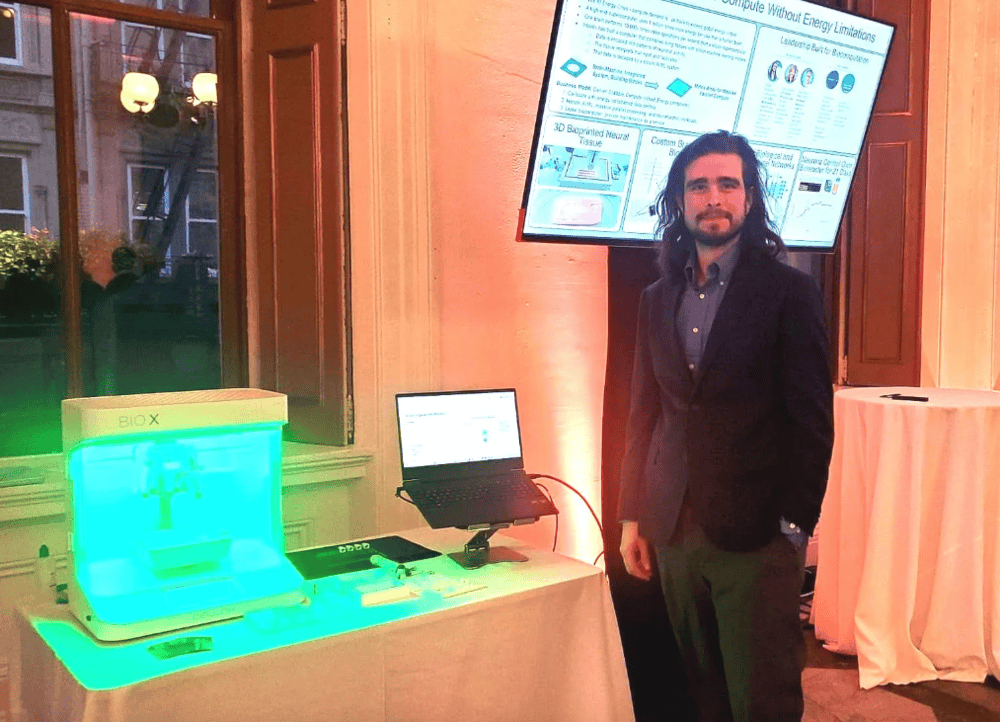
Daniel Rodriguez-Granrose, Co-Founder and CEO of Intactis Bio Corp, who combines deep expertise in neuroscience, tissue engineering, and artificial intelligence to build “bio-computation” platforms, living neural networks capable of performing AI/ML tasks with unprecedented speed and efficiency.
Daniel Rodriguez-Granrose, Co-Founder and CEO of Intactis Bio Corp, who combines deep expertise in neuroscience, tissue engineering, and artificial intelligence to build “bio-computation” platforms, living neural networks capable of performing AI/ML tasks with unprecedented speed and efficiency.
Salt Lake City, Utah — March 26, 2026
In a milestone that would have seemed implausible a decade ago, living neurons grown in a Salt Lake City laboratory have successfully performed arithmetic operations and transmitted the phrase "Hello, World!" — a classic first signal in computing history. The achievement, announced by Intactis Bio Corp, marks a concrete step toward commercially viable biological computers built from living neural tissue rather than silicon chips.
"If we could build AI on a neural tissue substrate instead of silicon chips, we would not only gain computational efficiency but also dramatically reduce environmental impact" said Daniel Rodriguez-Granrose, Founder & CEO of Intactis Bio.
The demonstration coincides with a $250,000 investment from Nucleus Fund, injected to help the company expand its platform's computational complexity and move closer to market. Additional support comes from a SHIFT grant (shiftgrants.org) and a Trail Angel Grant from Altitude Lab (altitudelab.org/financial-awards).
Nucleus Fund is the rebranded version of the Utah Innovation Fund, established in late 2023 support deep-tech startups across Utah. It operates under the Nucleus Institute, created by legislation passed in the 2025 Utah legislative session, structured as an independent, nonprofit, quasi-public corporation.
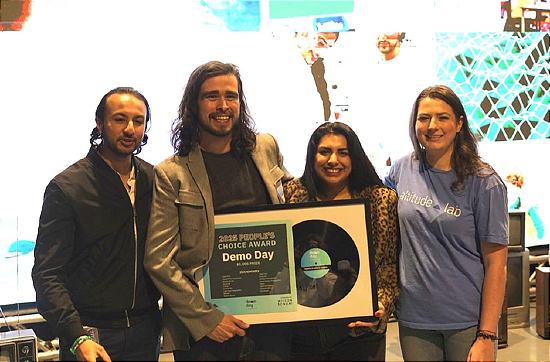
Kapil Sharma, Daniel Rodriguez-Granrose, Chandana Haque and Lauryn Narramore (of the Altitude Lab team)
How the demo worked
The team grew neurons from induced pluripotent stem cells (iPSCs), commercially available cells that can be guided into becoming many cell types, including neurons. Those neurons were integrated with custom silicon hardware through a multi-electrode array capable of both delivering electrical inputs and recording neural responses.
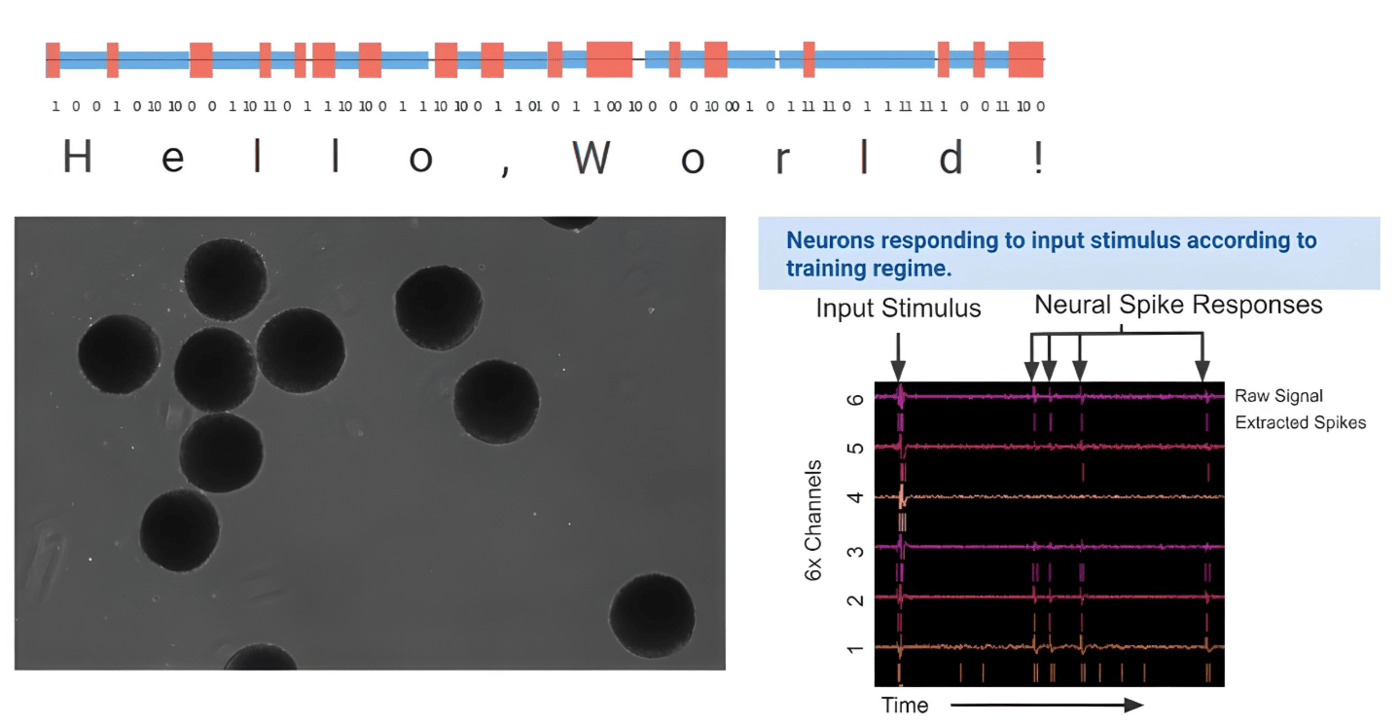
Structured information — arithmetic problems and words — was encoded as electrical stimulation patterns and delivered to the living cells. The neurons responded with measurable electrical spikes, and training altered the timing and frequency of those spikes, allowing distinct computational states to be reliably identified. The result: living cells, tightly coupled to silicon in a feedback loop, performing structured computing tasks.
The company
Founded and self-funded with $150,000 by CEO Daniel Rodriguez-Granrose — who holds a PhD and PSM and brings 14 years of experience in tissue engineering and AI/ML — Intactis Bio is being incubated at Altitude Labs in downtown Salt Lake City. It has assembled a team spanning neuroscience, hardware engineering, and commercialization.
Key figures include Dana Xiadani (Harvard-trained signal processing lead), Dave DeRoo (electrical engineer with 30+ years in brain-machine interfaces), and Travis Rush (PhD, former Senior Director at Recursion Pharmaceuticals), among others.
The company's core technology, previously covered by TechBuzz, centers on 3D-bioprinted neural tissue, vascularized and sustained in custom brain-machine bioreactors. Each substrate contains tens of millions of neurons, roughly eraser-sized, yet 600,000 times larger than any previously demonstrated engineered neural tissue of its kind. Interfaced through electrode arrays, these tissues can be stimulated, recorded from, and trained.
Bridging biology and mainstream AI development is the Biotransformer, Intactis's proprietary architecture that integrates with PyTorch, allowing developers to incorporate biological computation into standard workflows without deep neuroscience expertise. The platform has been patented in more than seven countries.
Lab grown neurons say "Hello, World!" Language and math inputs were converted into electrical stimulation patterns and delivered to lab-grown neurons. Different stimulation patterns were used to represent different types of information. The neurons responded with measurable electrical spikes. These signals were recorded and decoded. Training changed how often and when the neurons fired, allowing different computational states to be clearly identified.
Why it matters
Modern AI workloads are extraordinarily energy-intensive. The human brain, by contrast, performs roughly 10,000 times more operations per second than a supercomputer while consuming one million times less energy per day. Intactis projects a 95% reduction in energy costs and a 90% reduction in total costs compared with exaflop-scale silicon systems, along with an 88% reduction in physical data center footprint.
The stakes are particularly visible in Utah, where data center operations already strain the region's energy grid and place additional pressure on the shrinking Great Salt Lake.
Funding to date
Source
Amount
Nucleus Fund (new)
$250,000
RPV pre-seed + committed
$300,000
Founder self-funding
$150,000
Grants (Altitude Lab, Utah State, SHIFT, others)
Undisclosed
Open seed round target
$2.5M
What's next
Intactis has launched its Phase 1 Biocomputation Alpha platform, available in free and paid tiers, with paid users prioritized for capacity and co-development access. Phase 2 is planned for 2027. The company's long-term vision is exaflop-scale biohybrid machines — systems that integrate biological reasoning into data-center-scale AI workflows, adapting in real time in ways silicon alone cannot.
For inquiries or to join the alpha, contact Daniel Rodriguez-Granrose at daniel@intactis.bio.