Talbot West’s Case for AI Orchestration Over Point Solutions
Talbot West (Salt Lake City, UT) helps companies navigate enterprise AI adoption through its FRAME methodology and APEX prioritization, orchestrating systems, workflows, and data to deliver actionable AI roadmaps while avoiding siloed implementations.
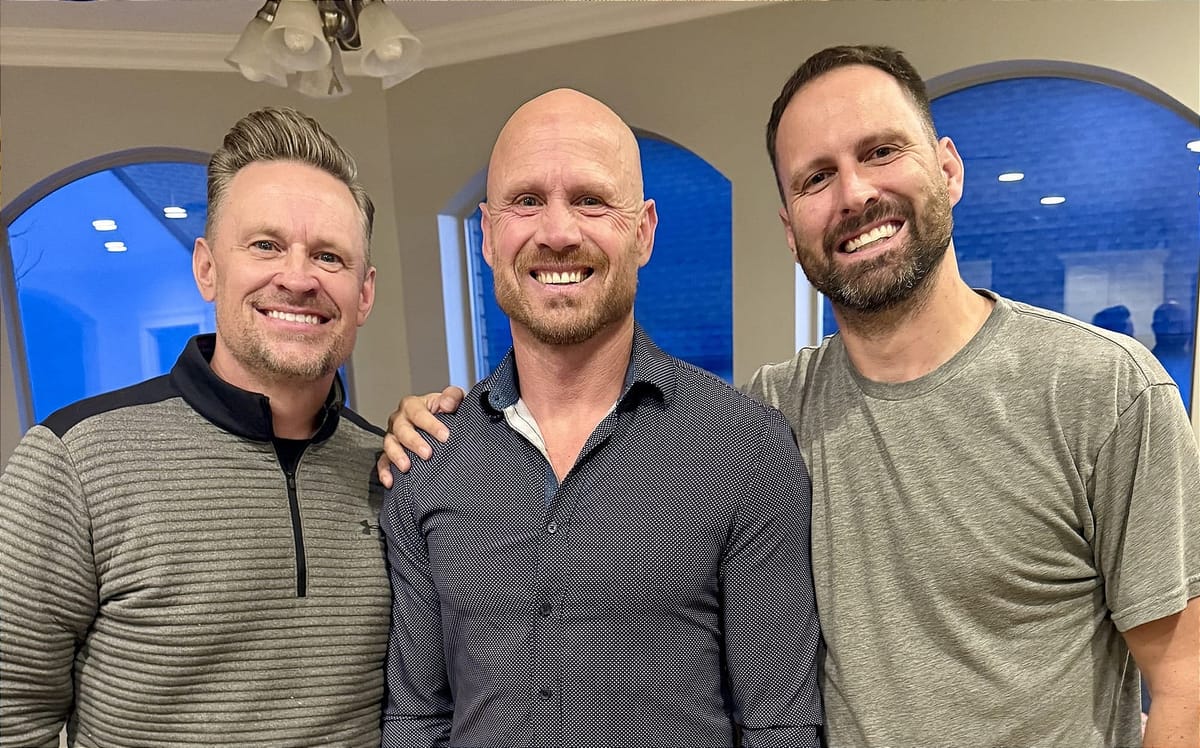
Steve Larsen (VP of Sales) with Talbot West co-founders Jacob Andra (CEO) and Stephen Karafiath (Sr. VP AI Solutions Architecture)
Steve Larsen (VP of Sales) with Talbot West co-founders Jacob Andra (CEO) and Stephen Karafiath (Sr. VP AI Solutions Architecture)
Salt Lake City, Utah — January 7, 2026
After several years of breathless hype, enterprise AI has entered a more sobering phase. Many companies now find themselves surrounded by tools they don’t fully understand, pilots that don’t scale, and vendors promising results without agreeing on where to begin. Large language models may have captured attention, but they have also exposed a deeper problem: most organizations lack a coherent way to decide how artificial intelligence should fit into their broader systems and operations.
Talbot West, a Salt Lake City-based AI advisory firm, believes the failure point isn’t technology—it’s orchestration. Rather than selling software or point solutions, the firm positions itself as a strategic guide, helping companies evaluate their entire operational landscape, prioritize AI initiatives, and sequence modernization in a way that actually delivers return on investment.
Beyond Point Solutions: Orchestrating Enterprise AI
Most AI deployments, according to Talbot West founder Jacob Andra, fail not because of technical limitations but because companies treat AI as a set of disconnected tools. “The number one pain point we hear is not ‘what can AI do?’—it’s ‘where do we even start?’” Andra said in an interview with TechBuzz.
Talbot West takes a different approach. The firm acts as a “quarterback,” coordinating existing teams, workflows, and technology investments. Instead of replacing internal staff or demanding a full-system overhaul, it helps organizations orchestrate their resources to work together efficiently while introducing AI where it adds the most value.
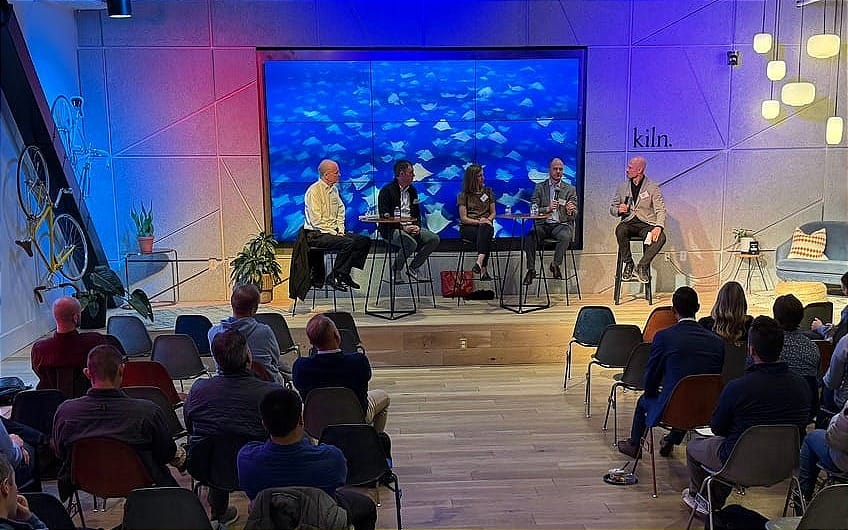
Jacob Andra moderated a roundtable AI discussion targeted to CFOs, Kiln Lehi, 2025
Founders With Complementary Expertise
The firm’s two co-founders bring complementary experience. Andra, who grew up in a family manufacturing business, has built multiple companies and ran a marketing agency, giving him hands-on operational experience. Co-founder Stephen Karafiath spent two decades at Oracle, rising from developer to lead of the company’s elite Developer Innovations team, overseeing custom enterprise solutions for Fortune 500 clients.
Together, the pairing combines operational know-how with enterprise-scale systems expertise—a mix Andra says is rare among AI consultancies. “There are great management consulting firms adopting AI, and there are AI-native companies,” he said. “We bridge that gap: we understand complex systems and we understand how to apply AI in a way that actually produces results.”
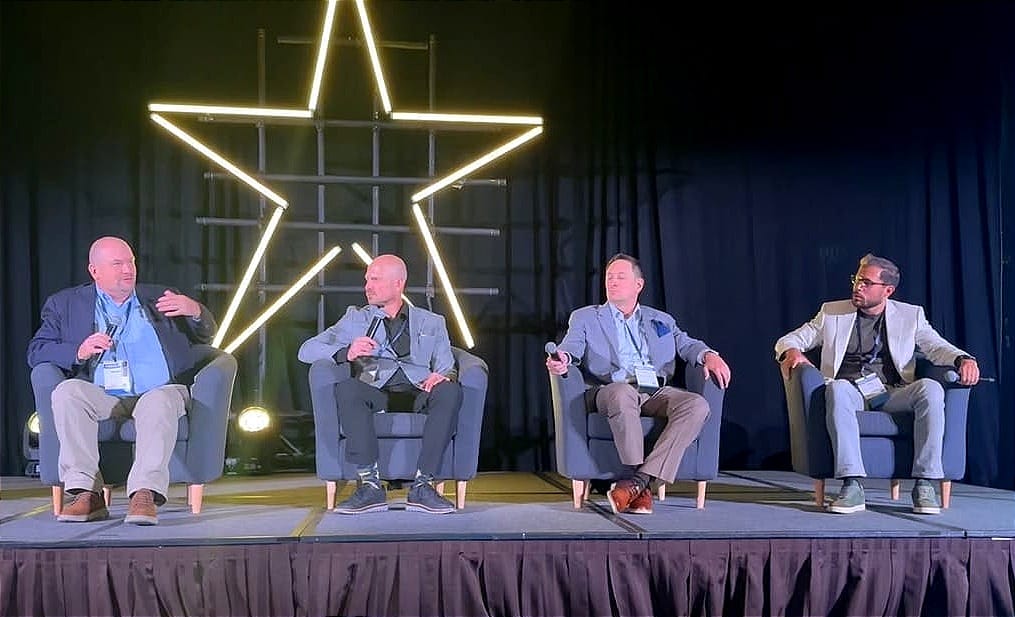
Jacob Andra discusses AI security on a panel at the Five Star Mortgage Conference, Dallas, TX, 2025
FRAME: One Blueprint Instead of Many Assessments
Central to Talbot West’s approach is its proprietary methodology, FRAME (Future-Readiness Assessment and Modernization Engineering). FRAME integrates disparate enterprise initiatives—including AI, data, workflows, and systems architecture—into a single, actionable roadmap.
Rather than producing a high-level slide deck or a piecemeal audit, FRAME delivers engineering-ready outputs, including architecture maps, modernization dependency graphs, and phased implementation schedules. These outputs are designed to be executed by internal teams or existing partners, reducing the friction often associated with AI projects.
FRAME is also modular and flexible. A sub-module, APEX (AI Prioritization and Execution), helps organizations prioritize competing AI initiatives by ranking them across dimensions such as strategic alignment, technical feasibility, cost, and expected impact. According to Andra, the framework’s structure addresses executive indecision and vendor overload while producing a clear starting point.
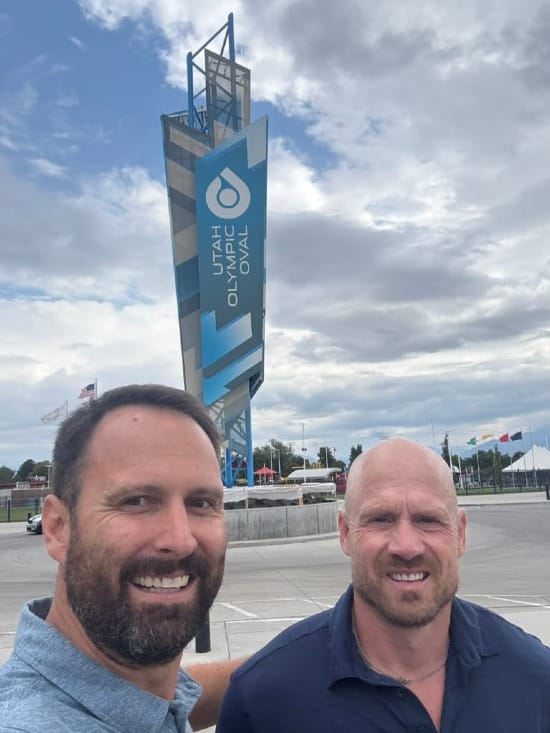
Talbot West co-founders Jacob Andra (CEO) and Stephen Karafiath (Sr. VP AI Solutions Architecture) at the Utah Olympic Oval in Kearns, Utah
Case Study: Engineering Firm ERP
Talbot West has deployed FRAME and APEX across diverse clients, from marketing companies integrating AI into existing software, to organizations still adopting fundamental enterprise technology. One illustrative example involves a mid-sized engineering firm with a self-built ERP and project management system. The company’s platform had grown organically over time, resulting in functional silos and uneven workflows.
Talbot West assessed the system and gave it a B+—solid, but with opportunities for improvement. Using FRAME, the firm created a roadmap for un-siloing data and introducing targeted AI workflows. Talbot West continues to guide the client’s internal team in piloting AI initiatives, demonstrating how orchestration and prioritization can generate meaningful operational impact without a full-scale replacement of existing systems.
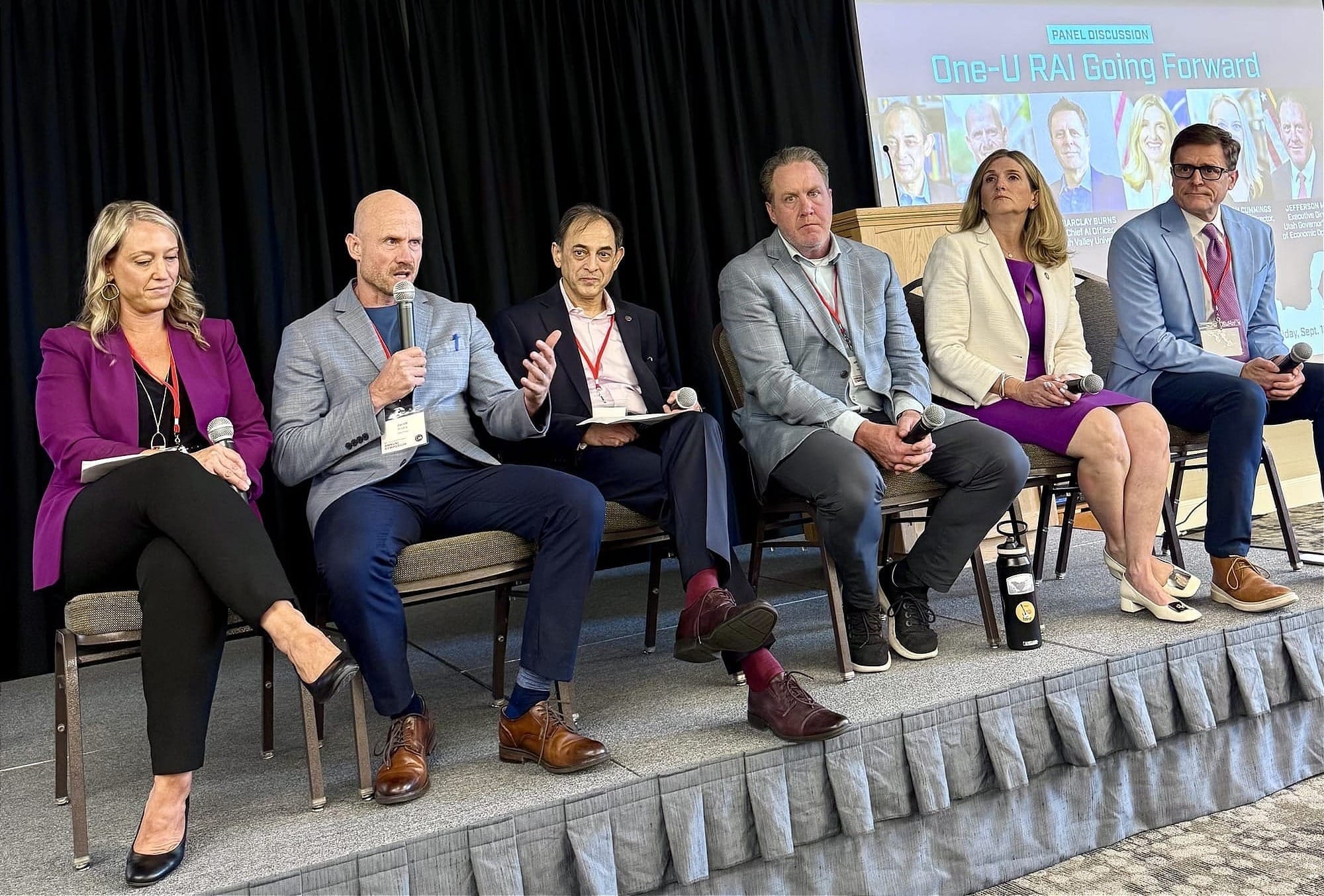
Jacob Andra, panelist at the Utah Responsible AI Community Consortium, with Rebekah Cummings, Manish Parashar, Jefferson Moss, Margaret Busse, and Barclay Burns, University of Utah, 9/13/2025
Extending AI Maturity Beyond Operations
The firm’s work also extends into mergers and acquisitions, where AI readiness is increasingly part of company valuations. Talbot West has partnered with investment banks on AI-driven M&A advisory platforms, helping sellers maximize exit value and buyers identify post-acquisition integration opportunities. Andra likens it to hiring a general contractor to assess a home before purchase: technical improvements can materially affect the return on investment.
Beyond Large Language Models
While much of the news cycle focuses on large language models (LLMs) such as ChatGPT, Talbot West leverages a wide range of diverse AI capabilities for its clients. Case in point: Lumawarp, a novel machine learning model developed by Utah-based Lucidity Sciences. “Lumawarp is faster and more accurate than anything out there for extracting patterns from large amounts of structured data,” said Andra.
Talbot West and Lucidity Sciences recently announced a strategic partnership wherein Talbot West serves as the orchestration and enablement partner for companies seeking to deploy Lumawarp.
Andra explained that LLMs, while useful for many task types, are the wrong tool for a wide range of use cases better served by a tool like Lumawarp—or something else entirely. “It’s a nontrivial task to identify which technology to apply to a business need,” he said, and advises business executives to resist the temptation to jump on what’s currently in vogue, hoping for an easy fix. “Often, for a complex business use case, we’re architecting an ensemble of many different technologies coordinated together. It’s almost never a large language model on its own."
Talbot West’s approach underscores a broader lesson in enterprise AI: success is rarely about choosing the “best” model or platform. It comes from understanding how AI fits into an organization’s broader systems, workflows, and decision-making. By prioritizing clarity and orchestration, Talbot West seeks to help organizations make informed choices, avoid siloed deployments, and achieve measurable returns from their AI initiatives.
“Most providers do not put the client first,” Andra said. “We come in from an extremely tech-agnostic perspective, looking at what will actually move the needle for the client. Our frameworks are flexible because the client’s needs come first.”
The firm recently expanded its leadership team with Steve Larsen, as VP of Sales, pictured above, signaling a shift from advisory-led growth to a more formal go-to-market strategy.
Andra also hosts The Applied AI Podcast which explores practical business applications and challenges of AI adoption across industries.