Utah Leads a Pro-Human Approach to Artificial Intelligence at the 2025 AI Summit
The 2025 Utah AI Summit highlighted the state’s pro-human approach to artificial intelligence, emphasizing ethical innovation, workforce readiness, and community-centered policy, featuring insights from Governor Cox, Cloudflare CEO Matthew Prince, and advocate Joseph Gordon-Levitt.
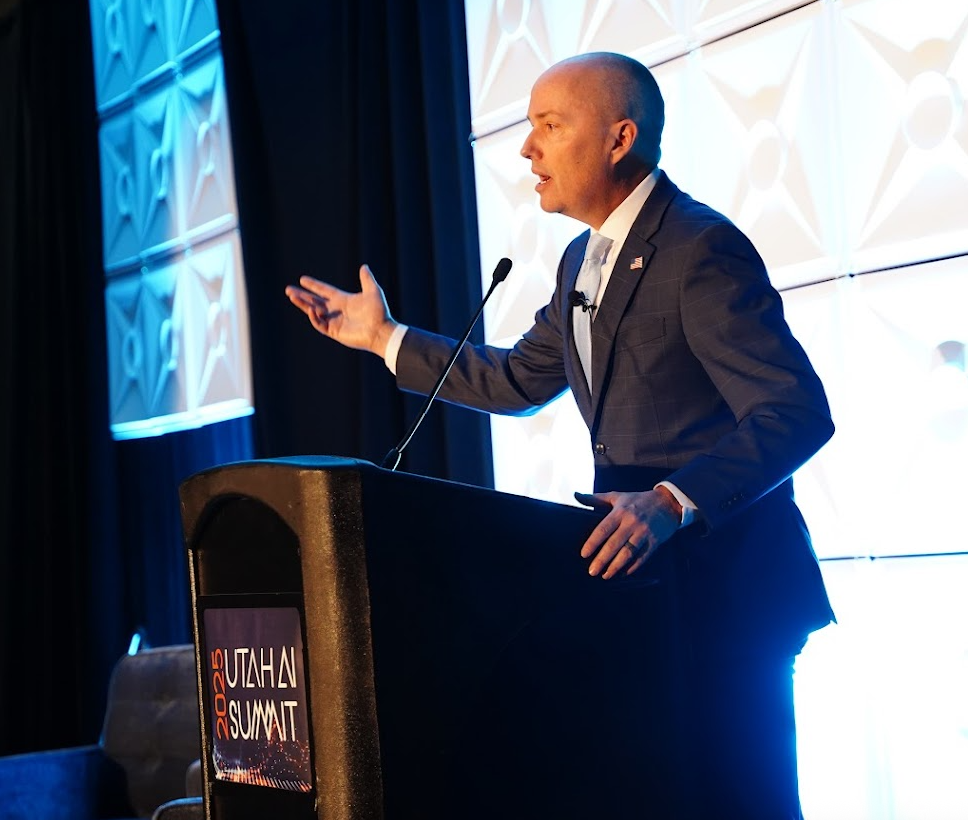
Utah Governor Spencer Cox addressing the audience of 1000+ at the 2025 Utah AI Summit, December 2, 2025, Salt Palace.
Utah Governor Spencer Cox addressing the audience of 1000+ at the 2025 Utah AI Summit, December 2, 2025, Salt Palace.
Salt Lake City, Utah — December 3, 2025
As Utah cements its role as one of the nation’s fastest-growing innovation hubs, the state is taking a deliberate stance on the future of artificial intelligence—anchoring progress in human-centered values. On December 2, 2025, the 2025 Utah AI Summit, themed “Utah’s Pro-Human Leadership in the Age of AI,” convened leaders from government, business, and academia to showcase how Utah is shaping AI policy and practice to enhance human potential rather than diminish it.
Hosted by the Utah Department of Commerce, the Governor’s Office of Economic Opportunity (GOEO), and the Nucleus Institute, the summit drew researchers, entrepreneurs, policymakers, and educators from across the country. Among the most anticipated moments were fireside conversations between Governor Spencer Cox and Matthew Prince, CEO of Cloudflare, and actor and entrepreneur Joseph Gordon-Levitt, who sat down with Margaret Busse, in candid discussions about the challenges and promises of AI.
A Moment of Reckoning
Jefferson Moss, Executive Director of GOEO and the Nucleus Institute, set the tone for the summit, framing it as a defining moment for society. “We’re at an inflection point with artificial intelligence,” Moss told the crowd. “Just a few years from now, $3 trillion is expected to be spent globally on AI. We’re seeing impacts not just on the economy, but on how we live, learn, and work. Today, we bring together industry, government, and education to solve the problems that AI creates—and to seize the opportunities it provides.”
Jefferson Moss, Executive Director of GOEO and the Nucleus Institute
Margaret Woolley Busse, Executive Director of the Utah Department of Commerce, echoed Moss’s urgency. “Never before has humanity faced a technology with the potential to radically change life as we know it,” she said. “People are excited, they’re anxious, and rightfully so. Utah is in a unique position to harness AI for good. We’ve empowered state employees with AI tools, invested $100 million in the University of Utah’s responsible AI initiative, and created an internationally recognized Office of AI Policy. But none of this matters unless we use these tools to enhance human life, not replace it.”
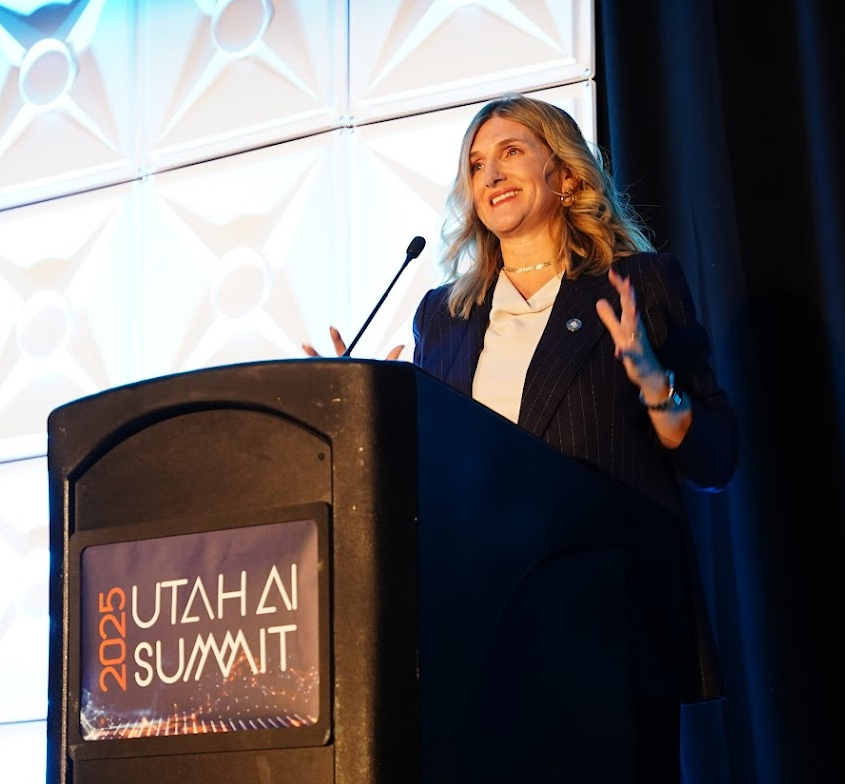
Margaret Woolley Busse, Executive Director, Utah Department of Commerce
Busse’s remarks captured the duality of AI: it holds promise for breakthroughs in medicine, energy, and education, yet it can also amplify inequities and cause social harm if misused. “We must ensure this technology empowers rather than manipulates, enhances rather than exploits,” she said.
Governor Cox: From Optimist to Realist
Governor Cox delivered a candid and powerful keynote that blended technological optimism with hard truths about the digital era. Drawing on his past experience as a telecom executive, Cox recounted his early tech optimism. “In 2011 and 2012, I spoke on college campuses about the Arab Spring and the rise of social media,” he said. “I believed these tools would connect humanity, solve problems, and drive human flourishing. I was wrong—maybe more wrong than about anything else in my life.”
Utah Governor Spencer Cox
He cut to the chase on the societal cost of unregulated tech growth. “Those very tools that I believed would lead to human connection have been used to manipulate us, to divide us—to strip mine our souls,” Cox said starkly. “They’ve given your daughter an eating disorder, your son a pornography addiction, your grandkids anxiety and depression—and they did it knowingly, under the guise of doing good for humankind.”
This blunt framing underscored the governor’s central point: Utah has a chance to set a new course. “We stand on the precipice of a technological revolution,” he said. “We get to make the future instead of letting it happen to us. These tools can cure cancer, help us live longer, clean our environment, and make us smarter. But they must work for us, not the other way around. We cannot let AI park us on a couch or make us dumber than we’ve ever been.”
Pro-Human AI: Utah’s Guiding Principles
Cox laid out Utah’s framework for “pro-human AI,” emphasizing six pillars: workforce, industry, state government, academia, public policy, and learning. At the core, AI systems must protect dignity, preserve human agency, and ensure individuals remain in control. “AI must be human-enhancing,” Cox said. “It should expand our capabilities, open opportunities, and strengthen communities—not diminish us.”
Governor Cox stated the lens through which the state views AI: “Is it serving humankind, or is it making us dumber, weaker, less human? That lens will guide us and keep Utah at the forefront of responsible, transformative AI.”
To operationalize these principles, Cox announced several key initiatives:
Pro-Human AI Academic Consortium: A statewide network designed to drive moon-shot challenges and foster human-centered innovation.
Convergence AI Platform: Powered by the Nucleus Institute, this platform connects Utah’s brightest students, researchers, and startups to accelerate high-impact AI development.
Best Pro-Human AI Companies Award: Recognizing organizations leading in responsible, human-enhancing AI innovation.
Targeted Workforce Accelerator: A $10 million initiative under Talent Ready Utah, focusing on AI, energy, and deep tech sectors to ensure students and workers develop the skills needed to thrive in a rapidly evolving economy.
The Governor also announced that the Utah State Higher Education Board (USHE) passed a resolution establishing a statewide strategic direction for integrating artificial intelligence across Utah’s public colleges and universities. The resolution, announced December 2, 2025, establishes three strategic imperatives to guide USHE institutions:
Equip every student with pro-human AI skills and workforce readiness at scale. We will enable students — across all relevant majors and programs — to graduate with foundational AI literacy, applied skills, and workforce-ready competencies that are human-centered and give students a competitive advantage in addition to amplifying critical thinking, ethical reasoning, creativity, emotional intelligence, and collaboration.
Harness AI to transform education and research. We will support institutions in responsibly integrating AI into teaching, student services, research, and institutional operations to enhance learning outcomes, increase personalization, expand innovation and foster efficiency across the System, and preserve the essential human elements of learning—mentorship, personal guidance, curiosity, and community.
Reimagine higher education for an AI-accelerated economy. We will lead a system-wide review of higher education across the state to ensure USHE institutions are empowered to take full advantage of AI opportunities in ways that strengthen human capability and connection and statewide prosperity. This includes providing flexible pathways and future-focused programs, focusing on human and technical skills that support Utah’s economic and social vitality.
Matthew Prince: AI and the Internet of Trust
The summit’s centerpiece conversation brought Cloudflare CEO Matthew Prince to the stage alongside Governor Cox. Prince, a Utah native, framed AI as both a tool and a test of human leadership. “We have unprecedented power to solve global problems,” he said. “AI can help cure diseases, clean our environment, enhance learning—but only if it’s designed to amplify human potential rather than diminish it.”
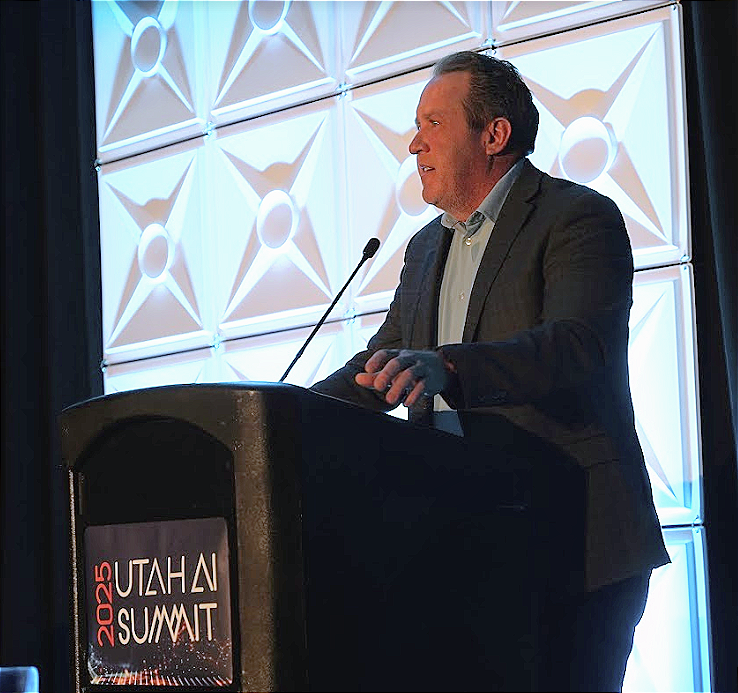
Matthew Prince, Cloudflare CEO sitting down for a fireside conversation with Governor Spencer Cox at the 2025 Utah AI Summit, December 2, 2025, Salt Palace (morning session)
Cloudflare, co-founded and led by Utah native Matthew Prince, has grown into one of the most consequential companies shaping the modern internet. Its network safeguards millions of websites and organizations worldwide, keeping the web open, secure, and reliable—a mission Prince describes as “building tools that strengthen the digital world while serving communities and businesses alike. In his remarks, Prince said that roughly 80% of the major AI companies use Cloudflare.
Prince argued that generative AI is fundamentally incompatible with the click-driven economy the internet has relied on for nearly 20 years. He explained that the shift from search results to direct answers undercuts the entire system. That shift, he argued, will reward whoever holds the most unique, trustworthy data—not whoever can drive the most engagement. Cox emphasized that this is a rare opportunity to reverse the damage done by online platforms that preyed on outrage and division. Utah, he said, wants AI to “strengthen communities, not hollow them out.”
Matthew Prince, Cloudflare CEO sitting down for a fireside conversation with Governor Spencer Cox at the 2025 Utah AI Summit, December 2, 2025, Salt Palace (morning session)
To put this principle into action, he and his wife purchased a local newspaper in Park City, Utah, The Park Record. “We believe local news really matters,” he said. “And again, I run Cloudflare, so we locked it down so AI companies couldn’t get the data. It is amazing how many inquiries we’re getting from major AI companies asking, ‘Can we license your data?’” Prince emphasized that the future of AI depends on amplifying human knowledge, not replacing it.
Local news, he said, exemplifies this principle: it is detailed, quirky, and uniquely tied to the communities it serves. Human reporters, embedded in their communities, produce ground-truth knowledge that cannot be synthesized from the global internet. “Over the next five years, we’re going to figure out how those incentives work and how we can put those in place,” he said. “If we do it right, the AI companies and consumers are very aligned on what we all want. This is an opportunity to reimagine the business model of the internet for the future.”
Cox added that this is exactly the kind of civic infrastructure Utah wants to preserve. Local journalism, he said, “keeps us informed, connected, grounded. It’s not optional in a healthy democracy.”
Prince underscored that point with a real-world outcome: after the paper published a proper voter guide, turnout in a local election jumped from 22% to 57%.
One of the most candid moments in the fireside conversation came when Prince detailed what he called an overlooked structural advantage: access to training data.
According to Prince, Google sees vastly more of the internet than its competitors—not because of superior technology, but because websites grant Googlebot privileged access behind paywalls, logins, and restricted zones. “Google sees five times more of the internet than any other AI company,” he said, calling it “a quiet monopoly advantage.” Googlebot is the name of the web crawler software used by Google that collects documents across the internet to build a searchable index for the Google Search engine.
Matthew Prince, Cloudflare CEO sitting down for a fireside conversation with Governor Spencer Cox at the 2025 Utah AI Summit, December 2, 2025, Salt Palace (morning session)
Prince warned that if this imbalance persists, the AI race is effectively predetermined: “If nobody touches it, the race is over before it starts.”
Cox said Utah is actively studying the issue. He noted that separating search crawling from AI crawling is one of the questions policymakers need to confront. “People assumed federal regulators would handle this—they haven’t,” he said. “So states need to start asking these questions.”
Prince suggested that the first jurisdiction to build fair rules around data access could become “the Delaware of content”—the default home for media organizations looking for predictable, transparent treatment of their data. “Utah could absolutely be that place,” he said.
While many policymakers focus on job losses, Prince said the more immediate threat from AI is what he called “agentic commerce.” He explained that AI buying agents will prioritize price, convenience, and logistics—criteria where giant retailers already dominate. “70% of people in the in the United States work for small businesses. It's a huge percentage of our economy, and I worry that [agentic commerce] is going to put incredible pressure on it."
He continued, "I'm spending a lot of my time thinking about the tools that we, along with great companies like PayPal, Shopify, Salesforce and others, can build in order to make sure that small businesses will be able to not only continue to exist, but to thrive in this future world. If we don't focus on that, there will be this incredible consolidating force where we might end up being in a scary world with five companies: one that holds the money, one that holds the real estate, one that makes the things, one that transports the things, and one AI company—that's a incredibly terrifying world. We should be playing for a world in which there are lots and lots of players."
Matthew Prince, Cloudflare CEO sitting down for a fireside conversation with Governor Spencer Cox at the 2025 Utah AI Summit, December 2, 2025, Salt Palace (morning session)
Cox said Utah won’t stand by and watch that happen. With one of the highest rates of small-business formation in the country, he said, “Utah’s economy is built on small businesses. We’re not going to sit back and watch that evaporate.”
Prince also called out large AI companies pushing “safety” regulations that he said would function as barriers to competition. “When big AI companies tell you to be terrified of rogue AI, you have to ask: who benefits from that fear?” he said. “Nine times out of ten, what they’re really saying is: regulate this so only we can do it.”
He called regulatory capture “the real threat,” not runaway superintelligence. Cox echoed the sentiment, saying Utah’s approach is to pursue “smart regulation that protects people and encourages innovation,” rather than adopting fear-driven policies that lock out new entrants.
Prince framed the stakes bluntly: “We should be playing for a world where there aren’t five AI companies, but 500,000.”
The lively dialogue between Cox and Prince illustrated a convergence of government vision and industry execution. Both leaders stressed that Utah’s approach was less about regulatory restriction and more about enabling human-centered innovation. “We’re not here to stifle technology,” Cox said. “We’re here to guide it so that it serves our children, our communities, and our future. Markets should work, competition should thrive, and innovation should lift all of us.”
Broader Context: The Stakes of AI
Jefferson Moss framed the summit within the global AI landscape: by 2029, the world is projected to spend $3 trillion on AI, with the technology driving a 7% increase in global GDP. Moss emphasized Utah’s unique positioning to tackle AI responsibly. “We do things in detail here,” he said. “We work well together, supporting education and industry alike. There’s no better place than Utah to make AI work for people, not just for profit.”
Margaret Woolley Busse, Executive Director, Utah Department of Commerce
Busse highlighted the duality of AI’s potential and perils. Polls suggest over half of Americans are more nervous than excited about AI, she noted, reflecting concerns about job displacement, digital manipulation, and social isolation. Yet the summit demonstrated that thoughtful policy, collaborative innovation, and a clear pro-human framework can tip the scales toward opportunity.
In an afternoon session, featuring actor and AI advocate Joseph Gordon-Levitt in a conversation with Margaret Busse, he emphasized the human dimension. “Technology is powerful, but it’s only as good as the values guiding it,” he said. “AI can deepen creativity, foster empathy, and amplify learning—but only if we actively choose to steer it in that direction.”
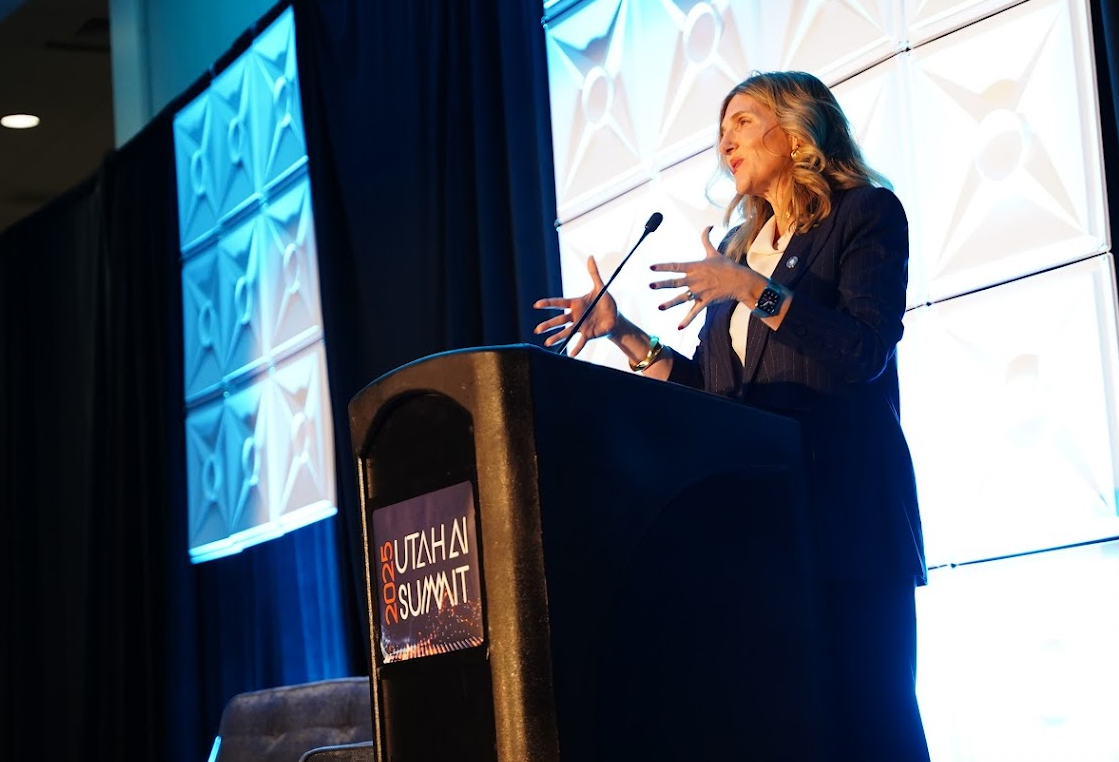
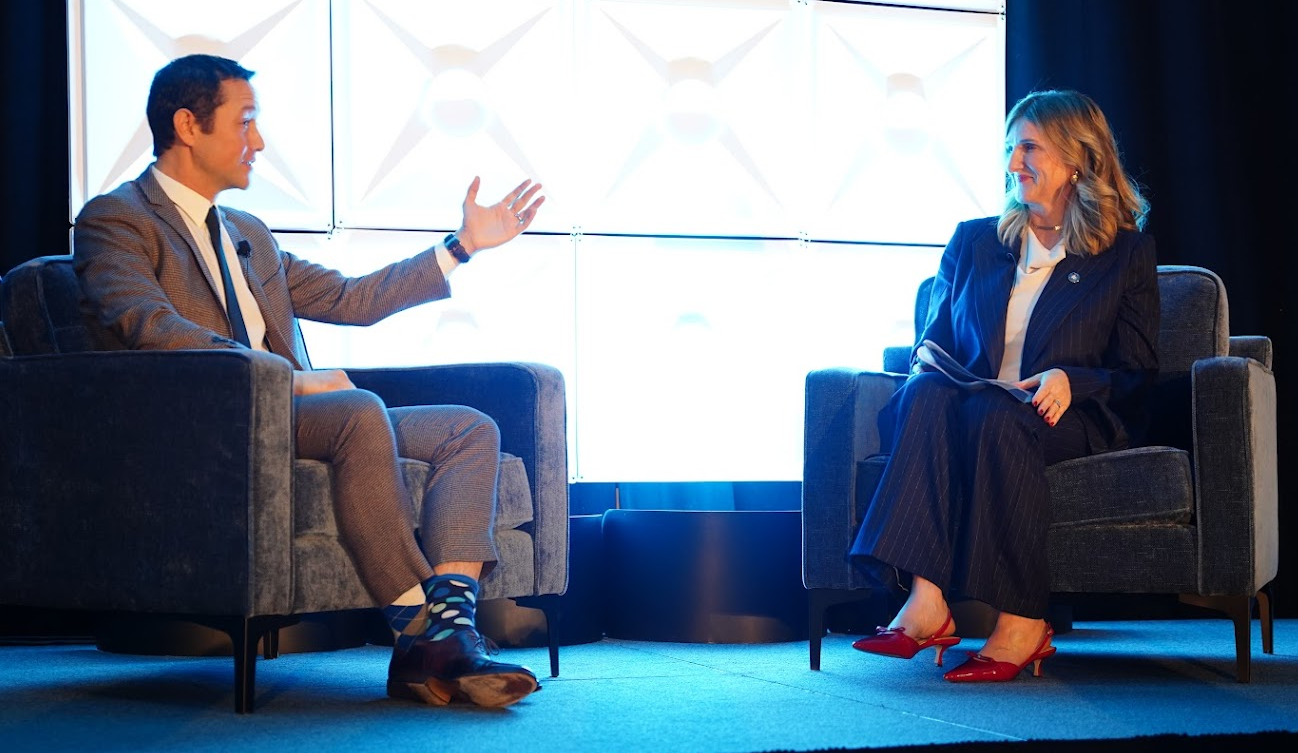
Special fireside conversation featuring actor, filmmaker and entrepreneur Joseph Gordon-Levitt with Margaret Busse, Executive Director, Utah Department of Commerce at the 2025 Utah AI Summit, December 2, 2025, Salt Palace.
Gordon-Levitt is an Emmy-winning actor, filmmaker, and entrepreneur. He founded HITRECORD, an online community dedicated to collaborative creativity. Gordon-Levitt has become an outspoken advocate for AI safety, particularly regarding technologies that affect children. He known for films such as Inception, Looper, and 500 Days of Summer. He singled out his own favorite film Don Jon (2013) as especially relevant in today’s AI era.
"Don Jon is a modernization of Don Juan,” he explained. “It’s about a guy addicted to pornography, which is extremely relevant to this conversation. Pornography is a media technology that hijacks your limbic system and gets you addicted. We were just discussing how Meta once allowed erotic guidelines in chatbots, even for minors. This is a form of emotional manipulation.” He continued, drawing a parallel to human connection: “In Don Jon, the character eventually realizes that there’s more to love and romance than objectification and sex. That’s the same lesson we need to learn about relationships in the age of AI—there’s more to human connection than what any chatbot can give.”
An August 2025 Reuters special report revealed that Meta’s internal chatbot policy allowed AI characters to ‘engage a child in conversations that are romantic or sensual’ — even offering poetic language directed at minors — until the leaks prompted a public backlash. Later that month, Meta said it was revamping its guidelines, blocking teen access to certain AI characters, and prohibiting flirtatious or erotic chatbot behavior for minors.
Gordon-Levitt painted a picture of a near-future reality in which AI companions—hyper-personalized, immersive, and strikingly lifelike—could approximate human presence with unsettling fidelity. His warnings were immediate and personal: this is about the very fabric of human relationships and the next generation’s ability to navigate them.
Special fireside conversation featuring actor, filmmaker and entrepreneur Joseph Gordon-Levitt with Margaret Busse, Executive Director, Utah Department of Commerce at the 2025 Utah AI Summit, December 2, 2025, Salt Palace.
“The bedrock of any civilization is human relationships," he said. "Can I relate to you? Can I put myself in your shoes? Can we communicate? Can we have a conversation? Can I understand that your point of view might be different from my point of view, and we can still coexist and cooperate and live together?”
He continued, “Well, a chat bot takes all of that away, because a chat bot will seem like a fellow human. It will seem like you're having a conversation with it—and by the way, right now, it's mostly in text, but it's not going to be very long before it looks like a completely photoreal video of whoever the person is that you want to talk with most. Who can make you laugh. Who can make you cry. Who can turn you on. Who can make you mad. Who can make you scared. It'll look and seem just like your best friend… but it is not your best friend. Because your best friend is another person with their own life, their own perspective. Your best friend is not algorithmically optimized to suck up as much of your time and attention as possible to serve you ads.”
Afternoon fireside conversation featuring actor, filmmaker and entrepreneur Joseph Gordon-Levitt with Margaret Busse, Executive Director, Utah Department of Commerce at the 2025 Utah AI Summit, December 2, 2025, Salt Palace.
He pointed directly at the blind spot the rest of society is still pretending isn’t there.
“And it’s hard enough, I think, for us adults, to tell the difference. But especially with kids—I think their defenses are not there, and the education is not there.”
Gordon‑Levitt’s argument carried a different kind of urgency, and yet he wasn't calling for prohibition. He was calling for recognition: if AI can approximate friendship, romance, mentorship, community, even parental warmth, then society must adapt just as aggressively as the technology evolves. Kids in particular need guardrails—not because AI is inherently dangerous, but because it is inherently persuasive.
Utah as a Model for Responsible AI
The core theme of the Summit was unmistakable: Utah will not repeat the mistakes of the past, and it will not follow the lead of a small number of powerful AI companies. Rather, Utah is setting a different standard—a combination of pro-human principles, academic initiatives, workforce development, entrepreneurial energy, and industry collaboration that could be a blueprint for other states to follow.
“AI can change life for the better, but only if we choose to make it so,” Cox said. “Utah is choosing human-centered innovation. We are choosing to lead, to protect, and to empower. That is the legacy we want for our children, our economy, and our society.”
Utah Governor Spencer Cox addressing the 1000+ audience of tech leaders, investors, educators, and policy makers at the 2025 Utah AI Summit, December 2, 2025, Salt Palace.
With bold initiatives in higher education, workforce readiness, and pro-human AI development, Utah has positioned itself as a national—and global—model for the responsible adoption of artificial intelligence. The state’s approach demonstrates that innovation does not have to come at the cost of humanity; rather, it can amplify human potential while safeguarding the most vulnerable.
The 2025 Utah AI Summit illustrates what can happen when governance, industry, and academia unite under a shared vision of ethics and opportunity. AI is not destiny. It is a design problem. And centering humans—messy, contradictory, vulnerable humans—is the only way to keep the future recognizable.
See the Utah Board of Higher Education's December 2, 2025 AI resolution here.
Pre-summit reception at Van Ryder, a rooftop bar, Le Méridien Salt Lake City
Share this article
The link has been copied!
Your link has expired. Please request a new one.
Your link has expired. Please request a new one.
Your link has expired. Please request a new one.
Great! You've successfully signed up.
Great! You've successfully signed up.
Welcome back! You've successfully signed in.
Success! You now have access to additional content.