Utah Meets Antiquity: UVU Hosts Researchers Who Are Unlocking a 2,000-Year-Old Library Buried by Vesuvius
A Kentucky computer scientist, Brent Seales, spent 25 years cracking open carbonized scrolls buried by Vesuvius in 79 AD. Now, AI and X-ray imaging are reading them for the first time — and an entire ancient library may follow.
Brent Seales, a Kentucky computer scientist spent 25 years trying to read scrolls that a volcano destroyed in 79 AD. Then AI showed up, and everything changed.
Orem, Utah — April 8, 2026
The first word ever read from inside a 2,000-year-old Herculaneum scroll was "porphyras," the Greek word for"purple."
When that result surfaced in 2023, The Daily Show had a field day. "I was hoping for ancient wisdom and a demon," the host deadpanned. "But yeah, you know, mixing red and blue is cool too."
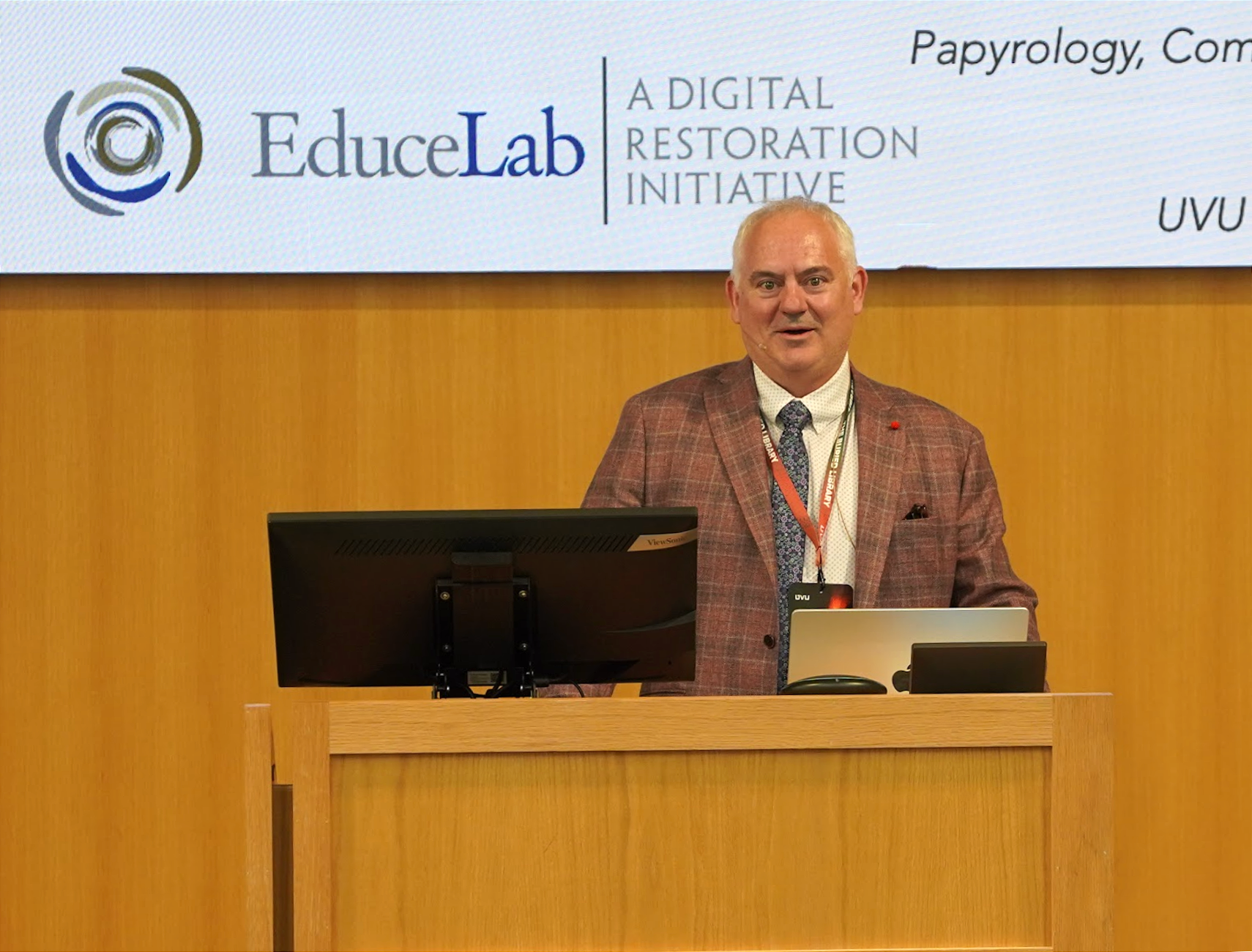
Today, Brent Seales, the Stan and Karen Pigman Chair of Heritage Science and Director of EduceLab at the University of Kentucky, standing at the front of the Matthew S. Holland lecture hall within Utah Valley University's Clarke Building let the clip play all the way through. The audience laughed. He smiled, knowingly.
"When you know what we knew," he told the audience, alluding to the mammoth effort he had devoted much of his professional life to secure support and funding for the deciphering of these seemingly unreadable ancient scrolls. "It would just be a short time and the words would come tumbling out."
Brent Seales, the Stan and Karen Pigman Chair of Heritage Science and Director of EduceLab at the University of Kentucky, speaking at the The Buried Library: Herculaneum Papyri and AI Conference.” a free conference taking place this week at UVU in Orem, Utah
He was right. Sixteen columns followed. Then 70 more. Then seven meters of readable text from a scroll that had been sitting, unopened, in a box at Oxford University for decades — a box that Seales had spent six years begging to look inside.
Memorably, Seales ceremoniously removed a reproduction of the seven meter scroll, and in a grand gesture, unfurled it in front of a cheering audience.
The Herculaneum scrolls are one of the great unsolved problems of the ancient world, and Seales has spent the better part of his career trying to crack them. When he spoke at UVU's symposium on ancient papyri today, it was the kind of talk where you realize midway through that you're watching someone recount a genuinely world-historical achievement — in a conference room in Orem. Just another Wednesday at UVU.
The Problem
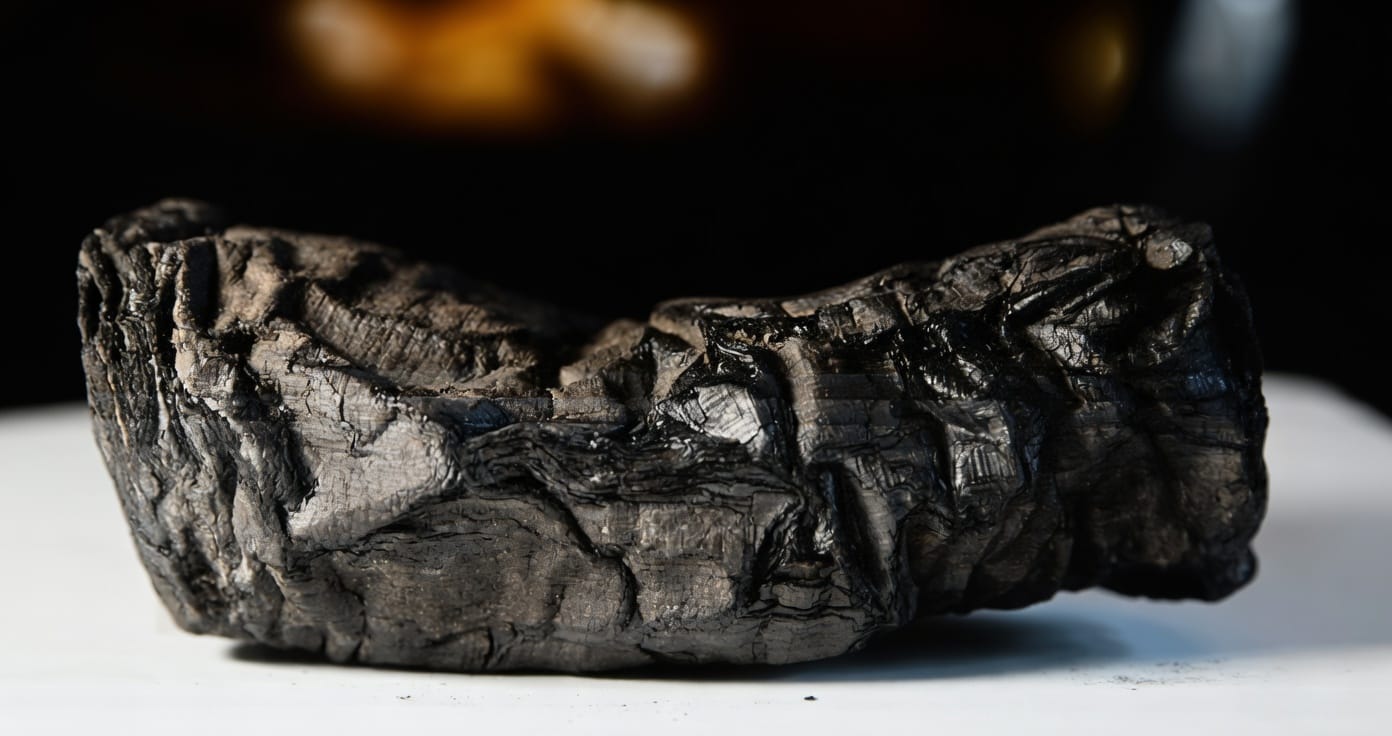
When Vesuvius erupted in 79 AD, it buried the Villa of the Papyri under a superheated pyroclastic surge that carbonized everything inside, including roughly 400 scrolls. The scrolls survived — sort of. They emerged from excavations in the 18th century looking like lumps of charcoal, brittle enough to crumble if touched. For 250 years, the best minds in Europe tried to open them physically. Most attempts ended with destruction.
Humphry Davy, head of the Royal Society in 1820, spent months on the problem and failed completely. In a letter that Seales clearly relishes, Davy complained that he'd been given "the hardest scrolls" — and blamed the Italians for keeping the good ones.
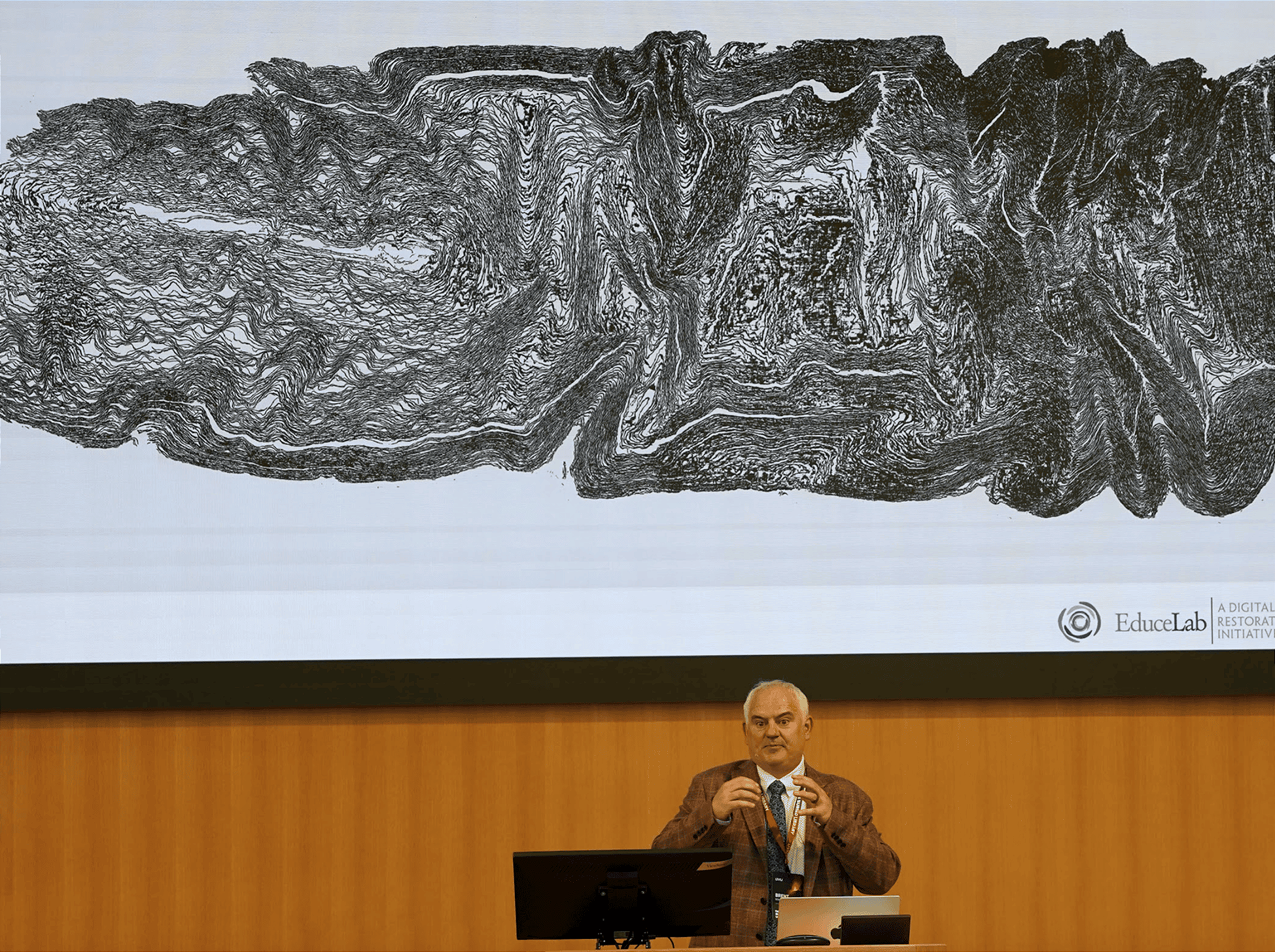
The reason physical unwrapping is impossible becomes clear when you see an X-ray cross-section of a carbonized scroll. It looks like a compressed accordion, layers locked against each other in interlocking folds. There is no seam to pry. There is no edge to lift. The only thing that happens when you try is that the scroll breaks.
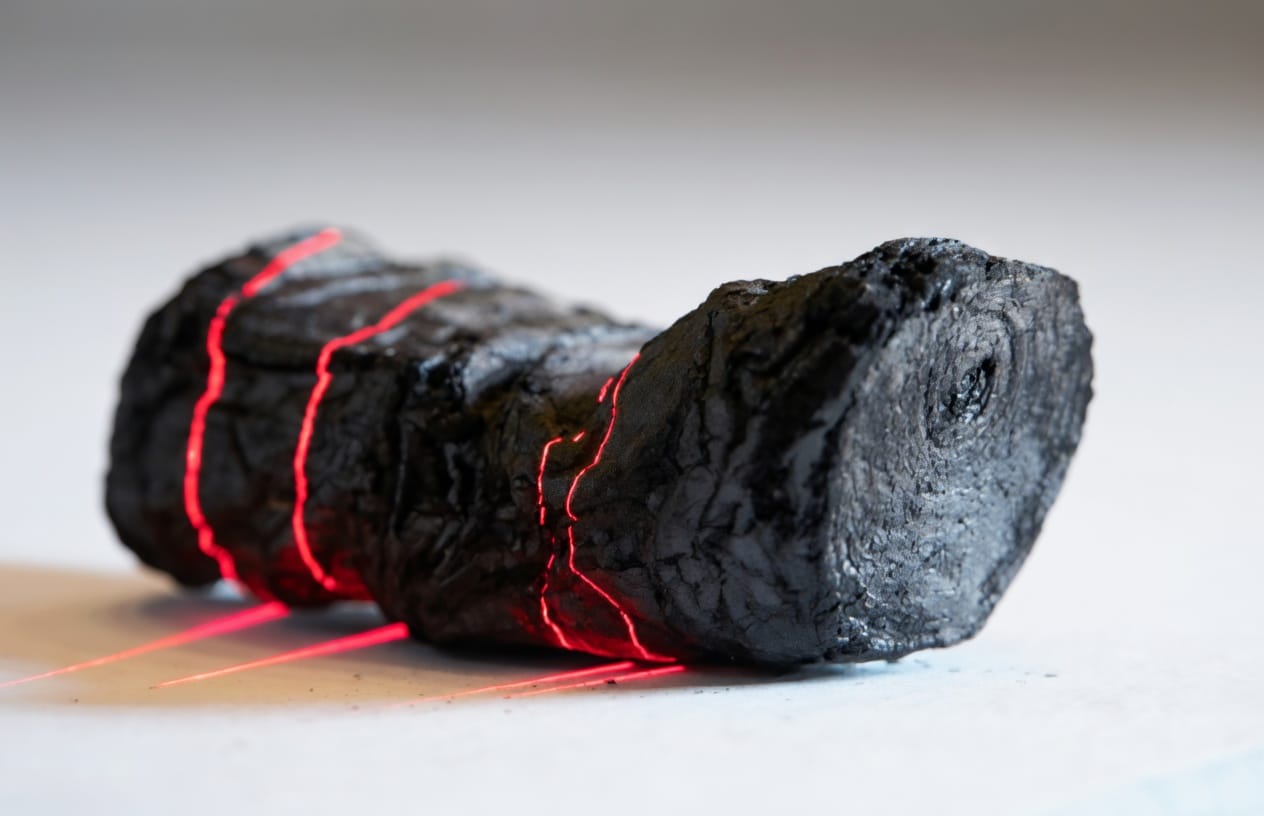
Carbonized Herculaneum scroll during micro-CT scanning. The glowing red lines indicate the scan trajectory. Because the layers are fused together like a compressed accordion, physical unwrapping is impossible without destruction. Virtual unwrapping — combining high-resolution X-ray scanning with specialized software — provides the only viable path to recovering the text. (Credit: Brent Seales)
So Seales went a different direction. He went virtual.
The Resolution Race
The core idea of virtual unwrapping is elegant: scan the scroll with X-rays, build a 3D model of its interior, use software to find the individual layers, flatten them out computationally, and read the text, without ever touching the physical object.
The problem, for most of Seales' career, was that the technology wasn't good enough. The ink the Herculaneum scribes used is carbon-based, meaning it's nearly invisible to X-rays. It is almost the same density as the carbonized papyrus it's written on. And the resolution of early CT scanners was far too coarse to see individual letters.
At UVU today Brent Seales explained the impossibility of physically unwrapping a carbonized Herculaneum scroll. The X-ray cross-section shows the papyrus compressed into tightly interlocking layers — like a fused accordion with no free edges. Breaking the scroll was the only outcome of traditional methods.
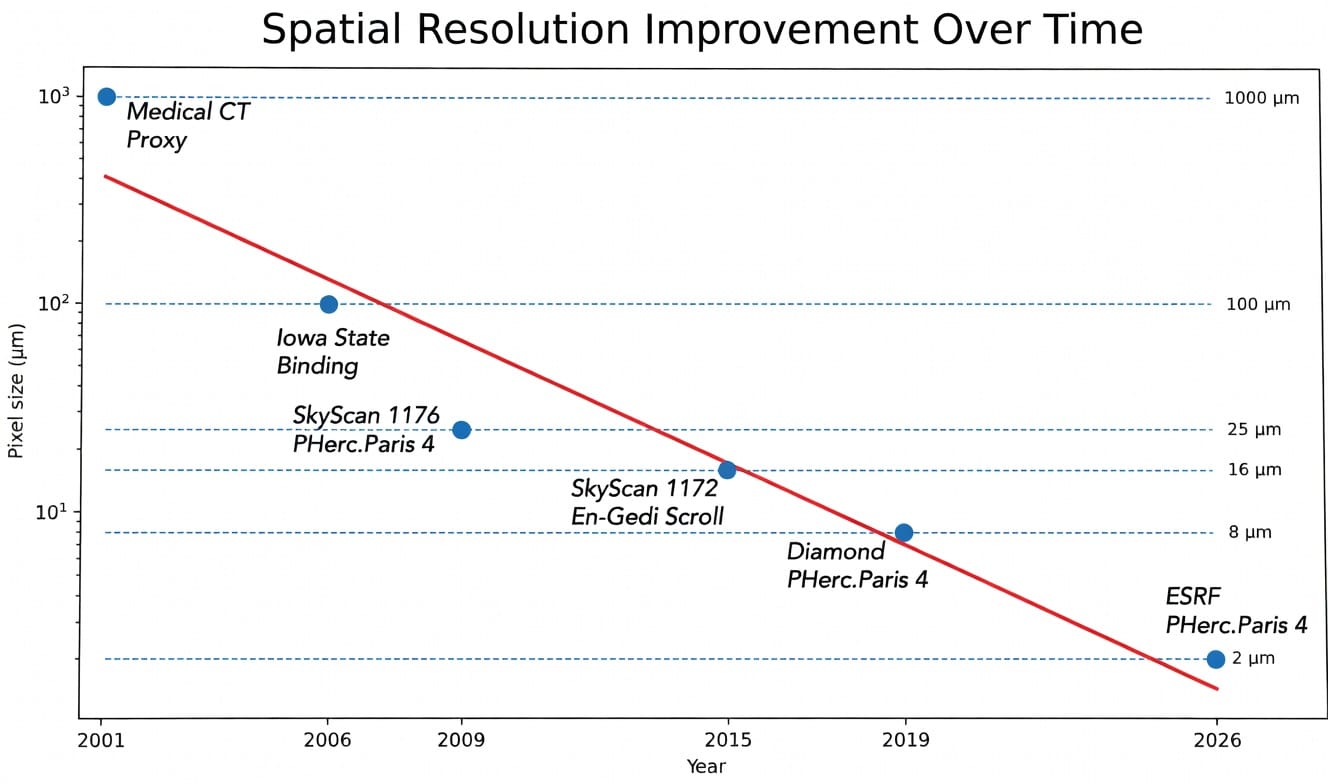
Here's a number that was meaningful to the engineers and investors in the audience: micro-CT scanning resolution has doubled roughly every three years since 2000. Seales calls it the curve nobody talks about, but it rhymes hard with Moore's Law.
In 2001, the best available resolution was about 1,000 microns — one millimeter. Seales describes it this way: imagine you're trying to read a city block from the air, and the entire city block is one pixel. You cannot tell me what cars are in the parking lot.
By 2009, his team had gotten a scroll into a scanner at 25 microns. They could see the layers. They still couldn't read the text. By 2014, working with the En Gedi scroll — a different ancient scroll, found near the Dead Sea — they cracked virtual unwrapping for the first time, producing readable text from a scroll that was still physically rolled up. That result pushed back our understanding of the Book of Leviticus by several hundred years.
Spatial resolution in micro-CT scanning has improved dramatically since 2001, roughly doubling every three years — a trend Brent Seales calls 'the curve nobody talks about' that strongly parallels Moore’s Law. From 1,000 μm in 2001 to 2 μm in 2026, this progress enabled the first virtual unwrapping of the En-Gedi Scroll in 2015, revealing ancient text from a physically unrollable scroll. (Credit: Brent Seales)
By 2019, scanning at 8 microns at the Diamond Light Source synchrotron outside Oxford, they had what Seales calls "the golden dataset" — the data that would eventually fuel the grand prize breakthrough.
Today, the latest scans of Herculaneum scrolls are running at 2 microns. To use Seales' metaphor: you've gone from a city block per pixel to the size of a manhole cover. You can read the license plates. At half a micron — a resolution achieved just recently in Grenoble, France — you can see the individual capillaries of the papyrus plant fibers, still intact inside carbonized scrolls that are 2,000 years old.
Enter the VCs
Here's where the story gets interesting for a tech audience.
By 2022, Seales had the science. He had the data. He had strong evidence that AI-enhanced imaging could surface the near-invisible ink signal from inside intact scrolls. What he didn't have was a way to throw an army of machine learning engineers at the problem quickly, within the constraints of a university research lab.
Nat Freedman and Daniel Gross, both well-known figures in the tech investment world, saw the inflection point. They co-founded the Vesuvius Challenge with Seales: an open, prize-based competition to read the Herculaneum scrolls, funded with their own money, run outside any institution precisely because, as Seales puts it, "no sane person would do it" through normal channels.
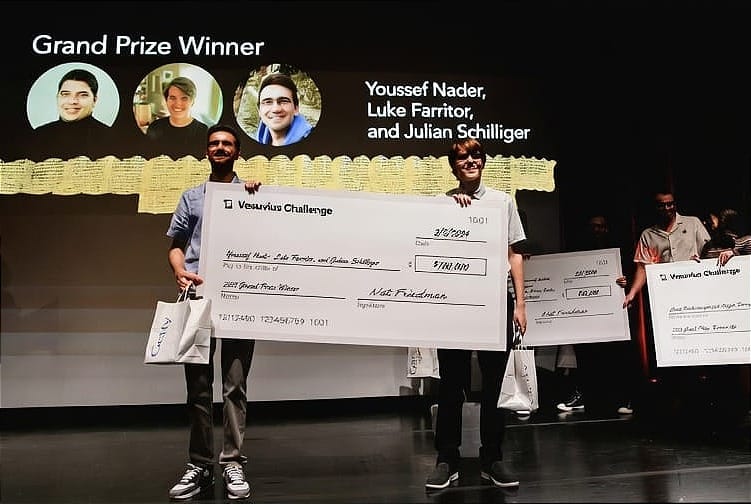
It worked faster than almost anyone expected. A then-undergraduate named Luke Farritor won the first-word prize for detecting "purple." Within months, three competitors — Youssef Nader, Farritor, and Julian Schillinger — had collaborated to win the grand prize by recovering 16 columns of previously unseen text from inside a fully intact scroll.
Vesuvius Challenge Grand Prize Winners (2023): Youssef Nader, Luke Farritor, and Julian Schilliger celebrate after recovering 16 columns of previously unreadable text from a sealed Herculaneum scroll. The open, prize-based competition — founded by Brent Seales, Nat Freedman, and Daniel Gross — succeeded faster than traditional academic routes by crowdsourcing AI talent to crack the 2,000-year-old challenge. (Credit: Brent Seales)
The text turned out to be Philodemus on Vices — an Epicurean philosopher, writing around 50 BC, riffing on pleasure, scarcity, and the nature of comfort. Federica Nicolardi, the eminent papyrologist who led the scholarly analysis, presented the findings at the UVU symposium alongside Seales. "I didn't think Epicureans had vices," Seales admitted from the podium. "I thought Epicureanism was like hedonism — just do what you want as long as it feels good. So that surprised me."
The passage that won the prize, it turns out, contains a meditation on whether abundance or scarcity is more conducive to pleasure. Which is, depending on your portfolio, either extremely ancient or extremely relevant.
The Boxes Inside the Boxes
Seales structured his whole talk around a metaphor he borrowed from JJ Abrams: a box you never open, because opening it spoils the imagination of what might be inside. The Herculaneum scrolls, he argued, are surrounded by nested boxes — volcano, archaeology, conservation, institutions, technology, scholarship, policy — and every single one had to be unlocked before the next could be attempted.
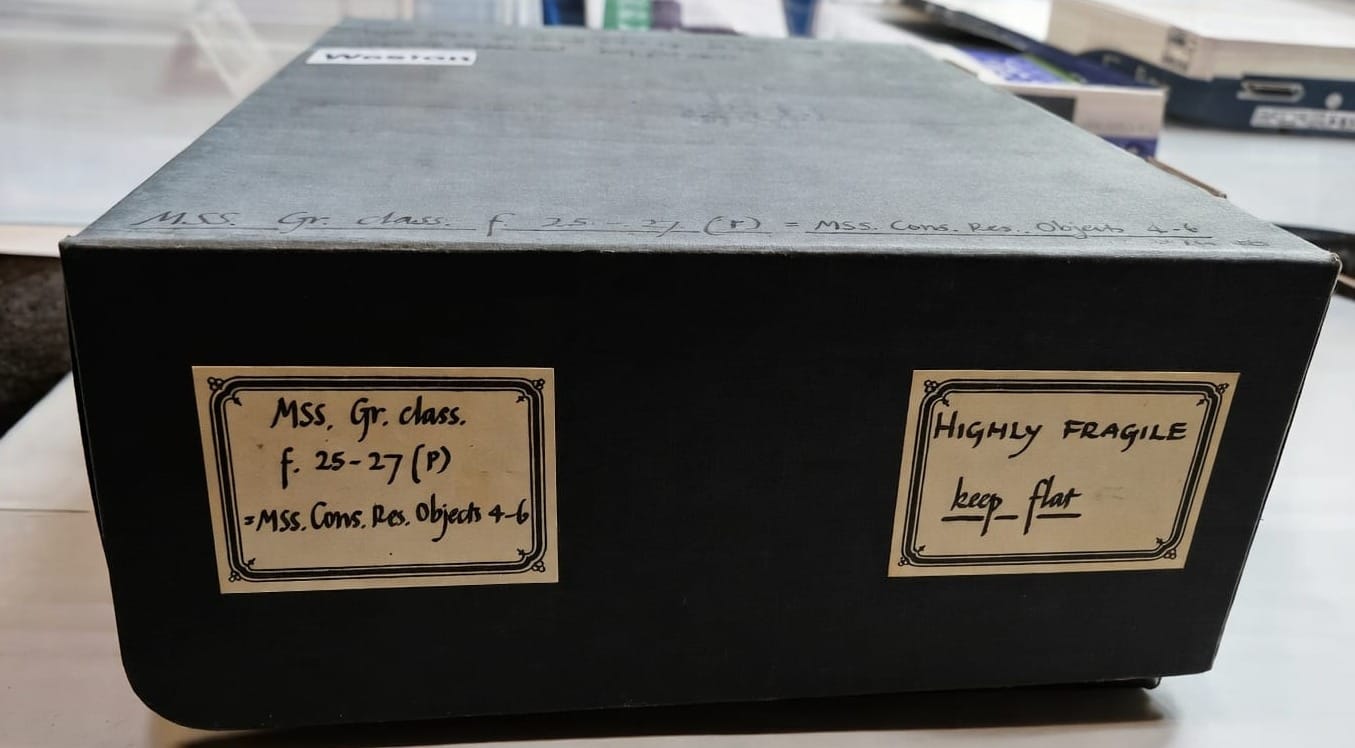
The institutional box was, by his own account, the most maddening. Every major custodial holder of Herculaneum material rejected him, some multiple times. Naples said no. Paris said no. Oxford said no, repeatedly, for years. At one point Seales and his team, unable to get permission to take Oxford's scrolls the ten miles to Diamond Light Source, instead transported scrolls from the French collection 1,200 miles to scan them.
Storage box for highly fragile Herculaneum papyrus fragments from the Oxford collection. For decades these scrolls were locked behind institutional barriers — repeated rejections from Naples, Paris, and Oxford. After six years of persistence, access was granted, leading to the discovery of a major scroll containing 70 columns of text.
Oxford's box eventually opened, after six years of asking. When it did, there was another box inside — literally. Inside was a scroll that turned out to contain 70 columns of text and seven meters of readable content. Some of the writing, Seales noted with visible delight, is visible to the naked eye — no AI enhancement required.
Oxford's response to learning what they had? They put it on exhibit.
Institutions, it turns out, move when value is proven. Anyone who has ever pitched a venture deal will recognize the dynamic.
It eventually worked.
What's Next
Of the roughly 400 known Herculaneum scrolls, about 50 have been scanned and analyzed — an expensive undertaking, about $100K per square centimeter — but these costs are coming down as the process becomes more efficient.
That number is about to move. A new European research grant gives Seales' team six more years working with the material, centered at the University of Naples. A next-generation synchrotron rescan at two microns is already underway, and Seales believes it will surface the remaining 13 meters of text from the grand prize scroll — including the title page and author attribution.
The rate-limiting factor, increasingly, is not the technology. It's the scholars. Reading these texts requires trained papyrologists who have spent careers on ancient Greek hands, on the specific quirks of Herculaneum scribes, on context that no large language model has yet internalized. Seales is candid about this. "I still don't see it," he said, showing a column that Nicolardi read fluently on the spot. The threshold of readability for an expert papyrologist, he noted, is dramatically lower than for everyone else.
The other rate-limiting factor is policy. When one scroll yields 16 columns, questions of access and authorship are manageable. When 400 scrolls potentially yield text simultaneously — material that hasn't been read since antiquity, appearing faster than any single institution can process — you need a framework. Seales raised the question explicitly and, to his credit, didn't pretend to have the answer.
"It hasn't been since Poggio Bracciolini basically running around saving Lucretius," he said, "that we've had the possibility of having this much material appear at once from the ancient world."
Bracciolini was a Renaissance scholar who rescued Lucretius' De Rerum Natura from monastery obscurity in 1417. The poem helped ignite the scientific revolution.
The Herculaneum library, Seales believes, could be bigger.
A carbonized Herculaneum papyrus scroll. Baked, compressed and contorted by the 79 AD eruption of Vesuvius, these scrolls cannot be physically unrolled without destruction. Their fused layers present an insurmountable challenge for traditional conservation — leading to the development of virtual unwrapping techniques using high-resolution X-ray scanning and artificial intelligence.
They look like lumps of charcoal. They are, in fact, a library.
Meanwhile, in Orem
If you want to see what all of this is about in person, you don't have to go to Naples or Oxford or Grenoble. Four authentic Herculaneum papyri — on loan from the National Library in Naples — are currently on display until Friday on the fifth floor of the Clarke Building at Utah Valley University.