From Insights to Outcomes: Qualtrics CEO Jason Maynard on AI, Experience Management, and the Future of Work
Qualtrics CEO Jason Maynard, in a conversation with Domo CEO Josh James at Domopalooza 2026, outlined AI's rapid evolution from insights to real-time outcomes, argued that context beats raw model power, and stressed that human agency remains irreplaceable in an AI-driven enterprise future.
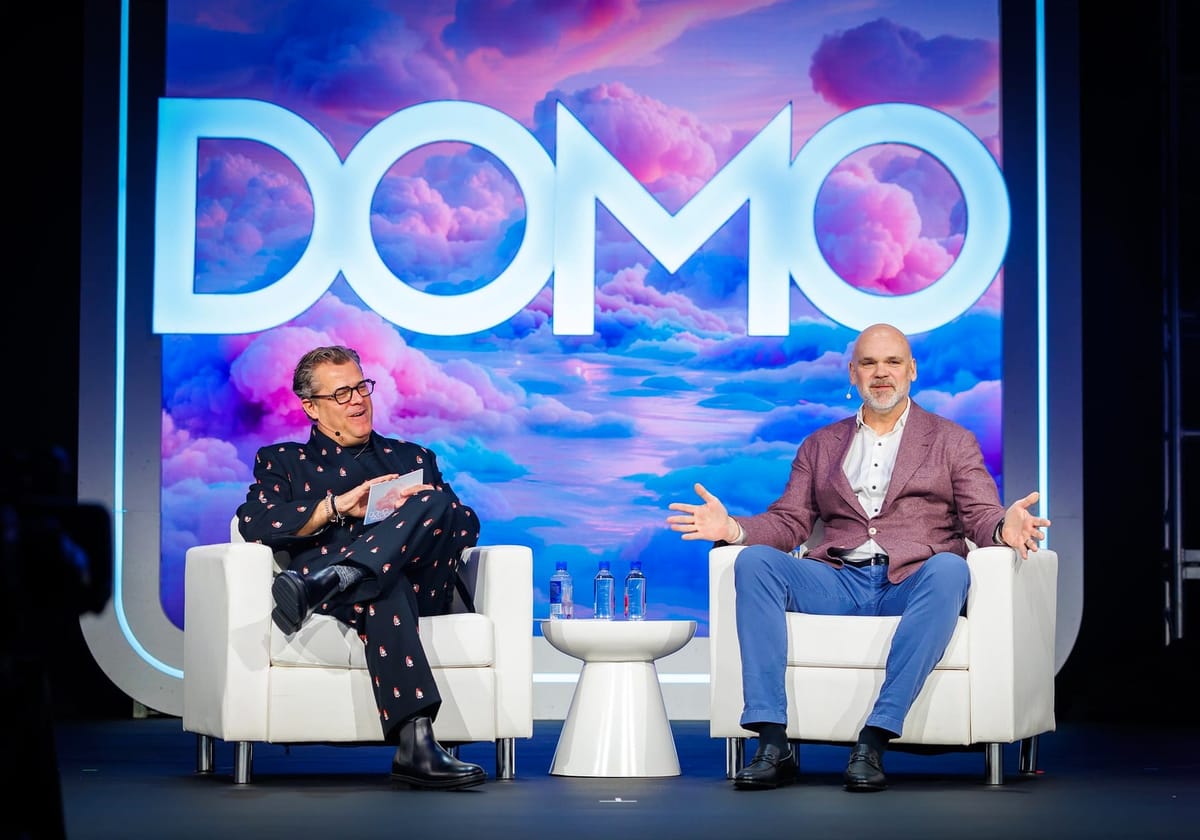
Domo founder Josh James and newly minted Qualtrics CEO Jason Maynard trading war stories from Oracle to open AI on the Domopalooza 2026 stage, Grand America, Salt Lake City, Utah (Credit: Brittany Nielsen)
Domo founder Josh James and newly minted Qualtrics CEO Jason Maynard trading war stories from Oracle to open AI on the Domopalooza 2026 stage, Grand America, Salt Lake City, Utah (Credit: Brittany Nielsen)
Domopalooza 2026 | Grand America Hotel, Salt Lake City | March 25, 2026
When Josh James introduced Jason Maynard to the Domopalooza stage today, he called him one of the most insightful analysts he'd ever worked with — high praise from a man who has worked with hundreds. Maynard, who built his reputation as a Credit Suisse analyst before climbing through senior roles at NetSuite and Oracle, stepped into his new role as CEO of Qualtrics just six weeks ago. But you wouldn't know it from the confidence and clarity he brought to the conversation. Over the course of a wide-ranging fireside chat, Maynard offered a frank and genuinely thought-provoking take on the state of enterprise AI, the evolution of experience management, the economics of inference, and what it all means for the people doing the work.
The Compression of Everything
Maynard's first major observation set the tone for the entire conversation: we are living through a period of unprecedented business cycle compression, and most organizations are still catching up to that reality.
"What blows me away is how fast the cycles have compressed," he said, reflecting on the shift from what he called the CPU era to the GPU era at Oracle. "Everything changed, really, in the last 18 months."
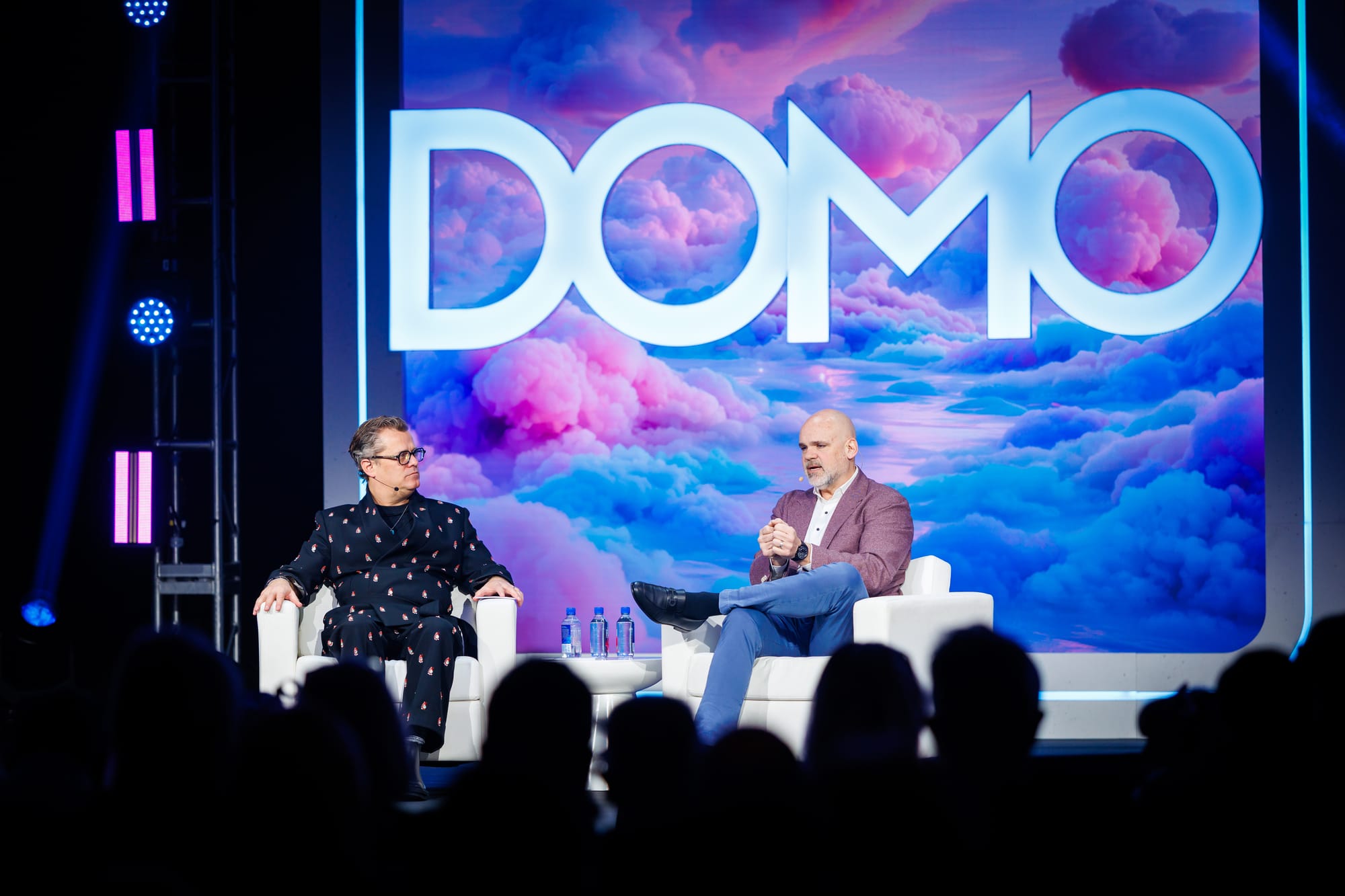
Josh James and Jason Maynard on stage for the opening keynote at Domopalooza 2026, Grand America, Salt Lake City, Utah (Credit: Brittany Nielsen)
He pointed to the rise of generative AI as the inflection point that rewired expectations across entire industries. And the deals being struck at the top of the market reflect just how serious the largest players are treating this moment. Maynard referenced the now-legendary story of Jensen Huang of Nvidia dining with Elon Musk and Larry Ellison, with Ellison joking on stage about literally begging for GPUs. These aren't just amusing anecdotes. They illustrate where power currently sits in the AI ecosystem, and how fast the ground can shift beneath even the most established enterprises.
"If you look at OpenAI and even Anthropic — and I would put Oracle in that camp as well — these deals are done at the highest levels of organizations," Maynard noted. "You have to go to dinner with Jensen, and then have the conversation about whether you can please give him money to buy GPUs." When billion-dollar infrastructure decisions require a dinner reservation, the traditional enterprise sales cycle has been fundamentally disrupted.
Qualtrics and the Phase Two of Experience Management
Maynard spent meaningful time unpacking what he sees as a pivotal transition inside Qualtrics and the broader experience management category. When Ryan Smith founded Qualtrics in the early 2000s and launched the concept of XM — experience management — the core value proposition was simple but powerful: move beyond operational data to capture attitudinal, or "X data," that explains why things happen, not just what happened.
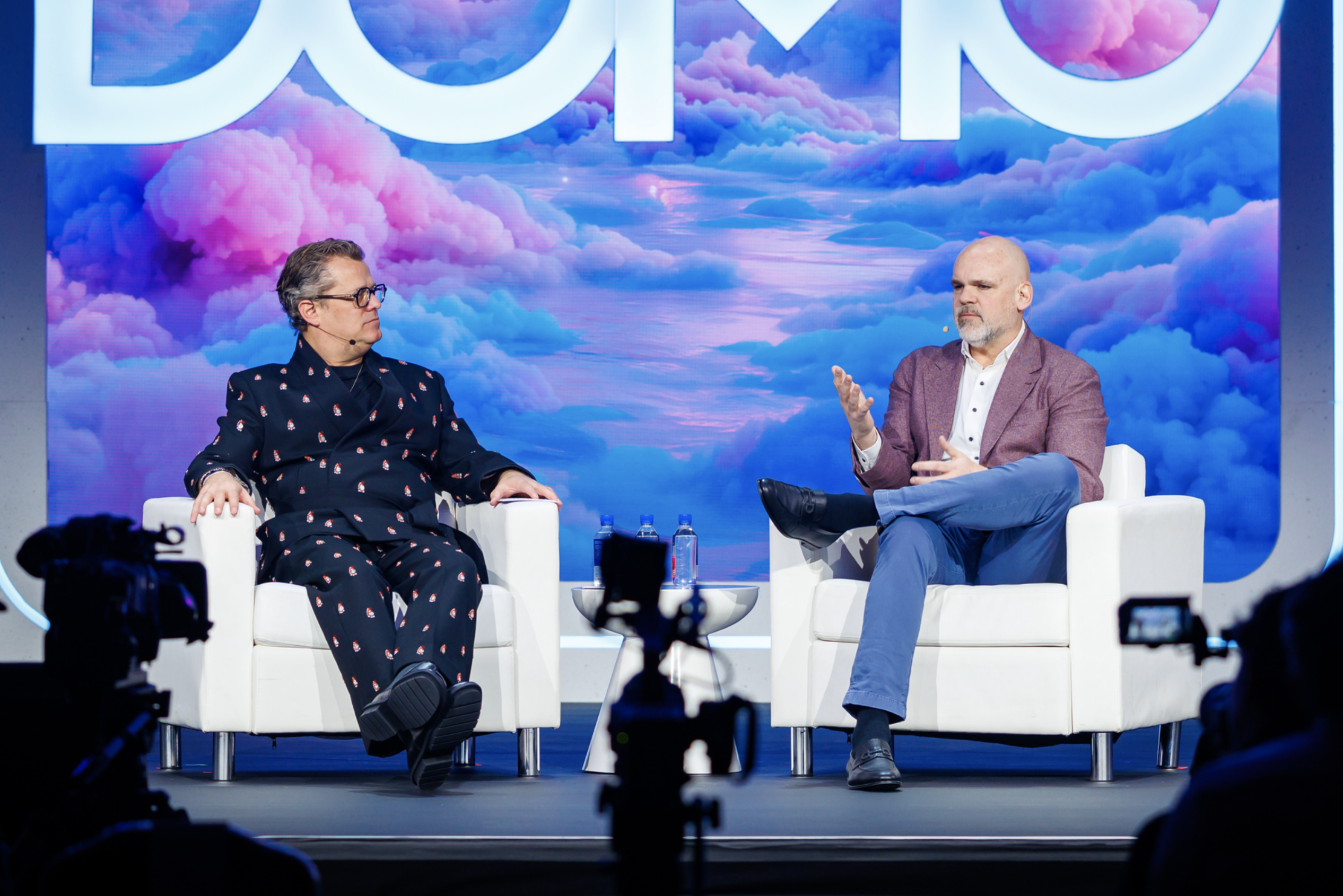
At Domopalooza's opening session, Josh James and Jason Maynard explored AI, the future of work, sartorial choices, and why the best technology still needs a human telling it what to do. (Credit: Brittany Nielsen)
Phase one of that journey, in Maynard's telling, was about finding the insight. You could listen, gather data from everywhere, and turn it into understanding. That capability matured. The category proved itself. Qualtrics grew into a multi-billion dollar business on the strength of it.
But phase two is something different — and considerably more ambitious.
"We now can listen and gather all that information from everywhere. We can turn it into insight, so we have understanding," Maynard explained. "But the question is now, how do you shape an outcome? How do you provide that decisioning in real time, using AI to intervene?"
His example was vivid: imagine a customer service interaction going sideways. Today, most organizations find out something went wrong after the fact, through a survey, a churn report, or an angry call. Maynard's vision for Qualtrics is a system that identifies the friction before it becomes a fire. "If you're a business, you don't want to get to the point where the customer is asking for the manager," he said. "You want to prevent that from happening."
This is the thesis that will drive Qualtrics' product direction: listening at scale, understanding in real time, and acting automatically and intelligently, before the moment is lost.
One of the most intellectually sharp threads of Maynard's conversation was his framing around context, and why it will determine who actually wins in the age of AI.
The common assumption is that whoever controls the most powerful model wins. Maynard pushed back on that framing in a measured but pointed way. Large language models, he argued, are probabilistic reasoning engines. They recognize patterns, but they don't inherently understand the rules and constraints of any specific business. Without context, AI can be fast and still be wrong. It can generate outputs that create friction rather than resolve it.
"Those who own the context have a lot of power in the world that we're going to be moving into," he said. "Without that context, I don't think the models solve business problems."
"Context is everything" — Qualtrics CEO Jason Maynard dropped some of the sharpest AI insights of the day in conversation with Domo CEO, Josh James
His framework: marry the probabilistic power of an LLM with a deterministic system, one that carries the rules, history, and constraints specific to your business, and that combination is where real value gets created. "Orchestrate the two together, and that's where the magic happens."
For Qualtrics, this is a strategic differentiation argument: the decades of experience data, behavioral signals, and customer and employee insights they've accumulated represents exactly the kind of proprietary context layer that a generic model cannot replicate. Competitors can license the same foundation models. They can't replicate the context.
The Economics of AI: Training vs. Inference
Maynard brought a level of financial literacy to the AI cost question that many executives gloss over, and it's a topic increasingly relevant to every CTO and CFO in the room.
The bulk of capital being deployed in AI today is Stargate, the $500 billion multi-partner megacampuses going up in Abilene Texas. It is going toward training models. "These are massive, massive, multi-billion dollar projects," he acknowledged. That's where the current economic gravity sits: in chips, in data centers, in power infrastructure.
But the operational question for enterprises isn't training. It's inference. It's the cost of actually running AI in production, at scale, in real time, across every customer interaction. And today, that cost is still prohibitive for many use cases.
Maynard was direct: those prices have to come down, and he believes they will. "Technology is always a deflationary force," he said. He also made a point that deserves broader attention. Physical infrastructure constraints are real and underappreciated. Energy costs, natural gas availability, the price of oil are not abstractions. They directly shape the cost of compute, and by extension, the economics of every AI-powered product being built today. "As we become more digitized, the physical becomes more important," he said.
Josh James and Jason Maynard got refreshingly real about the billion-dollar economics of AI — training costs, inference pricing, and why whoever controls the power grid in West Texas might just control the future of enterprise tech (Credit: Brittany Nielsen)
Human Agency Is Non-Negotiable
Perhaps the most resonant part of Maynard's session was his closing answer on job displacement. It's a question that hangs over every AI conversation, even when it isn't asked out loud.
He didn't dismiss the concern. He acknowledged there will be dislocation, just as there has been in every major industrial transition in history. But he came back firmly to a principle he called non-negotiable: human agency.
"AI is a tool for humans," he said. "Someone has to tell the machine what to do."
His practical advice for leaders in the room was equally grounded: the skills that will matter most in the next decade aren't the ones most easily automated. Critical thinking, sound judgment, and genuine decision-making ability are becoming more valuable, not less. "Someone has to tell the machine what to do," he repeated. For parents of college-age students especially, his message was clear: teach your kids to reason, because reasoning is what the machine still cannot replace.
The Bottom Line
Six weeks into one of the most high-profile CEO jobs in enterprise software, Jason Maynard is thinking clearly about the right things: context over models, outcomes over insights, human judgment over automation for its own sake. His framing of where Qualtrics is headed — from a survey and insights business to a real-time experience intervention platform — is a compelling evolution of the category Ryan and Scott Smith built.
For the operators and builders gathered at Domopalooza, his core message was simple but worth writing down: know the problem you're solving, work outside-in from your customer, and use the tools, AI included, in service of that. The organizations that get that order right are the ones that will still be relevant when the next 18-month compression cycle arrives.
Move over, Beethoven — Domo founder Josh James traded the boardroom for the baton at Domopalooza 2026, opening the conference in signature style: black kimono, string orchestra, zero chill. (Credit: Brittany Nielsen)
Domopalooza 2026 — billed as Domo's premier Data + AI Conference — is running March 24–27 at the Grand America Hotel in Salt Lake City, Utah, bringing together hundreds of directors, C-suite executives, data leaders, and AI innovators under one roof. This year's event is centered on three core themes: making AI a practical reality in business, running smarter operations through AI-powered experiences, and securing data within a safe, AI-enabled environment. Attendees are treated to a packed agenda of general sessions, breakout workshops, hands-on training, and two nights of live entertainment, with OneRepublic, Josh Turner, and Ja Rule among the featured performers, making Domopalooza as much a Utah cultural event as a technology conference.