Inside WGU’s Digital Playbook: Teaching Nearly 200,000 Students at Scale
Western Governors University (Salt Lake CIty, UT) leverages AI, data, and mentorship to deliver scalable, outcomes-driven digital education for over 193,000 students, combining personalized learning, workforce alignment, and innovative technology infrastructure, shares David Morales, WGU's CIO.
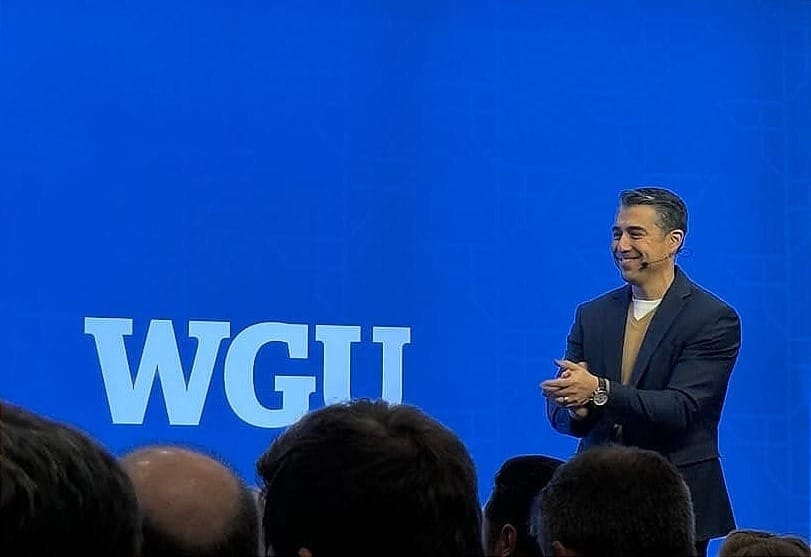
David Morales, Chief Information Officer, Western Governors University (Credit: WGU)
David Morales, Chief Information Officer, Western Governors University (Credit: WGU)
Salt Lake City, Utah - December 2, 2025
Western Governors University (WGU), Utah’s largest university, is quietly redefining digital education. Serving over 193,000 active students and 245,000 annual users, WGU combines AI, data, and a mentor-driven model to deliver high-quality learning at scale. At the heart of this transformation is David Morales, WGU’s Chief Information Officer, who recently spoke with TechBuzz about the university’s latest technological innovations. A former technologist at NASA and Walmart, Morales now oversees WGU’s fully digital, data-driven ecosystem, guiding students from enrollment through graduation.
AI as a Force Multiplier
WGU deploys AI across three critical areas: operational efficiency, student experience, and next-generation pedagogy. “AI is enabling me to increase my velocity, my throughput of what I produce by about 35 percent already,” Morales said. “Bots are helping me code, keep our libraries secure, and accelerate the development of new programs.”
On the operational side, AI streamlines administrative processes. Morales explained, “We’re using AI to improve enrollment, speed up transcript evaluation from weeks to days, and automate routine tasks—allowing us to do more with less while maintaining a seamless experience for students.”
David Morales, Chief Information Officer, Western Governors University (Credit: WGU)
For students, AI enhances learning in real time. “We have chatbots that interact directly with course content,” Morales said. “You can request quizzes, flashcards, or explanations of concepts—and the system responds instantly.” AI also guides students on assignments, highlighting where they meet competency standards and where improvement is needed.
Finally, Morales sees AI as a tool for pedagogical innovation. “We’re exploring how AI can enhance assessments, mentoring, and even provide personalized tutoring in a student’s native language,” he explained. “It’s not about replacing humans—it’s about empowering them, helping mentors and students achieve more efficiently and effectively.”
Scale With True Outcomes
“Scale doesn’t tell the whole story,” Morales said. “It’s about scale with true outcomes. You can’t have scale and then your students not being successful.” WGU tracks attainment, return on investment, and equity of opportunity. Students see tangible benefits: a $20,000 average salary increase within two years of graduation. “We want our students to attain the credential they’re seeking, to have a strong return on their investment, and to make sure everyone has the opportunity to succeed,” Morales added.
A Data-Driven Ecosystem
At the core of WGU’s digital ecosystem is Learner 360, a comprehensive platform that captures each student’s full digital footprint. “We know your activity across the system—from every login to how long you spend on each module,” Morales explained. This data enables mentors to provide highly personalized support, identifying when students struggle or fall behind. AI-powered alerts, called “distant time interventions,” can automatically schedule check-ins or suggest resources, ensuring students never feel lost in WGU’s large online environment.
Learner 360 integrates seamlessly with AI chatbots, course content, and third-party tools, giving mentors and administrators a holistic view of each student’s progress. By combining real-time analytics, direct feedback, and indirect usage signals, WGU continuously improves the learning experience, empowering mentors to intervene proactively and students to succeed on their own terms.
Connecting Education to Career
Central to WGU’s approach to connecting learning with career outcomes is the Achievement Wallet, a centralized platform that tracks each student’s skills and competencies. “Each course defines the skills you’re acquiring,” Morales explained “and we can record your mastery level, whether from coursework, transcripts, or external experiences like apprenticeships.” The wallet not only consolidates this information in one place but also links students to relevant opportunities—such as jobs or apprenticeships—based on their skill set and location.
The Achievement Wallet pulls in skills from coursework as well as work experience, military service, volunteer roles, certificates, and other learning students do throughout their lives.
Students can use WGU's Achievement Wallet to generate résumés built around verified competencies.
The Wallet can also generate a résumé that highlights a student’s verified skills, giving them a job-ready document they can share with employers.
AI plays a critical role, helping match students to positions, identify gaps in their competencies, and suggest next steps to advance their careers. Morales emphasized that this system empowers students to see their progress, understand where they excel, and take proactive steps toward career readiness. By integrating skills tracking with real-world opportunities, WGU’s Achievement Wallet turns digital learning into tangible, workforce-aligned outcomes.
A Diverse, Evolving Student Body
WGU serves a diverse population of learners, spanning multiple generations, backgrounds, and life circumstances. Traditionally, the average student was around 36 years old, but the university is now seeing more recent high school graduates enrolling, drawn to the flexibility of competency-based, fully digital learning.
WGU 2025 Commencement in Chicago
Morales highlighted the university’s continued focus on first-generation students: “We continue to serve first-generation students…professionals who couldn’t finish their degrees before…all seeking flexibility and self-service.” Many students balance full-time work, family responsibilities, or other commitments, which makes WGU’s self-paced and digital-first model particularly attractive.
Morales emphasized that students today expect immediate, responsive digital experiences. “Immediate response is extremely important. We track how fast our pages load, how quickly issues are resolved, and how efficiently we support students across the system,” he said. WGU’s population also reflects growing tech-savviness: learners are increasingly comfortable navigating online platforms and leveraging AI tools integrated into their courses, creating an environment where digital learning can scale without sacrificing individualized support.
WGU President Scott Pulsipher’s Vision for an AI-Driven University
WGU president Scott Pulsipher, speaking at the 2025 Utah AI Summit, described the university’s next evolution: moving from digitally native to fully “AI-native.” With AI reshaping everything from curriculum design to instructional models, WGU is effectively rebuilding its next generation from the ground up. Pulsipher said AI will do for learning what the internet did for access—enabling a level of personalization and adaptability that traditional models have never achieved.
Because WGU operates with a master curriculum and an end-to-end, technology-instrumented student journey, Pulsipher said the university has a structural advantage. Its integrated systems and large datasets allow programs to evolve quickly, which is crucial as the pace of change in the workplace now requires degree programs to be refreshed every six to twelve months. More than three-quarters of WGU programs already incorporate AI-specific skills, and the university is using AI to accelerate its own content development to keep pace with industry.
Scott Pulsipher, President, Western Governors University, and a panelist at the 2025 Utah AI Summit: The Impact of AI in the Workforce, moderated by State Senator Ann Millner (5th District), which explored the transformative effects of artificial intelligence on employment trends
Pulsipher also warned that using AI only to optimize existing tasks is a limited approach. The real opportunity lies in creating entirely new capabilities and forms of value. For WGU, this means preparing nearly 200,000 students for an AI-enabled workforce—not just with digital literacy, but as true “AI nativists.”
"At WGU, our focus is on using technology to expand access to education," said President Pulsipher. "We’re leveraging it to increase our capacity to help every individual learn, and to better align learning outcomes with the needs of the workforce."
He closed, echoing the words of David Morales, "we’re also using technology to strengthen how our mentors and staff connect with students—on a personal, meaningful level—so every learner knows they matter. We recognize their inherent worth and their innate ability to learn, and we believe that with the right opportunity, they can make a significant contribution. If we can deliver on that, then we’re fulfilling WGU’s mission by using technology to dramatically expand our impact on people."
Looking Ahead
WGU is actively exploring ways to deepen the impact of AI across learning, mentorship, and career readiness. Morales emphasized, “We stay engaged and true to our promise to bring AI in areas where our students will really win.” In the near future, AI will further enhance assessments, providing immediate feedback and competency scoring to help students focus on areas that need improvement. Mentors will also benefit, with AI tools identifying students who need support, automatically scheduling meetings, and tracking progress in real time.
Personalized tutoring is another focus area, including virtual tutors for ESL students that can explain concepts in a student’s native language while maintaining English-language assessment. Meanwhile, WGU plans to expand the achievement wallet, pushing personalized apprenticeship, job, and skill-building opportunities directly to students based on their current competencies and location. By combining AI, mentorship, and skills-based career alignment, WGU aims to continue transforming digital education into tangible, workforce-ready outcomes.