Local TV is Headed for a Cliff - Can it be Saved?
Whether you are the part of Utah that has access to local television or the part that doesn’t, you can let your voice be heard.


Whether you are the part of Utah that has access to local television or the part that doesn’t, you can let your voice be heard.

By Robert Bishop
Local-TV Builds Community
Did you know that many residents across Utah can only get local television by subscribing to a pay-TV service like cable, satellite or streaming? Did you know that the FCC has not approved a new over-the-air TV retransmission tower in 15 years? Did you know that as Utah grows, entire communities are being left without a way to get the over-the-air TV signal—even metro areas like Alpine, Eagle Mountain, Saratoga Springs, and parts of Highland, Cedar Hills, and Suncrest Draper (and that’s just Utah County)? Did you know the same is true for many other parts of Utah, especially rural Utah? Today, local-TV reaches fewer and fewer people. Rural, low-income, and younger families are especially affected.
In its heyday, 95% of US households had access to local-TV. As of 2022, 53% have either left cable or satellite pay-TV or never had it. Cord-cutters say it’s too expensive. Younger, cord-nevers only know streaming. And, cord-cant’s have no antenna reception.
While local-TV viewership continues to decline, social media has become the primary source for local and world news and entertainment. These platforms polarize and divide the public through disinformation and manipulation and are controlled by individuals with personal agendas. The simple fact is that Utah is losing its voice. What we need is more community and less meddling. Local-TV programming builds community in a way that social media cannot.
It’s not just the community-based programming, according to a 2023 national study, Utah’s local-TV stations bring $830M and 5,000 jobs to our state’s economy. These totals do not include the yearly stimulative effect which is estimated to be an additional $4.5B and 6,500 jobs. Do you think that money and those jobs will stay in Utah when our local-TV stations drive off a cliff? Did you see the picture?
How Did We Get Here?
Broadcasters use public airwaves at no cost on the condition that local-TV channels be broadcast for free. That’s the deal. When cable was deregulated in the 1970s, cable companies began charging subscribers for local-TV channels along with other channels in various programming packages. Later the FCC required that cable companies pay a retransmission fee to include local-TV channels.
These monthly retransmission fees have skyrocketed more than 8,000% over the last decade (e.g., from $0.25 to $20 per household). What is less known is that local TV stations only keep about 25% of these fees—with 75% going to the national networks as affiliate/reverse compensation. Over time, consumers have become confused and frustrated by rising costs for TV that was always meant to be “free.”
With the proliferation of the Internet and the invention of streaming, other options for TV entertainment have become available. As streaming services ballooned, national broadcasters turned their attention to paid streaming platforms like Peacock TV and Paramount+. These paid initiatives completely bypass local affiliates.
It's interesting to note that adaptive bit-rate streaming which is used by essentially everyone to stream video on the Internet (e.g., YouTube, Disney/Hulu, Netflix, and others) was invented by Drew Major, a native and lifelong resident of Utah.
Can It Be Saved?
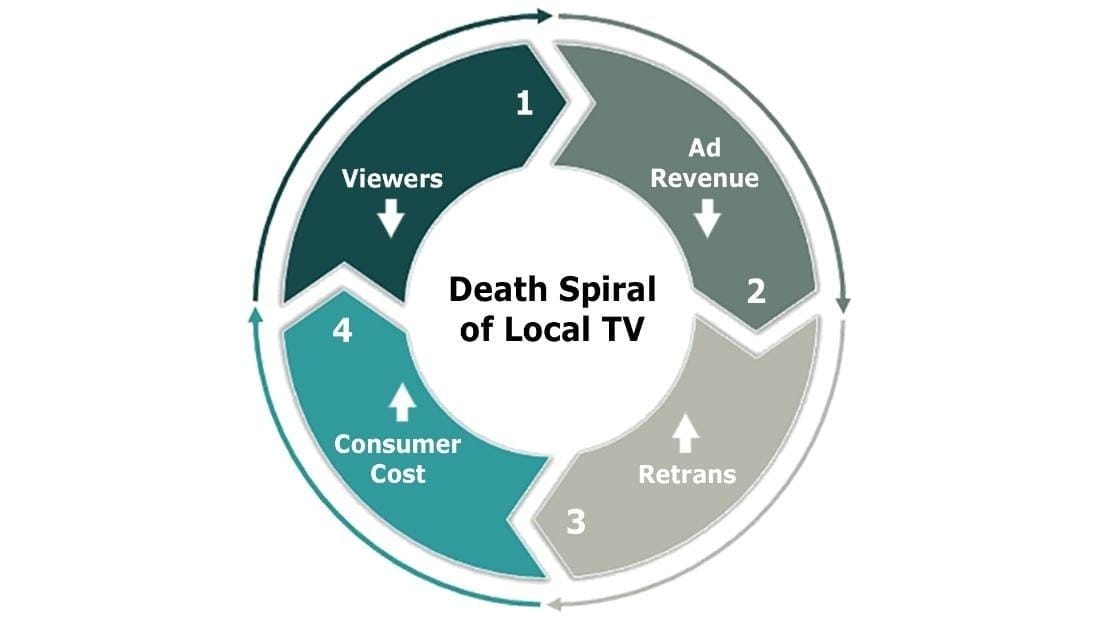
Here’s the conundrum: With fewer viewers, local-TV ad revenues decline. Local channels prop up the loss with increases in monthly retransmission fees (e.g., with each retransmission “renegotiation,” distributors come to the table with fewer viewers yet local broadcasters demand higher rates). These increases are then margined and passed down to subscribers. The higher costs create more cord-cutters and time passing creates more cord-nevers as youth become adults. And the death spiral of local-TV accelerates toward its inevitable end.
This was clearly demonstrated in July 2023 when Nexstar Media Group forced the nation’s largest local-TV outage after demanding more than double the current viewer fees from DirecTV. This affected 68% of all DirecTV households in the U.S. Not surprisingly, DirecTV capitulated shortly after the NFL season began. However, during this 76-day feud consumers were locked out from receiving the local channels they pay for. As expected, a few weeks after the new agreement, DirecTV announced new, higher pricing across the board. How messed up is that?
What Do Broadcasters Say?
The TV broadcast industry has been touting ATSC-3, an updated over-the-air TV standard, as a possible solution but the signal is not backward compatible and would have the same limitations in terms of reach that we currently have. How can anyone expect the over-the-air audience to rush out and buy a new TV, or younger generations to stop consuming media on phones, tablets, and streaming devices? I don’t know about you but my crystal ball says that by the time they implement this—if they ever do—the whole thing will be moot. Paid Internet streaming will have won. LG announced that they are going to stop making ATSC-3 compatible TVs. Samsung and Sony may not be far behind. Vizio was never on board.
There have been a few attempts to modernize free consumer access to local-TV and each ended in a burned-out cinder from lawsuits. It’s not that the national-TV networks don’t see the problem. It’s that they have chosen to focus on their own paid streaming platforms and not local broadcasters. In truth, national broadcasters want everyone to believe that Free-TV is dead. It’s not that local broadcasters don’t see the cliff. It’s that they're stuck in the mindset of ever-increasing retransmission fees as the solution.
Personally, I hope this gets resolved before it’s too late. I’d really be sad to say goodbye to local TV and the community ties that it builds. On the other hand, social media icons Elon Musk and Mark Zuckerberg—and probably the national TV networks—would love it if we just stayed the course.
What Can Be Done?
The solution lies with state governments. I’ve spoken with state legislators and state officials about these issues. The consensus in all of these conversations is that local-TV should remain free and be accessible to all Utahns, regardless of where they live. However, like most worthwhile things, it’s easy to say but much harder to do. What do you think would happen if everyone had unfettered access to local-TV for free and our local broadcaster’s audience size suddenly got a whole lot bigger? Do you think that might keep them from driving off a cliff? Do you think the national-TV networks would recognize that allowing everyone free access would be far more valuable to them than declining viewership and retransmission fees?

Fair Use Disclaimer: The use of the image from the 1991 film (partly filmed in Utah) Thelma and Louise, falls under the Fair Use Act Title 17, Section 107 of the United States Code of the US United States Copyright law in the context of news reporting, one of the accepted uses of copyrighted material. The image in the header of the article is used to illustrate a metaphor mentioned in the article.