Rethinking the Credential: Michael D. Smith’s Case for an Abundant University at UVU
At a Utah Valley University town hall, Michael D. Smith and TJ Bliss argued higher education must shift from scarcity to abundance, redesigning credentials, incentives, and pedagogy to expand access and equity.
Higher education isn’t vaguely “broken,” Michael D. Smith argues. It is structurally built around scarcity, and that scarcity is producing inequity at scale.
On Thursday, February 26, Utah Valley University hosted Smith for a town hall titled The Abundant University: A Vision for Higher Education. Smith, the J. Erik Jonsson Professor of Information Technology and Public Policy at Carnegie Mellon University and co-director of its Initiative for Teaching and Education Analytics, was joined by Dr. TJ Bliss, associate commissioner and chief academic officer for the Utah System of Higher Education (USHE).
The moderator, Wendy Simmerman, Senior Director of Workforce Alignment at UVU, guided the conversation through audience questions about what an “abundant university” would actually look like, and what is standing in the way.
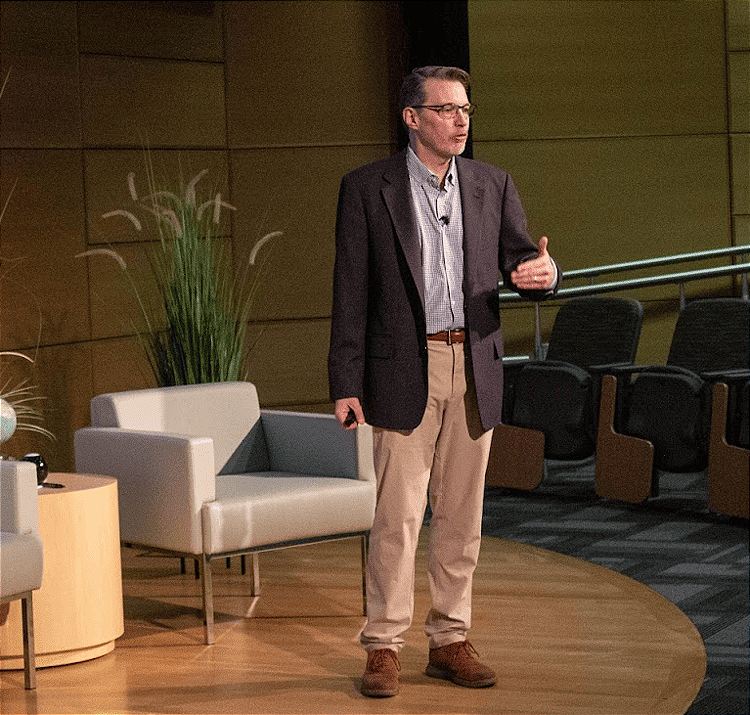
Michael D. Smith, J. Erik Jonsson Professor at Carnegie Mellon University, addresses a Utah Valley University audience during a town hall on ideas from. his book, The Abundant University. The panel examined how higher education can shift from scarcity to abundance.
Smith’s argument, laid out in his book The Abundant University: Remaking Higher Education for a Digital World, is straightforward: higher education has historically revolved around three scarce resources: access to classroom seats, access to expert faculty, and access to credentials.
Technology, he says, has largely eliminated scarcity in the first two. Lectures from leading scholars are now widely available online. “Content is ubiquitous. Content is abundant. We’ve solved that,” Bliss said during the discussion.
The remaining bottleneck is the credential.
And that bottleneck, Smith argues, reinforces inequality.
Research from Opportunity Insights shows that children from families in the top 1% of the income distribution are dramatically more likely to attend highly selective colleges than students from lower-income backgrounds; in some analyses, they are dozens of times more likely to enroll at elite institutions than students from the bottom quintile (Chetty et al., The New York Times, 2017; Opportunity Insights, 2017).¹
“That can’t be right,” Smith said. “It’s bad for social justice. I would also add, it’s bad for the economy.”
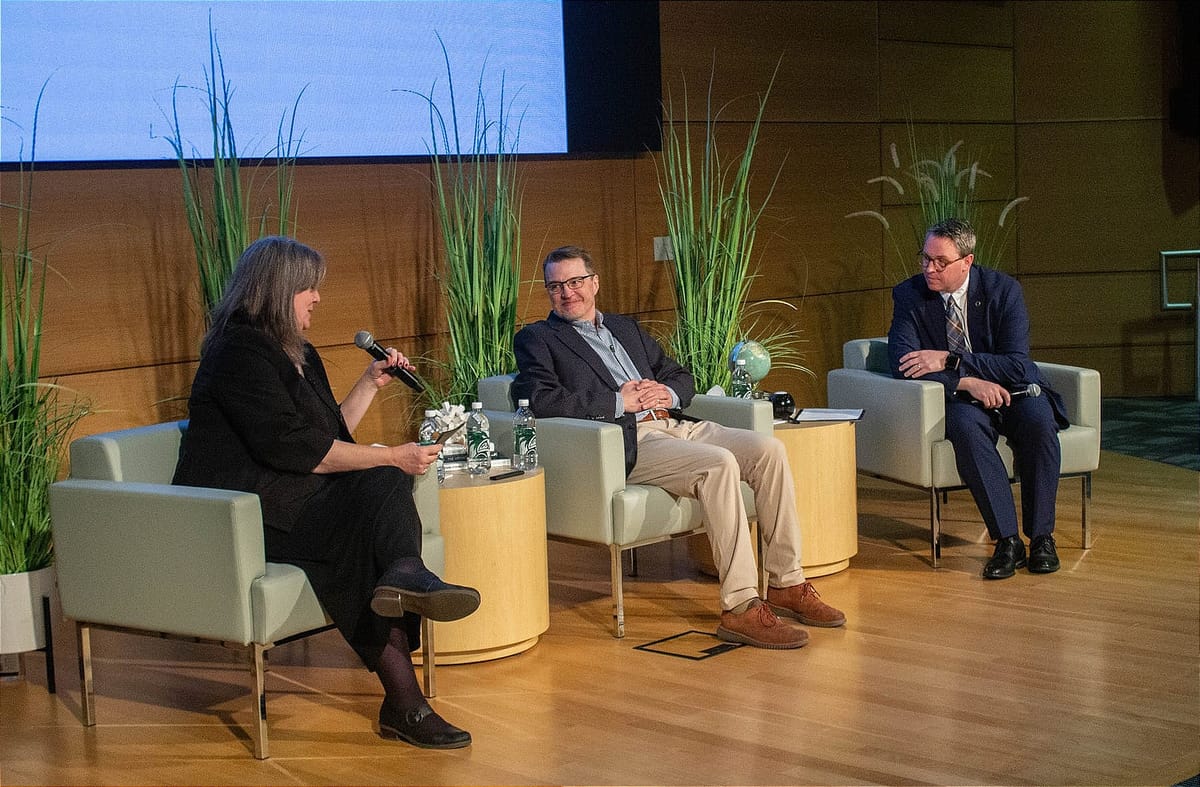
Michael D. Smith, J. Erik Jonsson Professor at Carnegie Mellon University, at Utah Valley University town hall on The Abundant University with Wendy Simmerman, UVU's Sr Director of Workforce Alignment, and TJ Bliss, Associate Commissioner at Utah System of Higher Education
What Abundance Would Mean in Utah
Simmerman asked what elements of the abundance model could be implemented statewide. Bliss pointed first to access.
He highlighted USHE’s Admit Utah initiative, which guarantees every Utah high school graduate admission to at least one public institution in the state. The goal is not just capacity, but clarity.
“Part of abundance is helping people understand where to get it,” Bliss said. “There can be water everywhere, if you don’t know where it is, or which is safe to drink.”
His second focus was more structural: rethinking what happens inside the classroom. If content is no longer scarce, the in-person experience must deliver what cannot be replicated on YouTube: leadership development, network formation, and what Bliss called adaptability, defined as “the ability to learn, unlearn, and relearn.”
“How do we train faculty to do those things?” he asked. “That’s the big question.”
For UVU, the conversation was not theoretical. University leaders have emphasized hybrid, online, and stackable credential pathways as part of a broader strategy aimed at working adults, first-generation students, and underserved communities. The town hall framed Smith’s abundance model as aligned with those goals: expanding flexibility while using real-time data to improve student outcomes rather than simply layering technology onto traditional delivery.
Incentives, Rankings, and What Would Break
If abundance were adopted tomorrow, Smith suggested, some long-standing incentive systems would immediately strain.
He pointed to rankings, including those published by U.S. News & World Report, which heavily weight selectivity metrics. In recent years, reporting in outlets such as The Wall Street Journal has documented how some universities expanded recruitment efforts in ways that increased application volume, and therefore rejection rates, to improve perceived selectivity.²
“There are two ways to change that ratio,” Smith said of acceptance rates. “And the easier one is to make the denominator bigger.”
Bliss focused on faculty incentives. At research-intensive institutions, he noted, salary and promotion structures tend to reward research output more than teaching quality. Studies of faculty compensation patterns have found positive associations between research productivity and pay, while teaching receives less consistent financial reward.³
“Those things are going to have to change in order for us to truly embrace abundance,” Bliss said.
Smith offered a personal anecdote from early in his career: when he told a senior colleague he had won a teaching award, the response was blunt: “Kind of sounds like you spend too much time on your teaching, doesn’t it?”
“Not only is this not relevant,” Smith said, “but it is a negative signal of quality that you would choose to invest in students.”
Fear, Habit, and the Online Question
Simmerman asked what blocks innovation. Bliss named two forces: fear and habit.
He challenged the assumption that online education is inherently lower quality. A substantial body of research has found that well-designed online and hybrid courses can produce learning outcomes comparable to — and in some cases better than — traditional formats, particularly when instructional design is intentional.⁴
“It doesn’t really go the other way,” Bliss said of simply transferring a face-to-face course onto Zoom. “You have to apply the same scholarship and discipline and rigor that we do to everything else, to our pedagogy.”
Smith framed resistance through disruption theory: institutions optimize around a particular technological environment. When that environment shifts, the very structures that produced success can become constraints.
Mission and Technology
Simmerman steered the discussion toward mission. Before debating delivery models, what is higher education for?
Smith quoted his own institution’s mission statement and called it “impenetrable.”
His alternative was shorter:
“Our mission is to help as many students as possible discover their talents, develop those talents, so they can use those talents for the benefit of society.”
He also described how technology could facilitate intellectual confrontation rather than replace it. He imagined co-teaching a class with a scholar who disagrees with one of his core theories allowing students to see competing arguments defended live despite geography.
“Wouldn’t the students get more out of that?” he asked. “Why don’t we do that? … Couldn’t we use technology to do that? Heck, yeah.”
Inclusion as the Metric
How would universities know they are moving toward abundance rather than simply digitizing scarcity, asked Simmerman?
Smith’s answer was inclusion.
He recounted an executive education program at a top business school that struggled to enroll women in an eight-week residential format. When the program moved online during COVID-19, female participation increased, suggesting that delivery format, not ability or interest, had been the barrier.
“Through a set of processes that my feminist daughter would rightly describe as the patriarchy,” Smith said, “male executives are able to say, ‘I’m going to take the next eight weeks away’ in a way that is much harder for female executives to do.”
Bliss said he would watch the student experience, particularly in general education. He described a relative who left UVU after feeling that course content could be found online.
“When we talk to our students, can they talk intelligently about the durable skills they got from their courses?” Bliss asked. “They will not talk about that from watching YouTube videos.”
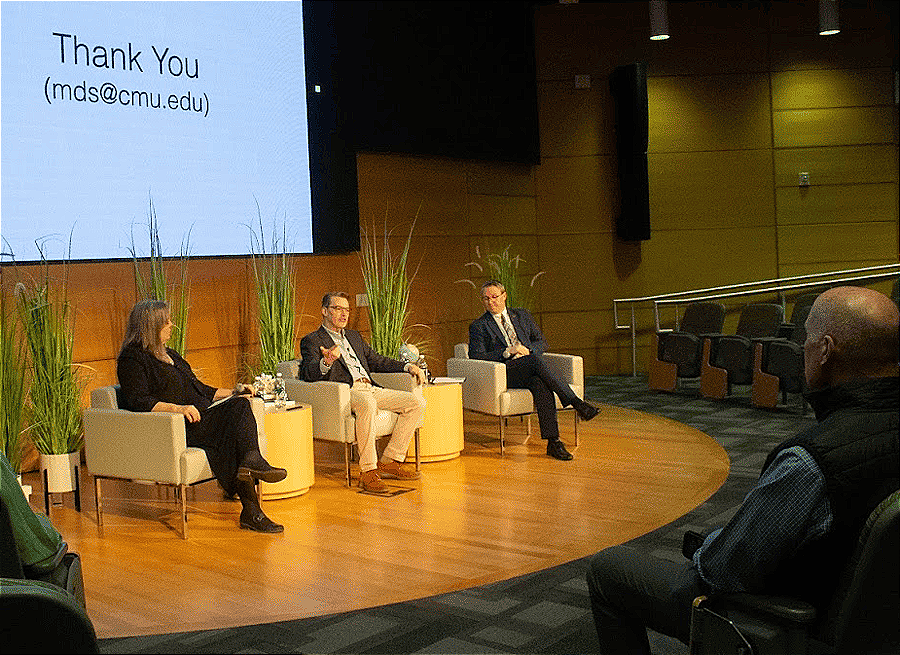
Michael D. Smith, at a Utah Valley University town hall on “The Abundant University” with Wendy Simmerman, UVU's Sr. Director of Workforce Alignment, and TJ Bliss, Associate Commissioner at Utah System of Higher Education
Data, Personalization, and What Comes Next
Smith closed with a data problem. In a class of 30 students, he said, some are bored and some are lost.
“The problem is, I don’t know which six we’re talking about,” he said. “Wouldn’t it be cool if I had the data to say, ‘You’re bored. Let’s give you something where you can go faster. You’re lost. Let’s give you more time.’”
Neither speaker urged students to abandon higher education. The message was that the constraints are institutional, not inevitable.
“These are solvable problems,” the moderator concluded. “And you can be part of the solution.”
Whether universities choose to redesign around abundance, or defend the remaining forms of scarcity, may determine which institutions flourish in the decade ahead.
Sources
Raj Chetty et al., “Mobility Report Cards: The Role of Colleges in Intergenerational Mobility,” Opportunity Insights (2017); summarized in The New York Times, Jan. 18, 2017.
Melissa Korn & Andrea Fuller, reporting on admissions selectivity practices, The Wall Street Journal, 2022–2023; see also public debates around ranking methodologies at U.S. News & World Report.
See, e.g., Ehrenberg, R. et al., research on faculty pay and research productivity, National Bureau of Economic Research.