Path Fertility Says “Normal” Sperm Tests Are Failing Couples — And a New Peer-Reviewed Study Backs Them Up
Path Fertility (Salt Lake City, UT) is challenging reproductive medicine’s most overlooked assumption. The company's SpermQT test, backed by three peer-reviewed studies, shows that “normal” sperm tests miss up to 25% of men with clinically significant fertility problems.
Path Fertility's team at ASRM 2025, October 25, 2025, San Antonio, TX
Path Fertility's team at ASRM 2025, October 25, 2025, San Antonio, TX
Path Fertility’s SpermQT test, now supported by three peer-reviewed studies including a landmark 10-clinic real-world trial, is making the case that male infertility is being systematically undertested — and the human cost is enormous.
Salt Lake City, Utah — April 6, 2026
When a young Utah couple in their 20s spent two years and roughly $80,000 trying to have a child — borrowing from family along the way — they eventually received a diagnosis that explained nothing: unexplained infertility. The woman had been put through extensive and invasive testing. Her husband had received a standard semen analysis. His results were normal. The doctors said he was fine.
He wasn’t fine. What that test couldn’t measure was whether his sperm could actually complete the biological work of fertilization — finding the egg, binding to it, penetrating it, fertilizing it. The sperm could swim. They just couldn’t finish the job.
Andy Olson and Kristin Brogaard, Co-Founders of Path Fertility
That couple were close friends of Andy Olson. Their experience became the founding story of Path Fertility, a Salt Lake City startup co-founded by Olson and Kristin Brogaard, Ph.D., who sat down recently with TechBuzz to discuss how they are building a direct challenge to one of reproductive medicine’s most stubborn assumptions: that a normal semen analysis means the male partner has been cleared.
Now, that challenge has significant new evidence behind it.
The JARG study asked a pointed clinical question: does an epigenetic sperm quality test, one that measures chemical markers governing how sperm genes behave, predict fertility treatment outcomes in ways a standard semen analysis cannot?
For one of the most commonly used fertility treatments, the answer was unambiguous. Among couples in the dataset where men received an “Abnormal” result on the epigenetic test, not a single pregnancy was recorded from intrauterine insemination (IUI).
IUI, where sperm are placed directly into the uterus around ovulation, is typically the first treatment recommended to couples struggling to conceive, valued for being less invasive and less expensive than in vitro fertilization (IVF).
By contrast, outcomes for IVF using intracytoplasmic sperm injection (ICSI), where a single sperm is injected directly into an egg, did not differ meaningfully based on the epigenetic result. ICSI, in other words, largely compensates for the functional sperm deficiencies the test detects. The clinical implication is stark: for couples where the male partner has an abnormal epigenetic result, repeating IUI cycles is likely wasted effort — and wasted money, time, and emotional reserve.
Earlier studies in Frontiers in Genetics (July 2023) and F&S Science (November 2023) established the scientific foundation, finding that sperm epigenetic variability was linked to pregnancy and live birth outcomes specifically for IUI, while IVF results showed no similar separation. The JARG paper extended those findings into a larger, real-world, multi-clinic setting. The pattern held.
This JARG paper is the third in a sequence of publications supporting Path Fertility’s approach. The 2023 Frontiers in Genetics paper helped establish the biological foundation, showing that tissue-specific epigenetic variation can carry clinically meaningful signals beyond what traditional tests capture. That groundwork was extended in the subsequent study published in F&S Science later that year, which found that epigenetic markers can augment—and in some cases outperform—standard semen analysis in predicting fertility potential.
Together with the recent JARG paper, these studies mark an early transition from basic science to translational application, setting the stage for more recent real-world and prospective clinical data that underpin Path’s current commercialization efforts.
A fourth peer-reviewed publication from Path Fertility’s prospective clinical trial is anticipated later this year.
Kristin Brogaard speaking at US Fertility conference
The Test — and the Gap It’s Filling
Path Fertility’s flagship product, SpermQT, is an epigenetic sperm quality test that analyzes DNA methylation patterns across more than 1,200 genes. A standard semen analysis tells a clinician how many sperm are present and how many can swim. SpermQT is designed to answer a different question: can these sperm actually fertilize an egg?
Results are reported as Excellent, Normal, or Abnormal. The test is ordered by a physician, completed through an at-home collection kit, and returns results in roughly two weeks. Patients can also order directly through Path Fertility’s website, where the company connects them with a physician for a consultation. The cash price is $385. It is more expensive than a standard semen analysis ($150–$250), but potentially far cheaper than the cost of failed treatment cycles.
The numbers that animate the company’s case are striking. The JARG study found that 72% of men with an Abnormal SpermQT result had a normal semen analysis, meaning the conventional test would have cleared them entirely. The company’s review of clinical data indicates that up to 25% of men with a “normal” semen analysis have sperm that cannot produce a healthy pregnancy without advanced intervention.
“This new study reinforces what so many couples experience firsthand,” said Andy Olson, CEO and co-founder of Path Fertility. “‘Normal’ semen analysis test results don’t always come with answers. Couples stuck in fertility limbo deserve better information sooner.”
Kaylen Silverberg, MD, Managing Partner, Texas Fertility Center
Kaylen Silverberg, MD, Medical Director at Texas Fertility Center and a voice in the JARG study, framed it from a clinical perspective: “Many couples hear that the semen analysis results are ‘normal’ and assume the male side has been cleared. The peer-reviewed research supporting SpermQT supports a more comprehensive evaluation of male fertility, just as we do with our female patients.”
A Long-Overlooked Inequity
In the early days of the company, Brogaard sat down with a reproductive endocrinologist at the University of Utah and asked what he thought of semen analysis. His answer: “It’s useless.”
“That was shocking,” Brogaard recalled, “because it’s the primary diagnostic tool they use. But we heard that same sentiment repeatedly: semen analysis has value if there’s no sperm at all, but otherwise it’s not predictive of fertility outcomes.”
That clinical frustration points to a broader problem that Path Fertility is squarely aimed at. About one in six couples experience infertility. Male factors contribute to roughly half of cases. Yet the burden of testing, treatment, and emotional strain falls almost entirely on women.
“Because we can’t properly diagnose male infertility, there’s ambiguity,” Brogaard said. “If a man has enough sperm and they’re motile, he’s assumed to be fine, even when he isn’t. That leads to couples cycling through treatments that won’t work, while the woman undergoes invasive procedures, hormone injections, and repeated emotional setbacks.”
Olson put it bluntly: “‘Unexplained’ isn’t a diagnosis; it’s a failure to diagnose.”
A Second Product — and a New Patient Group
While SpermQT has been Path Fertility’s flagship, the company recently launched a second product that addresses one of the most difficult scenarios in male fertility care: azoospermia, the condition in which no sperm are present in a man’s semen at all.
Azoospermia affects roughly 1% of men globally and up to 15% of men seeking fertility care. Today, these patients typically undergo a surgical procedure to extract sperm directly from the testicle, an invasive, expensive operation that fails roughly half the time. Many men go through surgery only to learn no viable sperm could be retrieved.
Path Fertility’s new test uses epigenetics to predict whether sperm are actually present in the testicle before surgery. It replaces the current binary “50/50” counseling with probabilities ranging from approximately 8% to 80%, depending on the patient’s epigenetic profile.
“Physicians have been very receptive,” Brogaard said. “This is often the hardest part of their job — putting someone through surgery and finding nothing.”
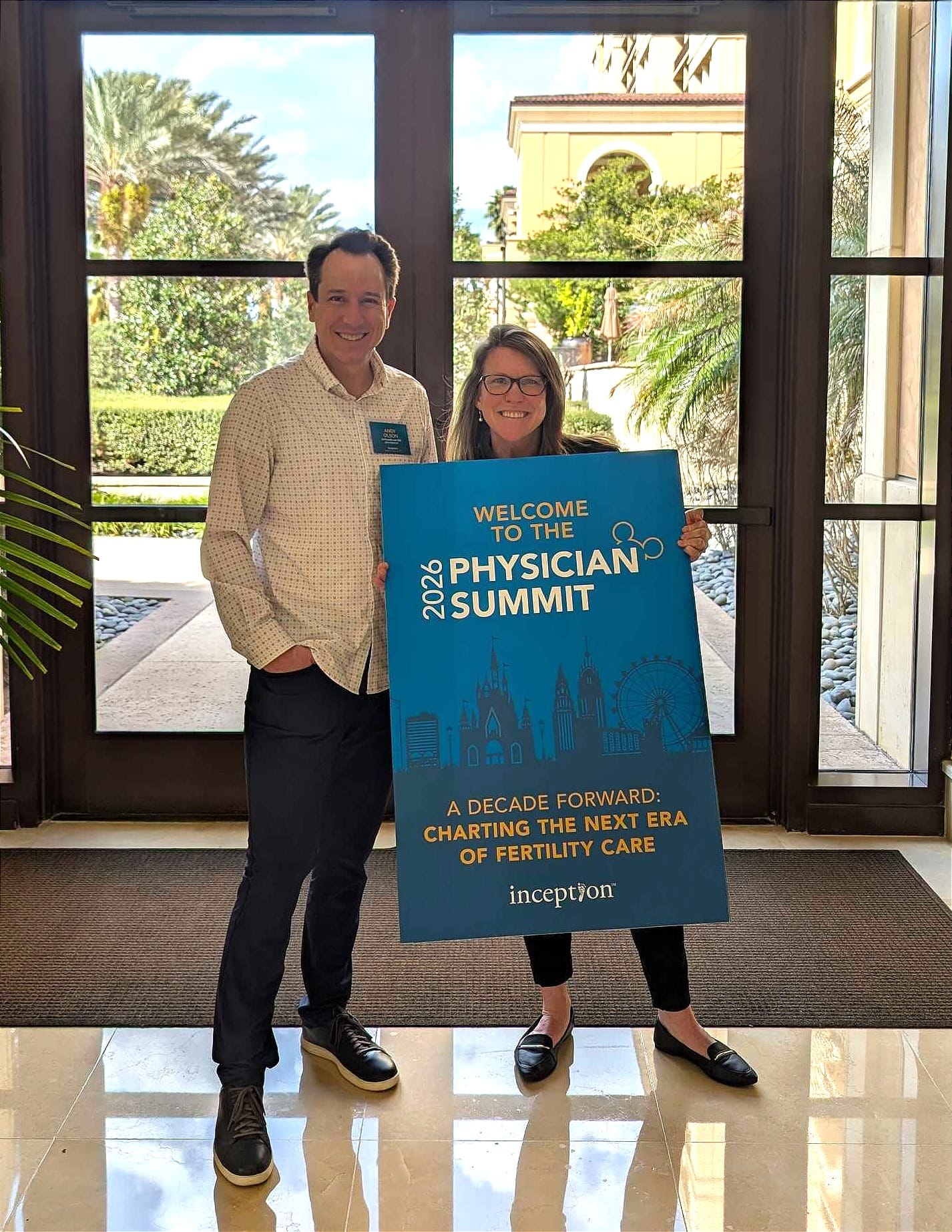
Andy Olson and Kristin Brogaard, Co-Founders of Path Fertility, at Inception Fertility's 2026 Summit, February 18-22, 2026, Orlando, FL
How the Business Got Here: Walmart, Kindbody, and the Enterprise Bet
Path Fertility’s commercial trajectory got a meaningful jolt when the company was accepted into Fuel Accelerator in Arkansas, a program of Fayetteville-based Startup Junkie Foundation and an innovation hub for new technologies. Fuel Accelerator also connects startups with large enterprises, including Walmart.
The team went in with a clear goal: get SpermQT covered as an employee benefit. Seven weeks into the program, Walmart asked why the test wasn’t already part of their benefits offering. The answer was that it could be. That conversation led to a contract through Kindbody, which manages fertility benefits for Walmart and numerous other large employers. Additional benefits providers followed.
“That was huge validation,” Brogaard stated. “It showed that earlier diagnosis of male infertility can reduce unnecessary treatments and lower costs. That economic case is critical for payer adoption.”
Today, SpermQT is embedded in the standard operating procedures of three major fertility clinic networks, with three more targeted for expansion. Adoption currently sits below 1% of the addressable market, but the company notes that organic pull is already visible: physicians are finding the test independently, downloading order forms from the Path Fertility website, and ordering without any direct outreach from the company.
“The fertility community is highly data-driven,” Olson said. “Publications and clinical evidence are what move the needle.”
The Guideline Push — and the Inflection Point Ahead
The most consequential near-term milestone for Path Fertility may be clinical guideline inclusion. The company took a deliberate approach: it went directly to the authors of fertility clinical guidelines and asked what evidence they would need to consider adding SpermQT to the standard of care. Path then designed a prospective, multi-site clinical trial around that answer.
Data for the trial’s primary endpoint was collected just recently, with results described by the company as statistically significant. A fourth peer-reviewed publication is expected to follow. If successful, guideline inclusion would represent a significant inflection point, one that typically triggers both broader physician adoption and payer reimbursement.
For now, the test is priced at $385 cash-pay. The company is also in active discussions with large employers to offer the test as a covered benefit at around $500 per employee — a compelling value proposition for employers already bearing the cost of expensive fertility treatments.
The Bigger Platform: Epigenetics Beyond Fertility
Male infertility is Path Fertility’s entry point, but it’s far from the destination. Underneath SpermQT is a broader epigenetic diagnostics platform that Brogaard and Olson believe has implications well beyond reproduction.
One example they discuss is “sperm age,” a biological age estimate derived from epigenetic patterns in sperm. In many cases, the company says this estimate is accurate to within about a year of a man’s chronological age. More intriguingly, lifestyle factors like smoking or elevated BMI appear to accelerate sperm aging, while healthier behaviors can slow or reverse it.
“That connects fertility to overall health,” Olson said. “It suggests a much broader role for this technology beyond reproduction.”
The company estimates its core fertility diagnostics market at approximately $1 billion. Expansion into reproductive cancers, an adjacent application of the same epigenetic platform, could grow the total addressable market to as much as $10 billion. Every test run adds to a growing proprietary dataset that the company expects to become a meaningful competitive moat over time.
Path Fertility is currently raising a $5 million round to fund commercial expansion, including sales talent and marketing, following an earlier $8.2 million raise in which nearly half came from non-dilutive funding. The company projects more than $100 million in annual revenue by 2030, based on approximately 250,000 tests per year and a path from current gross margins of roughly 35% to the mid-70% range as scale and commercial channels mature.
The Road Ahead
The obstacles are real. Physician awareness remains the company’s most immediate challenge. Brogaard estimates that only about 10% of U.S. fertility clinics are currently familiar with Path Fertility. Reimbursement pathways require clinical evidence that takes time to build. And changing established diagnostic workflows, even with strong data, is never fast.
But the JARG publication gives Path Fertility something that matters in this market: a real-world, multi-clinic, peer-reviewed dataset that makes the clinical case in terms that payers, physicians, and guideline authors can act on.
“This is a deeply emotional space,” Brogaard said. “I talk to patients regularly. People desperately want to have children. It’s not just a medical issue; it’s fundamental to how people see their lives and their future.”
Olson brought it back to where the company started. “When the diagnosis is wrong, or incomplete, it leads to years of unnecessary hardship. Our goal is to give physicians and patients better answers, earlier.”
For the couples who’ve spent years and tens of thousands of dollars chasing a diagnosis that standard tests couldn’t provide, Path Fertility is betting that “earlier” is already overdue.
Path Fertility is based in Salt Lake City, Utah. SpermQT is available through physician order and the company’s direct-to-consumer platform.
Share this article
The link has been copied!
Your link has expired. Please request a new one.
Your link has expired. Please request a new one.
Your link has expired. Please request a new one.
Great! You've successfully signed up.
Great! You've successfully signed up.
Welcome back! You've successfully signed in.
Success! You now have access to additional content.