SheTech-TechBuzz Media Interns Agatha Hunnicutt and Najma Ahmed profile Women Tech Awards finalist Lynn Reichert, exploring how her work at the Utah STEM Action Center expands STEM education, innovation, and food security across Utah communities.
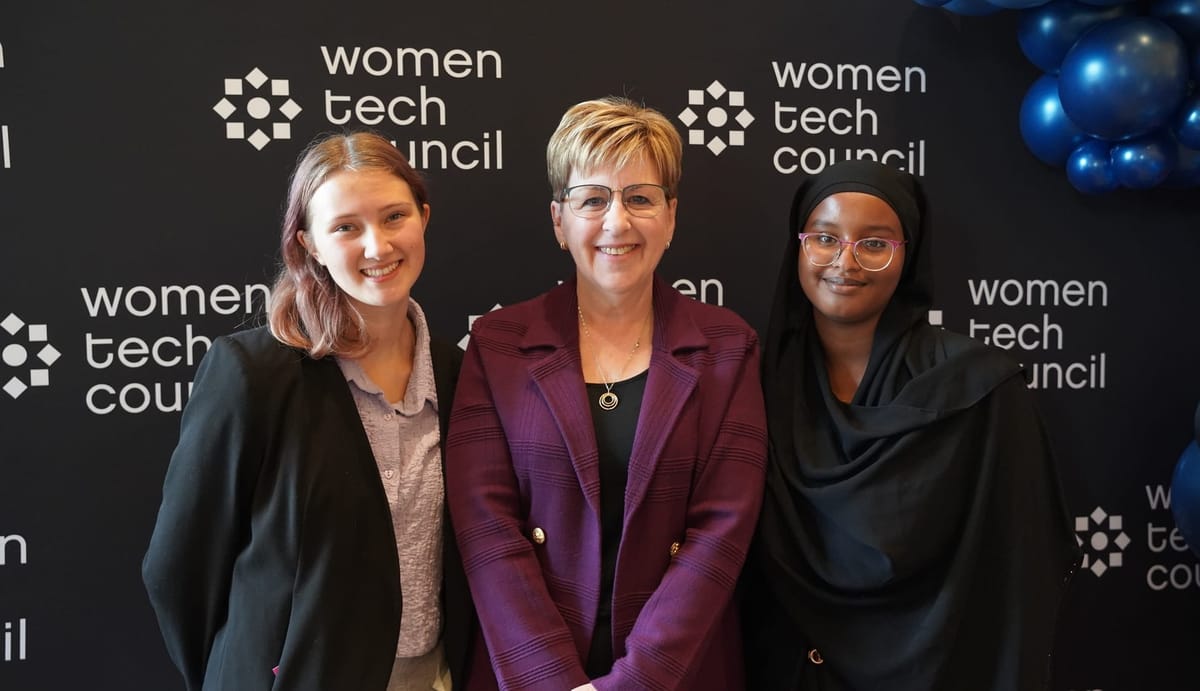
Agatha Hunnicutt, Lynn Reichert, and Najma Ahmed attend the 2025 Women Tech Council Awards, where Reichert was named a Women Tech Awards finalist, October 3, 2025, Grand America, Salt Lake City. Photo by Mark Tullis
Agatha Hunnicutt, Lynn Reichert, and Najma Ahmed attend the 2025 Women Tech Council Awards, where Reichert was named a Women Tech Awards finalist, October 3, 2025, Grand America, Salt Lake City. Photo by Mark Tullis
A Conversation with Lynn Reichert on STEM Education, Hydroponics, and Community Impact
Salt Lake City, Utah — January 15, 2026
“Listen to your own voice. Hear it. Don’t be afraid of it. Know that your input and your knowledge is important, and we need every voice to be heard. We need every different perspective to be brought to the table to create the best we can.” These are the strong words of Lynn Reichert, the Community and Innovation Manager for the Utah STEM Action Center. She is a Women Tech Awards finalist for 2025 and for good reason, due to her focus on making technology and STEM education accessible.
Coming from a sociology background, Reichert cares first and foremost about people: “Don’t ask me about history and dates. Tell me about how people were affected and [how] it changed society. That’s where my interest lies. That’s where I come from.” From there, Reichert has had a unique career path, but most of her jobs have centered around helping people seek education.
For example, she worked at the Department of Workforce Services to write grants for the expansion of Utah educational programs. She eventually brought these communication and negotiation skills to the newly formed Utah STEM Action Center.
In this position, Reichert has managed a number of projects with the shared goal of getting STEM into the hands of the public, matching the vision of the Center. One example is their Pop-Up Maker Faires, which include hands-on STEM activities they bring to schools and communities. Another is the Center’s more than 50 “STEM Spots,” which are mini libraries all around Utah containing STEM-focused books for all ages.
Reichert is also highly involved with running the Center’s summer and high school internship programs, and most recently, a hydroponics program.
All of Reichert’s work comes back to her passion for getting people involved in innovation through education: "Education can't do it alone. Industry can't do it alone. We need programs that serve both industry and education needs."
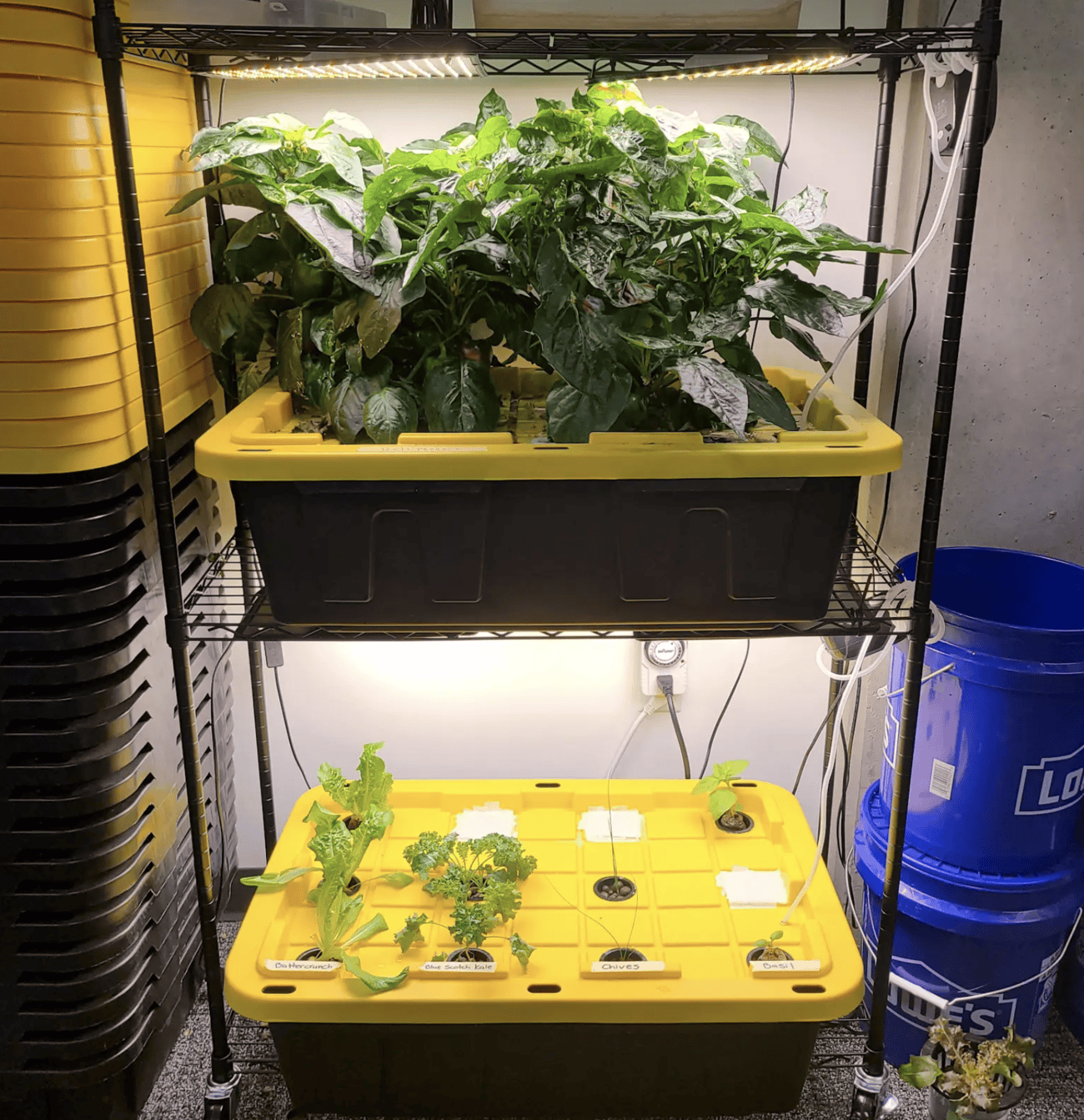
A small-scale hydroponics system at the Utah STEM Action Center, part of a effort to expand STEM education and address food insecurity
Hydroponics is a gardening technique that is more water-based than soil-based, using a plastic or man-made structure to support individual plant growth rather than the ground or a pot of soil.
Reichert has been working with the STEM Action Center to supply hydroponics units to communities. So far, 47 schools and 11 libraries have larger, commercial style units, meaning a larger, vertically stacked gardening structure that can be placed in a lunchroom or communal space. These larger units can be combined with smaller countertop units to expand access.
During the interview, Reichert shared examples of the projects housed at the STEM Action Center, including models of hydroponic units and a countertop system. The larger unit was successfully growing produce, including leafy kale.
A large hydroponic unit inside the Utah STEM Action Center
When Reichert opened the plastic structure—a preliminary design made from large storage containers—there was a tangle of healthy roots covering the lid.
Seeing the growing process—especially out of plastic containers in an office—highlighted how accessible this method of food production can be.
As Reichert and her team from the Center began distributing these hydroponics units to schools, she realized that growing food wasn’t just an educational activity for students—it was also a produce source for many who struggle with food insecurity.
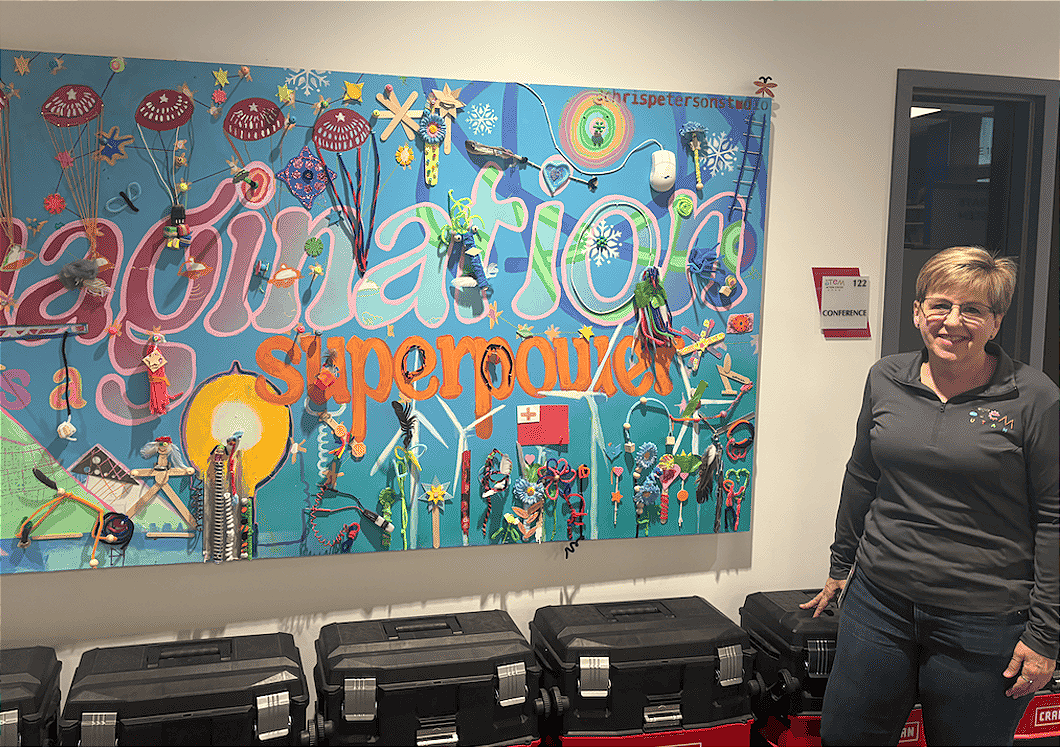
Lynn Reichert with STEM kits for community use, Utah STEM Action Center
One of the schools Reichert worked with was West Desert Elementary, a one-room schoolhouse in the Tintic School District that has never had a school lunch program. Because it is located in a rural area, many families struggle to provide lunch every day or regularly access fresh foods.
Reichert discussed the impact the school’s hydroponics unit has had: “They now have an everyday salad bar based on what they are producing themselves. You’ve addressed a food desert. You’ve addressed nutrition. You’ve addressed ‘I can do this. I can take care of myself.’”
Reichert remarked that the project’s results so far are “mindblowing,” and the program continues to grow as they develop more scalable units and a chatbot—she calls it a “hydrobot”—to provide quicker information to users. The hydroponic farms can now be found on tribal lands, in housing units, at the International Rescue Committee, and at community centers across Utah.
Reichert has loved working on this program and is drawn to the fast-paced nature of STEM: “STEM is changing every day. That’s why I love it, because I’m constantly learning and constantly challenged.”
Although Reichert has experienced imposter syndrome herself, she emphasizes that innovation is built by many people working together. “Do I understand all those technical pieces? No,” she said. “But I can see what pathway we need to take. I can see the big picture.”
Agatha Hunnicutt and Najma Ahmed are 2025-26 SheTech Media Interns with the Women Tech Council and TechBuzz News. Both attend West High School in the Salt Lake City School District.
Agatha Hunnicutt is a junior at West High. She is passionate about SheTech, mathematics, writing, film, and crochet.
Najma Ahmed has worked at the Natural History Museum of Utah as a Teen Explainer and Programs Assistant. She's involved in Global Diplomacy Club, High School Democrats of America, and SheTech.
SheTech Explorer Day 2026 will take place on February 24. Explorer Day a hands-on STEM conference for Utah high school girls, offering workshops, mentors, role models, career pathways, and collaborative tech challenges in an engaging, supportive environment.
Share this article
The link has been copied!
Your link has expired. Please request a new one.
Your link has expired. Please request a new one.
Your link has expired. Please request a new one.
Great! You've successfully signed up.
Great! You've successfully signed up.
Welcome back! You've successfully signed in.
Success! You now have access to additional content.