Utah’s Silicon Ridge Could Rewire America’s Critical Minerals Supply
Ionic Mineral Technologies' (Provo, UT) Silicon Ridge project in Utah County hosts a halloysite-based “IAC-Plus” deposit, confirmed by ALS Chemex, with rare earths and critical metals, offering a rare, domestic supply comparable to major Chinese deposits.
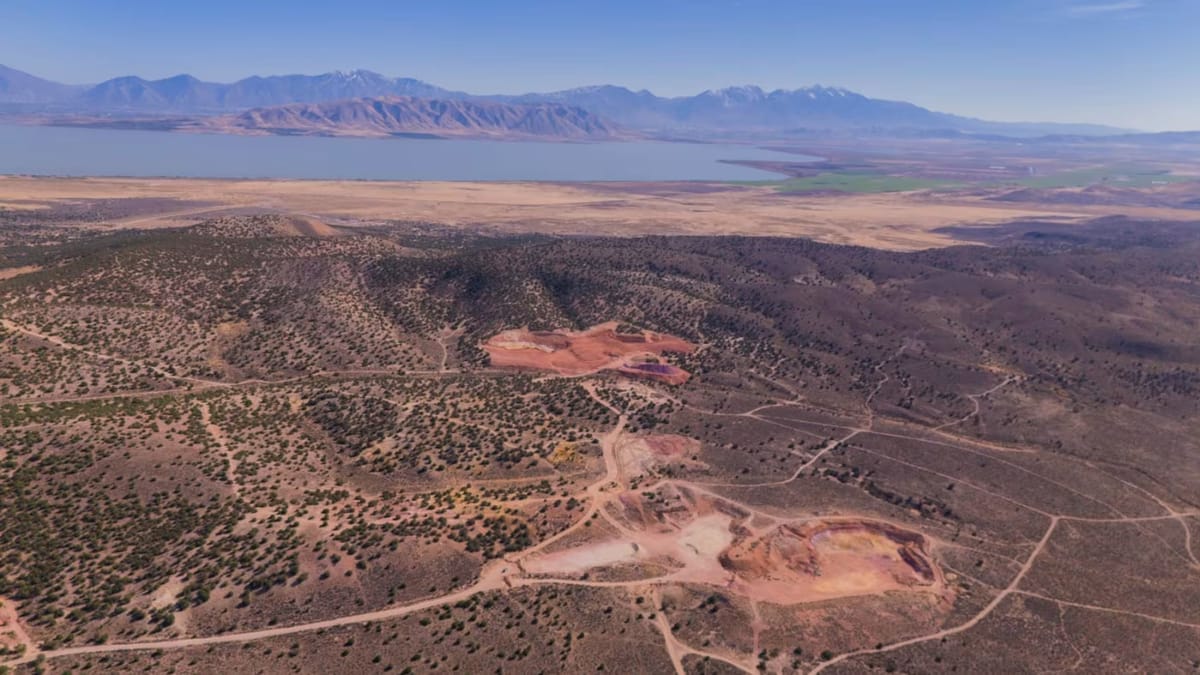
(Ionic Mineral Technologies) Silicon Ridge mine in west Utah County near the southern part of the Lake Mountains
(Ionic Mineral Technologies) Silicon Ridge mine in west Utah County near the southern part of the Lake Mountains
Provo, Utah - December 15, 2025
Ionic Mineral Technologies (Ionic MT) says it has confirmed a high-grade, multi-metal critical minerals deposit at its fully permitted Silicon Ridge project—one that mirrors the same rare geological formation underpinning China’s dominance in rare earth production, but sits squarely on U.S. soil.
If the data holds up through economic studies and commercialization, Ionic MT's Silicon Ridge project represents something the U.S. has talked about for years and rarely achieved: a domestic, scalable, and comparatively clean source of rare earths and critical technology metals essential to semiconductors, AI hardware, defense systems, and advanced energy.
Rare earths and critical minerals are no longer an abstract supply-chain issue. They are a choke point. This was a main theme of multiple 47G Critical Materials Summits from earlier this year and late last year.
China currently controls a large share of global rare earth production—particularly heavy rare earth elements—while also holding leverage over downstream processing. That leverage tightened further after Beijing’s late-2024 export bans on gallium, germanium, and antimony to the U.S., followed by 2025 export licensing requirements on key rare earths including scandium, yttrium, and lutetium.
Against that backdrop, Ionic MT’s announcement lands with potential consequence. Senator Mike Lee, speaking at the March 2025 47G Critical Materials Summit, stated: “We see what happens when we rely on these nations for essential resources: supply chain disruptions, economic vulnerabilities, and national security risks. It’s time to fix that, and Utah is uniquely positioned to lead.”
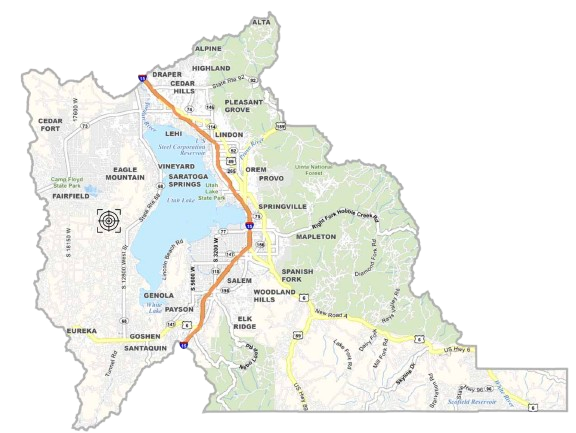
Silicon Ridge is located in the Lake Mountains in west Utah County, Utah, just west of Utah Lake and south of Saratoga Springs and Eagle Mountain and southeast of the small rural community of Fairfield.
Independent assays from ALS Chemex, a globally recognized ISO-certified laboratory, confirmed Silicon Ridge’s high-grade rare earth and critical metal content. The deposit is a halloysite-based ion-adsorption clay (IAC), similar to formations that supply 35–40% of China’s rare earths and over 70% of global heavy rare earths. Ionic MT describes it as ‘IAC-Plus,’ with rare earth concentrations on par with these major Chinese deposits, plus hydrothermal and magmatic enrichment of additional critical metals—including gallium, germanium, rubidium, cesium, scandium, lithium, vanadium, tungsten, and niobium.
Halloysite is a naturally occurring aluminum–silicon clay mineral with a distinctive microscopic tube-like structure that gives it unusual industrial value. Halloysite-hosted clays can be mined from the surface and processed at low temperatures, avoiding the energy intensity, acids, and waste associated with traditional mining. Those hollow tubes are key. They can:
Trap and hold metals such as rare earth elements, lithium, gallium, and germanium
Enable ion exchange, making extraction easier than in hard-rock ores
Be processed into advanced materials, including nano-silicon for lithium-ion batteries and high-purity alumina
“Dr. Travis Mcling of Idaho National Laboratory, speaking at the 47G Critical Minerals Summit earlier this year, called the broader region the ‘Unknown West of critical minerals. The resources we need to secure our supply chains are all around us,’” situating Silicon Ridge within a larger strategic geology and resource story. The discovery at Silicon Ridge underscores this point: beyond halloysite for battery materials, the site contains a full suite of rare earth and critical metals, potentially making it one of the most significant domestic deposits in decades.
Discovery Story and Context
Ionic MT initially focused on mining halloysite for nanosilicon used in lithium-ion batteries. In the course of routine exploration at Silicon Ridge, the company’s internal analysis revealed consistent traces of multiple metals. Credible third-party testing later confirmed high grades of gallium, germanium, rubidium, cesium, scandium, lithium, vanadium, tungsten, and niobium.
Scale, Grade, and Expansion Potential
The initial exploration footprint is already significant:
106 boreholes totaling more than 10,000 meters
35 trenches
A defined area of 650 acres
Within the halloysite clay fraction, Ionic MT reports an average combined rare earth and critical metal grade of approximately 2,700 ppm (0.27%)—a 4.74x enrichment over the bulk host material. That places Silicon Ridge at the high end of, and in some cases above, reported grades from Chinese ion-adsorption clay operations, which typically range from 500 to 2,000 ppm.
Dr. Brian Steed, speaking at the 2025 47G Critical Minerals summit, stressed the demand pressure for critical minerals at the 47G Critical Minerals Summit “What do we want as a state, as a nation, and globally? One word: More… Demand isn’t going down — it’s going up," underscoring the urgency of domestic mineral development and the strategic value of this potential source in Utah County.
From Discovery to Production—Fast
Exploration success often stalls at permitting or infrastructure. Silicon Ridge doesn’t face that problem.
The project sits on state-leased land with active mining permits, and Ionic MT already operates a 74,000-square-foot permitted processing facility in Provo, Utah. The site benefits from roads, power, and existing workforce materially shortening the timeline from resource confirmation to commercial output.
The Utah land is managed under the Utah Trust Lands Administration, which oversees roughly 3.3 million acres of combined surface and mineral estate and 1.2 million acres of minerals-only land. Created in 1994, the agency generates revenue through energy development, real estate, and surface resource use. All proceeds are deposited into permanent endowments for each beneficiary. The School and Institutional Trust Funds Office invests these endowments and calculates annual distributions, meaning Utah schools stand to benefit financially when Silicon Ridge goes into production.
The company has initiated a Preliminary Economic Assessment (PEA), with completion targeted for H1 2026. While a PEA is an early-stage study, the combination of permitting, infrastructure, and low-temperature processing gives Silicon Ridge a credibility gap over many earlier-stage critical minerals projects.
The company has initiated a Preliminary Economic Assessment (PEA), with completion targeted for H1 2026. While a PEA is an early-stage study, the combination of permitting, infrastructure, and low-temperature processing gives Silicon Ridge a credibility gap over many earlier-stage critical minerals projects.
At the 2025 47G Critical Minerals Summit, Eric Lyon, CEO of GW Strategies, framed the geopolitical stakes of critical minerals mining and how China approaches it: “They think in decades, not quarters… They’re playing three-dimensional chess while we’re stuck in 90-day business cycles," emphasizing the long-term strategic imperative of securing critical minerals at home.
Funding and Scale-Up
In July 2025, Ionic MT announced it had closed of a $29 million Series B financing round, oversubscribed above its $25 million target, demonstrating investor confidence in the company’s mission to secure a domestic supply chain for critical battery components.
The capital is earmarked to expand production at the Provo facility for:
Ionisil™ nano-silicon anode material: Scaling to 1,000 metric tons annually, supporting Gen-2 sample qualification with global battery OEMs and suppliers. The patented, silane-free magnesiothermic reduction process delivers energy capacities exceeding 2,500 mAh/g.
IonAl™ high-purity boehmite alumina: Increasing to 5,000 metric tons annually for lithium-ion battery separators and advanced ceramics. Commercial shipments and positive cash flow are expected in 2026.
This funding set the stage for Ionic MT to advance toward Tier-1 partner validation and transition to commercial revenue while reinforcing a domestic, integrated supply chain.
A Vertically Integrated Play
Silicon Ridge feeds directly into Ionic MT’s vertically integrated model, producing three co-product streams from a single clay input:
Critical Metals: Rare earths, gallium, and germanium for defense, semiconductors, and advanced electronics.
IonAL™ High-Purity Alumina: A precursor material for aerospace and advanced manufacturing.
Ionisil™ Nano-Silicon: A halloysite-derived lithium-ion battery anode material delivering a claimed 30–40% energy density improvement over conventional graphite. Ionisil™ is currently under qualification with tier-one battery OEMs, with first commercial qualification targeted for 2027.
Utah’s Strategic Bet
State leadership has been vocal in its support, framing Silicon Ridge as "a huge win for Utah and the nation," according to a LinkedIn post from Utah Governor, Spencer Cox. He continued, "These new critical mineral reserves discovered by Ionic Mineral Technologies will strengthen Operation Gigawatt and give America a secure, homegrown supply of the resources that power defense tech, AI, and advanced manufacturing."
On the technical side, interpretation of the discovery is being guided by Dr. Eric H. Christiansen, a retired professor of geologic sciences at Brigham Young University, a leading authority on Utah volcanology, and a former USGS scientist-in-charge for the region.
The next inflection points are clear: completion of the PEA, expansion drilling, Tier-1 partner validation, and scaling production at the Provo facility. If Silicon Ridge delivers on its early promise, it will become a case study for how the U.S. builds a sovereign supply chain for the materials that underpin modern technology—and do it faster, cleaner, and closer to home.