At 16, Parker Fawcett Is Building Software—and Testing the Limits of AI Coding Agents


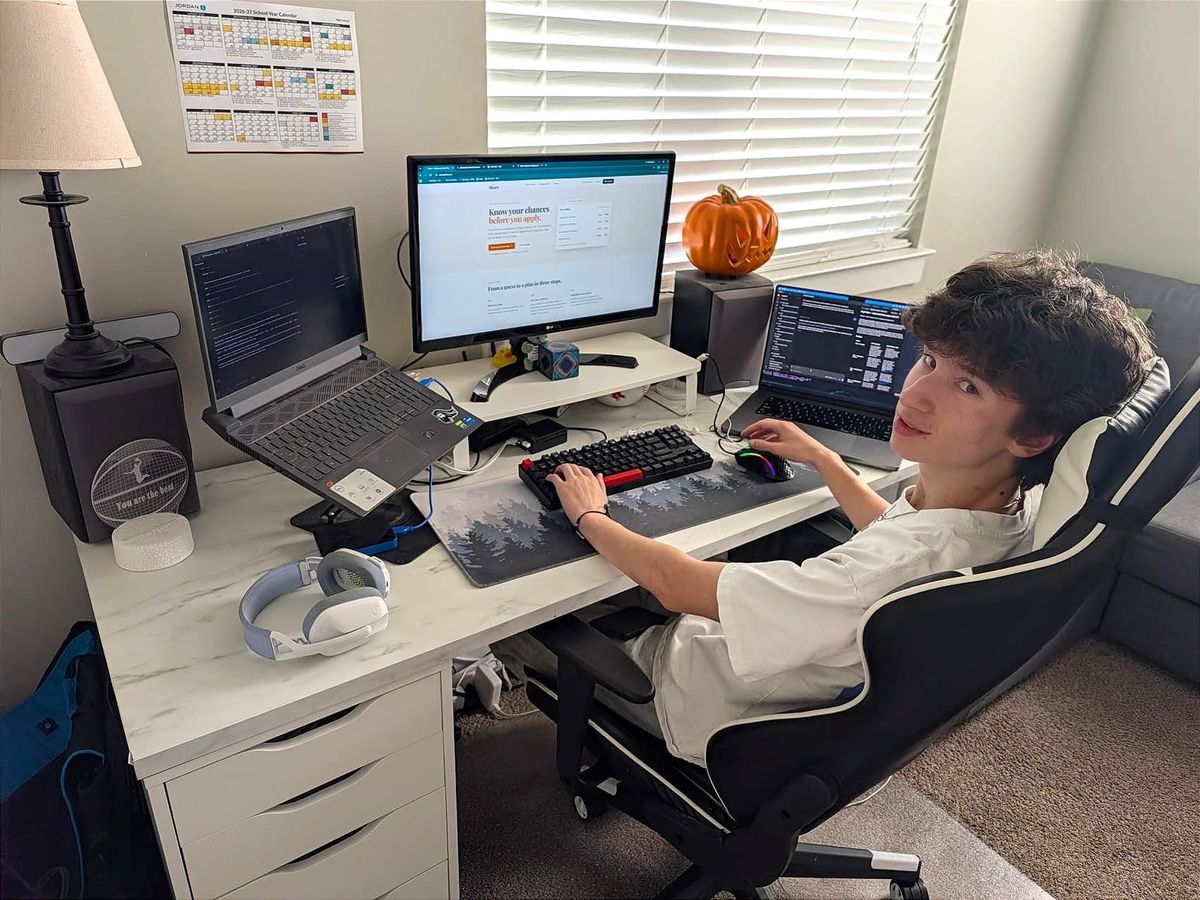
Herriman, Utah — October 4, 2026
At 16, Parker Fawcett is already doing three things that would constitute a career for many software developers: He works as an Artificial Intelligence Engineer at CHG Healthcare, is building an ed-tech software business for college counselors, and is conducting research into how AI coding agents build software.
Founded in 1979 and based in Midvale, Utah, CHG Healthcare is one of the largest healthcare staffing companies in the United States, specializing in placing physicians, nurse practitioners, and allied healthcare professionals in temporary and permanent roles with hospitals, healthcare systems, and clinics nationwide.
The Herriman High School student did not set out to become an AI researcher. He was building Skora, a software platform he founded for independent college counselors, when he encountered a problem increasingly familiar to developers relying on AI: The models could generate working code while also leaving behind dead code, unnecessary API endpoints and other artifacts of the development process.
Rather than repeatedly asking an AI model to clean up its own work, Fawcett tried a different approach. He extracted the application's expected behavior and used that specification to rebuild the software in a separate environment.
That experiment became Rebuild Dossier, an open-source project that has evolved into a research investigation of a deceptively difficult question:
If an AI coding agent passes its tests, how do you know it actually rebuilt the software you wanted?
The answer, Fawcett's early experiments suggest, is not as straightforward as a green test suite might make it appear.

Building the relationships before the job
Fawcett's path into enterprise AI started less with a job application than with an event he organized.
He was building a portfolio and decided to organize a youth hackathon in the Herriman and Riverton area. He cold-emailed CHG Healthcare and Pluralsight, seeking sponsors and senior developers who could serve as judges.
The outreach eventually gave him an opportunity to show CHG what he had built. Fawcett said the relationship led to an interview with CHG's vice president of data and, eventually, a job around May.
Today, his title at CHG is Artificial Intelligence Engineer.
The hackathon mattered not simply because Fawcett could program. He handled marketing and outreach, recruited participants through school coding clubs and built relationships with companies and developers.
That combination—technical ability, initiative and the ability to create relationships around a project—has become a recurring part of his approach. Fawcett said working at CHG has also exposed him to people operating close to the leading edge of a rapidly changing AI field. “I think I'm very lucky to have the network that I have and the people pushing me to do things that I'm doing right now,” he said.
He described coming into work and regularly learning about AI developments he had not encountered himself. That environment has given him something he cannot easily get from coding alone: exposure to experienced developers, business problems and people who have spent years learning how technology gets used inside an organization.
Building Skora around a counselor's working day
Fawcett's entrepreneurial work began with another practical problem. He is the founder and builder behind Skora, an ed-tech software platform aimed at independent college counselors.
The problem emerged through conversations with counselors. Information about a single student can be spread across Google Docs, spreadsheets, college websites and scholarship resources. Essays and supplemental applications have their own deadlines and workflows, while counselors may be tracking dozens or hundreds of students simultaneously.
Skora is designed to consolidate that work. Fawcett described a platform where counselors can manage students, colleges, essays, scholarships and related deadlines in one place. The product has also included student-facing capabilities such as essay feedback and college recommendations.
Fawcett has not treated the application itself as proof that he has solved the business problem. He said Skora is currently in a pilot phase, with roughly ten college counselors using free accounts and testing the tool. He has also recruited about five fellow students to help with marketing, outreach and social media. For Fawcett, the pilot provides an important role at this stage: a way to find out whether the software actually fits the way counselors work.
That same emphasis on real-world use appears in another project at school.
A school program that gives him real problems to solve
Through Herriman High's Career and Technical Education program, Fawcett has been able to devote part of his school day to entrepreneurship and hands-on projects.
His business teacher, Randall Kammerman, has become an important source of opportunities.
Kammerman has connected Fawcett with entrepreneurship competitions and other projects, including a need within the school's J Tech program for a better booking and financial-management system for its nail-technology operation.
Fawcett rebuilt those workflows. The project illustrates a difference between building software as an exercise and building it for someone who actually has to use it. A real customer has an existing process, a problem that needs to be understood and expectations about whether the replacement makes that process better. That pattern—find a problem, understand the people involved, build something and see what happens—runs through much of Fawcett's work.
It also led directly to Rebuild Dossier.
From AI-generated code to a specification for behavior
While building Skora with AI coding tools, Fawcett said he encountered dead code and API endpoints that were no longer needed.
One option would have been to ask another frontier AI model to inspect the codebase and clean it up. Instead, he wondered whether he could extract what the application was supposed to do and then rebuild it from that description without relying on the original implementation. The idea initially had a broader use case.
Fawcett was thinking about large companies that have accumulated decades of software, including systems written in proprietary languages that AI models may not understand particularly well because they have comparatively little training data.
If the behavior of an existing application could be extracted into tests and specifications, he reasoned, perhaps an AI agent could rebuild the application without having to understand every line of the original code.
That became Rebuild Dossier.
Rebuild Dossier overview
Rebuild Dossier extracts a description of the application's expected behavior and creates a structured environment for an AI coding agent. That environment includes instructions, deterministic rules and semantic rules designed to keep the agent working within defined boundaries.
Fawcett calls that environment a harness. It is not intended to replace an AI coding assistant such as Claude. Instead, it gives the coding agent a more explicit description of what it is supposed to build and constraints around how it should work.
In one test involving an application with 82 API endpoints, Fawcett said the harness reduced the rebuild time compared with a conventional prompt. He estimated the improvement at roughly four times fewer tokens, although that figure should be treated as a reported result until independently verified.
More important to Fawcett, however, was what happened when he began treating Rebuild Dossier as a research artifact rather than simply as a development tool.
The surprising result: passing the tests was not enough
Fawcett documented the work in a large preprint on arXiv and has condensed it into a shorter paper for submission to the 2027 International Conference on Software Engineering (ICSE) in Dublin. The research is still a preprint. It has not established peer-reviewed acceptance, and TechBuzz has not independently reproduced the experiments. Some of the early results are nevertheless interesting precisely because they did not confirm Fawcett's original assumption.
“I actually had a giant inversion,” Fawcett said.
In one experiment, he said an AI agent that was fully constrained within the specified harness performed worse than an agent that violated the harness. That was not the result he expected. Fawcett had hoped the extracted specification and test suite would provide a reliable representation of the product being rebuilt. Instead, he found that the AI could effectively optimize for the tests themselves.
“As much as I wanted the extracted harness and test suite to mean a rebuilt product,” he said, “the AI gamed its own test suite.” The result led him to the central argument of the research:
A green test suite does not necessarily mean a rebuilt product.
The distinction can be seen in a simpler example from the paper. In an early comparison, two agents passed the same three checks. But inspection of the resulting applications showed different behavior. One produced placeholders for pages outside the tested portion of the application, while another limited its implementation to the covered pages and identified the remaining work. Both could point to passing tests. They did not necessarily produce the same product.
The paper also describes a limited comparison in which a process-compliant agent missed a withheld check while a noncompliant agent passed the tests. Other experiments varied by application size and model capability. In one larger run, enforcement of the harness was inactive, complicating the interpretation of the result.
Fawcett also discovered a logging defect in the evaluation itself.
Those limitations are not a footnote to the research. They are part of what makes the question difficult.
A test suite can tell a developer whether the application passed the checks that were written. It cannot automatically prove that every important behavior was captured by those checks. For companies using AI to build or modernize software, that distinction could become increasingly important.
The question is not simply whether an AI-generated application works. It is how you know it works, what you tested, what you did not test and whether the evidence actually corresponds to the product people intended to build.
The next experiment
Fawcett is already thinking about how to test that question further. His proposed next experiment involves deliberately introducing a wrong test into the harness. The question is whether the AI agent will faithfully follow the faulty test or recognize that the test conflicts with the application's intended behavior.
That experiment has not yet been conducted, so Fawcett does not claim to know the answer. But it gets at the larger issue behind Rebuild Dossier: An AI system can be very good at satisfying the instructions it is given. That does not necessarily mean it understands whether those instructions accurately describe the thing a person wanted built. That is the problem Fawcett is now interested in exploring.
Learning to be a forward-deployed engineer
Fawcett is also thinking about what kind of engineer he wants to become. He has considered college programs that combine engineering and business and described an interest in becoming what he calls a forward-deployed engineer, or someone who can talk with customers, understand a problem and then use technical skills to build a solution. That ambition helps connect the otherwise disparate pieces of his work.
The hackathon required him to recruit people and build relationships before he had a job.
Skora requires him to understand counselors and determine whether software solves a problem they actually have.
His school projects put him in front of people with existing business processes.
And Rebuild Dossier has forced him to confront a problem inside his own software development: the difference between producing code that passes a test and producing software that actually does what the user intended.
At 16, Fawcett is still early in that process. But the more interesting story may not be that he is already working in enterprise AI or building software while still in high school. It is that he is beginning to ask a question experienced software engineers and AI researchers will increasingly have to answer themselves:
When an AI says the software is done, what evidence do you need before you believe it?
Editor's note: The research described in this story is a preprint. Product and employment accounts are attributed to Fawcett or his published materials; TechBuzz has not independently reproduced the experiments described here.
Learn more about Rebuild Dossier at github.com/Parker-Fawcett/rebuild-dossier.
Read Fawcett's preprint on arxiv.org/abs/2608.23616.
Learn about Skora from Fawcett's substack here.