U of U to Startup Partners: "We Are Open for Business"
Ahead of BioHive Premieres on October 8 at SLC Megaplex, University of Utah venture development director Kyrsten Woolstenhulme explains how the university connects researchers with business talent, funding and partners to launch new startups.
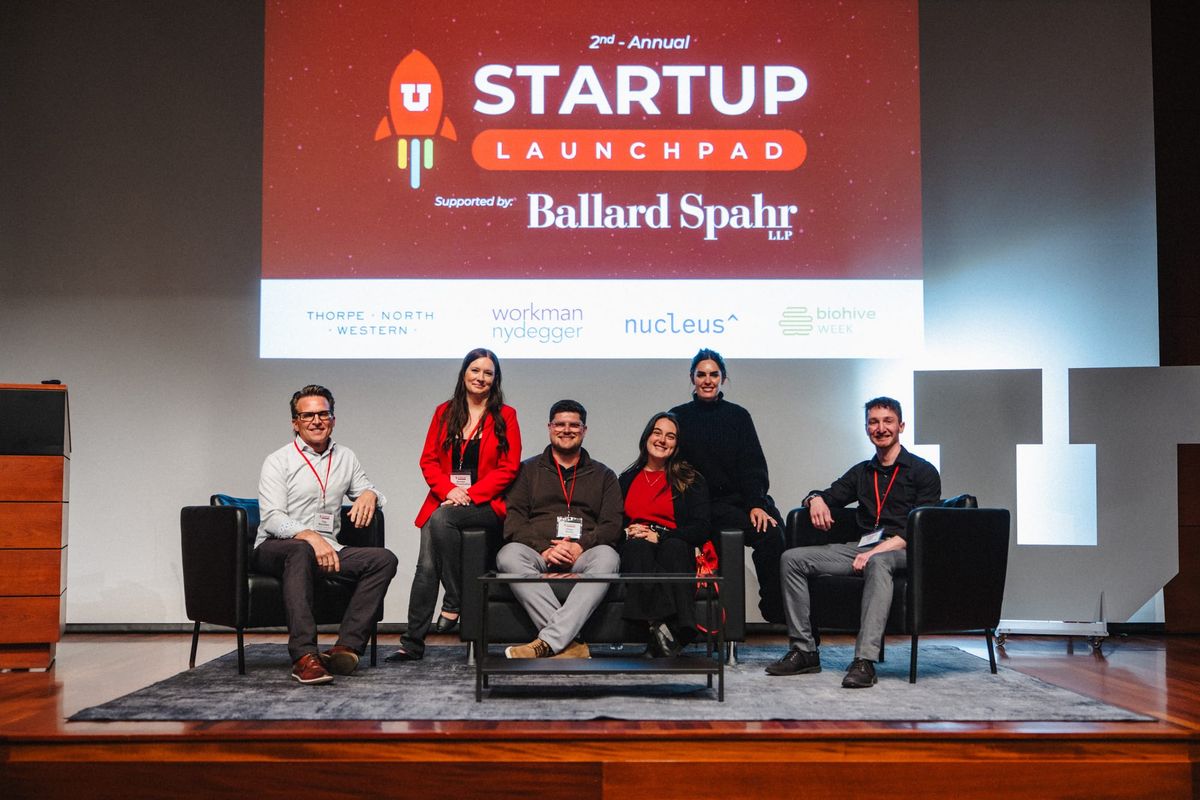
Kyrsten Woolstenhulme, Senior Director for Venture Development, University of Utah Technology Licensing Office, with her U of U colleagues at the April 2026 U Startup Launchpad event. Photo: University of Utah
Kyrsten Woolstenhulme, Senior Director for Venture Development, University of Utah Technology Licensing Office, with her U of U colleagues at the April 2026 U Startup Launchpad event. Photo: University of Utah
Ahead of BioHive Premieres, Kyrsten Woolstenhulme explains how the university connects researchers with business talent, funding and partners to move discoveries toward the market.
A life science startup can get a warm reception from investors and still leave without a check, told to come back with one more piece of data.
For Kyrsten Woolstenhulme, Senior Director for Venture Development in the University of Utah's Technology Licensing Office, closing that gap is the job. Her message to potential partners is straightforward: "We are open for business."
She will be part of the conversation next week at BioHive Premieres: Utah & The Future of Health, billed as Utah's first-ever healthcare innovation showcase. The event runs Thursday, Oct. 8, from 1:00 to 6:30 p.m. at Megaplex Salt Lake City at The Gateway, with programming on cancer care, digital health, biodefense, mental health, innovation in clinical trials, neurotechnology and more.
Ahead of the event, Woolstenhulme spoke with TechBuzz about how her team helps researchers build companies, what investors want to see, and where technologies stall between the lab and the market.
Business support around the science
"We want active partners to help us build these companies," Woolstenhulme said in a recent conversation with TechBuzz.
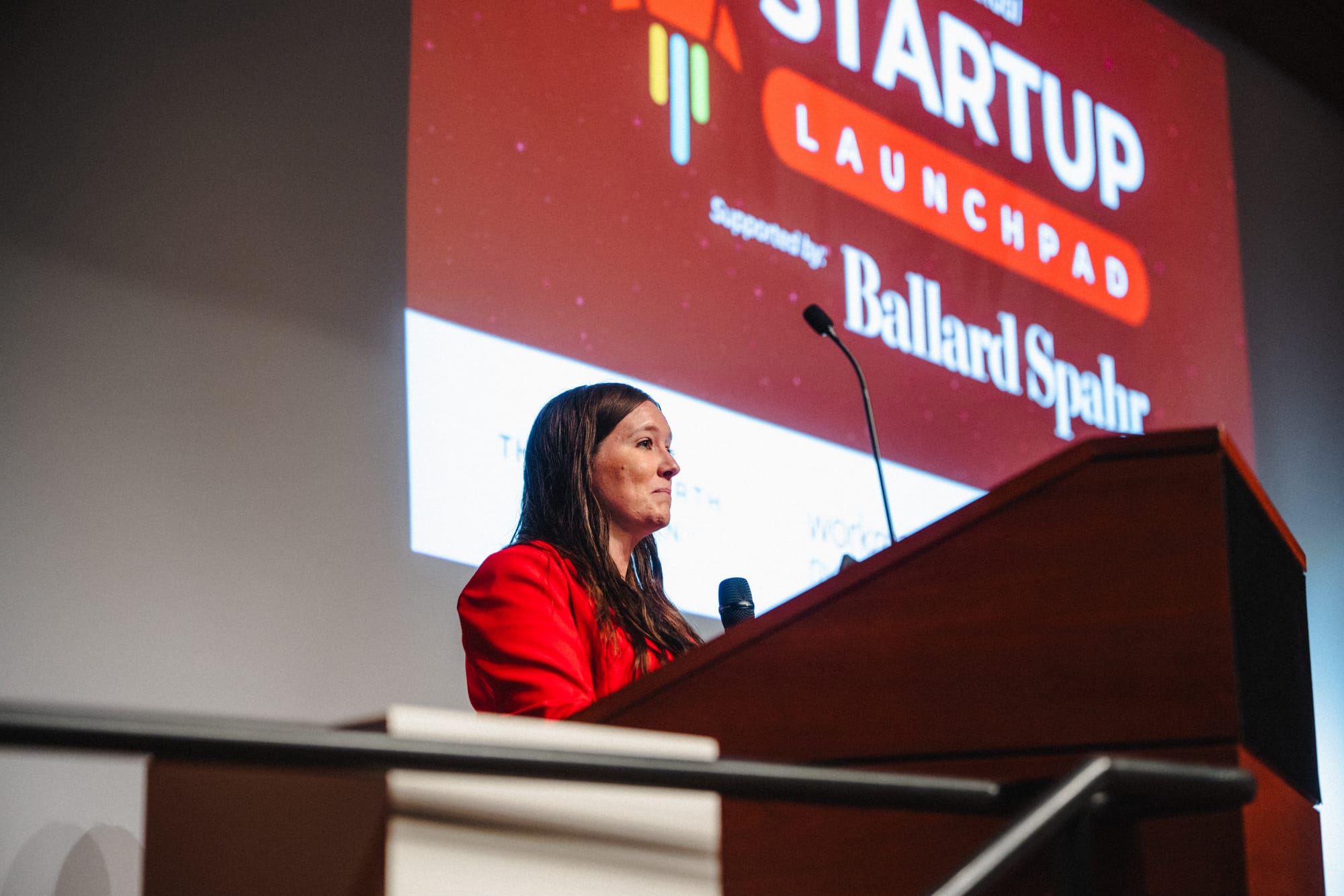
Kyrsten Woolstenhulme, Senior Director for Venture Development, University of Utah Technology Licensing Office, speaking at the April 2026 U Startup Launchpad event. Photo: University of Utah
Those partners might offer market perspective, identify funding or step into operating roles. Her office helps them find opportunities and navigate university resources. The goal goes beyond forming a company: it is to position that company to attract outside funding, work with larger organizations, meet regulatory requirements and deliver a product with both societal and economic impact.
One tool is Startup Launchpad, which connects researchers and founders with the people and services needed to build a company. "We talk about it like a bridge or a connector so that people have the right resource at their disposal at the right time," she says.
Through partnerships with trade organizations, community resources and other research institutions, the program links emerging companies with mentors, business talent and service providers. That matters because a new company may need accounting or marketing help long before it can justify a full-time chief financial officer or marketing executive. The idea is to surround a scientific team with business support rather than expect researchers to become experts in everything.
The funding gap
Even with that support, life science companies face a hard financing problem. Grants and other non-dilutive funding can advance early research, but they may run out before a company has produced the evidence that venture investors or corporate partners want.
"There is often limited capital for the work between early discovery in the lab, and the data and de-risking that needs to happen to support a venture investment or strategic partnership," Woolstenhulme says.
Investors may want validation in humans, or at least strong preclinical evidence. Additional work may involve reproducibility, quality systems or data suitable for regulatory review. "The question becomes, well, how do we get that next piece of data?" she says.
The university has built several programs aimed at different stages of that problem:
Tech Discovery Microgrants support early feasibility work.
Ascender Grants fund additional development and validation.
The Launchpad Seed Fund supports companies themselves, covering initial operations as they prepare to raise a fuller round.
Woolstenhulme also points to Nucleus Institute as part of Utah's response to the gap, with funding, programming and support for companies emerging from higher education.
What investors want
Woolstenhulme says investors consistently look for three things: differentiated science, strong and reproducible data, and a defined first product.
The third can require a shift for researchers whose technology has many possible uses. A broad platform may have enormous long-term potential, but an investor still wants to know which patients the company will serve first and why that market is the right starting point. "A broad platform with no initial focus doesn't show them a path to return," she says.
The task is not to describe everything a technology could eventually do. It is to show where the company will begin.
Easier licensing
The university has also worked to reduce friction in the agreements that let startups commercialize its intellectual property. Woolstenhulme says the Technology Licensing Office reviewed its licensing obligations with investors and startup legal counsel to find provisions that could cause problems during financing, then addressed them in the standard template before an agreement reached an investor's due diligence.
The work continues as individual companies raise money and bring in strategic partners. Some provisions are constrained by state and federal law. "Where we can be flexible, we want to see our company succeed," she says.
From the lab to the market
Woolstenhulme describes precision and personalized medicine as a recurring theme in university research and in conversations with industry. She also sees demand for AI-enabled drug discovery and development, from identifying potential therapeutic targets to selecting patients and optimizing clinical trials. Diagnostics, oncology, rare disease, infectious disease and neuroscience are among the areas where she says university strengths are drawing interest.
Her clearest example of the path from lab to company is Recursion, which she notes began in a University of Utah laboratory and grew into an AI-enabled drug discovery company. Recursion is on the BioHive Premieres agenda in "The Next Frontier in Cancer Care," hosted by Huntsman Cancer Foundation. See TechBuzz coverage of Recursion's IPO in 2021, a 2023 $50 million investment from NVIDIA, and Recursion's founder Chris Gibson speaking at Biohive's April 2026 U Startup Launchpad event, pictured above.
It is not the only company on the agenda with campus roots. According to the BioUtah, nine companies in the lineup trace back to campus in some way. Many of Blackrock Neurotech's technologies were patented by the university and are licensed to the company. BIOS spun out of the Utah NeuroRobotics Lab, and RefloDx is a spinout of the university's Center for Medical Innovation. FrostByte Defense Technologies began as a master's project in the university's RAC Grand Challenge. The box at the end of this story shows how the university describes each company's connection.
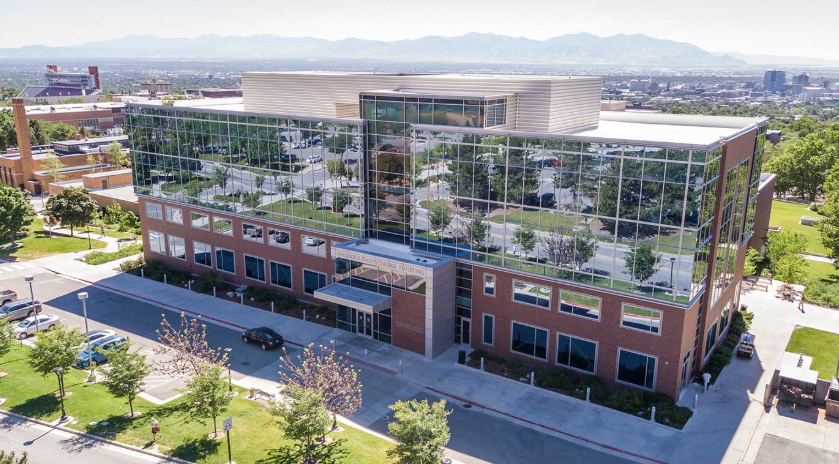
Technology Licensing Office at the University of Utah at 303 S Chipeta Way. Photo: University of Utah
Utah's advantage
Asked how Utah compares with hubs like Boston and the Bay Area, Woolstenhulme points to access. She describes a closely connected environment spanning university resources, state programs and organizations such as BioHive.
"You can, in a short time frame, access those collaborations and build real relationships within them, rather than trying to navigate a highly fragmented ecosystem," she says.
Inside the university, the proximity of health sciences and engineering can also help product development. A new diagnostic or device may need both a clinician's understanding of the problem and an engineer's skill in building the solution.
For her office, success is measured not only by the number of companies formed but by the jobs they create, the follow-on financing they receive and the products they bring to market.
Nucleus Institute: convene, educate and fund
Nucleus Institute hosts the neurotech session at BioHive Premieres, and it sees Utah's life science ecosystem from the capital side. Kristin Wihera, Nucleus's Director of Fund Operations, is on the agenda at 5:15 p.m.
Sitting down with TechBuzz recently, she described the organization's work in three verbs: "convene, educate, and fund."
Fund. Nucleus Fund is "fully backed by the state of Utah," Wihera says, and is structured as an evergreen fund, meaning returns come straight back to the fund rather than flowing through the standard GP/LP model. "That allows us to be a little more flexible on time, a little more patient, and lets us think in a different way than a standard investor might," she says.
Earlier in a company's life, Nucleus's Grow team helps founders apply for federal SBIR and STTR grants, which do not require giving up equity. "It's the federal government taking a risk on things that maybe a private investor wouldn't be willing to because it's still so early stage," she says.
She also sees investor attitudes shifting. "A lot of Utah VCs a year ago never would have considered a biotech deal, and now they're starting to think about life science deals," Wihera says. In her view, part of the reason is that AI has upended software and SaaS, where many Utah investors were comfortable, and they are looking for a more defensible position. Life sciences generally offers strong intellectual property and decades of research behind a product.
The old objection that life sciences is too slow is fading too, she says, because the field is acquisitive and major strategic partners buy companies early. "It could be that it's actually faster returns than some other spaces, which is a little counterintuitive because it might be longer to revenue," she says.
Capital gaps remain. Pre-seed and seed activity is mobilizing, Wihera says, but many portfolio companies still struggle to find the right Series A leads.
Educate. Nucleus Fund runs a student analyst program with about 20 undergraduates, MBA students and PhD candidates at any given time, working on diligence and deals alongside the team. Some go on to invest, she says, and others move into operating roles, including one former analyst who now works at a portfolio company. "Being able to zoom out and think like an investor is never going to be a bad skill," she says.
A second program, Market Edge, trains founders on pitching to investors and building a business model, aimed at researchers who have spent their careers in the lab and now face the question of how to commercialize.
Convene. Nucleus runs Catalyst programs that bring together academia, industry and government around fields it expects to matter. It has done one on AI, another on quantum earlier this year, and is now running one on neurotech. The questions are direct: "Where are we strong right now? Where are we weak? And how can we fix that?"
Wihera says the neurotech group has shown her how deep Utah's roots in the field run. "Utah has been at the foundation of this world," she says, pointing to the Utah Array as "one of the primary pieces of technology in this space."
Talent is the sticking point. Employers in the group keep saying that graduates know certain things while the job requires others, she says, and the group is exploring experiential learning that earns academic credit. But accrediting bodies limit what universities can credit, and "making these two completely different incentive systems work together is really, really hard."
She relays a line from Nucleus founder Jefferson Moss that captures the problem: academia thinks in reports or academic years, government in election cycles, and founders in "weeks, days, hours." Nucleus's role, Wihera says, is to be the party that can "pull them together and help them run at the same speed."
What she wants next.
Over the long run, she says, mature ecosystems start spawning new companies. Utah had that with Adobe, and she sees early signs of it with Recursion. "We need one more company that's gonna become really big and successful," she says, with a great exit or IPO that spins off a wave of new companies. In the nearer term, she hopes to see Nucleus systematize the matchmaking of seasoned executives and mentors with the companies that need them, and to see some major Series A rounds close.
Publish, but talk to us first
At a research university, protecting intellectual property has to coexist with the expectation that faculty publish. Woolstenhulme sees the two as complementary, with one catch: timing.
Engaging the licensing office early lets the university put protections in place before a discovery is publicly disclosed. "We don't want to stop you from publishing," she says. "We just want to make sure we have the right protections in place before that publication occurs. So come talk to us early."
Details: BioHive Premieres: Utah & The Future of Health
When: Thursday, Oct. 8, 2026, 1:00 to 6:30 p.m. Where: Megaplex Salt Lake City at The Gateway Cost: $29 general admission, including popcorn, candy and soda Register here:www.biohive.com/biohivepremieres/
U of U roots on the BioHive Premieres agenda:
Spinouts and startups:
Recursion, a U biotech spinout established with Epic Ventures
Techcyte, a 2013 University of Utah startup
BIOS, spun out of the Utah NeuroRobotics Lab
RefloDx, a spinout of the U's Center for Medical Innovation (Greg Critchfield representing the company)
Epitel, listed in the university's Technology Licensing Office startup portfolio
Licensed technology: Blackrock Neurotech, many of whose technologies were patented by the university and are licensed to the company
Founded by or born at the U:
Myriad Genetics, launched in 1991 by Peter Meldrum and U genetics professor Mark Skolnick
BioFire Defense, whose precursor, Idaho Technology, was founded by three U alumni
FrostByte Defense Technologies, which began as Jakob Travis's master's project in the U's RAC Grand Challenge
At 4:10, Theater 2 runs "Raising the Bar: Clinical Innovation Done Right," hosted by Egnyte, so attendees will have to choose.
Other sessions:
The Next Frontier in Cancer Care (Theater 1, 2:00 p.m., hosted by Huntsman Cancer Foundation): Huntsman Cancer Foundation, Recursion, Myriad Genetics and Halia
Data, Devices & Digital Health (Theater 2, 2:00 p.m., hosted by Silicon Slopes): Silicon Slopes, Savvos, Techcyte and Intactis
The Interface: Neurotech in Utah (Theater 2, 5:15 p.m., hosted by Nucleus Institute): Nucleus Institute, Blackrock Neurotech, Epitel and BIOS
Session times and participants are subject to change. See the full agenda on the event page.