Convergence Point will connect Utah research, talent and industry under one roof
Utah broke ground on Convergence Point, a $50 million-supported hub designed to connect university research, students, entrepreneurs, industry and investors statewide and accelerate ideas toward commercialization and impact.
Project Manager of Convergence Point Angela Smith, Nucleus CEO Jefferson Moss, Utah Governor Spencer Cox, Utah House Speaker Mike Schultz breaking ground at Convergence Point, Draper, Utah, October 1. Photo: Nucleus Institute
Project Manager of Convergence Point Angela Smith, Nucleus CEO Jefferson Moss, Utah Governor Spencer Cox, Utah House Speaker Mike Schultz breaking ground at Convergence Point, Draper, Utah, October 1. Photo: Nucleus Institute
Draper, Utah — October 2, 2026
Angela Smith grew up in St. George with a fairly limited idea of what she could do with her career. She became a teacher, following a path similar to her mother, and taught for six years. It was not until she later moved to the Bay Area and found herself surrounded by people working in technology that she began to see possibilities she had never considered.
“I think I could do this too,” Smith recalled thinking.
That experience now shapes Smith's vision for Convergence Point, the innovation campus that broke ground Thursday at The Point in Draper.
Angela Smith, Chief Operating Officer of the Nucleus Institute and Project Manager for Convergence Point, at the October 1 Ground breaking of Convergence Point in Draper, Utah, alongside Jefferson Moss, CEO of Nucleus Institute. Photo: Nucleus Institute
Angela Smith, Chief Operating Officer of the Nucleus Institute and Project Manager for Convergence Point, said many Utah students face the same limitation she once did: They are being asked to choose careers and opportunities they may never have encountered.
That is one reason Convergence Point will include dorms for students from across Utah. Smith envisions students from institutions including Snow College, Southern Utah University, Utah State University and Utah Tech University (and other institutions) spending a semester at the innovation campus, working on high-impact projects alongside industry.
“The exposure to different sectors and different opportunities that exist in this one building is a game changer,” Smith said.
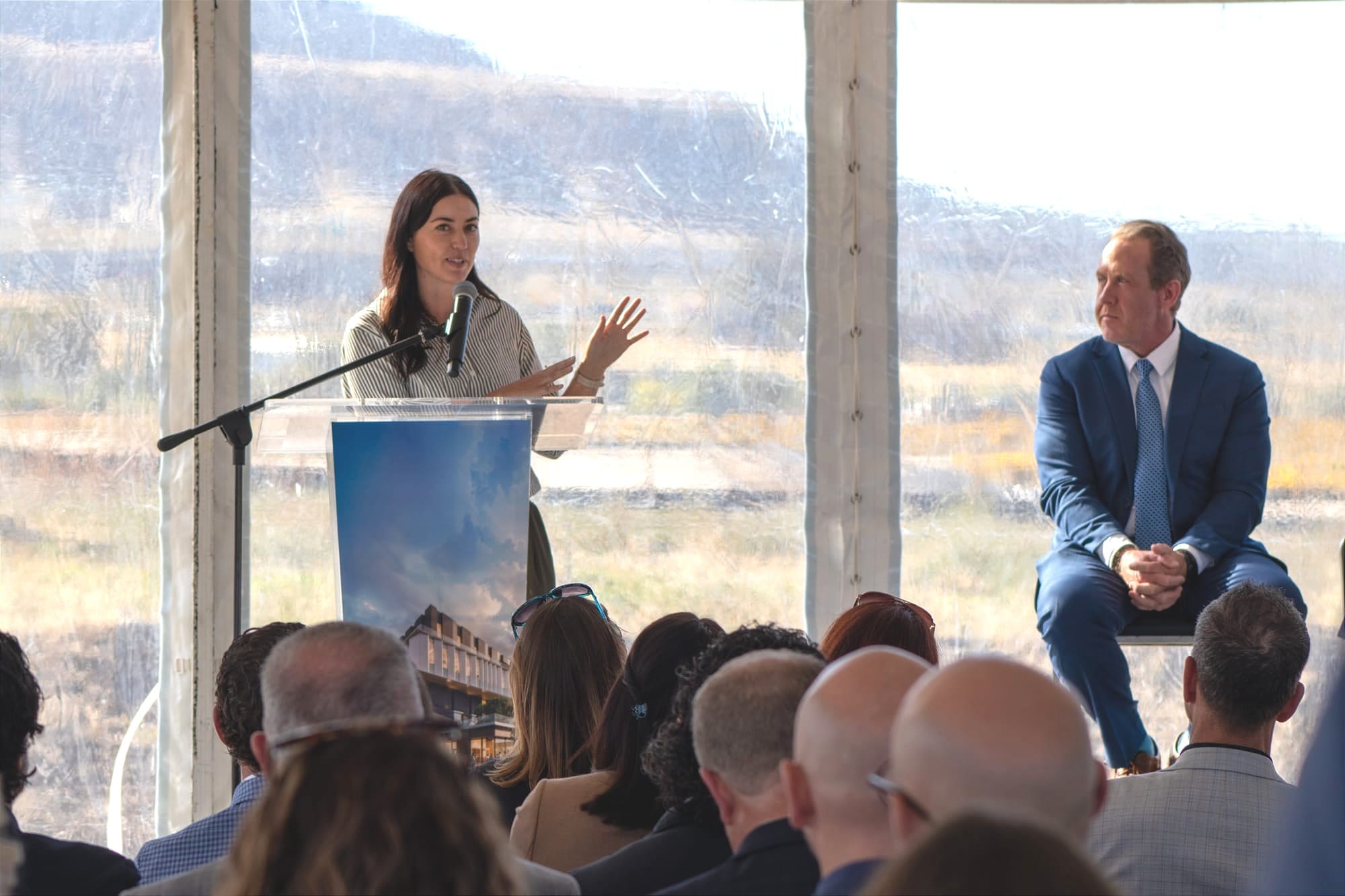
Angela Smith, Chief Operating Officer of the Nucleus Institute and Project Manager for Convergence Point, speaking at the October 1 Ground breaking of Convergence Point in Draper, Utah. Photo: Nucleus Institute
For Smith, that student experience is at the heart of why Convergence Point is being built.
The project also has a broader economic and innovation mission: to connect Utah's universities, researchers, entrepreneurs, companies, investors and government so that ideas can move more quickly from research toward commercialization and real-world impact.
More than a building
Smith described Convergence Point as an “innovation campus” designed to use innovation to solve large problems facing Utah.
The building will include Impact Labs focused on issues including housing affordability, water and air, and emerging technologies that could address problems facing Utah residents.
A significant portion of the facility will be dedicated to Innovation Entrepreneurial Hubs, providing guided programmatic support for commercializing deep-tech research as it crosses what entrepreneurs often call the “valley of death” between research and successful companies.
The campus is also planned to include prototyping resources, mentors, access to a global innovation and venture network, and event and design-thinking spaces intended to bring industry, academia and government together.
“We will take groundbreaking research happening on campuses all over Utah and also across the world, and bring them together in this building to commercialize and turn them into impact,” Smith said at the groundbreaking.
Ground breaking event of Convergence Point in Draper, Utah, October 1, 2026. Photo: Mark Tullis, TechBuzz
That makes Convergence Point different from a conventional research facility. The research itself will continue at Utah's colleges and universities. The Draper campus is intended to create a place where researchers, students, companies, investors and government leaders can encounter one another and work on problems together.
The student component is similarly intended to extend beyond the Wasatch Front.
Rather than limiting opportunities to students already located near the state's largest technology and business concentration, the concept is to bring students from throughout Utah into the building for an immersive experience.
For Smith, the idea is rooted in her own experience.
After growing up in St. George and becoming a teacher, she said living in Silicon Valley exposed her to people building technology companies and helped her recognize that she could participate in that world as well. She returned to Utah, earned an MBA and eventually moved into venture capital investing.
She said other students should not have to wait for a similar accidental exposure.
“My Why for this building is the individual lives that will be impacted,” Smith wrote following the groundbreaking. “The doors that this building will open for them.”
Connecting the pieces Utah already has
Jefferson Moss, CEO of the Nucleus Institute, has worked on the project for about five years. He said the vision was shaped by conversations with government, higher education and business leaders throughout Utah.
The project was originally known as Convergence Hall. Moss said the name was changed to Convergence Point to reflect the building's intended role as a central point within a broader “convergence corridor” stretching from Logan to St. George.
The underlying premise is that Utah already has many of the pieces needed to produce new companies, technologies and solutions.
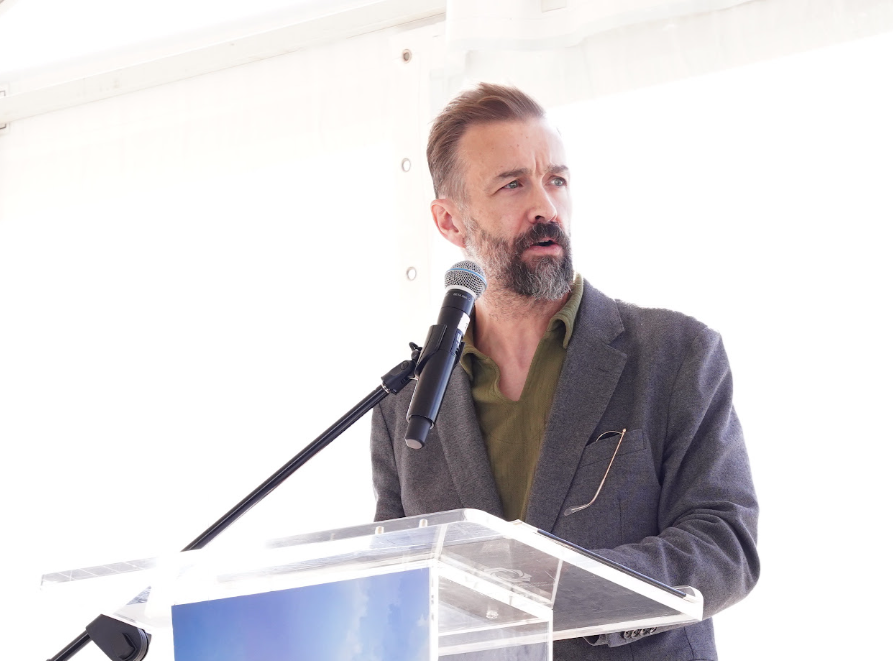
Jefferson Moss, CEO of the Nucleus Institute, speaking at the ground breaking of Convergence Point in Draper, Utah, October 1, 2026. Photo: Nucleus Institute
“We know Utah is very well suited for this. We have incredible research. ... We also have incredible entrepreneurs. ... And then I look at our policymakers,” Moss said.
Utah has universities conducting research, companies looking for solutions, entrepreneurs trying to build businesses, investors looking for opportunities and government leaders trying to address statewide problems.
The challenge, Moss said, is bringing those resources together.
“Our goal ... is to make Utah the fastest place in the country, hopefully the fastest place in the world, to be able to move ideas from discovery to impact,” he said.
The project's statewide scope is central to that effort.
Utah has 16 public colleges and universities, each bringing different areas of research, expertise and talent. Convergence Point is intended to give those institutions a common place to connect with businesses and organizations outside their individual campuses.
Cydni Tetro, (center) Board Member Nucleus Fund Investment Committee at the October 1 Ground breaking of Convergence Point in Draper, Utah. Photo: Mark Tullis, TechBuzz
Cydni Tetro, a member of the Nucleus Fund Investment Committee, said the statewide approach is one of the project's defining characteristics. “What I appreciate about what we get to do at the Nucleus Institute,” Tetro said, “is be the group that brings all of this together. For the first time, it's statewide. It's across all the important growth sectors.”
Tetro said students could participate in internships, research teams and jobs with companies working in the building, while also having opportunities to start companies of their own.
Cydni Tetro, Board Member Nucleus Fund Investment Committee, alongside members of the Utah State Board, at the October 1 Ground breaking of Convergence Point in Draper, Utah. Photo: Mark Tullis, TechBuzz
Making connections easier
Governor Spencer Cox offered a concrete example of the type of connection Convergence Point is intended to facilitate.
A researcher in Logan might be working on a problem that a company in St. George knows how to solve. A student at one of Utah's institutions might have a promising idea but need a mentor, business partner or first company to help move it forward.
“The idea that a researcher in Logan may be working on a problem that a company in Saint George knows how to solve, a student at any one of our institutions may have this incredible next idea, but needs a mentor, a business partner, or a first company to really move that idea forward,” Cox said.
Those connections happen today, Cox said. The goal of Convergence Point is to make them easier to find and faster to build.
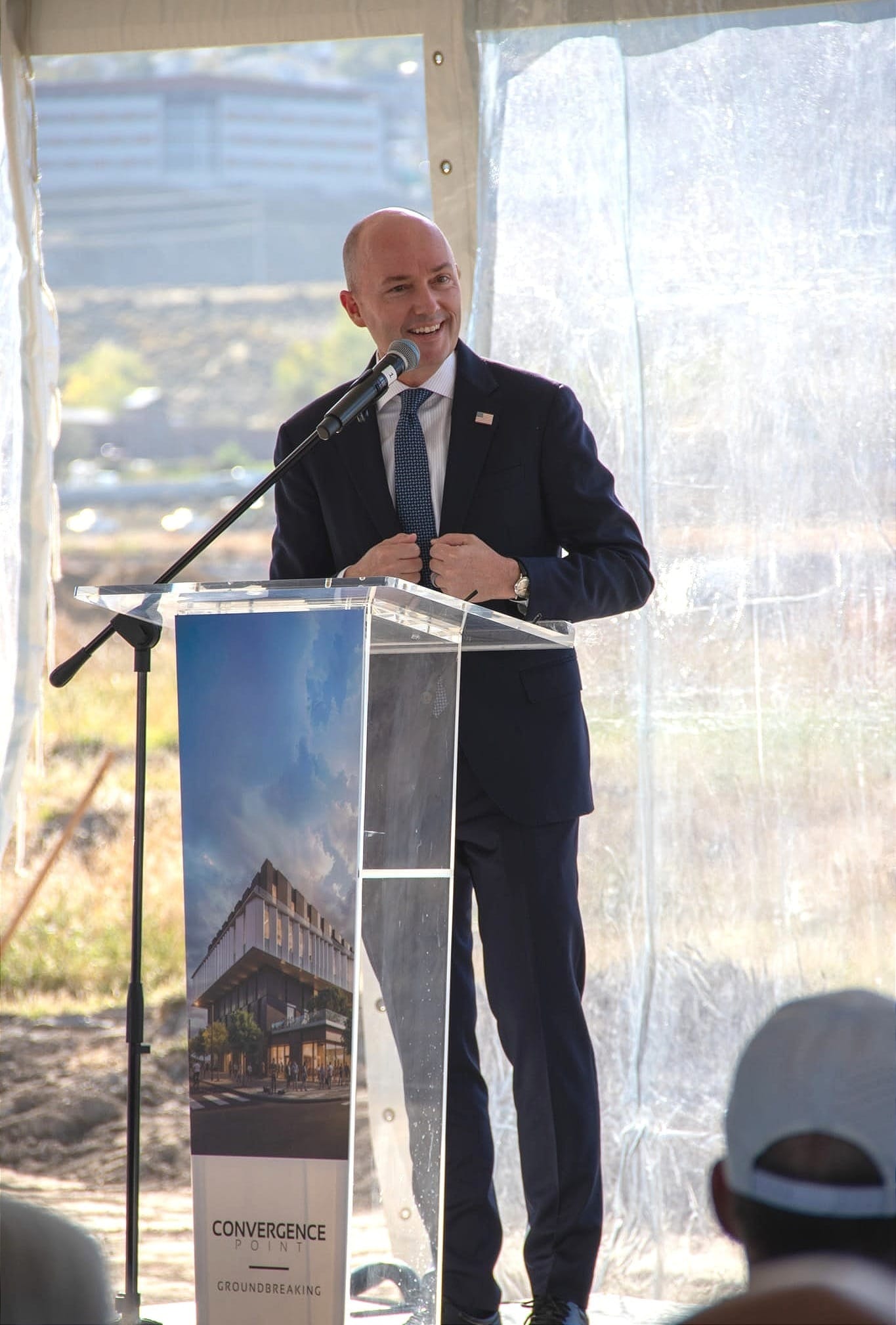
Governor Spencer Cox, addressing the audience at the October 1 ground breaking of Convergence Point in Draper, Utah. Photo: Nucleus Institute
The project grew out of visits by Utah leaders to innovation districts, universities and research centers around the country and world, as well as conversations with hundreds of Utahns about how to strengthen connections among the state's existing resources.
Cox said the physical building should give researchers, students, businesses, investors and government leaders a place to sit together and work on real problems. “The measure of our success will be what people are able to build together because this place exists,” he said.
Utah Commissioner of Higher Education Geoffrey Landward framed the idea in more scientific terms, comparing Convergence Point to a particle collider.
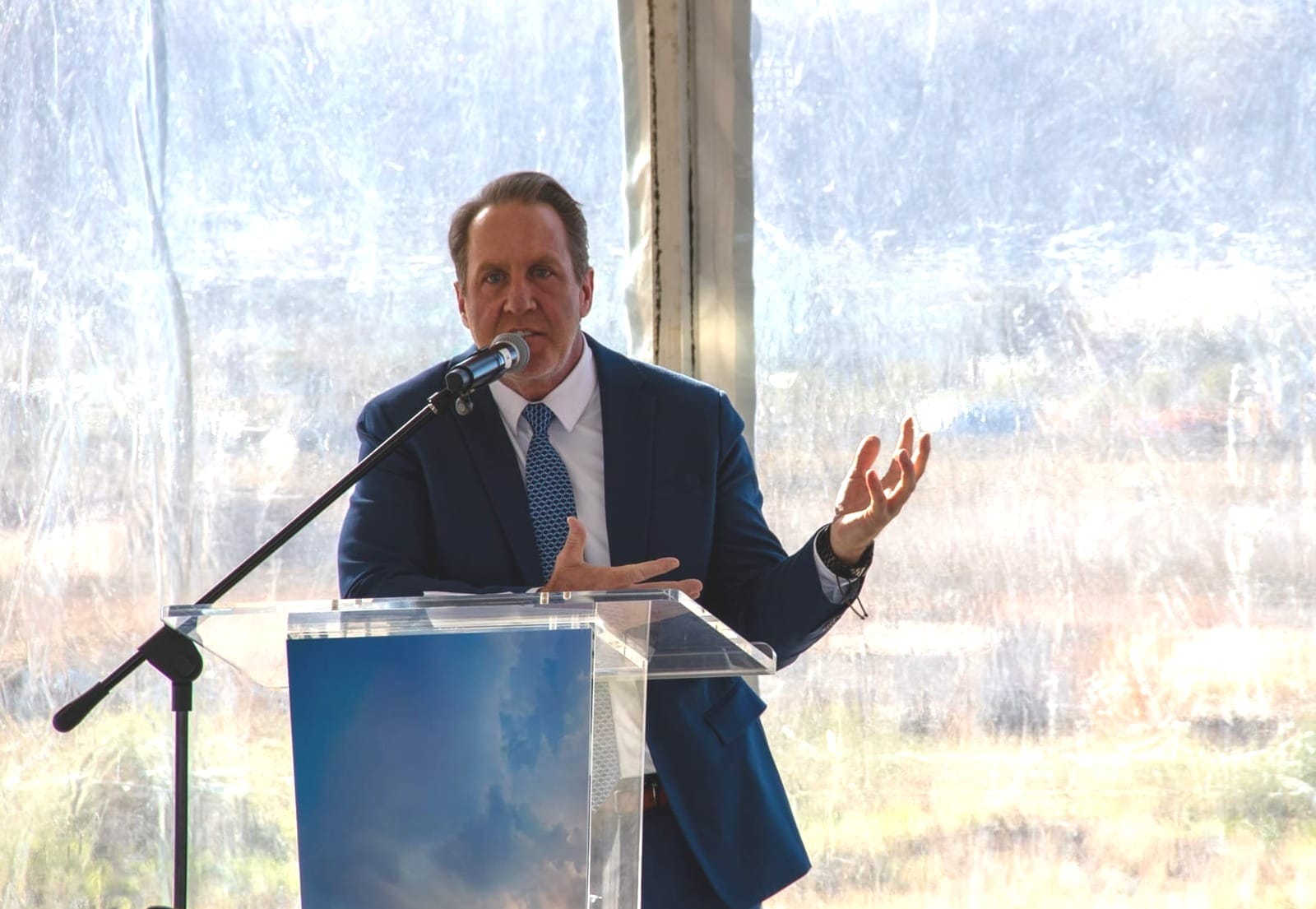
Utah Commissioner of Higher Education Geoffrey Landward speaking at the ground breaking of Convergence Point, October 1, 2026, Draper, Utah. Photo: Mark Tullis, TechBuzz
“Convergence Point is our collider,” Landward said. “Instead of particles, we're bringing together researchers, industry, entrepreneurs, institutions of higher education, students, government, and investors.”
The goal, he said, is to bring those groups, along with their ideas, research, resources and imagination, into close proximity and allow new combinations to emerge.
“Some of the businesses, the technologies, even entire industries that will shape Utah’s next 50 years haven’t been imagined yet, and I think they’ll be discovered here,” Landward said.
From research to companies
Utah House Speaker Mike Schultz described the gap between research and commercialization in similarly direct terms. “Innovation isn't just having the good idea,” Schultz said. “You have to create the idea. You have to get that idea out of the lab. You have to connect the student that has that idea with a company, with financing.”
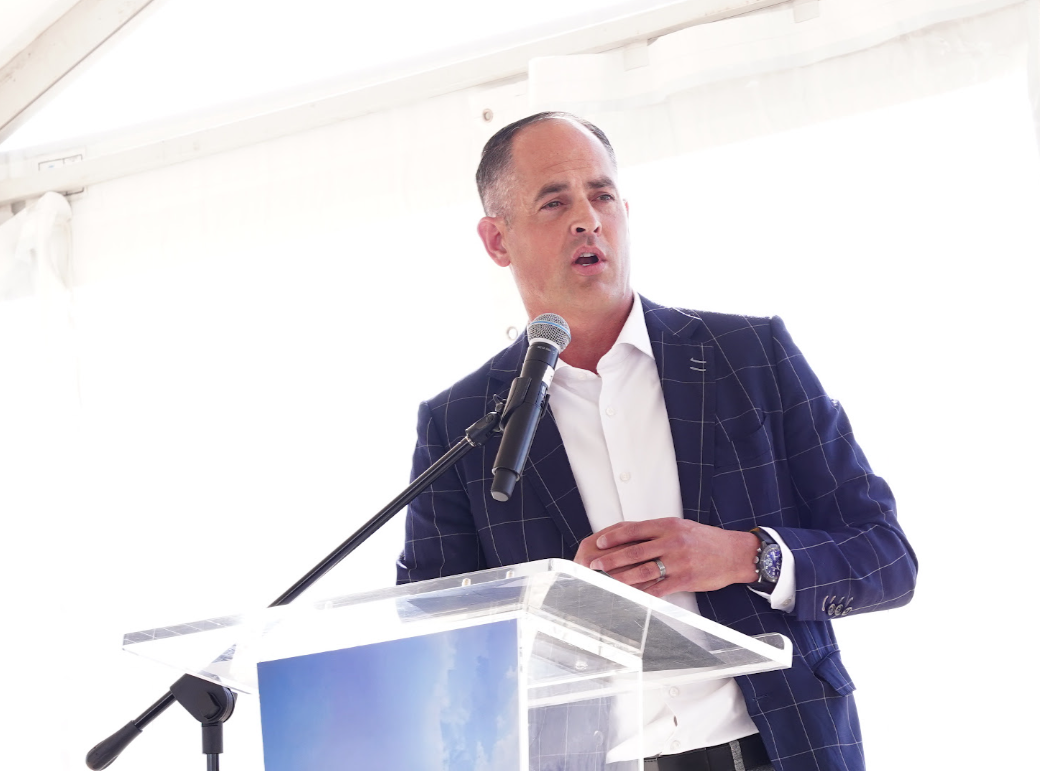
Utah House Speaker Mike Schultz, peaking at the October 1, 2026 ground breaking of Convergence Point in Draper, Utah. Photo: Mark Tullis, TechBuzz
That transition, from research to entrepreneurship, is a central reason for the project. The state Legislature provided $50 million in one-time funding for Convergence Hall in 2023. The appropriation appears in Senate Bill 2, the state's 2023 capital budget.
The Legislature later reorganized the Utah Innovation Lab into the Nucleus Institute through House Bill 530 in 2025. The legislation created the Nucleus Institute and established the structure for the Utah Innovation Fund and its investment committee.
Schultz said the state's role is to help build bridges and remove barriers while allowing entrepreneurs and businesses to take ideas forward. Nucleus Institute is coordinating the broader effort to connect Utah's higher education system with industry and commercialization opportunities.
For Senator Mike McKell, the project represents a different kind of infrastructure. “Obviously, we're going to see concrete go into the ground. We're going to see steel walls come up,” McKell said. “But what we're really building is infrastructure of ideas.” That infrastructure is intended to reduce the degree to which innovation depends on people already knowing one another.
Mike McKell, Utah State Senator, 25th District, and Majority Assistant Whip, speaking at the October 1 Ground breaking of Convergence Point in Draper, Utah. Photo: Mark Tullis, TechBuzz
A statewide innovation campus
The physical building is expected to provide space for research demonstrations, startup showcases, investor meetings, workforce programs and public events. It is also intended to serve as a showcase for Utah innovation for visitors from outside the state and internationally.
Moss said the project is designed to bring together the state's strengths in areas including artificial intelligence, life sciences, aerospace, defense, cybersecurity, energy and minerals.
Jefferson Moss, CEO of the Nucleus Institute, speaking at the October 1 Ground breaking of Convergence Point in Draper, Utah. Photo: Nucleus Institute
Cox said Utah's opportunity is not necessarily to create entirely new pieces of an innovation ecosystem, but to connect the pieces it already has. “Utah has always been a state of builders,” Cox said. “We're also a state of problem solvers.”
Convergence Point is intended to give those builders and problem solvers a place to find one another. For Smith, however, the project's ultimate measure is not simply how many companies are created or how much research is commercialized. It is whether students who come through the building discover opportunities they did not know existed.
Smith said she wants students to leave Convergence Point understanding that the technology, companies and careers they encountered there are possibilities for them, too.
Construction on Convergence Point is expected to be completed in summer 2029.
Commissioner of Education Geoff Landward, Project Manager of Convergence Point Angela Smith, Nucleus CEO Jefferson Moss, Utah Governor Spencer Cox, Utah House Speaker Mike Schultz and Senator Mike McKell turning soil at the Convergence Point ground breaking ceremony, Draper, Utah, October 1. Photo: Nucleus Institute
Share this article
The link has been copied!
Your link has expired. Please request a new one.
Your link has expired. Please request a new one.
Your link has expired. Please request a new one.
Great! You've successfully signed up.
Great! You've successfully signed up.
Welcome back! You've successfully signed in.
Success! You now have access to additional content.