Inside Tekton Design: The Orem Speaker Maker Trying to Recreate the Reality of Sound
Tekton Design (Orem, UT) has built a following for high-end speakers. Now founder Eric Alexander says a new patented technology called IRL can change how recorded sound is captured, reproduced and experienced.
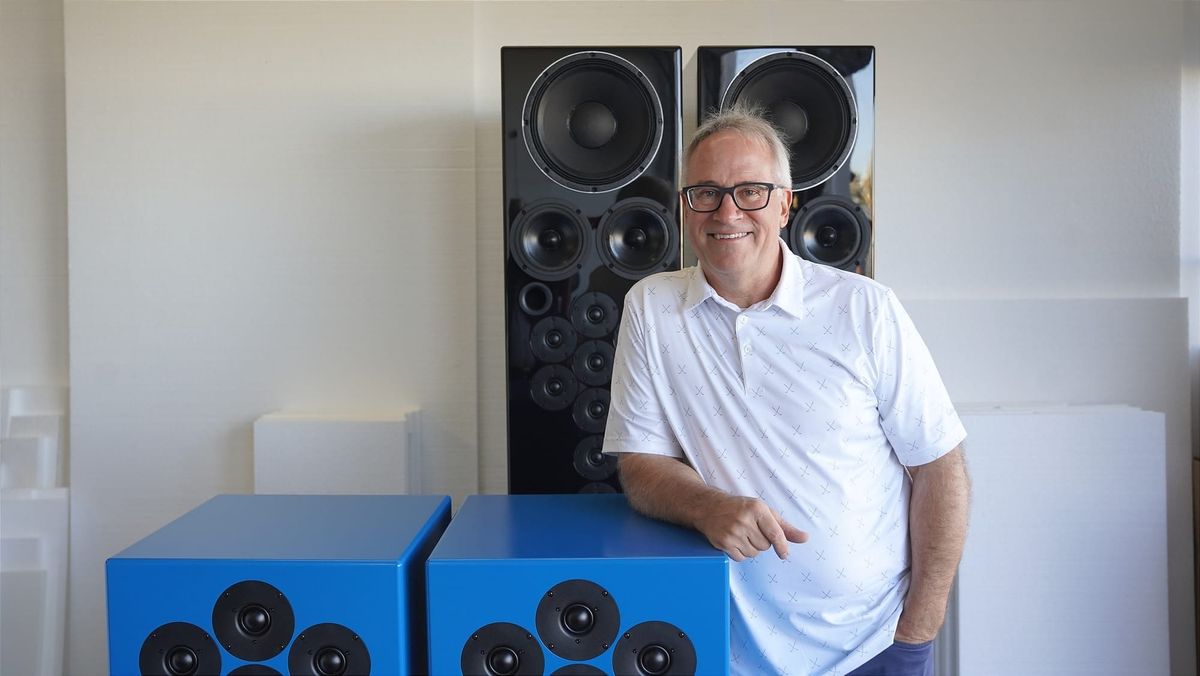
Eric Alexander, Founder and CEO of Tekton Design, at his company’s manufacturing facility in Orem, Utah. Alexander has spent decades developing high-end loudspeakers and is now pursuing a broader approach to immersive audio through his IRL technology. Photo: Mark Tullis, TechBuzz
Eric Alexander, Founder and CEO of Tekton Design, at his company’s manufacturing facility in Orem, Utah. Alexander has spent decades developing high-end loudspeakers and is now pursuing a broader approach to immersive audio through his IRL technology. Photo: Mark Tullis, TechBuzz
Orem, Utah — October 1, 2026
Walk through a crowded food court at University Place and listen for a moment. Roughly 250 people may be talking at once. Voices arrive from every direction. A chair scrapes the floor. A tray drops somewhere behind you. Music comes from overhead. Someone laughs several feet away. A conversation begins behind your left shoulder. Yet the human brain does something remarkably sophisticated: It builds a coherent three-dimensional picture of the acoustic environment.
That kind of real-world listening experience is central to what Orem speaker designer Eric Alexander, Founder and CEO of Tekton Design, says he has been trying to reproduce with a technology he calls IRL. Alexander described the University Place food court as a useful illustration of IRL’s underlying premise. It is a dense acoustic environment in which sound arrives continuously from different directions, distances and elevations.
For Alexander, the challenge is not simply making audio louder, clearer or more enveloping. It is making reproduced sound behave more like sound in the real world. That goal has occupied much of his career.
From teenage tinkerer to speaker designer
Eric Alexander began experimenting with electronics and sound as a child. He remembers spending time in the back of his elementary-school library building simple electronic devices and experimenting with speakers, switches, capacitors and inductors.
But one of the most important early influences was Kevin Heath, who lived in Alexander’s North Ogden neighborhood when he was about 14. Heath had a mobile DJ and sound business in the 1970s, one of the first in Utah, he says, and Alexander began helping him with dance competitions, stomps, and events. Alexander eventually began building his own speakers and selling them while still a teenager.
Decades later, the two reconnected. Heath recalled that Alexander invited him to his shop and gave him four speakers and a power amplifier for his home studio. “I want to thank you for getting me into the business,’” Heath recalled Alexander saying.
Heath has spent more than six decades in the music business. His assessment of Alexander is unusually emphatic. “Eric is a genius,” Heath said. “I’ve been in the music business for 64 years. He is a genius. There’s very few that can do what he does.” But the more interesting part of Heath’s observation was what he believes distinguishes Alexander’s work.
“He focuses on the ability to feel the music, not just hear it,” Heath said.
That distinction gets to the heart of an audio tech innovation Alexander calls IRL — “In Real Life.” And he has spent roughly a decade trying to make the name literal. He describes IRL as a “unifying principle of sound.” That phrase requires some unpacking. Alexander isn't simply claiming that IRL puts more speakers around a listener. He says the technology is designed around the way humans actually hear and localize sound in physical space.
"I've said, we're in the bottom of an ocean," Alexander explained to TechBuzz during one of several interviews for this story. “Our ocean is air.”
An illustration shared by Tekton Design to represent Eric Alexander's philosophy of sound. Alexander believes IRL can preserve spatial information in recordings in ways that allow listeners to perceive sound more like they would a real-world source. Source: Tekton Design/Max Stitzer
His argument is that conventional audio reproduction does not preserve enough of the information our ears use to locate sound in the real world. IRL, he says, addresses the problem beginning with how sound is captured and continuing through how it is reproduced. The argument goes beyond speaker placement. He says conventional recording and playback can discard information about how sound behaves in the real world, information he estimates can amount to roughly 30% of what was present in the original acoustic event.
The problem Eric Alexander says he couldn't solve with better speakers
Eric Alexander has spent decades developing loudspeakers. His work has included patents, custom speaker systems and recognition from high-end audio publications. But he eventually concluded that continuing to improve the speaker itself would not solve the larger problem. The turning point came after rehearsing with a band as a professional drummer.
After a session, Alexander went home expecting his high-end stereo system to reproduce some of what he had just experienced in the rehearsal room. Instead, he found the recorded music technically impressive but fundamentally different from the live experience.
“I have to be the guy that fixes this,” Alexander recalled. “I want to be the guy that fixes this.”
That realization sent him down a path that eventually moved beyond conventional loudspeaker design. Around 2015 he began conceptualizing his “unifying principle” of audio: the possibility of recording an acoustic event and reproducing it so that the listener experiences the same spatial relationships that existed in the original environment.
Alexander argues that conventional stereo recordings do not preserve everything that reaches a listener in a live environment. He has developed patents and signal-processing techniques intended to identify and reconstruct what he believes is missing.
One of his more consequential claims is that a significant amount of acoustical information (he estimates it at approximately 30%) is lost during recording and production. His solution, he says, is not simply to add more speakers. It is to use information contained in a conventional recording differently.
“The stereo mix contains what’s missing,” Alexander explained. “I know what’s missing, and I know how to basically unfold that and re-represent it, and that’s what we are doing with IRL.”
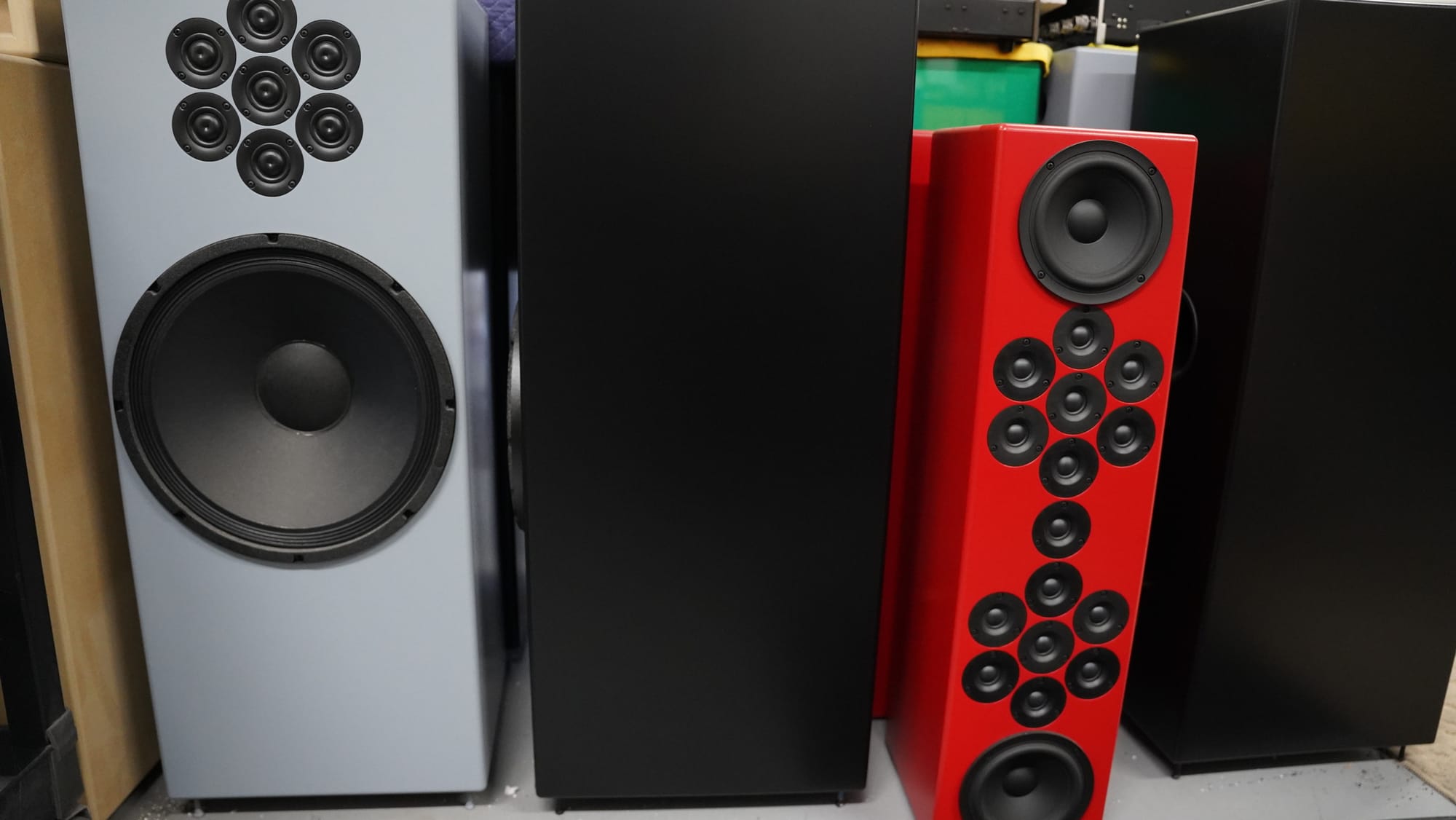
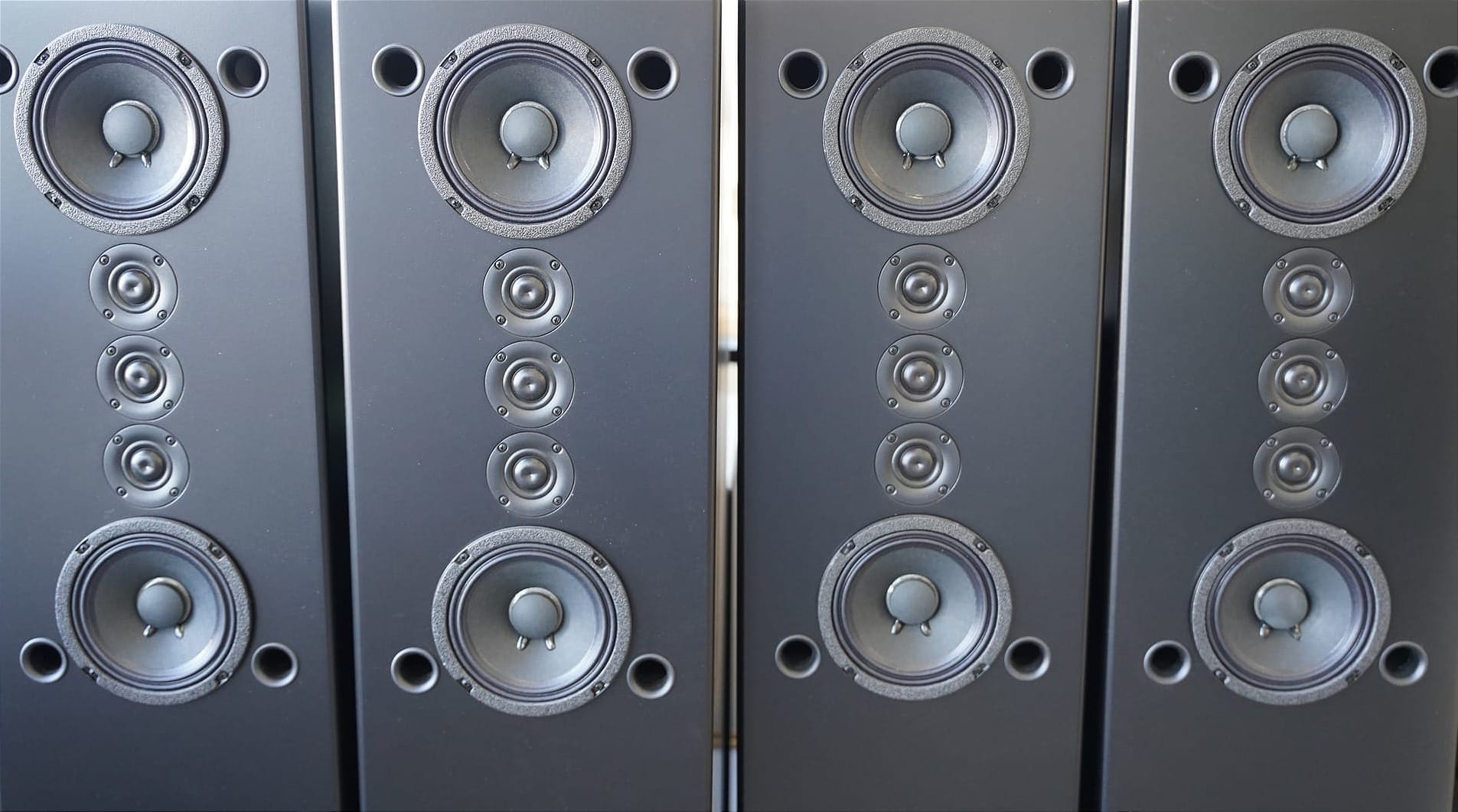
Assorted completed Tekton Design speakers at the company's Orem manufacturing facility. Photo: Mark Tullis/TechBuzz
Hearing sound in three dimensions
That distinction became apparent during a demonstration. Alexander recently invited TechBuzz for a demonstration in Tekton's Orem manufacturing facility. In the demonstration room, he illustrated the idea using recordings of aircraft and trains. The train track becomes a kind of infinite horizontal stage. As the recorded train approaches, the apparent size and intensity of the sound change. As it passes, the sound expands and then recedes. The result, at least from my listening position, was difficult to describe in the conventional language of left, right and center. The sound didn't simply seem to come from another speaker. It seemed to occupy space and move seamlessly across a plane.
On one Singers Unlimited recording, the dense vocal harmonies of Michelle (originally written by Paul McCartney and John Lennon) seemed unusually separated and at the same time seamlessly connected and unusually well-defined.
On a Freddie Hubbard recording, I noticed details in Hubert Laws' flute solo and subtleties of Ron Carter's bass playing that I had not consciously noticed in decades of listening to that specific album, Super Blue.
A Fleetwood Mac recording of Dreams produced another surprise: individual drum elements seemed unusually clear and distinct and placed in a specific location rather than collapsing into a familiar mushy mixture of each member of the rhythm section that I was used to hearing with that track from previous sound systems, even expensive ones. Stevie Nicks' vocals seemed especially clear and had a fixed location in front of me, right at about one o'clock.
Those observations are subjective, of course. But they were consistent enough across recordings to make the demonstration difficult to dismiss as simply “more speakers.”
The most striking examples remained the ones involving movement. A shockingly realistic recording of an F-35 seemed as if the aircraft was passing overhead. Similarly, a recording of a train approached from the side, grew in apparent size and then receded across an acoustic field, all around and in front of me.
In conventional surround systems, a sound can be deliberately positioned in a particular speaker or channel. Alexander's goal is different: to reproduce the acoustic cues that tell the brain where a sound actually exists. Alexander argues that IRL is designed to preserve and reconstruct those relationships. “The magic of it is in the recording,” he said during the demonstration, rather than simply in the equipment used for playback.
“You feel and live his sound”
Heath described how he experienced an early IRL demonstration about a year and a half ago. He remembers hearing a recording of a rainstorm. “The rain was falling, and falling, then harder. I felt like the rain was falling on me. Felt like I was getting wet,” he said.
Then he heard a bird to one side and a distant train horn somewhere else, far way, in the acoustic field. “It’s around on every degree,” Heath said, describing the experience in his own terms. “You feel and live his sound, where most you hear.”
Heath also sees another part of Alexander’s approach as important: reducing the amount of hardware required to create a convincing spatial experience. He recalled seeing ultra-expensive high-end audio systems throughout his career and wondering why someone would need millions of dollars of equipment to listen to a high fidelity recording when a superior experience can be found much less expensively.
His conclusion about Alexander’s work was that Alexander had effectively “compressed” the ultra high-end audio experience into a much smaller system. “He’s compressed it down so you can feel it,” Heath said. His simplest description was also his strongest: “All I can say is that with Eric's technology, you feel the music, you live it. You don’t just hear it.”
That is essentially the promise Alexander is making with IRL.
When the room becomes part of the instrument
My experience at Tekton was not unique.
Russ Sorensen has known Alexander and his speakers for years. Alexander says Sorensen has "a golden ear, the best in the state." Sorensen has worked for 25 years as the concert technician for the Utah Symphony, working closely with renowned concert pianists. He spent two decades as head technician for Daynes Music in Salt Lake City and trained at the Steinway factory in New York. He now specializes in preparing Steinway concert models D and B and sells/refurbishes high-end used professional pianos.
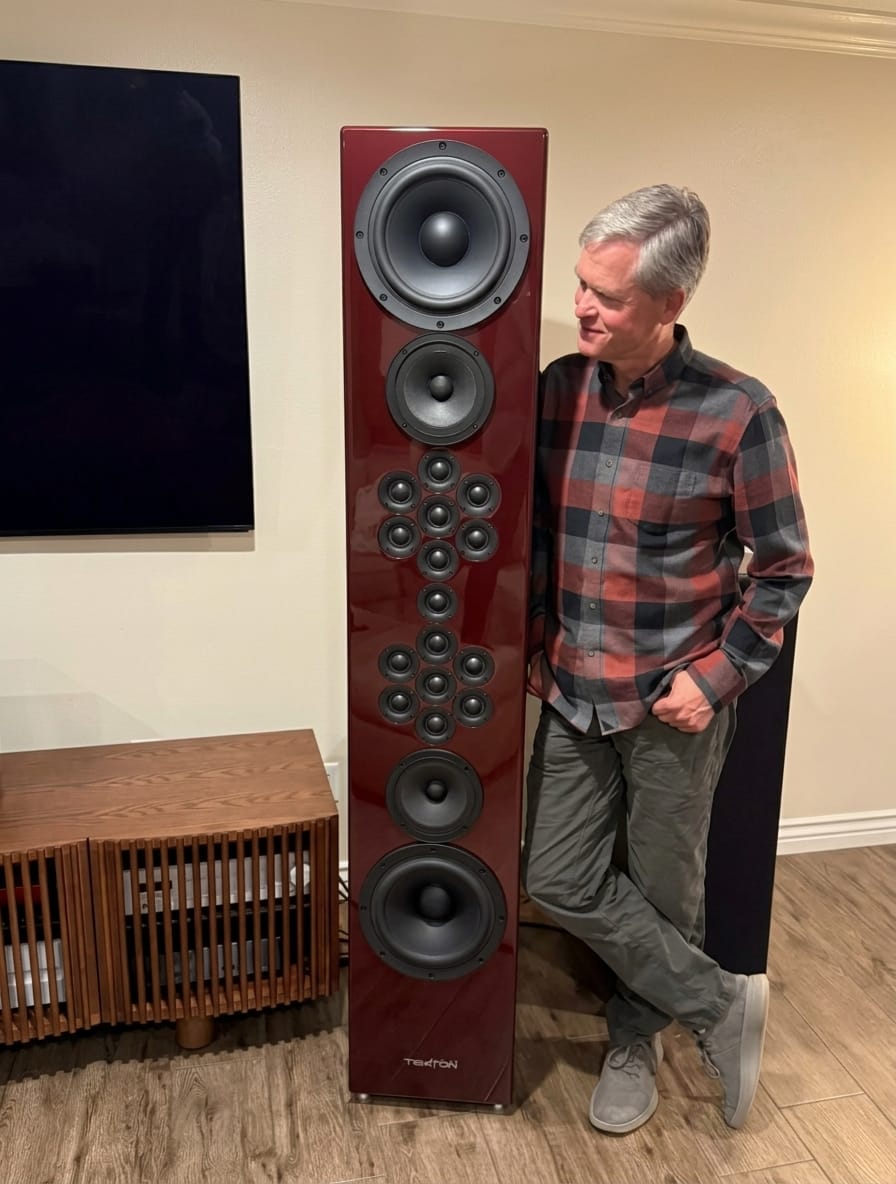
Russ Sorensen, Founder of Serious Pianos, and lead piano tuner for the Utah Symphony, in his home standing next to a custom-finish Tekton Symphony line of speakers.
Sorensen, Founder of Serious Pianos, is a career piano technician who specializes in concert grands. He approaches sound from a somewhat different direction than Alexander does. His work is not primarily about electronics or speaker engineering. It is about listening closely enough to understand what a piano is actually doing.
When Alexander introduced him to IRL more than two years ago, Sorensen brought his father-in-law to the Tekton facility in Orem to hear it. Sorensen said both men burst into tears because of the unexpected intensity of the experience. “It’s just a very emotional response to it,” Sorensen said.
He also said the difference became particularly apparent with acoustic music.
“Rock music and jazz sound really good on stereo, and yet genres that are more acoustic, like an orchestra, solo piano, organ, don't necessarily sound quite as good,” he said. “I think IRL has solved that problem. Suddenly, those things sound really good.”
That observation connected with something I had heard in the Tekton room. Sorensen had a similar reaction. He pointed to the way sound behaves in a large space such as the Tabernacle at Temple Square in downtown Salt Lake City: reflections arrive from above, behind and from the sides, becoming part of the listener's experience of the instrument.
“When you experience music in a space such as the Tabernacle, a cathedral, or a concert hall, the space creates the acoustic necessary for that kind of music. For the first time, IRL recreates the immersive sensation of being in that type of space. It’s like Real Life!” said Sorensen.
Sorensen also noticed something different in the bass response, describing it as something he could physically feel rather than simply hear. He said he did not yet understand exactly how Alexander was accomplishing it.
That distinction is important. Sorensen is not presenting himself as an engineer who has independently verified Alexander's patents or technical explanations. In fact, he readily acknowledges that he is not a “techie.” What he can describe is what happens when he sits in the listening position. The thing that astounds me is that Eric is doing things with sound reproduction that no one else has done,” Sorensen said. “Or at least they haven’t taken it to this extent.”
There is another development that may matter even more to the future of IRL. When Sorensen first encountered the technology, Alexander was making specialized four-channel recordings. More recently, Sorensen said, Alexander developed a way to take a conventional two-channel stereo recording and process it for IRL playback. “That’s what’s breaking this open,” Sorensen said. “Because it makes it accessible to what most of us do with stereo.” That changes the potential scope of the idea.
A new recording technology that requires an entirely new catalog of music faces one set of challenges. A system that can work with the enormous library of existing stereo recordings faces another.
Alexander told me that existing recordings can be remastered for IRL. Sorensen's account suggests that moving from specially captured IRL recordings toward conventional stereo material is already part of the technology's development.
That also provides a more practical test of Alexander's larger claim. If IRL is intended to change the way people experience recorded sound, it cannot depend entirely on recordings made specifically for IRL. It eventually has to demonstrate that the technology can do something different with the music people already know.
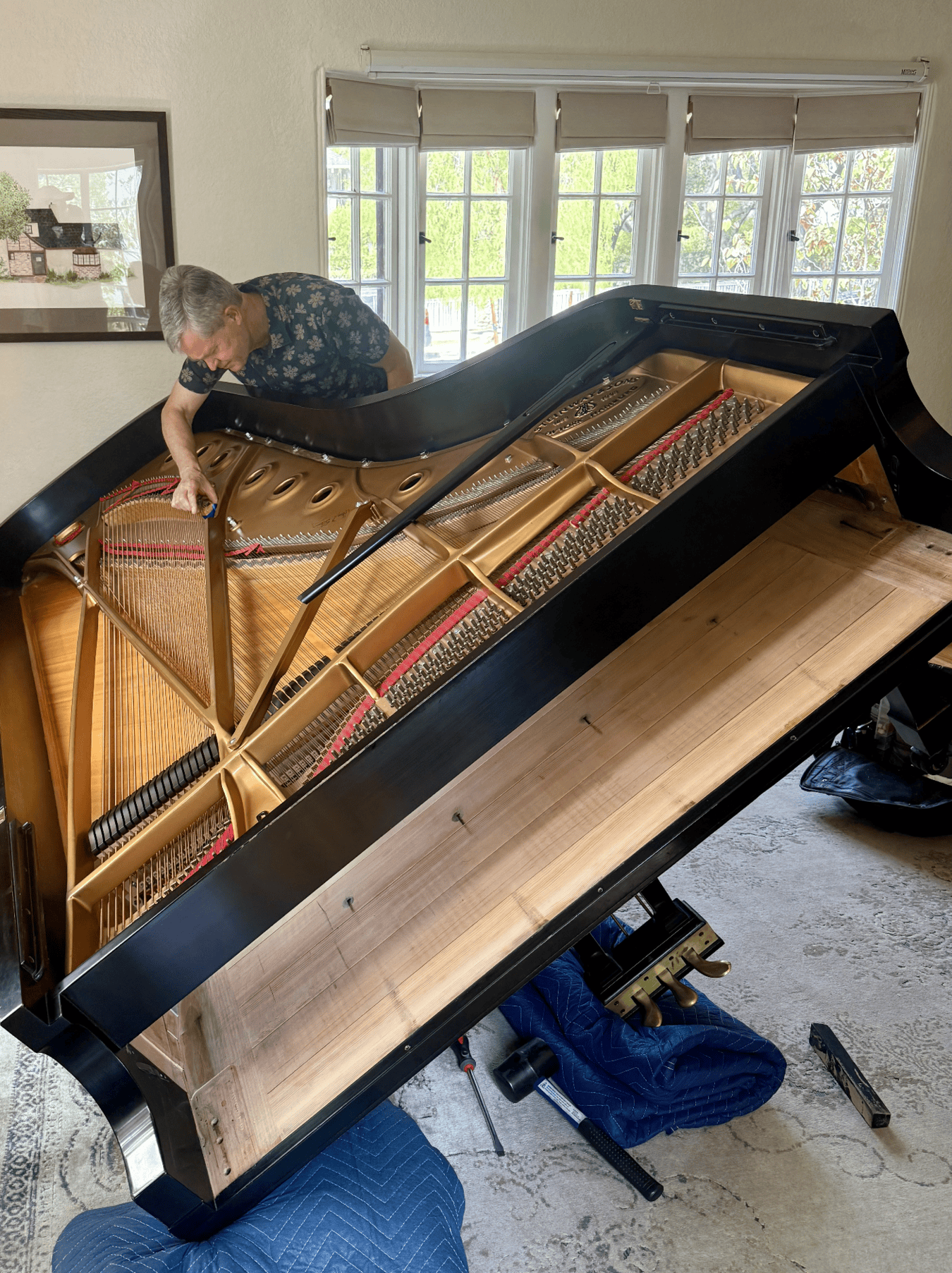
Russ Sorensen, lead piano tuner for the Utah Symphony, works on a grand piano. Sorensen, "the man with the golden ear," according to Eric Alexander, is a longtime piano technician. He has been testing Eric Alexander's IRL audio technology on his own Tekton speakers. Photo: Russ Sorensen.
That is what happened when Sorensen and I listened to familiar recordings in Alexander's shop. We were not hearing music we had never encountered before. We were hearing recordings we already knew, and knew well; we noticed things we had not noticed before.
For Sorensen, as someone who has spent decades listening to pianos, organs, orchestras and other fine acoustic instruments, the question is not simply whether a system can sound impressive. It is whether the reproduced sound behaves enough like the real thing that the room, the instrument and the space around it once again become part of the experience.
That is the problem Alexander has spent most of his life trying to solve.
From a speaker company to something bigger
Tekton Design, based in a modest warehouse in Orem, remains a speaker company, building roughly 1,000 to 2,000 speakers a year. Tekton's lineup spans a wide range of full-range loudspeakers, from models such as the roughly $1,000 Lore to increasingly elaborate designs including the Double Impact, Moab, Symphony, Encore, Ulfberht and the flagship 1812 Model V12, which sells for $14,000 a pair.
Assorted completed Tekton Design speakers at the company's Orem manufacturing facility. Photo: Mark Tullis/TechBuzzPhoto: Mark Tullis/TechBuzz
The company also builds speakers designed around low-powered single-ended-triode tube amplifiers, including the Perfect SET line, and offers home-theater configurations and other specialized products.
The common thread is Alexander's emphasis on high-sensitivity, direct-radiating designs and proprietary driver arrays. It is an engineering philosophy that predates IRL and helped establish Tekton's reputation in the high-end audio market.
The company does little conventional marketing; much of its audiophile customer base discovers Tekton through word-of-mouth and the reputation of its technology. Tekton continues to build conventional high-end loudspeakers, including custom systems with specialized finishes, such as a high gloss black that matches a Steinway grand piano, for particularly demanding customers. But IRL could represent a significant new direction for the business.
Alexander believes the underlying technology could eventually apply beyond home audio, including film, music production and other applications in which the spatial character of sound matters.
Alexander has demonstrated IRL to is Tim Leishman, a longtime BYU acoustics researcher who earned a Ph.D. in acoustics from Penn State and taught physics and acoustics at BYU from 2000 to 2021. Currently he is Principal Acoustical Researcher at the Institute for Scientific Research in Music in Massachusetts. Leishman specialized in the measurement, modeling and control of sound fields and oversaw the construction of BYU's Accoustics Research Group. Alexander says Leishman's reaction to the demonstration was striking: "That's the most remarkable thing I've heard."
Alexander also demonstrated the system for KSL movie critics, who had spent years evaluating high-end cinema experiences. He says their reaction reinforced his belief that IRL represents something fundamentally different from conventional surround sound.
The commercial question now is whether the technology can move from a compelling demonstration into a repeatable platform. That could mean new recording techniques, licensing the underlying technology, partnerships with established audio companies or applications in film and entertainment.
Alexander has talked openly about the possibility of licensing the technology if a major technology or audio company sees its potential. For now, however, the system remains closely connected to the Orem workshop where he has spent decades refining loudspeakers.
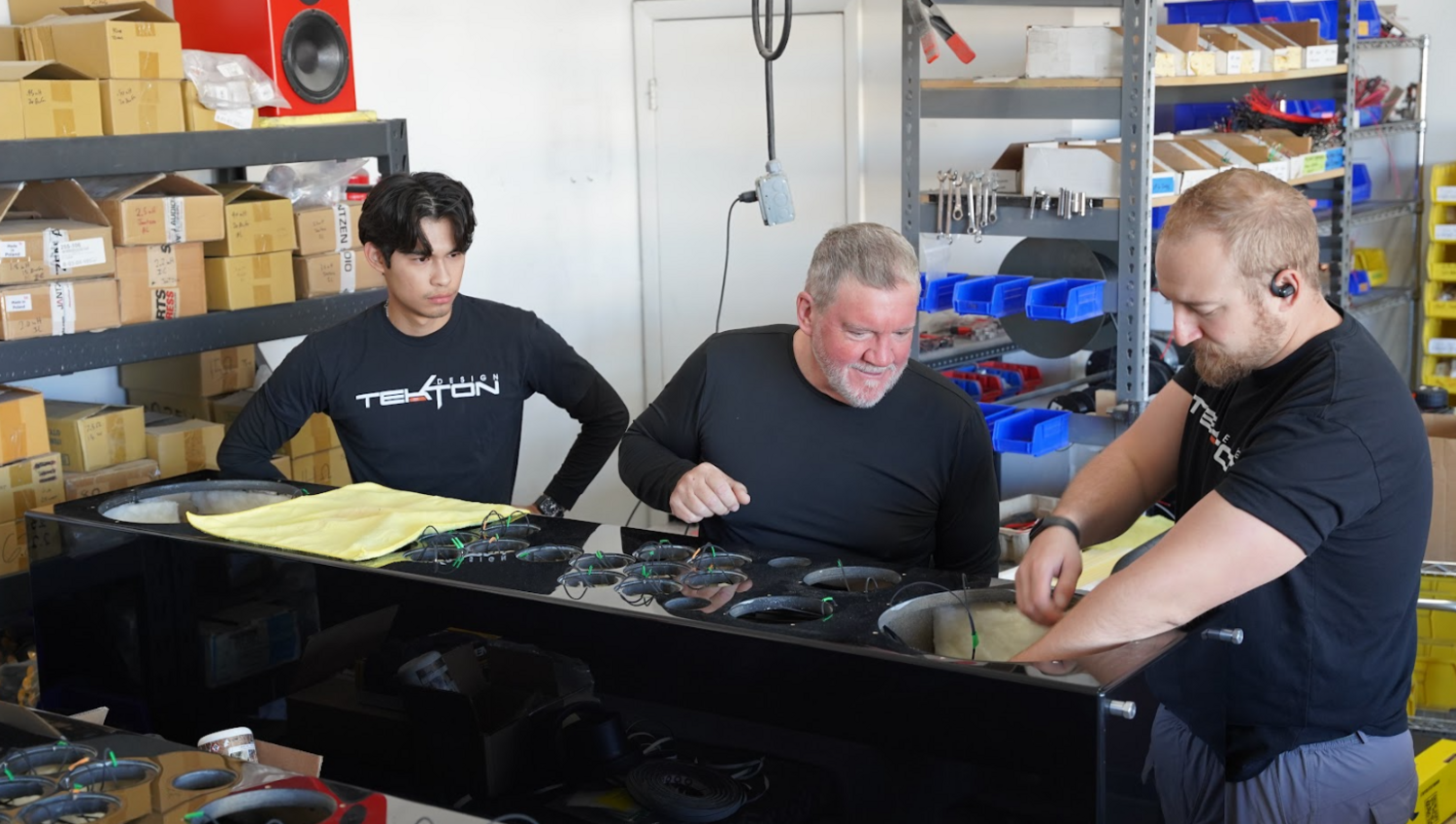
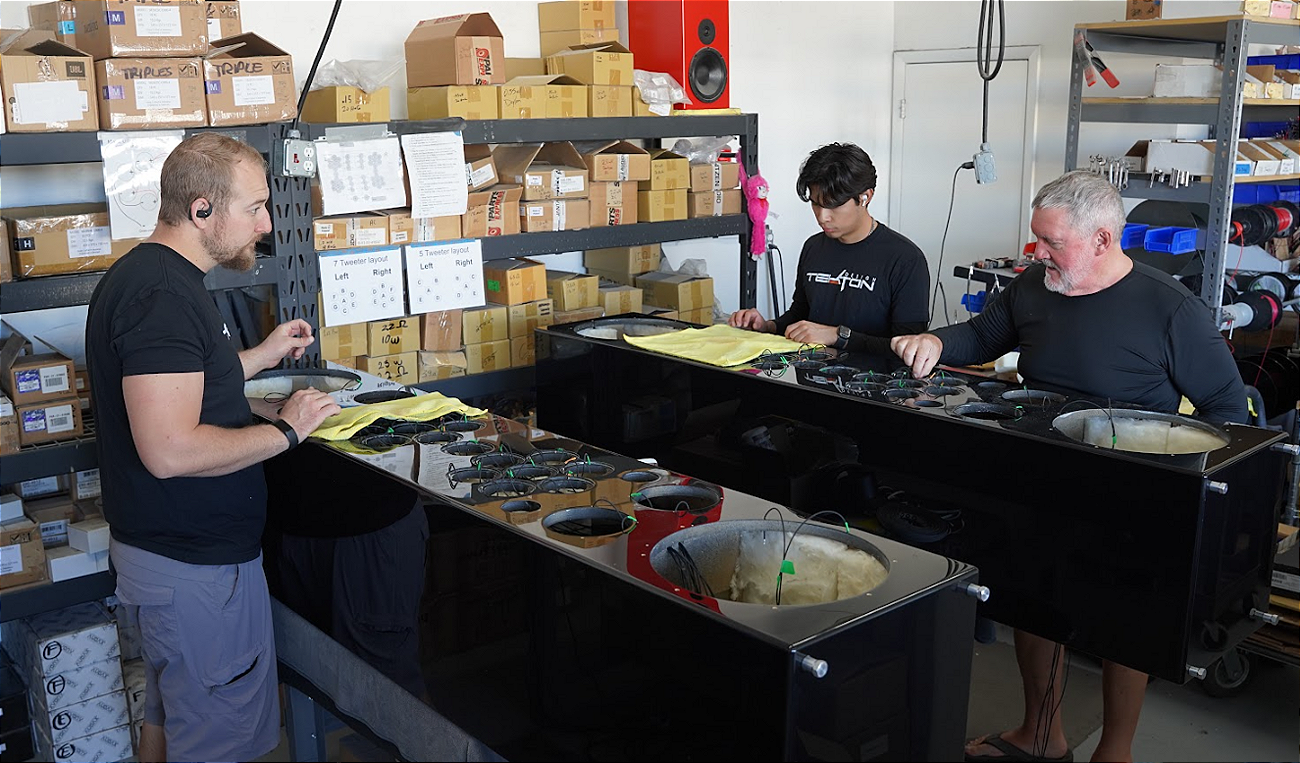
Chuck Miller traveled from Limestone, Tennessee, to Orem in his RV to closely watch his custom high gloss flagship speakers being built by hand by Tekton engineers Ian Rodriguez and Alex Honaker. A longtime Tekton customer, Miller previously bought a pair of the company's Moabs after discovering the Utah manufacturer through audiophile forums. Chuck Miller: “I’ve heard speakers that cost far more than these things, but I’ve never heard anything that sounded better at any price.” Photo: Mark Tullis/TechBuzz
Chuck Miller, a retired audiophile from Limestone, Tennessee, drove his RV to Orem to observe the finishing touches of a new pair of top-of-the-line Tekton speakers that he ordered with a high-gloss black finish. For Miller, the trip to Orem was part of a retirement bucket-list project: traveling the country in his RV and listening to some of the high-end audio systems he had previously only read about. Miller has immersed himself in high-end audio enough to seek out expensive systems around the country. He keeps coming back to a relatively obscure speaker maker in Orem, Utah to find his ultimate audio set up.
“It’s the technology that Eric's using in this array,” explained Miller. “Most people look at it and just think, ‘Oh, they’re just using a lot of speakers.’ But there’s more sophisticated technology going on in that array and in the design of the whole speaker than people realize.”
Six years ago Miller bought a pair of Tekton Moabs after discovering the company through online audiophile forums. Since then, he has traveled to audio shows and visited high-end systems around the country, including systems costing far more than his Tektons. “I've heard speakers that cost far more than these things,” Miller said. “But I've never heard anything that sounded better at any price.”
Tekton Design welcomes customers to visit the manufacturing facility in Orem to see how their speakers are being built meticulously by hand. Chuck Miller (right) traveled from Tennessee in an RV to Orem (and to a handful of national parks in the area) to view the finishing touches on his latest Tekton Design speakers. He is pictured here with Alex Honaker (left) and Ian Rodriguez. Photo: Mark Tullis/TechBuzz
The real-world test
Alexander’s food-court example offers an interesting way to understand what he is attempting. Nobody walking through a crowded food court thinks about “surround channels.” The environment simply exists. Sound comes from above, below, behind and beside you. Some sources are close. Others are distant. Some are loud. Others are barely audible. The brain continuously interprets those differences without requiring a speaker in every location.
That is the phenomenon Alexander is chasing.
His argument is that recorded audio has historically been engineered around the limitations of the playback system. IRL, he says, reverses that relationship: preserve and reconstruct the spatial information, then let the playback system reproduce it. After spending most of his life figuring out how to build better speakers, Alexander now believes the bigger breakthrough may have less to do with the speakers themselves. It may be about recovering the environment that existed around the original sound. And that is why, for Eric Alexander, the goal is not simply to hear music. It is to feel like you are there.
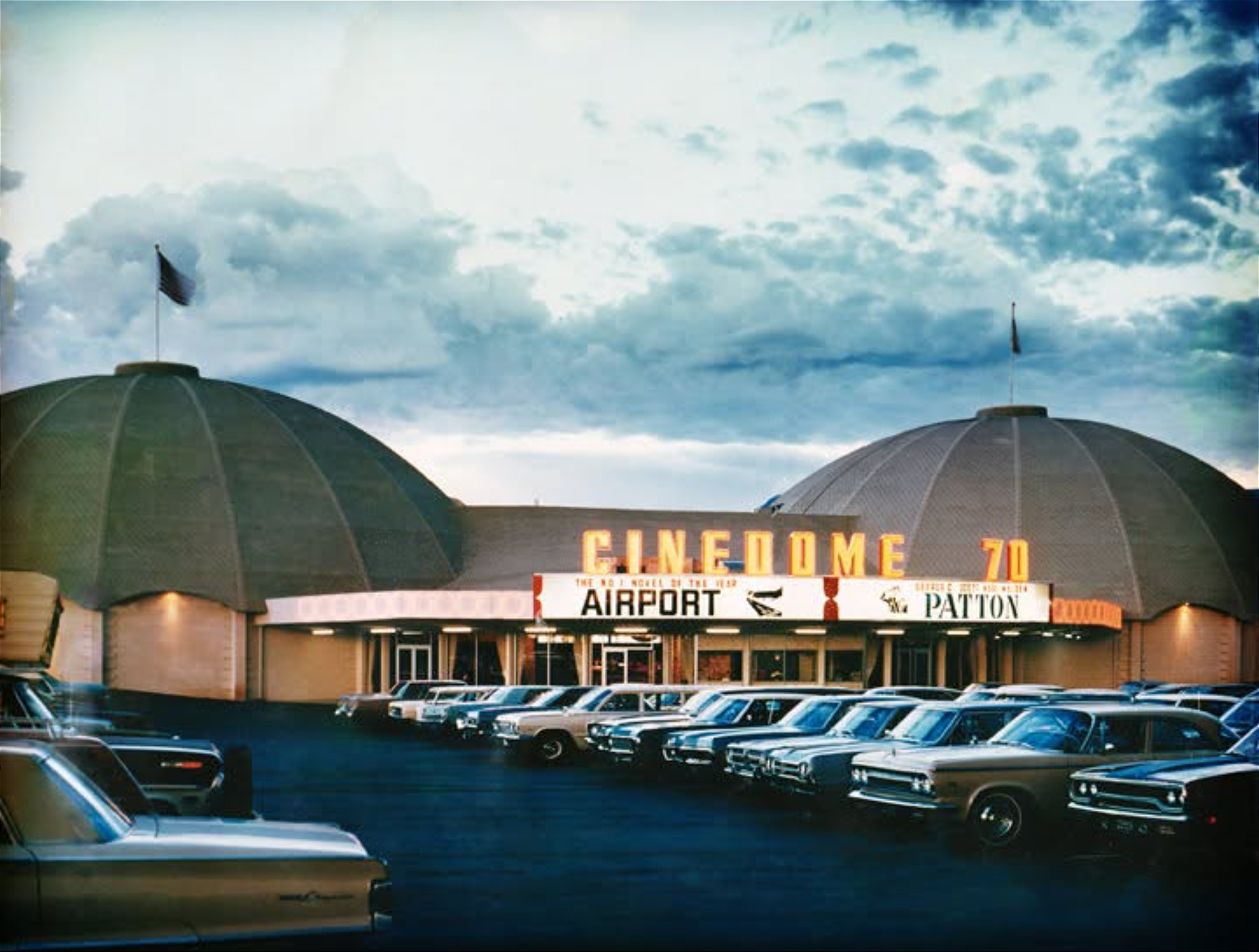
Editor’s Note: While discussing his novel sound technology with Eric Alexander, we discovered a shared connection: we both grew up in Ogden, Utah. Alexander fondly recalled the iconic Cinedome 70 theater in nearby Riverdale—the site of some of his formative acoustic experiences. As it happens, my parents, Darrell and Nancy Tullis, operated the Cinedome, and I grew up working there. In 1974, we installed Sensurround for the premiere of Earthquake, using low-frequency bass horns and high-power amplifiers to create low-frequency vibrations that moviegoers felt as much as heard. For Alexander, that visceral experience left a lasting impression, sparking a lifelong quest to bridge the gap between reproduced audio and live acoustic reality—a pursuit that ultimately led to the creation of IRL.
Cinedome 70, Riverdale, Utah, June 1970 - Photo: Nancy Tullis
Share this article
The link has been copied!
Your link has expired. Please request a new one.
Your link has expired. Please request a new one.
Your link has expired. Please request a new one.
Great! You've successfully signed up.
Great! You've successfully signed up.
Welcome back! You've successfully signed in.
Success! You now have access to additional content.