Notorio Brings Company Formation, Legal Documents, Cap Tables, and AI Into One Platform
Notorio founder Leo Lupiano wants to simplify the legal and administrative work of building a company. The platform combines formation services, registered agent support, cap table tracking, document management and AI-assisted workflows.
Leonardo Lupiano, founder of Notorio and an entrepreneur in residence at Utah Tech University, works on the company's business-management platform. Lupiano, who is completing his law degree at UNLV's William S. Boyd School of Law, founded Notorio to simplify company formation and the legal and administrative work involved in running a business. Photo: Leo Lupiano
Leonardo Lupiano, founder of Notorio and an entrepreneur in residence at Utah Tech University, works on the company's business-management platform. Lupiano, who is completing his law degree at UNLV's William S. Boyd School of Law, founded Notorio to simplify company formation and the legal and administrative work involved in running a business. Photo: Leo Lupiano
St. George, Utah – November 4, 2026
Starting a company can be relatively straightforward. Keeping its legal and administrative affairs organized is another matter.
A founder might use one service to file formation documents, another for registered agent services, a third to manage a cap table, and still others for invoicing, electronic signatures and document storage. Important records can end up scattered across cloud folders, email accounts and spreadsheets. When a company needs to locate an operating agreement, confirm ownership or retrieve a signed contract, finding the right document can become an exercise in digital archaeology.
Notorio is designed to bring much of that work into one platform.
The company offers business formation, registered agent services, a digital mailbox and tools for managing company records, documents, invoices and ownership information. Its latest platform also incorporates AI-assisted document drafting and company information retrieval, along with workflows intended to keep records connected to the people and entities they concern.
The target customer is an early-stage company that wants to keep operations lean without neglecting the legal and administrative foundations it will need as it grows.
“We looked at what was required from the get-go and just decided to bring everything together,” said founder Leo Lupiano in an interview with TechBuzz.
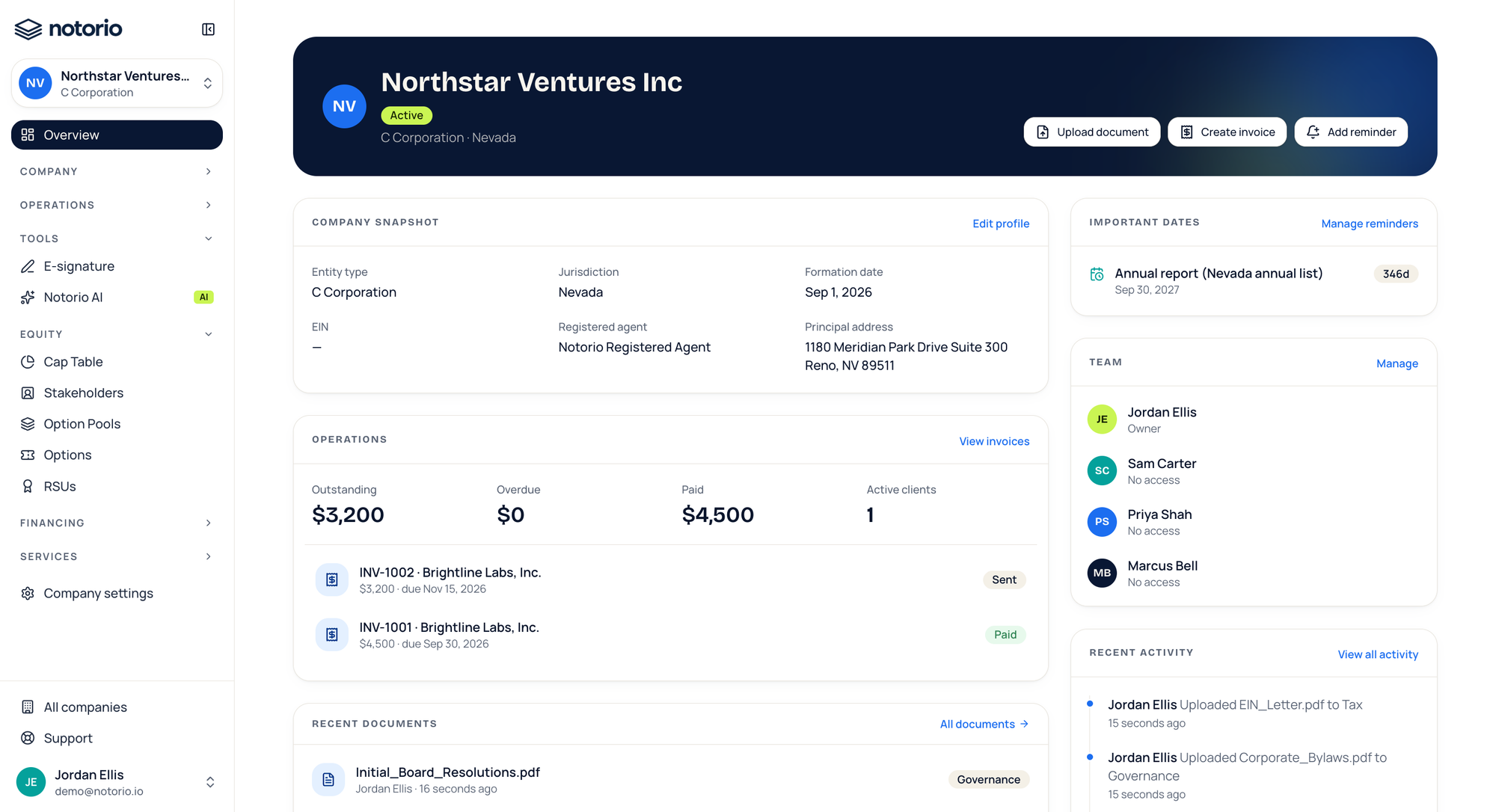
Notorio’s company dashboard brings business records, compliance reminders, invoices, documents, team information and ownership-management tools into a single interface. The platform is designed to give founders a centralized place to manage the administrative and legal functions of their companies. The dashboard shown uses sample company data. Graphic: Leo Lupiano
From startup experience to legal technology
Lupiano's path to Notorio began with an interest in entrepreneurship and an understanding that he eventually wanted to study law. He started his career as a student at Utah Tech University, working at the university's Atwood Innovation Plaza. The experience put him alongside early-stage founders and gave him a close look at the practical challenges of building a company. One of the startups he encountered there, Trula, eventually hired him.
Lupiano entered law school in 2024, enrolling at the William S. Boyd School of Law at the University of Nevada, Las Vegas. He saw an opportunity to bring his startup experience together with the business and legal concepts he was studying.
Conversations with professors and entrepreneurs helped him identify a problem worth addressing. Some founders were considering alternatives to Delaware for incorporation, while international entrepreneurs were trying to understand how to establish U.S. business entities. At the same time, Lupiano remembered the difficulty of getting basic company documents from founders who had misplaced them or stored them in folders they could no longer locate.
The result was the idea for a centralized legal and business-management platform.
Lupiano also maintains a connection to Utah Tech. Earlier in 2026, after reconnecting with Aaron, the director of the university's Innovation Plaza, he was invited to serve as an entrepreneur in residence. He travels to St. George to participate in events and advise students and entrepreneurs.
His interest in the legal environment for startups has also appeared in TechBuzz. In October 2026, Lupiano contributed a Startup 101 article, “Utah's Business and Chancery Court: What Startup Founders Should Know”, examining the court's jurisdiction, early cases and potential implications for Utah companies and investors.
The subject connects to a central part of Notorio's mission: helping founders establish and maintain the corporate records and governance structures that become increasingly important as a company grows.
Bringing the company into one place
Notorio's platform is intended to serve as a central recordkeeping and administrative hub.
Notorio's company dashboard consolidates key business information, including corporate details, registered agent information, compliance deadlines, invoices, team access and recent document activity. The interface is designed to give founders a centralized view of their company's administrative operations. The dashboard displays sample company data. Graphic: Leo Lupiano
A company can use the service to manage its formation information, state identification and employer identification number, directors and officers, company documents, team members, clients, vendors and invoices. The platform also includes reminders and activity tracking.
Registered agent services are available in multiple states. Companies can use Notorio as their registered agent or retain another provider. When Notorio serves in that role, legal notices and other official correspondence can be uploaded to the company's account.
The digital mailbox is another part of the offering. Lupiano said incoming mail is uploaded to the platform, where users can review and retain important correspondence. The service also filters out unsolicited mail that might otherwise clutter the mailbox.
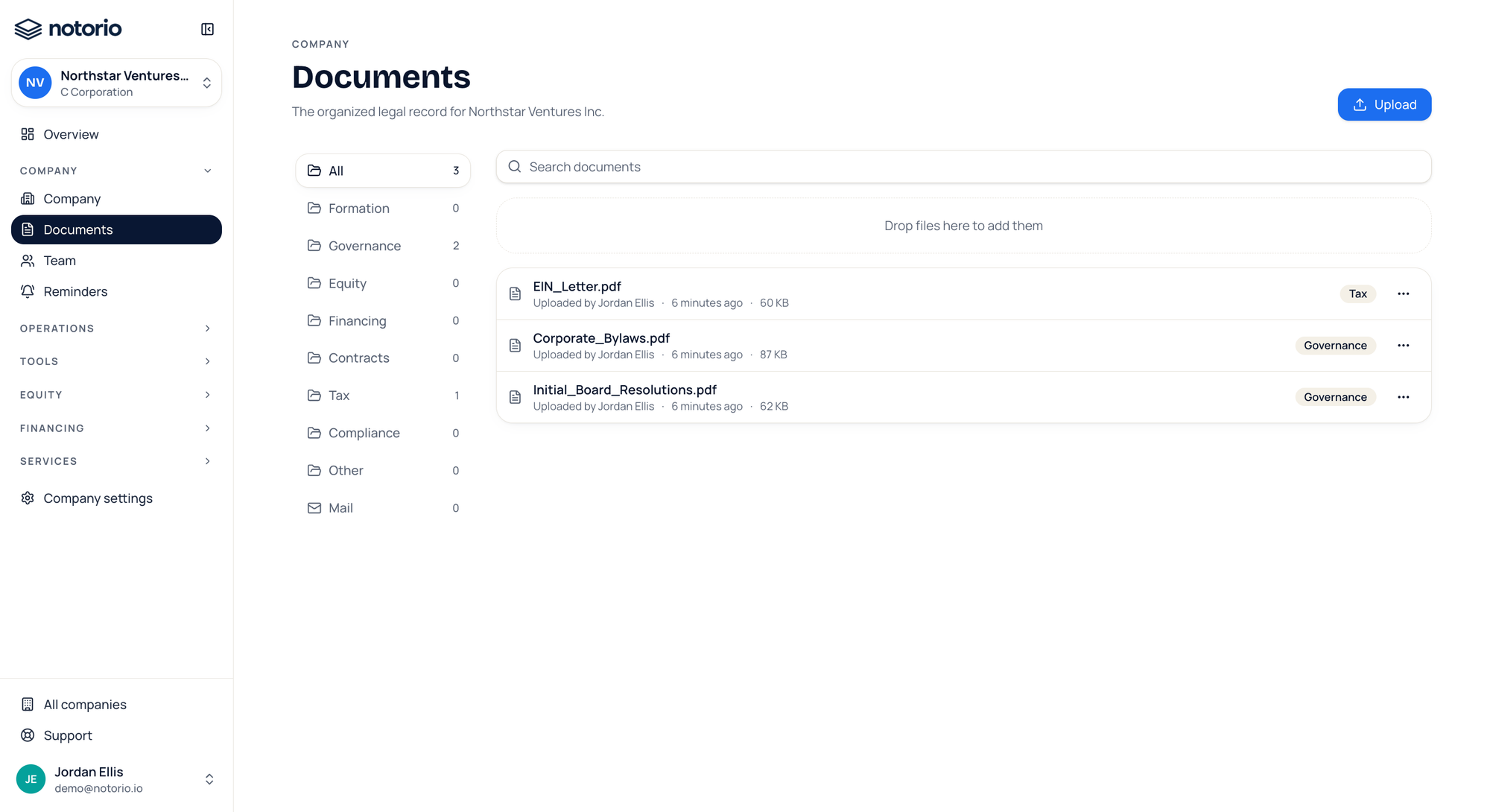
Notorio's centralized document management hub allows users to organie essential legal and administrative records—such as corporate bylaws, initial board resolutions, and tax filings—into categorized corporate folders.Graphic: Leo Lupiano
There is a privacy consideration as well. Business filings can make an address publicly available, and founders who use a home address may find that it remains associated with the company long after the business has closed. A registered agent and separate business mailing address can help keep a founder's residential address out of that public-facing role.
The platform also addresses a less visible but consequential task: maintaining ownership records.
Notorio's cap table tracker is designed to support both limited liability companies and corporations. For LLCs, it can track membership units; for corporations, it can track shares and related equity information, including option pools, restricted stock awards and restricted stock units.
Lupiano said the company has encountered smaller businesses that continue to manage ownership information in Excel spreadsheets. More extensive cap table products can provide sophisticated functionality, but may be more than an early-stage company needs. Notorio's approach is to include ownership tracking alongside the other company records rather than require founders to adopt another standalone system.
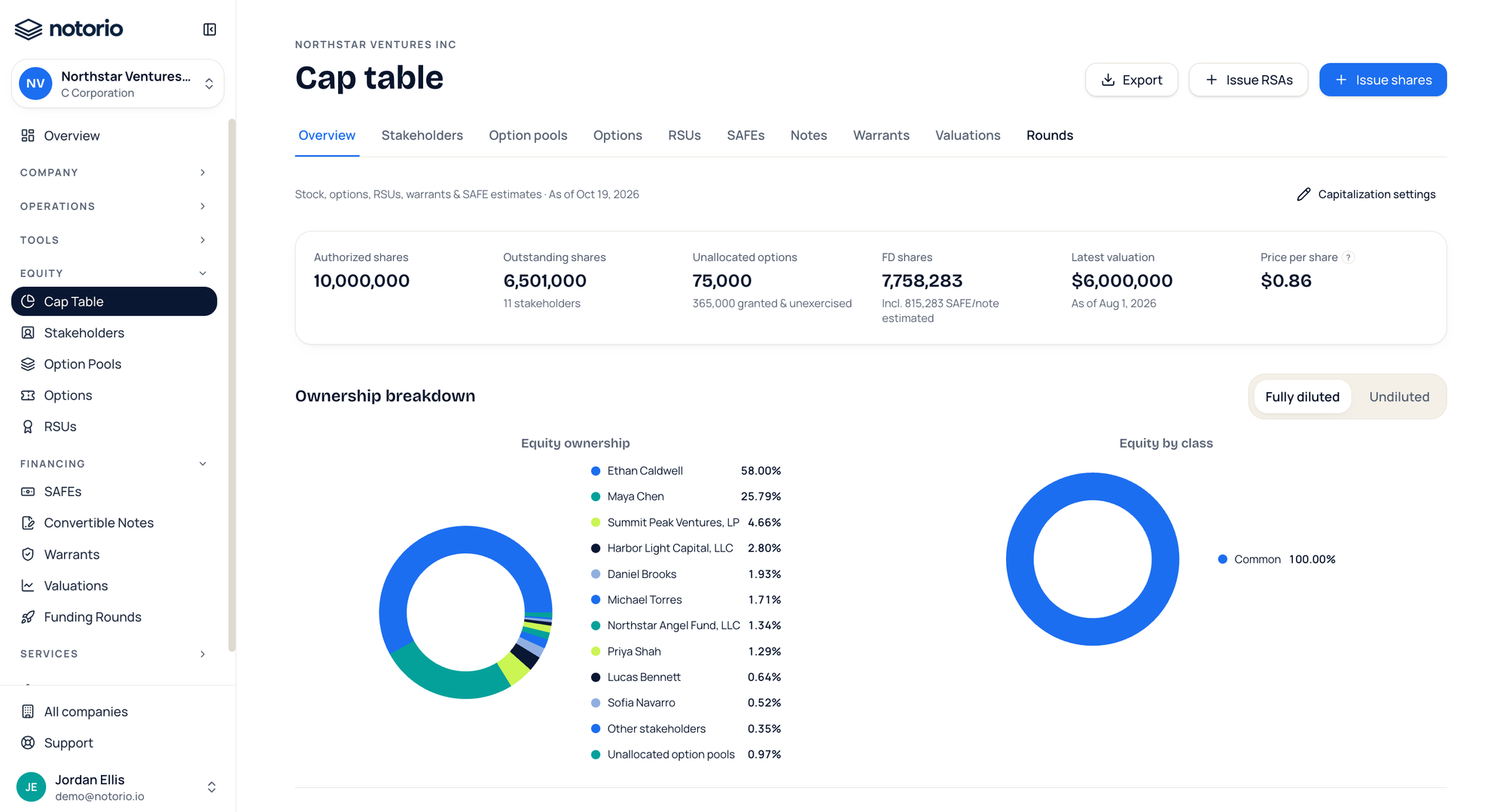
A demonstration view of Notorio’s integrated cap table tool, displaying capitalization metrics, equity ownership breakdowns, and share class distributionsfor a sample entity. Graphic: Leo Lupiano
Companies with existing records can import their information, according to Lupiano.
AI connected to company records
The newer version of Notorio adds an AI component that Lupiano described as being integrated throughout the platform rather than operating as a separate chatbot.
The idea is to give the system access to a company's own records and documents so users can ask questions about the business, locate information and generate reports. A founder might ask for a summary of the cap table or whether the company has outstanding reminders.
The AI can also assist with drafting agreements, including nondisclosure agreements and employee agreements. Because the system has access to company information, Lupiano said, it can use details about the business when preparing a draft.
The workflow is designed to connect the document to the rest of the company's records. A draft can be associated with a stakeholder or employee, edited and saved to that person's record. The platform's electronic-signature function can then be used to send the agreement for signature, with the signed document saved back to the appropriate record.
That integration is a central part of Notorio's pitch. Rather than draft a document in one AI service, download it, upload it to a separate signature provider and then store the signed version somewhere else, the company wants those steps to happen within the same system.
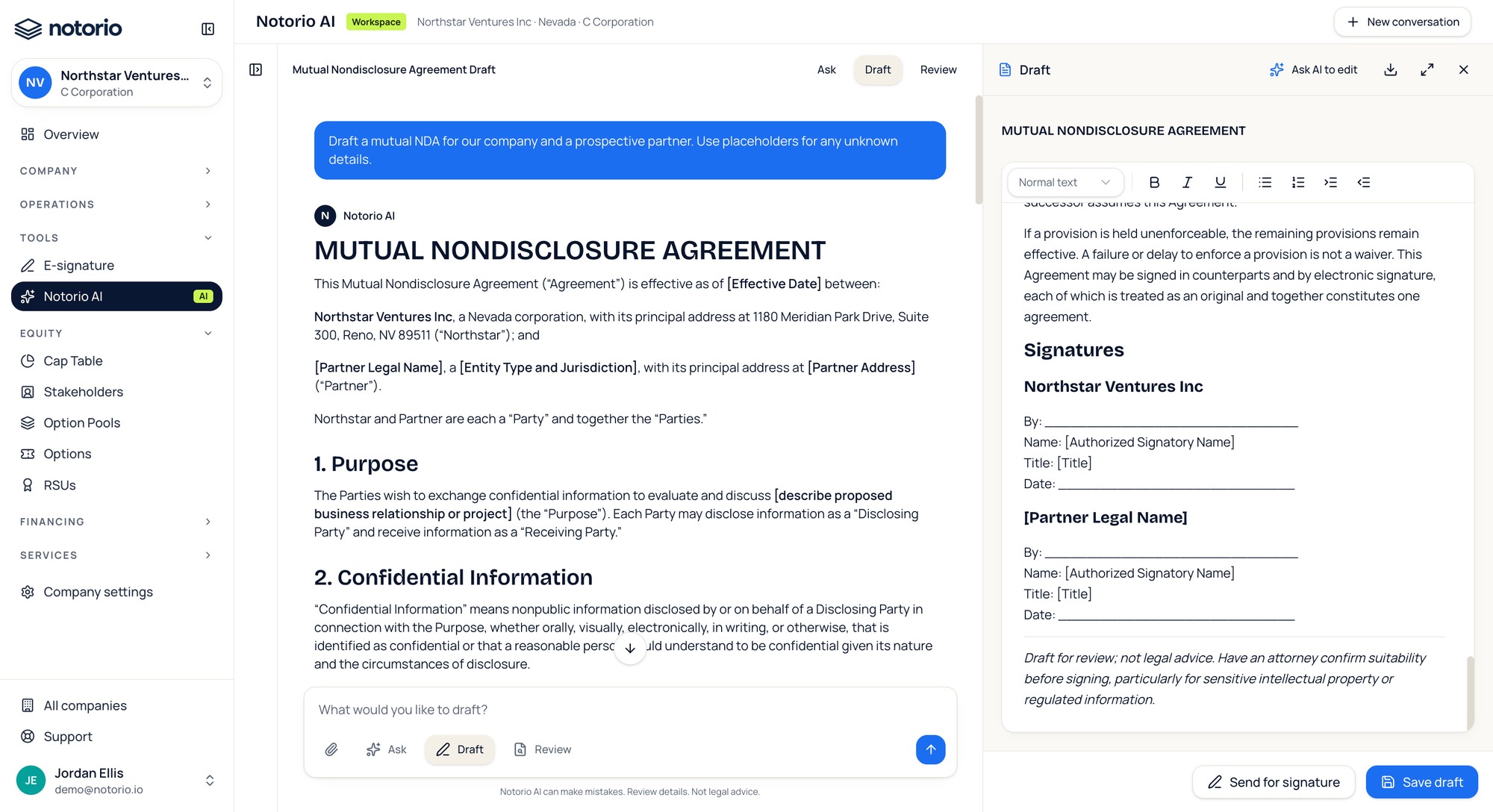
Notorio AI generates a mutual nondisclosure agreement using company-specific information and placeholders for details that still need to be supplied. The platform allows users to draft and edit agreements, then save them to company records or send them for electronic signature. Notorio emphasizes that AI-generated documents should be reviewed by an attorney before signing. Graphic: Leo Lupiano
During an interview demonstration, Lupiano showed a dashboard for managing multiple companies, along with company profiles, documents, mail, team access, invoices, cap table information and the AI drafting workflow. The companies shown in the demonstration were sample records, not actual customer accounts.
The distinction between AI-assisted document preparation and legal advice is important. Notorio is positioning the technology as a way to help founders organize information and prepare a starting point for agreements, not as a replacement for an attorney. Lupiano said users can give an attorney access to the platform so the attorney can review documents and manage company records.
He also sees the platform as a potential tool for attorneys who work with startups. A business attorney, for example, might refer a client to Notorio for formation, registered agent services or cap table management, then continue advising the company on more complex legal matters.
Lupiano said Notorio has begun developing relationships with law firms and wants to expand those partnerships. He sees an opportunity for attorneys to use the software to manage documents and information across their own client relationships.
The question of where to incorporate
Notorio's formation services also put the company in the middle of a broader discussion about corporate domicile.
Delaware has long been the preferred state for many venture-backed corporations, in part because of its established Court of Chancery and decades of corporate case law. That body of precedent has provided companies and investors with a degree of predictability when disputes arise.
But Delaware's position has faced renewed competition. Nevada and Texas have made changes intended to attract businesses, and Wyoming remains appealing to some companies, including international founders who place a premium on privacy.
Lupiano sees the movement as a form of competition among states for corporate registrations. He said companies are paying closer attention to how different jurisdictions handle corporate disputes and the legal protections available to executives and investors.
“It's corporate competition,” he said. “It's jurisdiction competition.”
Utah is not yet competing at the same scale as Nevada and Texas, in Lupiano's assessment, but he believes the state's Business and Chancery Court could become a factor as it develops a record of decisions. The court opened in October 2024, and its first years have begun to establish the body of cases that future companies and attorneys can evaluate. Utah's 2026 annual report recorded more than 100 filings.
Lupiano sees that growing body of precedent, combined with Utah's relatively low business formation fees, as reasons companies may give the state greater consideration over time.
The cost difference can be substantial. Lupiano cited a Utah LLC filing fee of less than $50, compared with approximately $400 in Nevada. Those figures are filing costs, not a complete comparison of the taxes, annual fees and other obligations a company may face in either state.
Choosing a state of incorporation also does not automatically determine where a company must register or pay taxes as it operates. A business organized in one state may have to qualify to do business in another, depending on its activities and the applicable state rules. Companies with employees or operations in multiple states need to consider those obligations separately from the initial incorporation decision.
For Notorio, the larger opportunity is helping founders navigate the administrative side of those decisions and keep the resulting records in order.
A starting point, not a substitute for counsel
Notorio's value proposition rests on three straightforward ideas: reduce the number of services a founder has to manage, make important company information easier to find, and lower the friction and cost of getting a business organized.
Leonardo Lupiano, founder of Notorio and an entrepreneur in residence at Utah Tech University. Photo: Leo Lupiano
Lupiano's own experience starting companies helped shape that approach. He recalled using several different services when forming Notorio itself, from filing with the state to obtaining registered agent services and setting up invoicing. Company documents ended up in separate folders, making it harder to keep track of what was where.
He wants Notorio to provide a single place to handle those functions, particularly for founders who would rather devote their time and limited capital to developing a product and finding customers.
The company is also careful, at least in its stated positioning, not to suggest that software eliminates the need for legal advice. Lupiano said his goal is to give founders a more organized starting point and potentially reduce the amount of foundational work they need to pay an attorney to do.
“Coming to an attorney with this will save you money,” he said. “You're not coming to the attorney and saying, ‘Hey, do everything from the get-go.’”
That distinction matters. Formation documents, ownership structures, employment agreements and corporate governance can have long-term consequences. AI-generated drafts and templates may help organize the process, but founders still need to understand what they are signing and when a qualified attorney should review it.
Notorio enters a market that already includes specialized services for incorporation, registered agents, cap table management and legal document preparation. Its challenge will be to demonstrate that bringing those functions together is not simply more convenient, but sufficiently reliable and useful that founders will make it part of their company's operating infrastructure.
The company is still early in that effort. Lupiano has described dozens of clients, but has not disclosed detailed customer, revenue or formation figures. Those numbers will become important measures of whether the platform is gaining traction beyond its initial network and service relationships.
The company is now entering a new phase of growth. After beginning development in June 2025 and releasing an initial MVP that September, Notorio spent its first year deliberately limiting user growth to work closely with early clients and refine the product based on direct feedback. That input shaped the Version 2 platform, launched in late October 2026, which is designed for broader scaling. With the updated system fully live, Lupiano said Notorio is shifting its focus toward expanding its client base and establishing strategic partnerships with law firms and accounting providers.
For now, Notorio is betting that early-stage companies would rather manage their legal and administrative foundations in one place than assemble a collection of separate tools—and that a more organized start can make the work of building a company a little less complicated.