Tara Rosander on Juvo Ventures’ Investment Thesis: Connecting Learning to Opportunity
Newly appointed Managing Director Tara Rosander outlines Juvo Ventures’ Series A strategy, focusing on AI-driven learning tools, infrastructure, and measurable economic mobility across workforce and education ecosystems.
Western Governors University’s main office building. Photo: Western Governors University
Western Governors University’s main office building. Photo: Western Governors University
Salt Lake City, Utah — October 19, 2026
Artificial intelligence is making it easier to learn. Proving what someone knows, and connecting that knowledge to opportunity, is a different challenge.
For Tara Rosander, the newly appointed managing director of Juvo Ventures, that distinction helps explain an investment opportunity spanning education, workforce development and the infrastructure connecting the two.
“One of the biggest shifts I am seeing with AI is, it’s making it easier to learn but harder to prove what you know,” Rosander said in an interview with TechBuzz.
She sees room for companies that can close that gap, helping people demonstrate their capabilities and translate learning into meaningful opportunities throughout their careers.
Juvo, the venture-investment arm of Western Governors University, announced Rosander’s appointment on October 13. She oversees the firm’s investment approach and operations, reporting to WGU President Scott Pulsipher. Her arrival brings together experience in company building, investing and economic development, with a focus on how education can support economic mobility.
Rosander previously served as deputy commissioner and chief operating officer at Utah’s Governor’s Office of Economic Development. She also chaired the Nucleus Fund’s investment committee and serves on the Women Tech Council board.
Her state role gave her a perspective on business needs that extended beyond the companies typically encountered through venture investing. Businesses entering Utah or expanding their operations repeatedly raised two related questions: Where would they find workers, and how would those workers acquire the skills their operations required?
Those conversations made workforce preparation a tangible business issue, rather than an abstract discussion about education.
Rosander sees opportunities for companies addressing those needs, including businesses developing approaches to AI-related training and reskilling. Her move to Juvo places those interests within a more focused investment mandate: backing innovation across education and workforce development.
A Series A Focus
Juvo Ventures launched its inaugural $52 million fund in 2020 (initially as New U Venture Partners) to back early-stage, pre-seed, and seed companies across education and workforce development. With Fund II, the firm is moving toward Series A companies.
Its typical investment range is $1 million to $4 million, Rosander said, although Juvo could invest more in an especially compelling opportunity. The firm would also consider selected Series B investments.
The strategy is not restricted to companies founded by WGU students or alumni. Instead, Juvo looks across the market for businesses making learning more accessible and helping people connect it to economic opportunity.
That mandate extends beyond instructional software. Rosander pointed to financial aid and student lending, learning management systems, content management systems and other infrastructure supporting education as potential areas of interest.
The common thread is what those products enable for learners.
“So what we’re really looking at is like those measurable outcomes, right, to provide economic mobility,” she said.
That focus allows Juvo to consider different business models while maintaining a connection to its broader purpose. A company might help someone finance an education, navigate a learning program, acquire new skills or connect classroom experience with work. Each addresses a different point along the same journey.
What WGU Brings
WGU’s involvement gives Juvo a relationship with a university whose work centers on learning and opportunity. Rosander described WGU as the firm’s anchor investor and a participant in its general partner.
She also emphasized that Juvo operates outside the university as a for-profit investment business. Its relationship with WGU does not replace the need to evaluate companies commercially or generate returns.
That distinction matters. Juvo is investing in businesses, not serving exclusively as an incubator for student ventures.
Still, Rosander sees potential value in the connection. She pointed to WGU Labs and other university initiatives as resources that can help Juvo understand developments in education and inform its sourcing of investment opportunities.
The relationship could also offer ways to explore how new approaches work in practice. Precisely how particular companies connect with university programs, learners or graduates depends on the opportunity. Rosander, who was still learning the broader organization at the time of the interview, did not describe a universal mechanism for those connections.
Her emphasis was on the combination: a venture firm able to move nimbly, alongside a university deeply engaged in the challenges its portfolio companies seek to address.
Becki Wright, CEO and Founder of Proximity Impact, receiving a Women Tech Award (and a hug) from Tara Rosander at the 2026 Women Tech Awards, September 17, 2026, Grand America. Photo: Laura Kinser
Returns and Results
Rosander describes Juvo as a “double bottom line fund.” Financial performance and learner impact both matter.
On the investment side, she emphasized traditional responsibilities: being a good fiduciary partner, helping portfolio companies build value and pursuing liquidity opportunities.
The impact side requires looking at what those companies make possible for learners.
Rosander cited a portfolio serving more than 10 million learners and a network encompassing approximately 42,000 school districts, higher education institutions and training providers. She clarified that the organizational figure refers to connections through portfolio companies, including customers and partners, rather than WGU alumni.
Those figures describe the portfolio’s reported reach. They are distinct from measures showing whether a learner completed a program, secured employment or increased earnings.
The distinction is important to Juvo’s thesis. Reaching people creates an opportunity to improve outcomes, but reach alone does not establish economic mobility. Rosander said the firm’s impact focus is on the results its companies help students achieve.
As Juvo evaluates investments, the challenge is to connect a company’s commercial potential with evidence that its product helps learners advance.
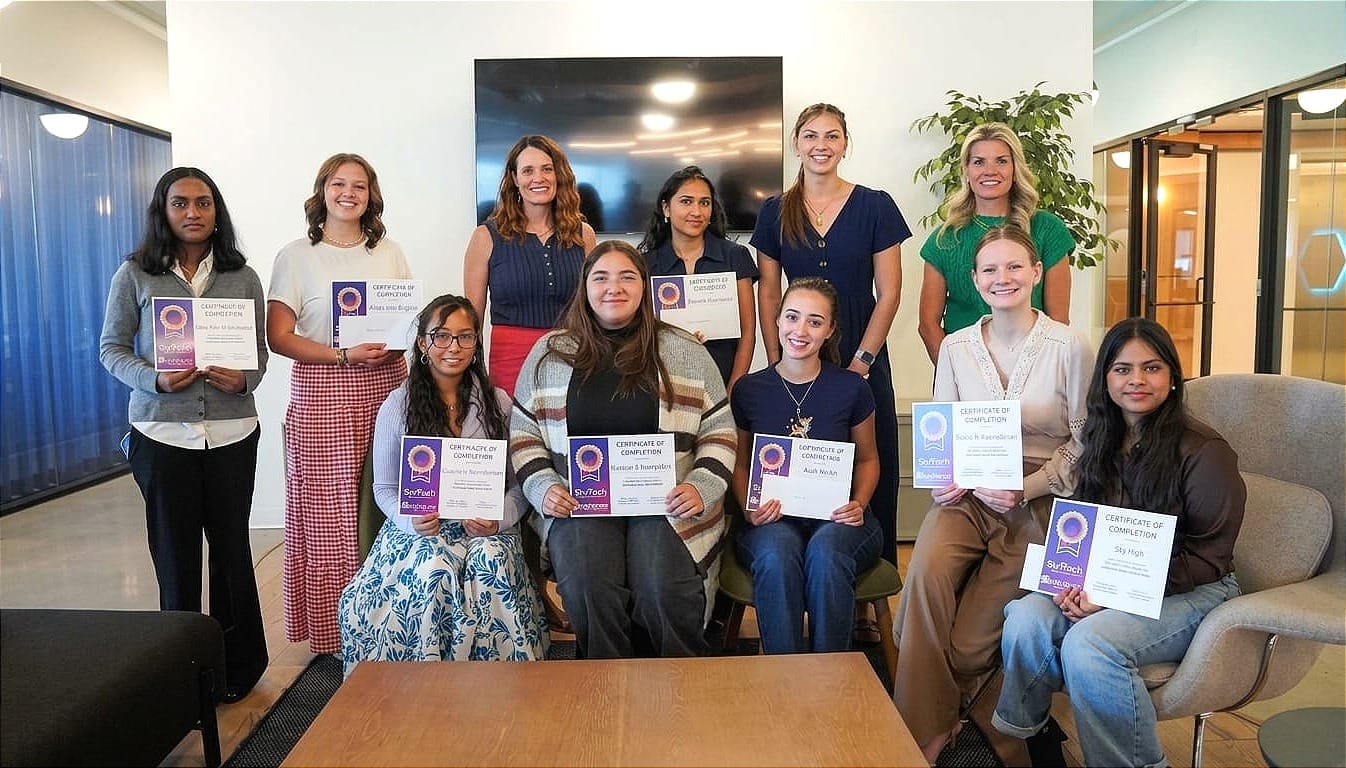
Tara Rosander, newly appointed Managing Director of Juvo Ventures, with Hannah Neilson (Manager of WTC Intern Programs), Kristin Wright (Program Director at Women Tech Council), and some of the 2025–26 SheTech-TechBuzz Media interns during their graduation ceremony at the TechBuzz offices in South Jordan, Utah, May 2026. Photo: Mark Tullis, TechBuzz
Investing Across a Working Life
Rosander’s description of Juvo’s mandate extends beyond a single degree or first job. She sees a lifelong path of learning and work, with opportunities for companies to help people navigate transitions along the way.
AI adds urgency to that perspective. As tools change how people learn and perform tasks, employers and learners face questions about which skills matter and how to demonstrate them.
For Juvo, that creates an investment thesis broader than simply backing the next education app. It includes the systems that support access, the tools that help people develop capabilities and the connections that make those capabilities useful in the workplace.
Rosander’s task is to identify businesses that can deliver on that promise while producing investment returns. The test is whether those companies can connect education to economic opportunity in ways that are commercially durable and measurable for learners.