OxEon Opens Advanced Manufacturing Facility as Utah Energy Company Scales Toward Commercial Production
With more than $36M in Dept of Energy support, OxEon Energy (North Salt Lake, UT) is working to scale its solid oxide electrolysis technology. The company’s new automated manufacturing facility represents a milestone in its transition from research and demonstration toward commercial production.
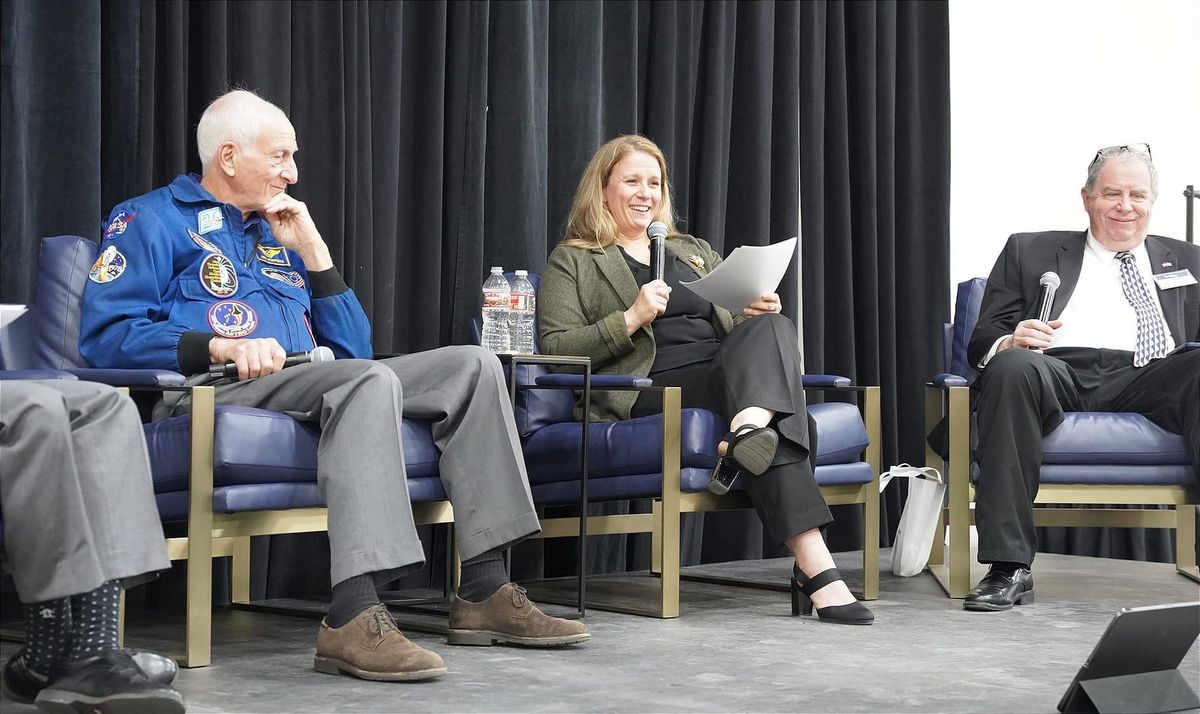
OxEon Energy cofounder and COO Jessica Elwell (center) moderates a discussion with former NASA astronaut Dr. Jeffrey Hoffman (left) and OxEon CEO Joseph Hartvigsen (right) during the company's October 30 event in North Salt Lake, held as part of Utah Hard Tech Week. The discussion explored the engineering challenges behind NASA's MOXIE experiment, which demonstrated oxygen production from the Martian atmosphere, and the lessons the project provided for developing reliable energy technology. Photo: Mark Tullis, TechBuzz
OxEon Energy cofounder and COO Jessica Elwell (center) moderates a discussion with former NASA astronaut Dr. Jeffrey Hoffman (left) and OxEon CEO Joseph Hartvigsen (right) during the company's October 30 event in North Salt Lake, held as part of Utah Hard Tech Week. The discussion explored the engineering challenges behind NASA's MOXIE experiment, which demonstrated oxygen production from the Martian atmosphere, and the lessons the project provided for developing reliable energy technology. Photo: Mark Tullis, TechBuzz
November 2, 2026
OxEon Energy opened the doors to its new automated advanced manufacturing facility on October 30, giving members of Utah's technology and business community a look at the next stage of the company's effort to commercialize its energy technology.
The fireside chat, held during Utah's inaugural Hard Tech Week, brought together company founders, employees, government representatives, industry partners and Dr. Jeffrey Hoffman, the former NASA astronaut who helped lead the development of technology that demonstrated oxygen production on Mars.
For OxEon, the facility represents a significant step in moving beyond research and development toward manufacturing at commercial scale.
"With over $36 million in support from the Department of Energy, OxEon is beginning to scale our capabilities and grow our impact on the world's energy economy," said Jessica Elwell, OxEon's cofounder and chief operating officer. "This space represents an important milestone for OxEon as it signifies our obvious shift from R&D and demonstration to commercial impact."
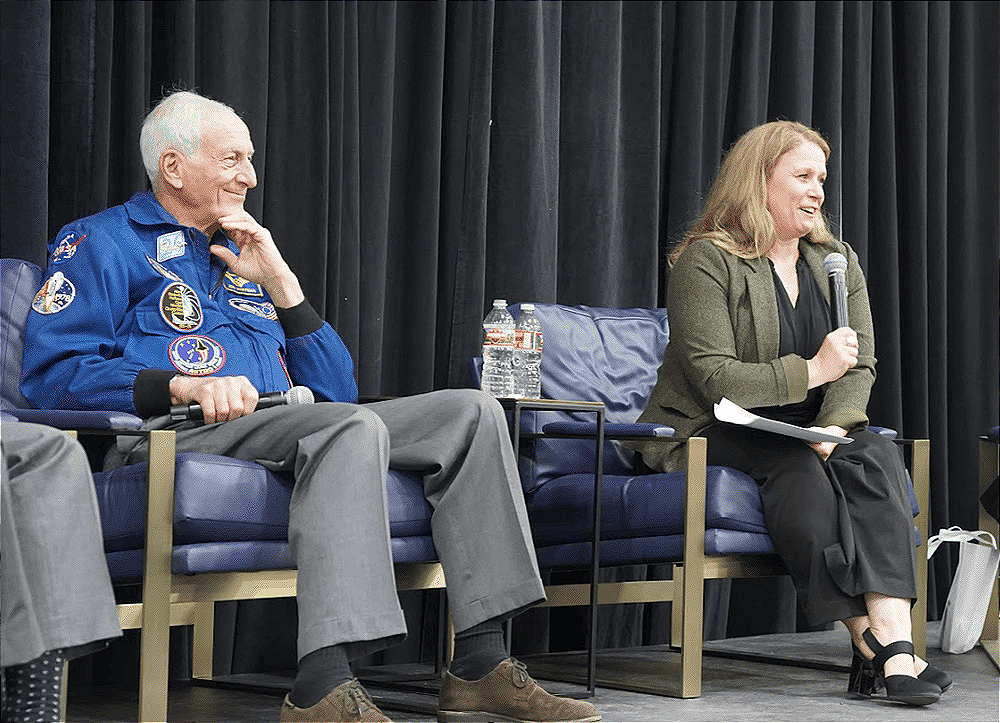
OxEon Energy cofounder and COO Jessica Elwell moderating a discussion with former NASA astronaut Dr. Jeffrey Hoffman during the company's Hard Tech Week fireside chat. North Salt Lake, October 30, 2026. Photo: Mark Tullis, TechBuzz
The DOE funding, announced in March 2024 under the Bipartisan Infrastructure Law, supports automation and manufacturing scale-up of OxEon's solid oxide electrolysis technology. The original initiative established a target of 25 megawatts of annual manufacturing capacity, with a longer-term ambition of reaching gigawatt-scale production.
The new facility is a physical milestone in that effort.
From Mars to Earth
The technology behind OxEon's manufacturing effort has an unusual history. The company's solid oxide electrolysis cells were used in NASA's MOXIE (Mars Oxygen In-Situ Resource Utilization Experiment), an instrument aboard the Perseverance rover that demonstrated the ability to extract oxygen from the carbon dioxide-rich Martian atmosphere.
The fireside chat also explored Hoffman’s experiences during his five Space Shuttle missions, including detailed accounts of mishaps during the Hubble Space Telescope repair mission and his participation in what Jessica Elwell described as NASA’s first unplanned extravehicular activity (EVA), or spacewalk. Those experiences provided a broader look at the problem-solving, preparation and adaptability required in human spaceflight.
Hoffman, who served as a NASA astronaut for 19 years and flew on five Space Shuttle missions, was deputy principal investigator for the MOXIE experiment. He joined OxEon leaders for a discussion about the engineering challenges involved in developing and operating the system.
The challenges extended well beyond designing a device that could produce oxygen. The equipment had to survive the stresses of launch and landing, operate across extreme temperature variations and function autonomously on another planet.
OxEon's electrochemical stack underwent dozens of thermal cycles, including exposure to temperatures approaching 800 degrees Celsius and temperatures as low as minus 65 degrees. Engineers also subjected the hardware to vibration and shock testing.
The operating environment presented another challenge: Once the system was on Mars, engineers could not physically intervene to repair it. Commands had to be developed, tested and transmitted through the Perseverance rover.
Hoffman described one instance in which engineers caught a potentially dangerous error in computer code while testing commands on Earth before transmitting them to Mars.
"We got lucky this time," he recalled, describing the importance of validating commands before sending them to the rover.
The experience reinforced the importance of rigorous testing and reliability engineering, particularly when equipment must operate in an environment where failure cannot be repaired.
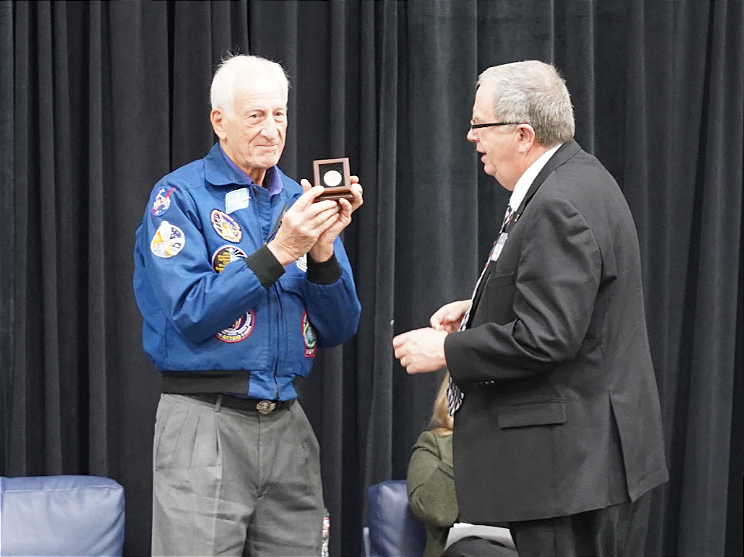
OxEon Energy's CEO Joseph Hartvigsen presented Hoffman with a custom MOXIE Award medallion made from the same ceramic materials used in the MOXIE experiment to produce oxygen on Mars. The medallion features NASA’s Perseverance rover on one side and the inscription “Bringing Foresight to Focus” alongside Hoffman’s name and the year 2026 on the reverse.
OxEon Energy CEO Joseph Hartvigsen presenting former NASA astronaut Dr. Jeffrey Hoffman with a MOXIE Award during the company’s October 30 event, held as part of Utah Hard Tech Week. Hoffman, who served on five Space Shuttle missions, discussed his work on NASA’s MOXIE experiment, which demonstrated the ability to produce oxygen from the Martian atmosphere. North Salt Lake, October 30, 2026. Photo: Mark Tullis, TechBuzz
Turning an experiment into a reliable technology
The discussion also highlighted how the MOXIE project helped OxEon advance its technology.
Engineers had to address potential damage to the electrochemical stack from oxidation and carbon accumulation, among other challenges. Some solutions required additional engineering work and convincing NASA's Jet Propulsion Laboratory to approve operational changes.
The team also had to determine which problems could be solved through design improvements and which required changes to operating procedures.
The first MOXIE system was an experiment. Future systems intended to support human exploration of Mars will require substantially greater operational reliability.
That distinction is relevant to OxEon's terrestrial ambitions as well. Moving from a successful demonstration to a commercially viable product requires consistent performance, repeatable manufacturing and confidence that equipment will operate as designed over extended periods.
Elwell described the MOXIE project as a defining experience in her career. She recalled joining a room of engineers with considerably more experience and initially taking a seat toward the back, uncertain how she could contribute.
Over time, she said, the willingness of experienced team members to teach, collaborate and work through problems shaped both her professional development and the company's approach to engineering.
The project also reinforced a culture of examining failures, understanding what went wrong and changing processes to prevent similar problems.
The discussion also touched on how spaceflight can fundamentally change an astronaut’s perspective. During the audience Q&A, Jeff Edwards asked Hoffman about an experience in orbit when he saw a meteor passing below the Space Shuttle. Accustomed to seeing meteors streak across the sky from Earth, Hoffman initially questioned what he was seeing. Then he realized that, from orbit, the atmosphere was beneath him—and a meteor burning up in it would appear below the spacecraft.
In the Q&A, 47G advisor Jeff Edwards asked Dr. Jeffrey Hoffman to describe a notable experience he had in orbit. Dr. Hoffman described the unusual phenomenon of seeing a meteor pass below the Space Shuttle while in orbit. Hoffman explained how seeing the atmosphere from above changed his perspective. OxEon Energy's Hard Tech Week event. North Salt Lake, October 30, 2026. Photo: Mark Tullis, TechBuzz
Hoffman said the experience helped illustrate how different the perspective from space can be. Looking down at Earth, surrounded by the vastness of a universe largely hostile to life, astronauts often return with a deeper appreciation for the planet’s fragility and its ability to sustain life.
Energy technology with implications beyond space exploration
Hoffman said his experience working with OxEon had impressed him with the potential of the company's technology.
He noted that major advances in energy technology have historically changed civilization, from the control of fire to steam power and electricity. Improvements in how energy is produced and used, he said, remain fundamental to the future of human society.
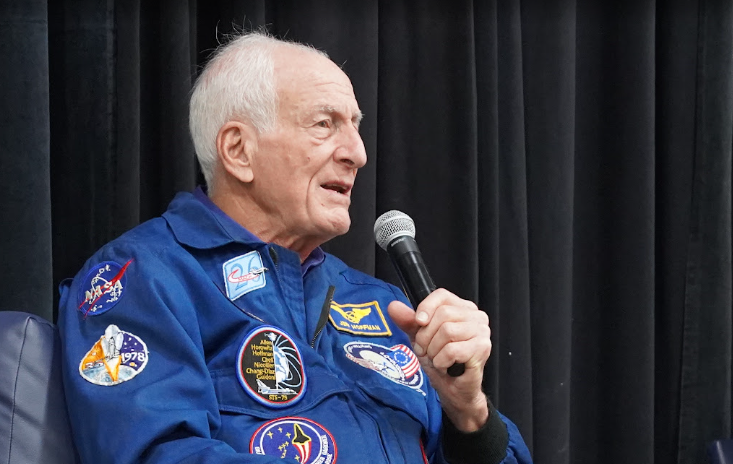
former NASA astronaut Dr. Jeffrey Hoffman speaking at the OxEon's October 30 fireside chat, held as part of Utah Hard Tech Week. The fireside chat explored Hoffman’s experiences during his five Space Shuttle missions, including detailed accounts of mishaps during the Hubble Space Telescope repair mission and his participation in NASA’s first unplanned extravehicular activity (EVA), or spacewalk. North Salt Lake, October 30, 2026. Photo: Mark Tullis, TechBuzz
OxEon's solid oxide electrolysis technology has applications beyond producing oxygen on Mars. As TechBuzz reported in its November 2025 coverage of the company's North Salt Lake pilot facility, the technology can process carbon dioxide and water to produce oxygen, carbon monoxide and hydrogen. Those outputs can serve as building blocks for synthetic fuels and other energy applications.
The company has identified potential markets in renewable aviation fuel, trucking and marine transportation, as well as defense applications involving the production of synthetic fuel in remote environments.
The October 30 event was part of Utah's inaugural Hard Tech Week, organized by 47G and Utah Tech Week. In addition to the discussion with Hoffman, attendees were invited to tour OxEon's new facility and see where the company intends to advance its manufacturing capabilities.
For OxEon, the challenge now is translating years of research, engineering and demonstration into manufacturing capacity capable of serving commercial energy markets.
As Elwell put it in welcoming attendees, the company's progress is about more than the technology. It also reflects the people, partnerships and willingness to tackle problems that initially appear impossible.
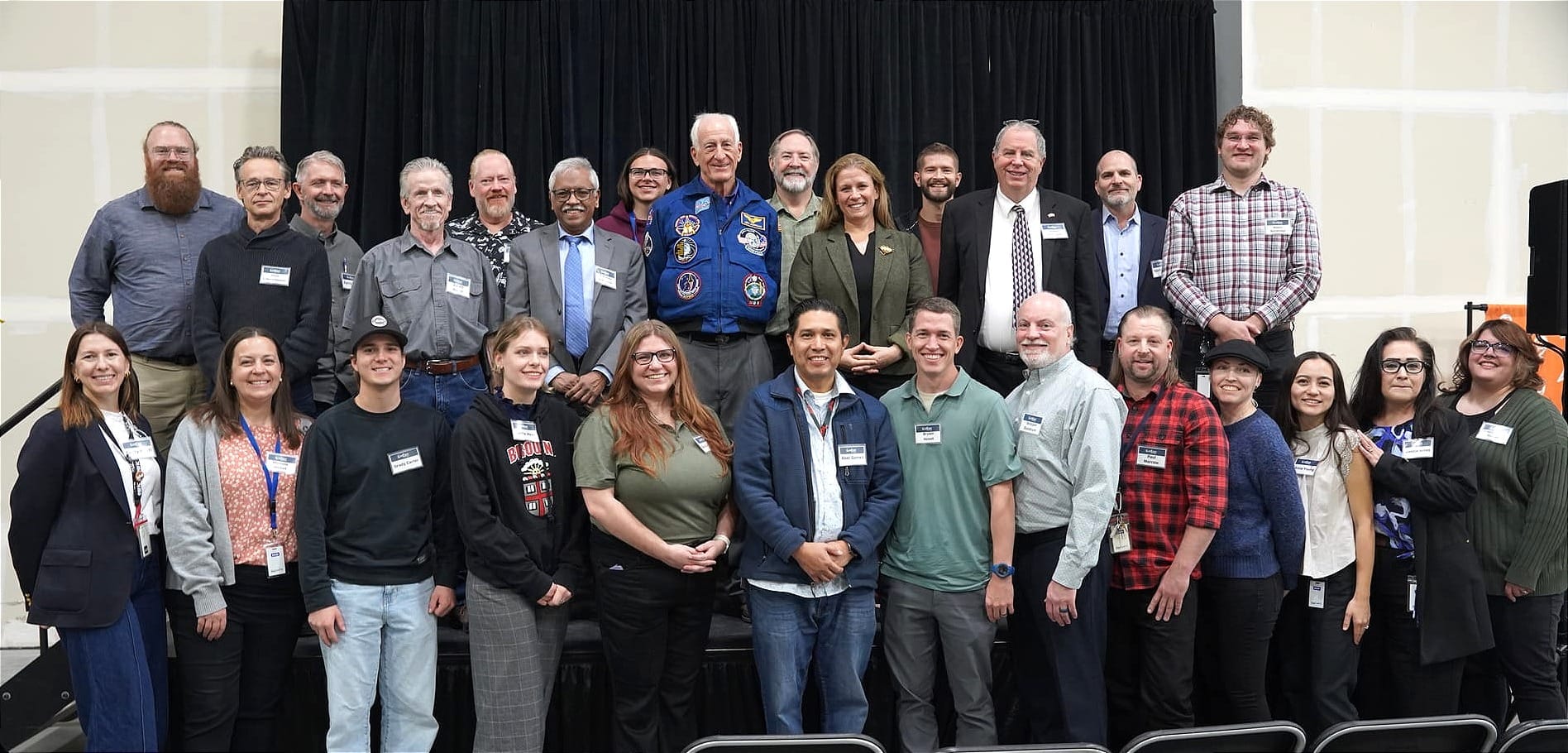
OxEon Energy team members, partners and guests gather for a group photo during the company’s October 30 fireside chat, held as part of Utah’s inaugural Hard Tech Week. Former NASA astronaut Dr. Jeffrey Hoffman stands at center in his blue NASA flight suit, alongside OxEon leadership, including Jessica Elwell, and members of the broader Oxeon team celebrating the company’s work in advanced energy technology and manufacturing. North Salt Lake, October 30, 2026. Photo: Mark Tullis, TechBuzz
Share this article
The link has been copied!
Your link has expired. Please request a new one.
Your link has expired. Please request a new one.
Your link has expired. Please request a new one.
Great! You've successfully signed up.
Great! You've successfully signed up.
Welcome back! You've successfully signed in.
Success! You now have access to additional content.