NuCube Energy Plans Utah Tests to Connect Microreactor Heat With Industrial Uses
NuCube Energy plans non-nuclear testing with Utah’s San Rafael Energy Lab and BYU to evaluate heat-transfer components, validate reactor models, and support future research into industrial heat applications and electricity generation.
Cristian Rabiti, Chief Executive Officer and Co-founder, NuCube Energy. Photo: Idaho State University
Cristian Rabiti, Chief Executive Officer and Co-founder, NuCube Energy. Photo: Idaho State University
Idaho Falls, ID — October 20, 2026
NuCube Energy plans to use a non-nuclear testing platform in Utah to explore a practical challenge in microreactor development: transferring high-temperature heat into systems that industrial customers can use.
The Idaho Falls-based company is collaborating with the Utah San Rafael Energy Lab (USREL) and Brigham Young University researchers on a platform built around a 250-kW induction furnace. Rather than produce heat through nuclear fission, the furnace will provide a controllable heat source intended to represent conditions associated with NuCube’s proposed NuSun reactor.
The immediate work will focus on components, heat pipes, instrumentation, and heat-transfer performance. Once completed, the infrastructure could support additional experiments involving industrial processes and electricity generation.
For NuCube Energy CEO and co-founder Cristian Rabiti, a central purpose is collecting experimental evidence to check the engineering models behind the reactor’s design.
“Licensing a reactor requires data that is qualified and that is credible,” Rabiti said in an interview with TechBuzz.
Moving Heat Into an Industrial Process
Founded in 2023, NuCube Energy is developing factory-built microreactors intended to supply electricity and high-temperature process heat. Its proposed reactors use TRISO fuel with heat pipes carrying energy away from the core.
Rabiti said the reactor design targets temperatures up to roughly 1,100°C, although the Utah experiments will operate at a lower temperature.
The Utah project is not a demonstration that a completed reactor can deliver 1,100°C heat to a customer. It is a planned test environment for studying components and how they perform together.
Delivering heat to an industrial application requires a connection between the reactor’s heat pipes and the customer’s process. Rabiti said NuCube is developing specialized heat exchangers to transfer that energy into a separate fluid. The fluid and exchanger configuration could vary depending on the application.
The experiments will help researchers assess how effectively an exchanger transfers heat while maintaining a high delivery temperature. Rabiti described a process of designing the equipment, placing it in the test system, and comparing measured performance with expectations.
Different industrial uses may require different exchanger designs. The platform could therefore support repeated experiments rather than a single demonstration.
A Utah Platform for Repeated Experiments
Rabiti described the partners’ contributions as complementary. USREL would provide testing infrastructure supported by a Department of Energy grant. NuCube would contribute the heat-exchanger design and hardware, with assistance from BYU.
At the time of the interview, Rabiti said the contract was still being negotiated. He hoped procurement would begin within a month or two, but did not provide a firm testing start date.
Some findings could remain proprietary, particularly results relating to NuCube’s components. More general heat-pipe research could be suitable for publication by university researchers, he said.
The project builds on an existing relationship with Utah. According to NuCube’s announcement, the company signed a memorandum of understanding with the Utah Office of Energy Development in May 2025 to work toward siting a NuCube reactor at USREL.
That preliminary siting effort is separate from the furnace-based testing. The non-nuclear platform is not a reactor installation, and the memorandum does not establish approval to construct or operate one.
In its October 6 announcement, NuCube identified chemical manufacturing and hydrogen production as applications researchers could explore using the completed platform.
The company’s June investor presentation offers a specific example of its industrial ambitions: a collaboration with NewHydrogen to explore using NuCube technology as a heat source for a hydrogen-production process. That relationship does not establish a commercial reactor installation or an experiment scheduled at USREL.
The October announcement also identifies potential electricity-generation studies using a supercritical carbon dioxide Brayton cycle, which uses heated, pressurized carbon dioxide to drive a turbine.
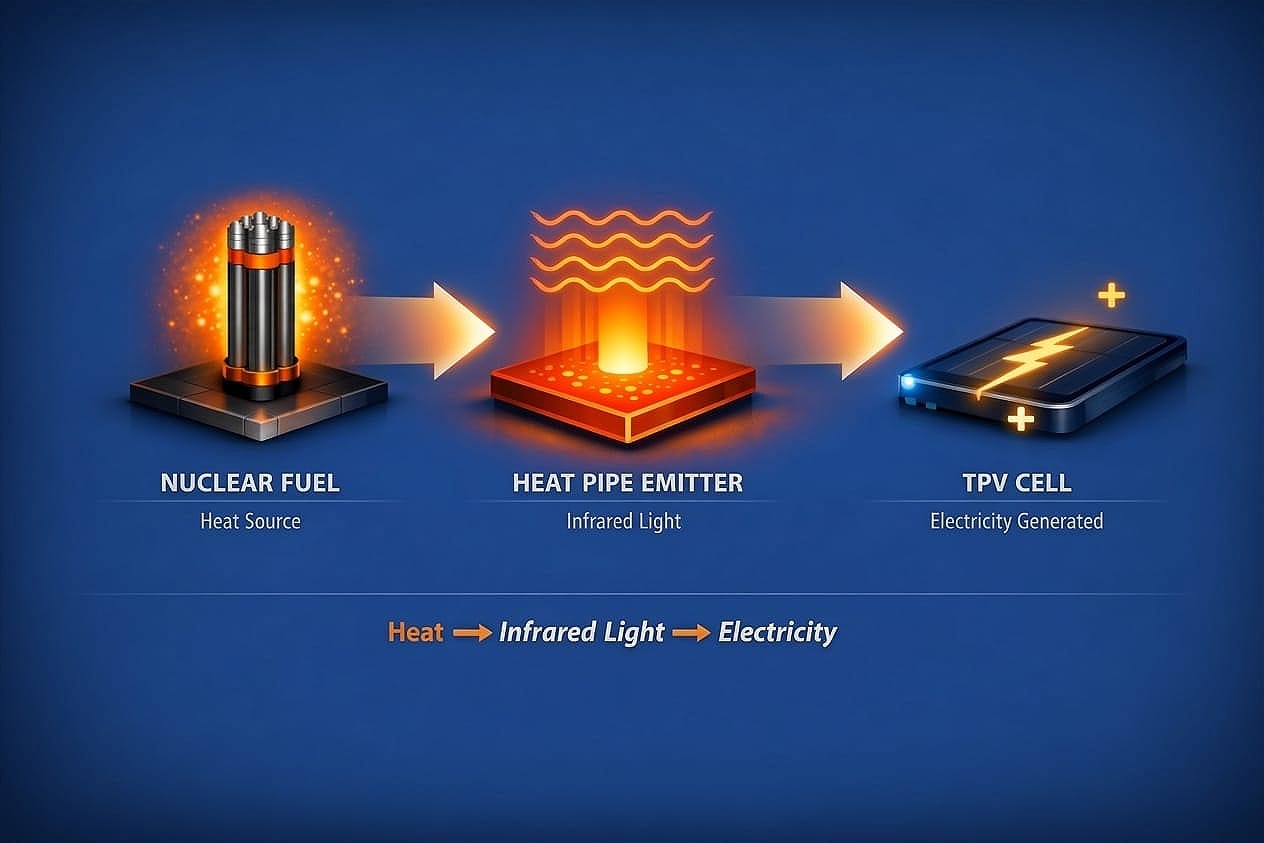
Separately, NuCube is exploring thermophotovoltaic conversion, or TPV. In that approach, specialized cells convert infrared radiation from a hot source directly into electricity, without a turbine.
NuCube Energy's conceptual illustration of thermophotovoltaic electricity conversion. The diagram depicts the company’s proposed nuclear energy system, not the non-nuclear furnace planned for USREL. Graphic supplied by NuCube
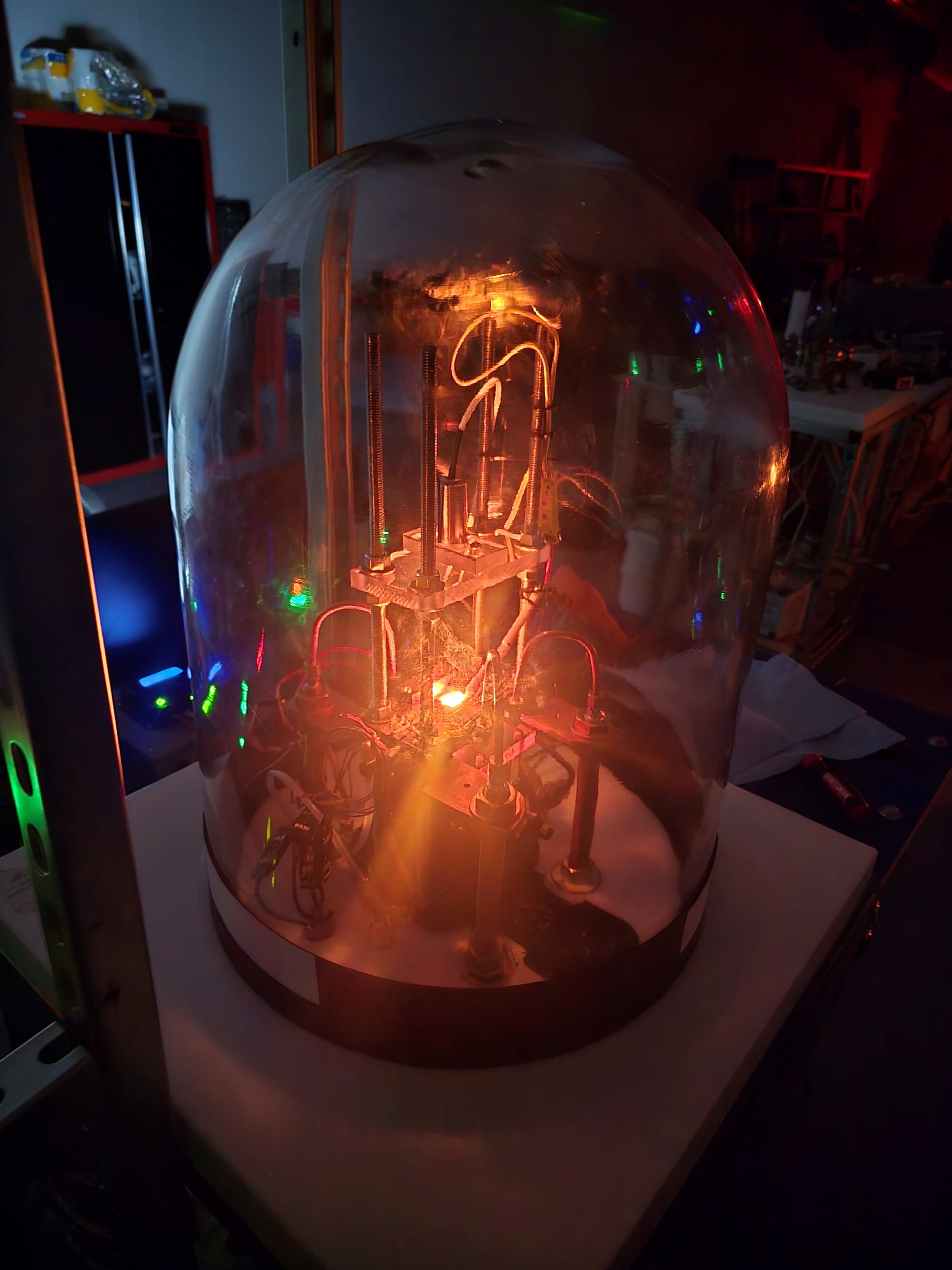
The June presentation includes a photograph of a TPV test apparatus at NuCube’s Idaho Falls facility and reports electricity-production testing at 1,100°C. The slide does not specify the electrical output, conversion efficiency, or test duration. It describes an apparatus test, not an operating nuclear reactor or a completed Utah demonstration.
These are distinct development activities. Rabiti’s description of the initial Utah work centers on heat pipes and heat exchangers; the broader platform is intended to support additional applications over time.
NuCube Energy's thermophotovoltaic test apparatus at its Idaho Falls facility. The company’s June 2026 investor presentation reports electricity-production testing at 1,100°C. This apparatus is separate from the planned USREL test platform. Image supplied by NuCube
Proposed Reactor Scale
The 250-kW furnace rating should not be confused with the proposed reactors’ output.
NuCube Energy offers two configurations: NuSun-1, targeting approximately 1.3 megawatts of electrical output, and NuSun-15, targeting approximately 15 megawatts.
Configured to deliver heat rather than electricity, Rabiti said, the designs would provide roughly 4 and 45 megawatts of thermal output, respectively.
Those figures describe proposed designs and alternative uses of their output. They are not measurements from the Utah platform or simultaneous electrical and thermal outputs demonstrated by a commercial installation.
Building Evidence Across Separate Projects
The Utah work is one part of NuCube’s development program. Rabiti described a separate collaboration with Canadian Nuclear Laboratories involving an existing heat-pipe database. The effort includes qualifying the data so it can support model validation and licensing work.
That requires more than obtaining measurements. Engineers also need to understand how those measurements were taken, the accuracy of the instruments, and the uncertainty associated with the results.
Rabiti called this establishing the “pedigree” of the data. The objective is to determine whether the company’s software reliably predicts physical performance.
A separate project with Idaho State University would move to an operating nuclear reactor. Rabiti said NuCube Energy is targeting a heat-producing research unit at the university’s Pocatello campus by the end of 2029.
He described a configuration that could accommodate different heat applications and energy-conversion experiments, rather than an installation initially dedicated to electricity production. The date remains a company target, subject to the approvals, financing, fuel supply, and other development milestones needed to reach operation.
For the Utah collaboration, the nearer-term milestones are completing the arrangements, procuring equipment, and preparing the test platform.
The value of those experiments will lie in the measurements they produce. Before NuCube Energy can translate its reactor designs into commercial energy systems, it needs evidence showing how the components perform and how effectively their heat can be put to work.