AI Utah Demo Day: How MX Labs and JobNimbus Are Applying AI to Business Problems
AI Utah Demo Day at Pattern (Lehi, UT) featured MX Labs and JobNimbus, showcasing how Utah companies are applying artificial intelligence to financial services, software development, customer feedback analysis and product decisions.
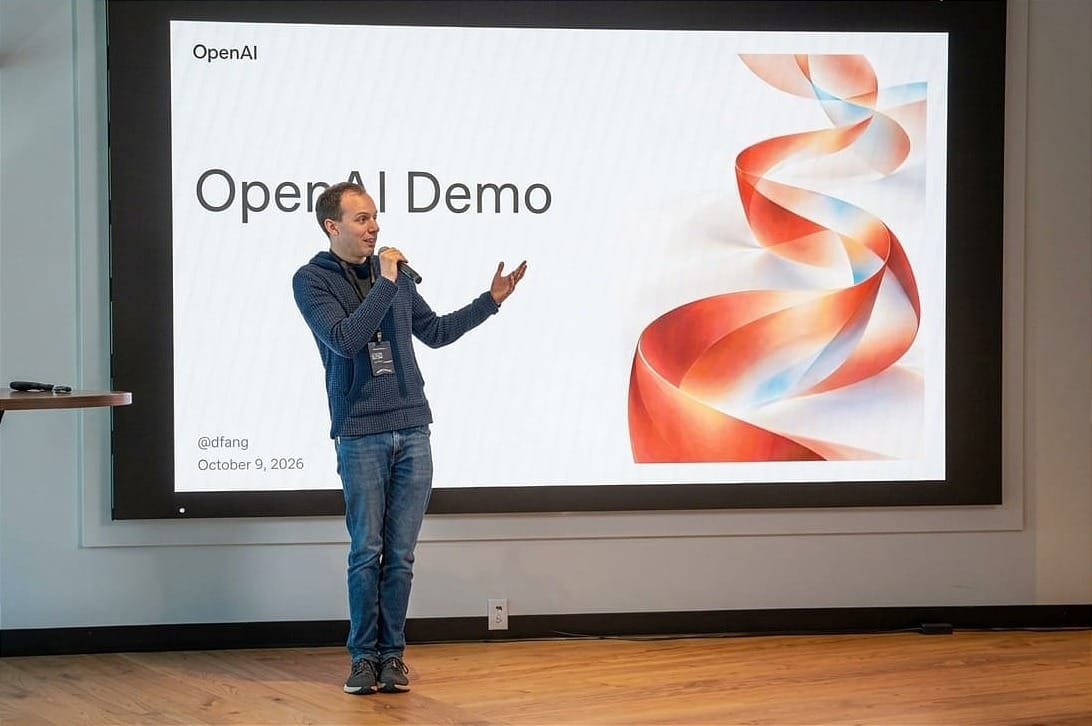
Attendees of AI Utah Demo Day assembled to hear presentations about AI application at MX and JobNimbus. Also presented were representatives of OpenAI and Nucleus Institute. October 9, 2026, Pattern HQ, Lehi, Utah
Attendees of AI Utah Demo Day assembled to hear presentations about AI application at MX and JobNimbus. Also presented were representatives of OpenAI and Nucleus Institute. October 9, 2026, Pattern HQ, Lehi, Utah
Lehi, Utah — October 15, 2026
As companies explore how to incorporate artificial intelligence into their operations, two Utah technology leaders offered a look at how they are applying AI to real-world business challenges.
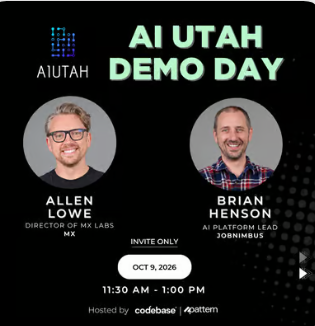
Continuing its Demo Day series, AI Utah Demo Day brought together Allen Lowe, director of MX Labs at MX, and Brian Henson, AI platform lead at JobNimbus, for short presentations and a question-and-answer session over lunch at Pattern’s headquarters in Lehi on Friday, October 9. Hosted by Jon Bradshaw, founder of Codebase.com, the event aimed to strengthen connections across Utah’s AI community.
Jon Bradshaw, founder of Codebase.com, AI Utah and the AI 100, welcoming the attendees to the October 9 AI Utah Demo Day, Pattern HQ, Lehi, Utah. Photo: Mark Tullis, TechBuzz
Lowe discussed how AI is changing software engineering and financial technology, while Henson demonstrated how JobNimbus uses AI to analyze customer conversations and identify patterns that can inform business decisions.
Jacob Miller, VP of Platform Intelligence at Pattern, welcoming the audience to AI Utah Demo Day featuring Nucleus Institute, OpenAI, MX and JobNimbus, Pattern's HQ, October 9, 2026, Lehi, Utah. Photo: Mark Tullis, TechBuzz
MX Labs: Refining AI Coding Workflows
Allen Lowe, director of MX Labs at MX, described how his team is using AI agents to accelerate software development—and what it learned when the approach began producing unnecessarily complicated code.
Lowe, a software engineer with nearly two decades of experience, initially resisted AI engineering because he worried the technology would replace him. His perspective changed after working with Claude at Shopify, where he recognized that software engineering was changing.
“I decided to just put my work boots on and get to work,” Lowe said.
At MX Labs, Lowe is working on AI applications for financial services, including an AI assistant intended to help banks and credit unions adopt modern technology while maintaining their customer relationships.
His presentation focused on "Bernstein," the moniker for an internal agent orchestration system his team uses to coordinate AI-assisted software development. Rather than having an engineer write code and review each change manually, Bernstein distributes work among agents responsible for writing, reviewing and revising code.
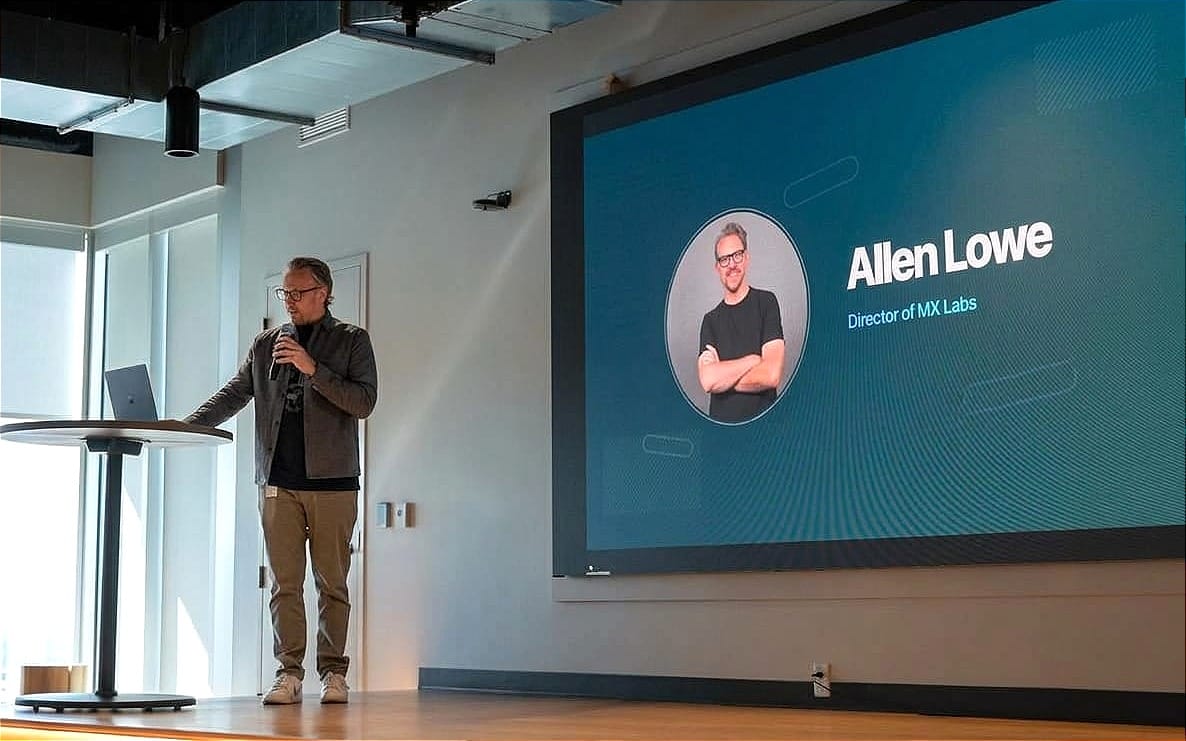
Allen Lowe, director of MX Labs at MX, presents at AI Utah Demo Day at Pattern’s headquarters in Lehi on October 9, 2026. Lowe discussed how MX Labs is using AI agents to accelerate software development and improve the quality and simplicity of AI-generated code. Photo: Mark Tullis, TechBuzz
The process began as a manual experiment. Lowe and a colleague initially exchanged AI-generated changes and reviewed one another's work. When they realized the process could work, they built a system to automate much of the cycle, allowing agents to iterate before a human engineer reviews the proposed changes.
But automation introduced a new problem: the agents could produce code that passed tests and received multiple approvals while still being unnecessarily complex.
Lowe described a case in which an agent was asked to centralize environment-variable parsing—a relatively straightforward engineering task. Instead, it generated thousands of lines of code and introduced complexity the task didn't require.
The experience led Lowe to reconsider the workflow rather than simply blame the AI model. His team made three changes: instructing the author agent to make the smallest change possible, adding a dedicated reviewer to assess whether a solution was as simple as it could be, and allowing the reviser to reject review suggestions or defer them to future work rather than implementing every recommendation.
The lesson, Lowe said, was that producing functional code is not the same as producing good code. AI systems need to be guided toward simpler solutions, not merely encouraged to complete tasks.
Lowe said the share of merge requests that became smaller during review rose from roughly 1 percent to nearly 8 percent after his team adjusted the AI workflow to favor simpler code. He also described Bernstein as capable of generating dozens of merge requests in the time a single engineer might produce one, at a substantially lower direct cost per change.
Those comparisons illustrate the potential productivity gains, although the cost and throughput figures depend on what work is included and how quality is measured.
For Lowe, the larger challenge is to make AI agents useful engineering collaborators by building workflows that reward simplicity and quality, not just output.
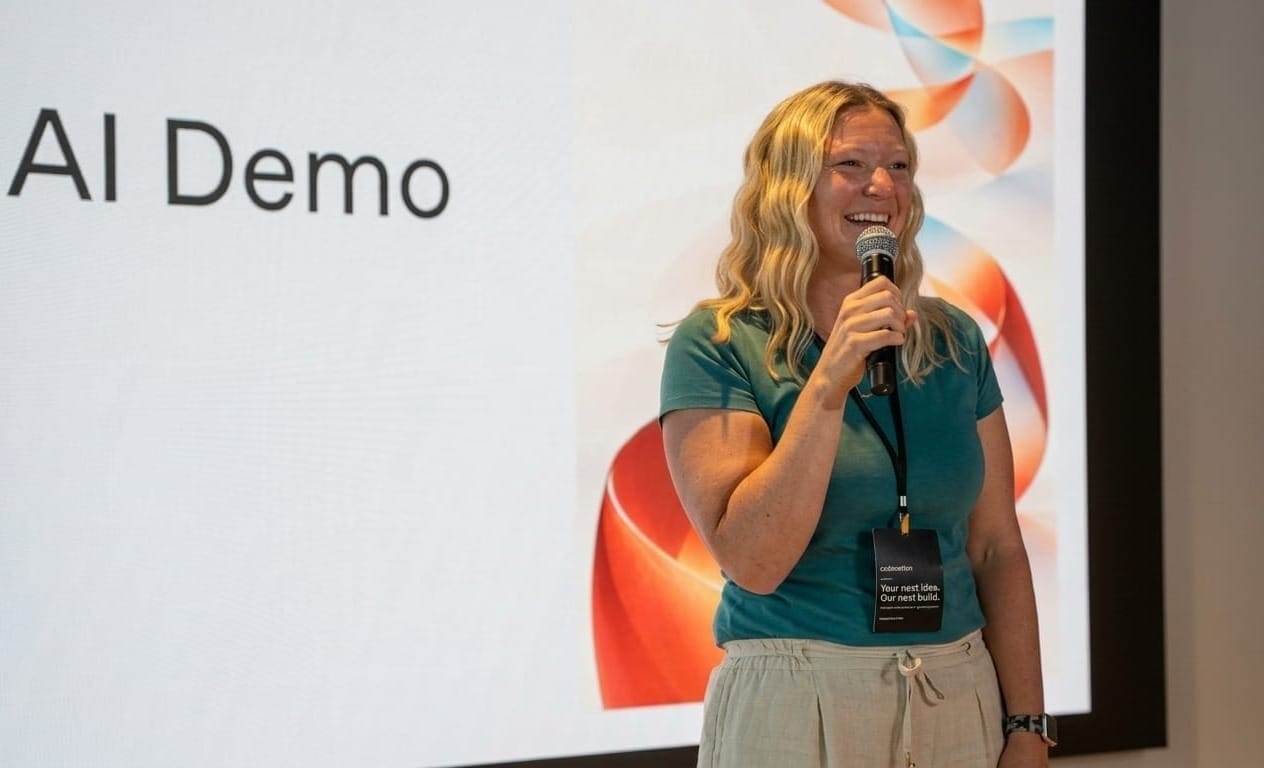
Jackie Borget, Community Outreach Manager at The Nucleus Institute, making an announcement about Converge AI at Weber State University on October 21. AI Utah Demo Day at Pattern’s headquarters in Lehi on October 9, 2026.
JobNimbus: Using AI to Understand Customers
Brian Henson, AI platform lead at JobNimbus, demonstrated how the company is using AI and graph databases to turn customer conversations into structured information that can inform product and business decisions.
Henson said he initially felt apprehensive about AI while participating in an executive program at Brigham Young University. He ultimately decided to make learning the technology a priority.
“I made it into focus and like an intent there to say, hey, this is my chance. I’m in school. This is a new thing. I should be learning everything I can,” Henson said.
At JobNimbus, customer feedback influences the product roadmap, work prioritization and the allocation of resources. But with hundreds of customer conversations taking place across the company each day, collecting transcripts is not the same as systematically learning from them.
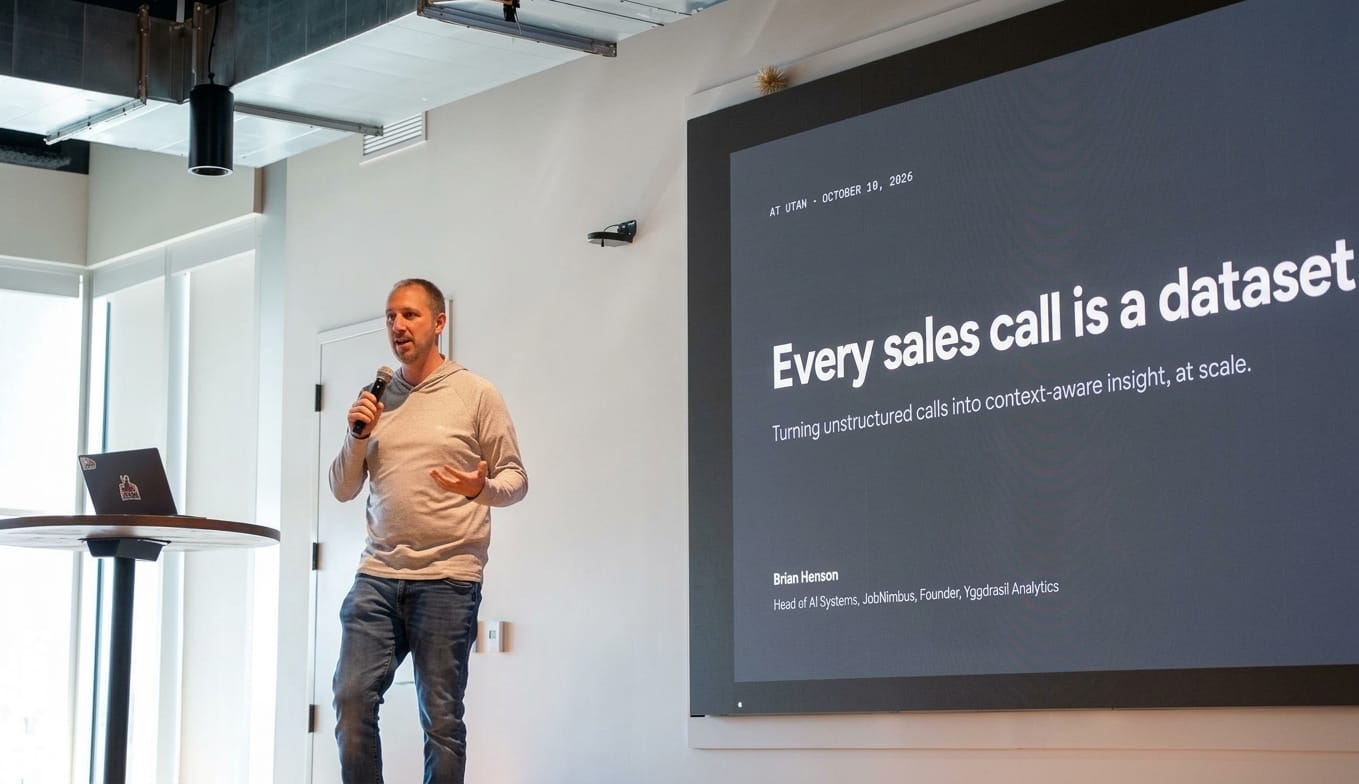
Brian Henson, AI Platform Lead at JobNimbus onstage at AI Utah Demo Day at Pattern’s headquarters in Lehi on October 9, 2026. Photo: Mark Tullis, TechBuzz
Henson's team is working to bridge that gap by extracting information from conversations and organizing it in a graph database. Unlike a conventional table-based structure, a graph connects related pieces of information, making it possible to explore relationships among customers, products, features, objections and business outcomes.
The process begins with entity extraction: identifying relevant information in a transcript and representing it as connected data. The team then analyzes relationships among those entities to identify recurring themes and patterns.
Henson said the initial approach relied on a single large language model (LLM) call to process a transcript. The team moved to a multi-step workflow that classifies the type of conversation before applying more targeted analysis. A sales call, for example, requires a different analytical approach from a customer onboarding or retention call.
The resulting graph can connect a product feature to the feedback customers provide about it, including sentiment and recurring objections. Henson demonstrated a visualization based on a sample of 47 calls, with larger nodes representing topics mentioned more frequently and color indicating positive or negative sentiment.
The graph can help teams look beyond an overall satisfaction score to investigate why customers respond as they do. A cluster of negative feedback, for example, could point to a product feature that customers struggle with or a related feature that isn't delivering the expected value.
Because the information is connected, teams can also explore related topics and trace patterns across customer conversations over time. That could help sales teams understand which responses are effective in addressing objections, while product teams could use the analysis to identify opportunities for improvement or investigate potential churn risks.
Henson also discussed how the company handles the challenge of grouping different terms that refer to the same underlying concept. His approach combines conventional code with LLM-based analysis where necessary, using clustering to reduce computational demands.
The broader objective is to make customer feedback more actionable. Rather than relying on individual anecdotes or manually reviewing transcripts, JobNimbus is exploring ways to identify patterns across large volumes of conversations and use those findings to support product, sales and customer-success decisions.
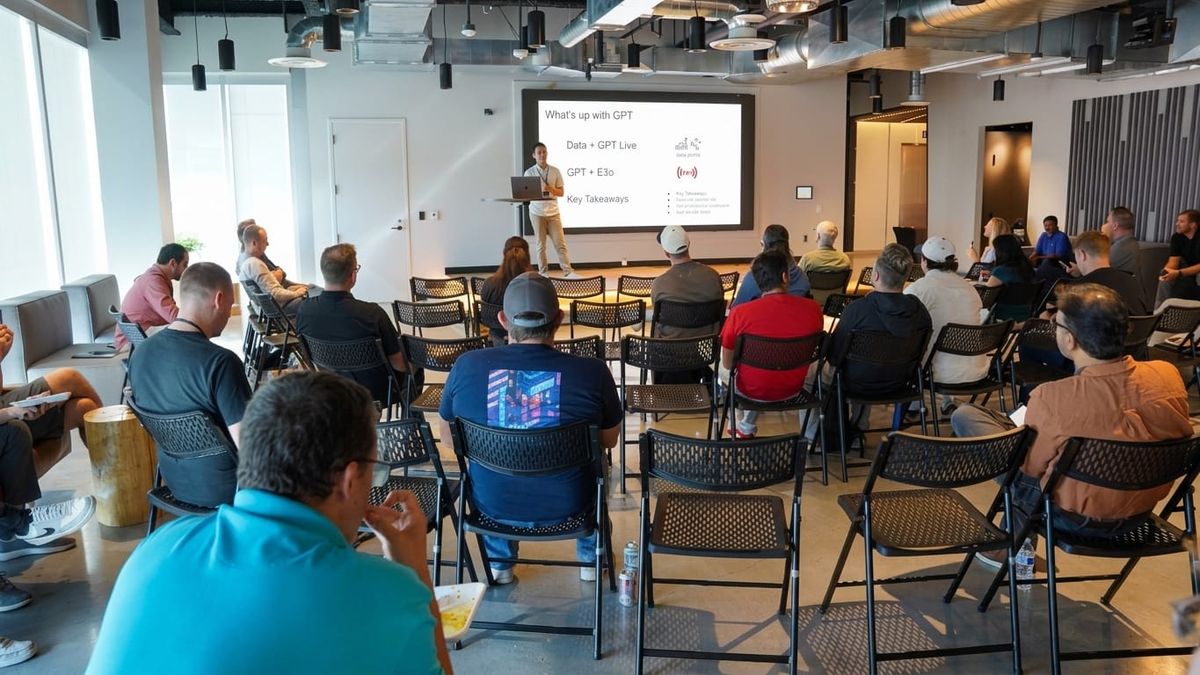
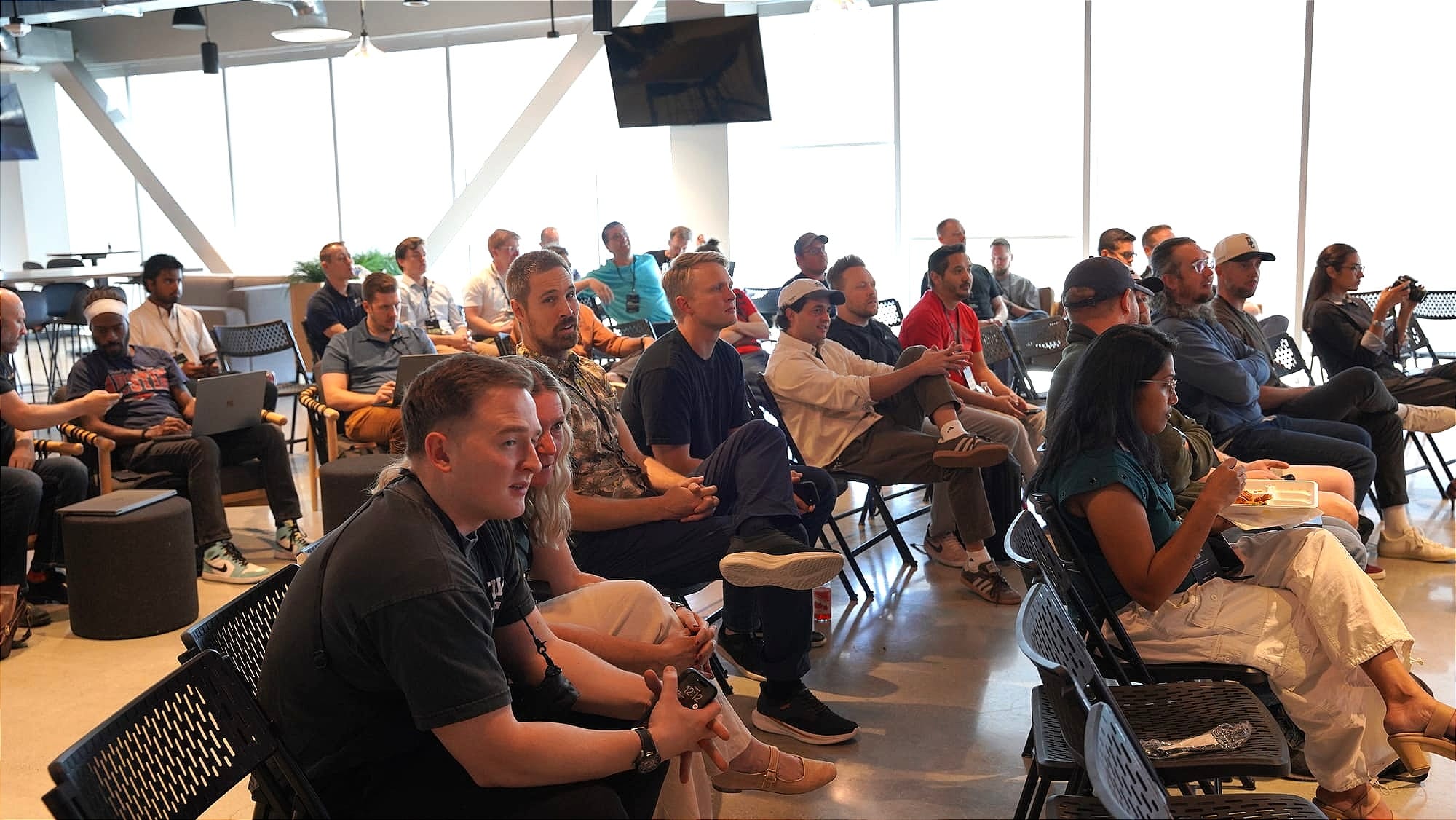
Engineers, founders and AI practitioners gather at Pattern’s headquarters in Lehi, Utah, for AI Utah Demo Day on October 9, 2026. Presentations from MX Labs and JobNimbus explored AI applications in software development and customer insights. Superb Indian cuisine was provided. Lehi, Utah. October 9, 2026. Photo: Mark Tullis, TechBuzz
Practical Applications of AI
The two presentations illustrated different ways Utah companies are incorporating AI into their operations: MX Labs is exploring AI agents to change how financial services and software development work, while JobNimbus is using AI to extract actionable insights from customer conversations.
Both examples demonstrate that adopting AI involves more than choosing a model. Companies must also determine how to integrate the technology into existing workflows, manage the associated costs and translate its outputs into useful business decisions.