Skavengerz to Power Nationwide Treasure Hunt With $1 Million Championship Prize
Skavengerz (Ogden, UT) is partnering with KryptoChase (Blanding, UT) to power a nationwide treasure hunt spanning all 50 states, offering $5,000 state prizes and a shot at a $1 million championship through GPS-based challenges.
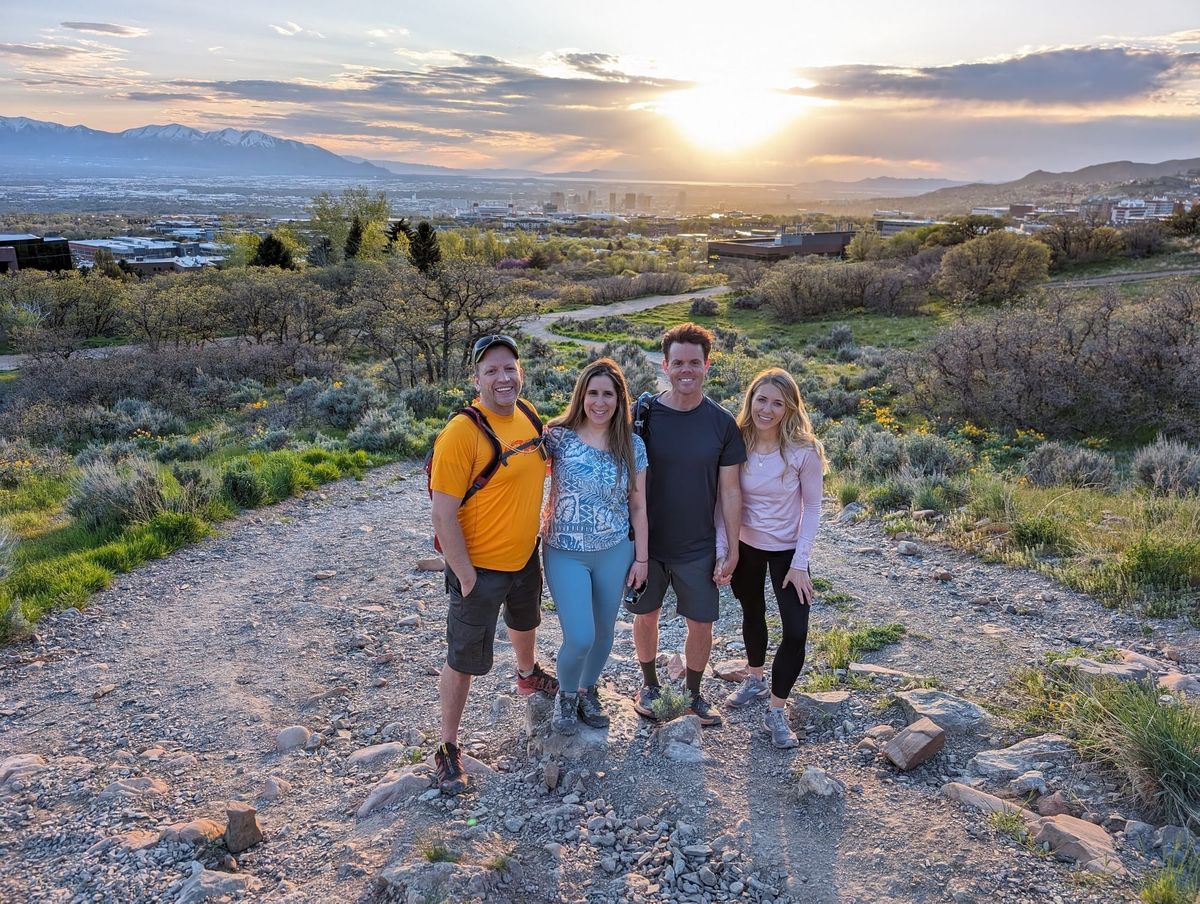
Nate and Tatiana Alder with Brandon and Shelby Osmond, enjoying a beautiful sunset hike along the foothills of the Wasatch Front. Photo: Nate Alder
Nate and Tatiana Alder with Brandon and Shelby Osmond, enjoying a beautiful sunset hike along the foothills of the Wasatch Front. Photo: Nate Alder
Ogden, Utah — October 8, 2026
What began as a Utah startup focused on getting people off their phones and into the real world is about to be tested on a much larger stage.
Skavengerz, a location-based adventure platform, is partnering with KryptoChase to power a nationwide series of real-world treasure hunts that will begin with competitions in each state and culminate in a national championship with a $1 million prize.
The first qualifying hunt will take place along Utah’s Wasatch Front.
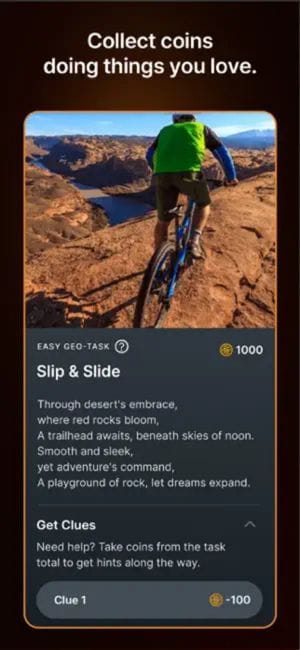
Participants will use the Skavengerz mobile app to solve riddles, complete location-based challenges and navigate to designated locations. The first verified participant to complete the required challenges will win $5,000, with the option to receive the prize in Bitcoin or cash, and advance to the KryptoChase National Championship for a chance at the $1 million prize.
The hunts are designed to be completed over a single weekend rather than requiring participants to devote months or years to solving a treasure hunt.
That distinction is important to Jeremy Lyman, founder of Krypto Chase and CEO of Blue Mountain Hospital in Blanding, Utah, who has been interested in treasure hunts for years.
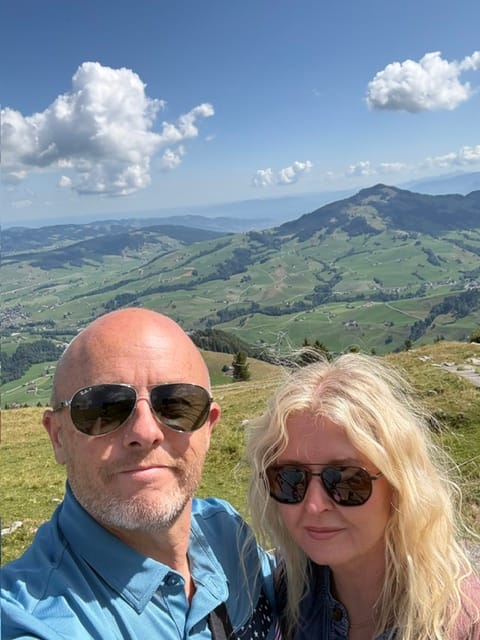
Jeremy Lyman and his wife Heather in the Swiss Alps. Photo: Jeremy Lyman
Lyman has been fascinated with treasure hunts, puzzles and riddles for years. He has personally participated in major treasure hunts, including the search for the treasure hidden by New Mexico antiques dealer Forrest Fenn, whose elaborate hunt attracted hundreds of thousands of participants before the treasure was reportedly found in 2020 within Yellowstone Park near Nine Mile Hole, Fenn's favorite fishing spot, which is located on the Madison River between the west entrance of the park and Madison Junction. Fenn's cryptic clues alluded to the thermally-fed Firehole River meeting the cooler waters of the Madison, brown trout that live in the Madison, wading across high water to cross the Madison to reach the other side.
“I wanted to take kind of the idea of what they were doing, but make it more accessible,” Lyman said. “Not everybody's got a decade of their life to dedicate to a treasure hunt.”
From a Texas test to a nationwide competition
KryptoChase has already tested its concept.
In 2025, the company conducted a free treasure hunt in Texas that attracted about 1,000 participants. In that competition, the prize was placed in a physical cryptocurrency cold wallet hidden at the final location. The experiment exposed some of the practical problems involved in running a large-scale treasure hunt. Clues were distributed by email, creating the possibility that messages could be blocked or routed to spam. There was also the question of how to verify that the person who found the physical prize was actually a registered participant. And because the prize itself was physically hidden, someone who was not participating could theoretically stumble across it.
KryptoChase ultimately needed a better way to manage the competition. That led the company to Skavengerz. “We looked for a better solution, and that's how we ended up partnering with Skavengerz,” Lyman said. “Better technology, mobile app. You can use it anywhere. It tracks your location.” For Skavengerz CEO Nate Alder, the partnership represents a significant expansion of the platform's original concept.
When TechBuzzprofiled Skavengerz in 2025, Alder and co-founders Brandon Osmond and Gary Rhoads described the company as an “anti-Metaverse” experience designed to encourage people to put down their phones and explore the physical world.
The company has since expanded its business model beyond individual consumers.
Alder said Skavengerz is increasingly working with destination marketing organizations, chambers of commerce, resorts and other organizations that want to encourage visitors to explore a particular place.
Instead of simply giving visitors a map or list of attractions, a destination can use Skavengerz to turn the visit into a game, with challenges, rewards and prizes. That makes KryptoChase a larger-scale demonstration of the same underlying technology.
“We built Skavengerz to inspire people to get off the couch and explore the real world,” Alder said. “Partnering with KryptoChase demonstrates how our technology can transform treasure hunting into an exciting, large-scale experience that combines adventure, technology and friendly competition.”
The technology behind the hunt
The KryptoChase competition won't rely on participants racing to a single location after receiving a clue. Instead, each hunt will contain multiple location-based challenges. Participants must complete four locations before they can solve the final challenge and proceed to the final location. That structure is designed to spread participants throughout the geographic area rather than sending thousands of people toward the same spot simultaneously. It also gives the company several ways to verify that a participant actually completed a challenge.
Skavengerz uses GPS geofencing to determine whether a participant has reached a designated location. Participants may also be required to perform an action at the location and submit a photograph through the app.
The company says its system can analyze other information as well, including travel distances and unusual account behavior, to identify potential GPS spoofing, account sharing or other attempts to cheat. “We use many different algorithms to validate task completion and verify their coordinates on completed tasks,” said Brandon Osmond. “We also flag certain behaviors and accounts that might be impossible, like travel-distance impossibilities.”
The challenges are also designed to make it difficult to solve the entire competition remotely using search engines or artificial intelligence. Some challenges may involve ordinary riddles, puzzles or trivia. Others are designed around physical observations and local knowledge. For example, a participant might be required to travel to a monument and identify something physically present at the location that isn't readily available online. “That’s where the benefit of being a local will definitely supersede anyone that just travels into the state,” Alder said.
The company is deliberately mixing different types of puzzles so that no single specialized skill gives a participant a decisive advantage. A mathematician might have an advantage on one puzzle. A programmer, linguist or history enthusiast might have an advantage on another. “We create the quests in a way that definitely give locals in a state an advantage that know the state,” Alder said.
Designed for a weekend
KryptoChase plans to release the first clues Friday morning, with additional clues released according to a predetermined schedule. The company can adjust the difficulty as the competition progresses by releasing increasingly specific clues. The goal is to make sure the hunt doesn't continue indefinitely.
“If nobody has been able to solve it, we'll start releasing clues Sunday morning at a certain cadence, almost guaranteeing somebody will find it by Sunday,” Lyman said. The approach also helps level the playing field between serious treasure hunters and people who simply want to spend a weekend doing something different.
Participants won't receive the competition's clues until the hunt begins, meaning someone can't spend months researching the location in advance. And while teams can work together to solve puzzles, the actual participant completing the physical challenges must use the same registered account and device.
A group of friends, family members, college roommates or coworkers could collaborate on solving clues, for example, but only the registered participant can physically check into the required locations and ultimately claim the prize. “There’s only one seat,” Lyman said.
Bitcoin — or cash
The competition's cryptocurrency connection is intentional, but participants don't have to be Bitcoin enthusiasts. Each state winner will receive $5,000 in either Bitcoin or cash, according to KryptoChase. The same choice will apply to the $1 million championship prize.
Lyman said the decision was partly based on lessons from the Texas test. The company originally envisioned giving winners Bitcoin directly through a cold wallet. But Lyman said KryptoChase recognized that some potential participants may be unfamiliar with cryptocurrency or uncomfortable receiving a cryptocurrency prize. “If they just want cash, we'll pay it in cash,” he said.
The KryptoChase registration also includes an educational component intended to introduce participants to Bitcoin and cryptocurrency.
5,000 participants per state
Each qualifying hunt will be capped at 5,000 participants. Registration is opening across the country, with the Utah hunt scheduled to be the first. KryptoChase plans to announce the date and general geographic area for individual state competitions as registration develops.
The Utah event will be announced after the initial registration milestone is reached. Registration pricing starts at $50 for early participants, with additional pricing tiers as spots are filled.
The Skavengerz app itself is free. Participants who want to compete for the KryptoChase cash and Bitcoin prizes must register for the official KryptoChase competition.
The company also plans to offer practice quests through Skavengerz so participants can become familiar with the app before competing. Those practice challenges are intentionally much easier than the actual KryptoChase competitions.
That distinction reflects one of the larger changes from the Texas test: rather than relying on email, physical clue drops and a hidden wallet, the competition can now be managed digitally through a platform built specifically around location-based experiences.
A new test for Skavengerz
For Skavengerz, the KryptoChase partnership is more than another quest. The company is increasingly positioning its platform as infrastructure for organizations that want to bring people into physical places and give them a reason to explore once they arrive.
A tourism organization could use it to encourage visitors to discover local attractions. A resort could use it to guide guests around its property. A chamber of commerce could create a series of challenges around local businesses. KryptoChase takes that same idea and applies it across an entire country.
For Lyman, the appeal is still the same one that drew him to treasure hunts in the first place: getting people outside, solving something difficult and sharing an experience with other people. Thousands of participants could eventually compete in the KryptoChase series. Dozens will win $5,000 state prizes, and one person will ultimately have a chance to walk away with $1 million.
But the companies are betting that the experience itself will be part of the reward.
“Some of them are going to win $5,000, and somebody’s going to win a million bucks,” Lyman said. “Obviously, if that works well, we'll do it again and again. We'll probably do it every year.”
For Skavengerz, meanwhile, the competition offers a real-world test of whether its Utah-built technology can turn a concept originally designed for local exploration into a platform capable of coordinating thousands of people, hundreds of locations and a nationwide competition.