From Fighter Jets to Bobsleds: Utah Aerospace Companies Engineer Team USA's Next Generation of Sleds
Albany Engineered Composites, Hexcel and Nammo Composite Solutions are bringing aerospace materials and manufacturing expertise to Olympic bobsled development as Utah prepares for the 2034 Winter Games.
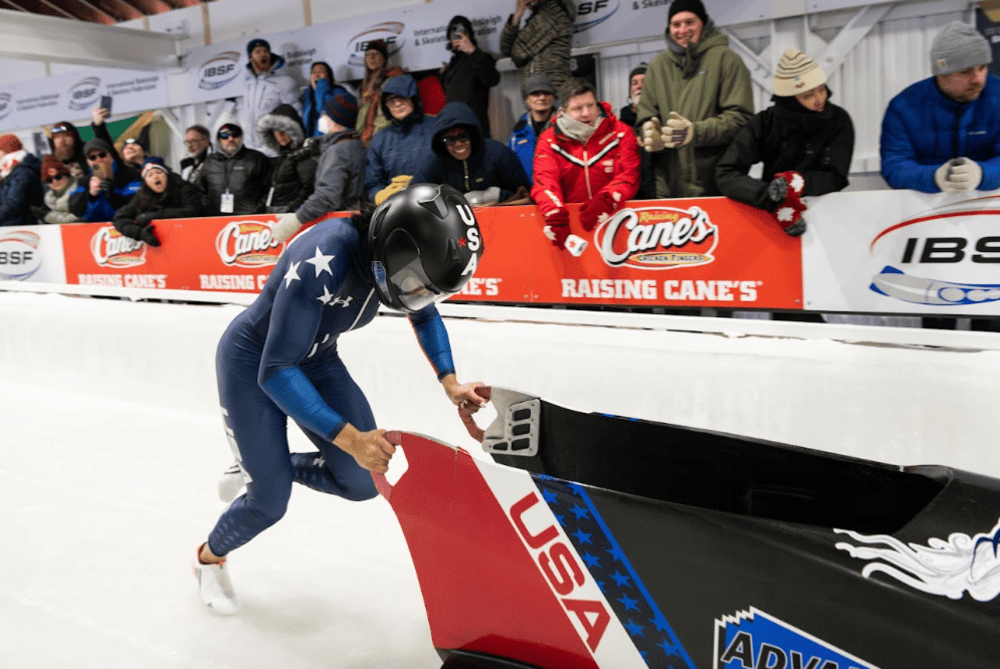
Kesha Love, a Team USA bobsled pilot, two-time Olympian and world champion, launches a U.S. sled at the start of a run as spectators watch. The demands of bobsledding—from managing weight and aerodynamics to withstanding extreme forces—make the sport a natural testing ground for aerospace engineering expertise. Photo: USABS
Kesha Love, a Team USA bobsled pilot, two-time Olympian and world champion, launches a U.S. sled at the start of a run as spectators watch. The demands of bobsledding—from managing weight and aerodynamics to withstanding extreme forces—make the sport a natural testing ground for aerospace engineering expertise. Photo: USABS
Salt Lake City, Utah — November 3, 2026
A bobsled hurtling down an icy track at Olympic speeds has more in common with a fighter jet than most people might imagine. Both depend on lightweight structures, advanced materials, aerodynamic efficiency and precise control under extraordinary physical forces. Both are engineered to perform in demanding environments where even small design decisions can have significant consequences.
Now, three Utah companies with deep experience in aerospace and defense manufacturing are bringing that expertise to one of the most equipment-dependent sports in the Olympic Games.
At 47G's annual Zero Gravity Summit, held October 28-29 at the Salt Palace in Salt Lake City as part of Hard Tech Week, 47G, USA Bobsled & Skeleton (USABS), Albany Engineered Composites, Hexcel and Nammo Composite Solutions announced a partnership to develop the next generation of Team USA bobsleds.
The collaboration brings together advanced composite materials, engineering and manufacturing capabilities to support American athletes preparing for the 2034 and 2038 Winter Olympic Games. Albany will design and manufacture next-generation composite bobsleds, Hexcel will contribute advanced composite materials expertise, and Nammo Composite Solutions will design and manufacture carbon-fiber cowlings for Team USA's two-man sleds.
The announcement illustrates an increasingly important opportunity for Utah's aerospace and defense industries: applying technologies developed for demanding military and aerospace applications to entirely different performance challenges.
"Partnerships like this are a great reminder that innovation can come from unexpected places," said Lyndon Smith, president – Americas and Global Fibers at Hexcel Corporation. "The same advanced materials and technical expertise that support aerospace and defense can open new possibilities in elite sport. We're excited to work alongside USA Bobsled & Skeleton and our industry partners to see what we can accomplish together."
For USABS CEO Aron McGuire, the collaboration addresses a sport in which engineering and athletic performance are inseparable. The difference between winning and losing can be measured in hundredths or even thousandths of a second, and the sled is a critical part of that equation.
A Rocket Ship on Ice
Team USA pilot Kesha Love, a two-time Olympian and world champion, sees the connection between aerospace engineering and bobsledding firsthand.
Companies working with fighter aircraft and military systems understand many of the same requirements that govern bobsled design, she explained: aerodynamic efficiency, precision, low weight and the ability to withstand extraordinary speeds and forces.
Love recently compared notes with a fighter jet pilot who was surprised to learn how much G-force bobsled athletes experience on certain tracks. Some courses can subject pilots to six or seven Gs, she said.
"This is a rocket ship on ice," Love told TechBuzz at Zero Gravity Summit. "This is our fighter jet."
The comparison is more than an analogy. A competitive bobsled is a carefully engineered vehicle, with every component serving a purpose. Its design must account for the aerodynamic profile, structural integrity, handling characteristics and the physical requirements of the athletes inside it.
Carbon fiber is one of the materials used in sled construction because of its lightweight characteristics. But minimizing weight is only one part of the challenge. The structure must also be sufficiently rigid and durable to withstand repeated high-speed runs and the forces generated as the sled navigates the track.
Precision matters at the component level, too. Love explained that the shape of the sled's body and seemingly minor design details influence how it tracks and responds on different courses.
"Every little component to the sled has an actual purpose," she said. "It's not just something that looks for decoration and design. It's genuinely purposeful."
Kesha Love, Team USA bobsled pilot, two-time Olympian and world champion, speaks with TechBuzz at 47G’s Zero Gravity Summit on Oct. 28, 2026. Describing the razor-thin margins that separate competitors in bobsledding, Love noted, “Sometimes we’re not even talking about hundreds. Sometimes it’s thousandths [of a second].” Photo: Natalie Aldous, X-Factor Strategic Communications
That attention to detail is familiar territory for companies manufacturing advanced composite structures for aircraft, missiles and unmanned systems. The challenge is translating those capabilities into a vehicle that must perform under a different set of operating conditions.
Engineering the Sled Around the Athletes
One of the less obvious considerations in bobsled design is the relationship between the weight of the sled and the athletes who occupy it.
Competition rules establish a maximum combined weight for the sled and its crew. Consequently, the optimal sled is not necessarily the lightest possible sled. Its weight must be calibrated to the athletes.
In an interview with TechBuzz at Zero Gravity Summit, McGuire explained that a four-man crew made up of relatively light athletes may require substantial ballast to reach the permitted combined weight. A heavier crew, by contrast, can use a lighter sled because the athletes themselves contribute more to the total.
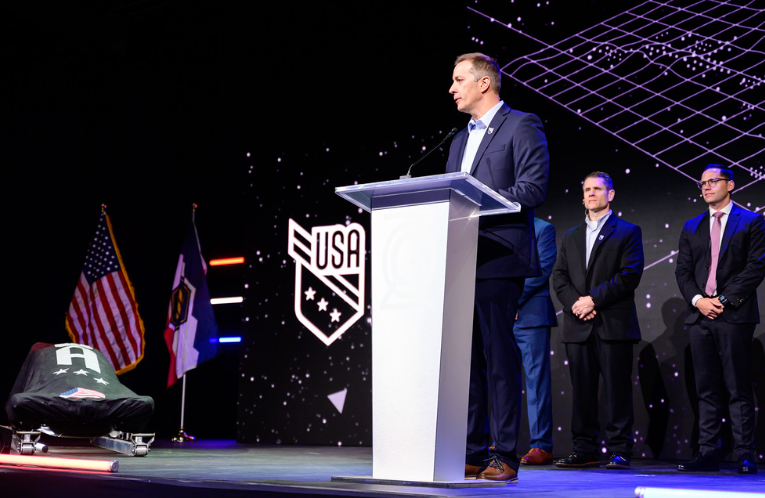
Aron McGuire, CEO of USABS, speaking at Zero Gravity Summit, October 28, 2026. Salt Palace, onstage with USABS colleagues and Aaron Stark of 47G. Photo: daniandcophotos
The placement of that weight is equally important. McGuire said the team considers how to distribute weight to maintain balance and keep the center of gravity low.
In other words, sled design cannot be separated from crew composition. The engineering objective is to produce the most effective combination of sled, weight distribution and athletes.
The sled's dimensions and ergonomics also influence performance. Athletes must be able to fit comfortably inside and operate the sled with confidence. A design that prioritizes one engineering variable at the expense of the people using it can undermine the overall result.
McGuire explained that giving athletes sufficient room is important because their confidence in the sled affects how aggressively they pilot it.
The lesson is that the fastest sled is not necessarily the one that optimizes a single measurement. Its design must account for the interaction between the vehicle and the athletes who control it.
The Engineering Behind a Clean Run
Even a highly engineered sled cannot compensate for imprecise piloting.
Bobsled pilots must navigate a sequence of curves and straightaways while managing forces that can reach several times their body weight. They must anticipate how the sled will respond and make adjustments without introducing unnecessary resistance.
McGuire explained that excessive steering can cause the sled's runners to cut into the ice, creating drag. Bouncing against the track or allowing the sled to move sideways also costs valuable time.
"The best pilots don't steer that much, but they steer where it matters," he said.
Most steering takes place in the curves, where the G-forces help the runners engage with the ice. On straightaways, the runners have less grip, limiting the effectiveness of steering inputs.
Pilots must also think ahead. How they position the sled entering and exiting one curve affects their ability to navigate the next. That requires a combination of physical skill, mental preparation and an intimate understanding of the track.
Love and McGuire described a sport in which small corrections can have an outsized impact. Coaches may tell a pilot that the sled was a few inches too high or too low in a particular curve. The pilot must absorb that feedback, understand what happened and make the appropriate adjustment on the next run.
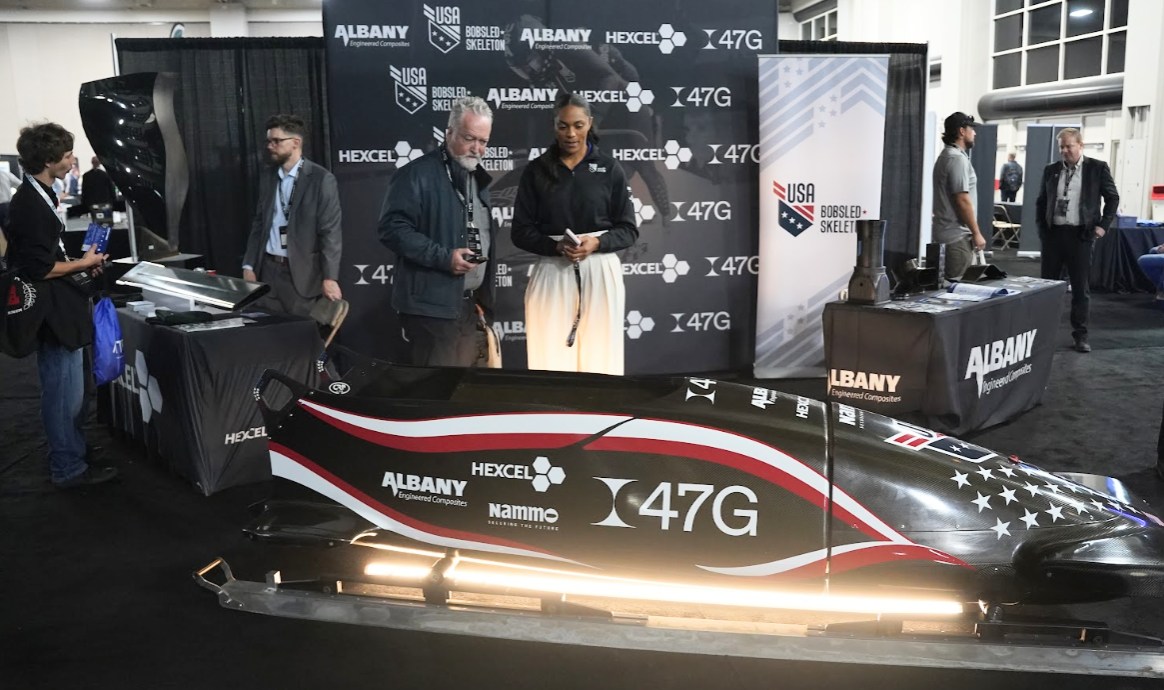
Kesha Love, Team USA bobsled pilot, two-time Olympian and world champion, points out details of the bobsled to TechBuzz at 47G’s Zero Gravity Summit on Oct. 28, 2026. The next-generation sled behind her reflects the collaboration among USA Bobsled and Skeleton, Albany Engineered Composites, Hexcel, Nammo Composite Solutions and 47G. Photo: Natalie Aldous, X-Factor Strategic Communications
The process is complicated by the limited amount of time athletes actually spend driving.
According to McGuire, pilots make approximately 120 to 125 runs annually, with each run lasting about a minute. That amounts to roughly two hours of actual driving time per year.
Training opportunities are constrained by the seasonal nature of the sport and the availability of suitable ice conditions. Every run therefore becomes an important opportunity to learn.
Pilots study track layouts, examine point-of-view video and rely on their physical sensations to understand how a sled responds under high G-forces. A two-dimensional track diagram provides a starting point, but it cannot fully communicate what it feels like to navigate a curve at speed. After each run, coaches provide feedback, and pilots must quickly translate that information into adjustments.
It is a demanding combination of engineering, observation and human performance. The sled must respond predictably, but the pilot must also develop the confidence and judgment to make precise inputs.
A Partnership Built Around Specialized Expertise
The newly announced collaboration brings together three companies with complementary capabilities.
Albany Engineered Composites will lead the design and manufacturing of next-generation composite bobsleds. The company brings aerospace engineering and advanced composite manufacturing experience to the effort. The company, headquartered in Rochester, New Hampshire, has two Salt Lake City manufacturing facilities totaling approximately 600,000 square feet.
"Advanced composite technology has helped transform aerospace by enabling engineers to design components that are strong, lightweight and capable of performing in some of the most demanding environments," said Jeff Daniel, vice president, commercial segment at Albany Engineered Composites.
"Bringing that expertise to bobsled creates an exciting opportunity to apply what we have learned in aerospace to a completely different performance challenge. We are proud to work alongside USA Bobsled & Skeleton to develop technology that can support Team USA athletes on the road to 2034 and beyond."
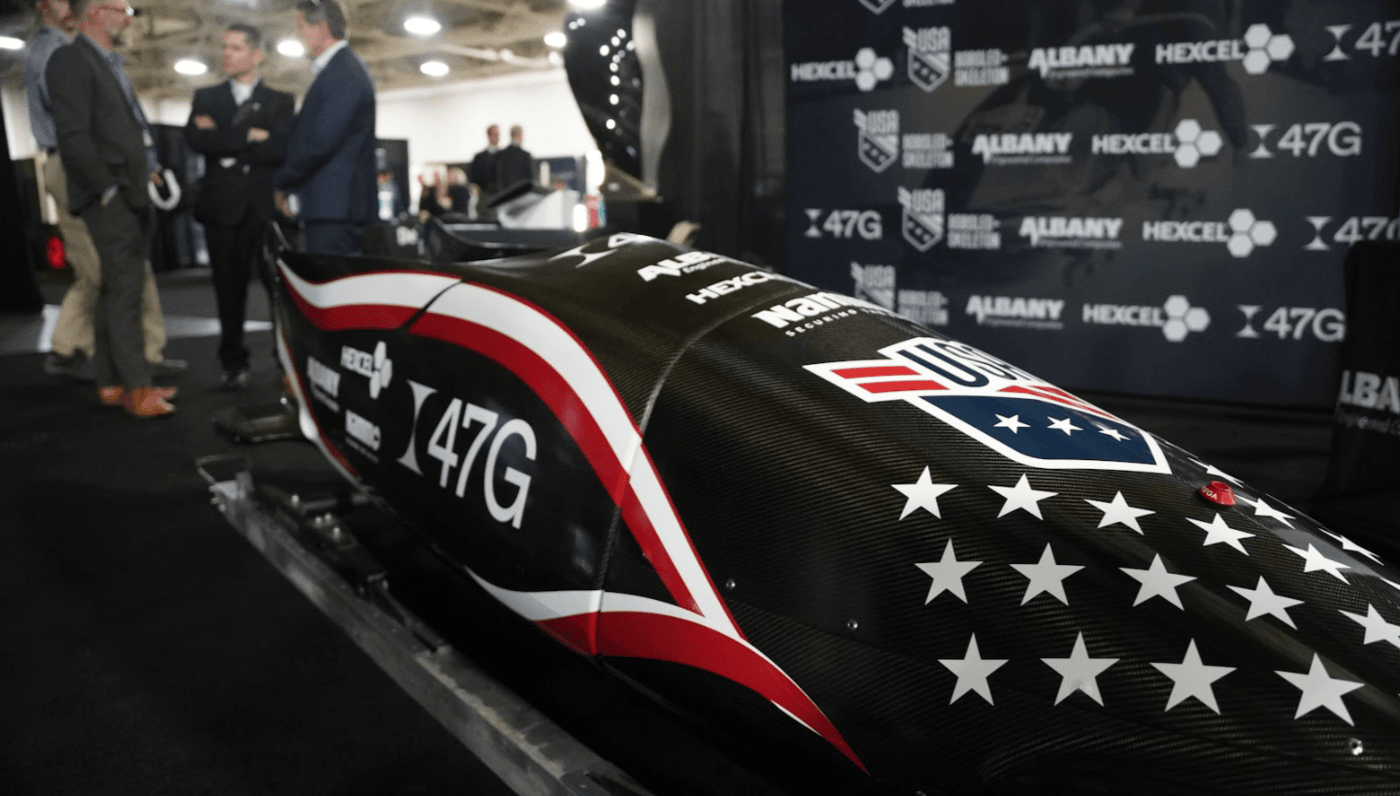
The Team USA bobsled displayed at 47G’s Zero Gravity Summit features a carbon-fiber composite construction, reflecting the advanced materials and manufacturing expertise behind the project. Albany Engineered Composites is leading the sled’s design and manufacture, Hexcel is contributing advanced composite materials expertise, and Nammo Composite Solutions is producing carbon-fiber cowlings for the two-man sleds. Photo: Mark Tullis, TechBuzz
Hexcel, headquartered in Stamford, CT with a major global carbon-fiber and composite-material manufacturing site in West Valley City, Utah, housing the company's North American research and technology center, will contribute its expertise in advanced composite materials.
Nammo Composite Solutions will design and manufacture carbon-fiber cowlings for Team USA's two-man bobsleds. Part of Nammo, headquartered in Raufoss, Norway, Nammo Composite Solutions is located in Salt Lake City and specializes in composite structures and assemblies for aerospace and defense.
The division of responsibilities illustrates how specialized capabilities can be brought together to address a complex engineering challenge. Rather than relying on a single manufacturer to provide every element, USABS is assembling an ecosystem of partners whose expertise spans materials, design and production.
The collaboration also reflects the broader technology ecosystem supporting the organization. Snowflake of Menlo Park, CA, is a technology partner to the project providomg data analytics, reviewing information gathered during training and competition and supplying feedback to the team. Technology partnerships are not limited to the construction of the sled. Analytics, recruiting and athlete preparation offer additional opportunities for innovation.
Utah's Olympic Opportunity
The partnership comes as Utah prepares to host the Olympic and Paralympic Winter Games in 2034. USABS athletes already train and compete at Utah Olympic Park in Park City, creating a natural connection between the state's winter sports infrastructure and its advanced manufacturing and aerospace industries.
For 47G, the collaboration demonstrates how Utah's Olympic legacy can extend beyond hosting world-class competition.
Aaron Starks, president and CEO of 47G, addresses attendees at the organization’s Zero Gravity Summit on Oct. 28, 2026. The summit brought together Utah’s aerospace, defense and advanced-manufacturing community to explore opportunities for collaboration and highlight the technologies and capabilities shaping the state’s hard-tech ecosystem. Photo: daniandcophotos
"Utah has spent decades building an ecosystem where advanced manufacturing, aerospace, research and entrepreneurship intersect," said Aaron Starks, president and CEO of 47G. "As we look toward 2034, we have an opportunity not only to host the world's best athletes, but also to showcase the technologies, companies and talent helping shape the future of performance and innovation."
The newly announced partnership is intended to support Team USA through two Olympic cycles, 2034 and 2038. That creates a long-term opportunity for the participating companies to apply their engineering and manufacturing capabilities to the evolving demands of elite bobsled competition.
The work also offers a proving ground for technologies developed in Utah's aerospace and defense sectors. Advanced composites that have helped engineers reduce weight and improve performance in aircraft and other complex systems can now be applied to a vehicle racing down an icy track.
For the athletes, the objective is simpler: a sled that is lighter, stronger, more predictable and better suited to the people driving it.
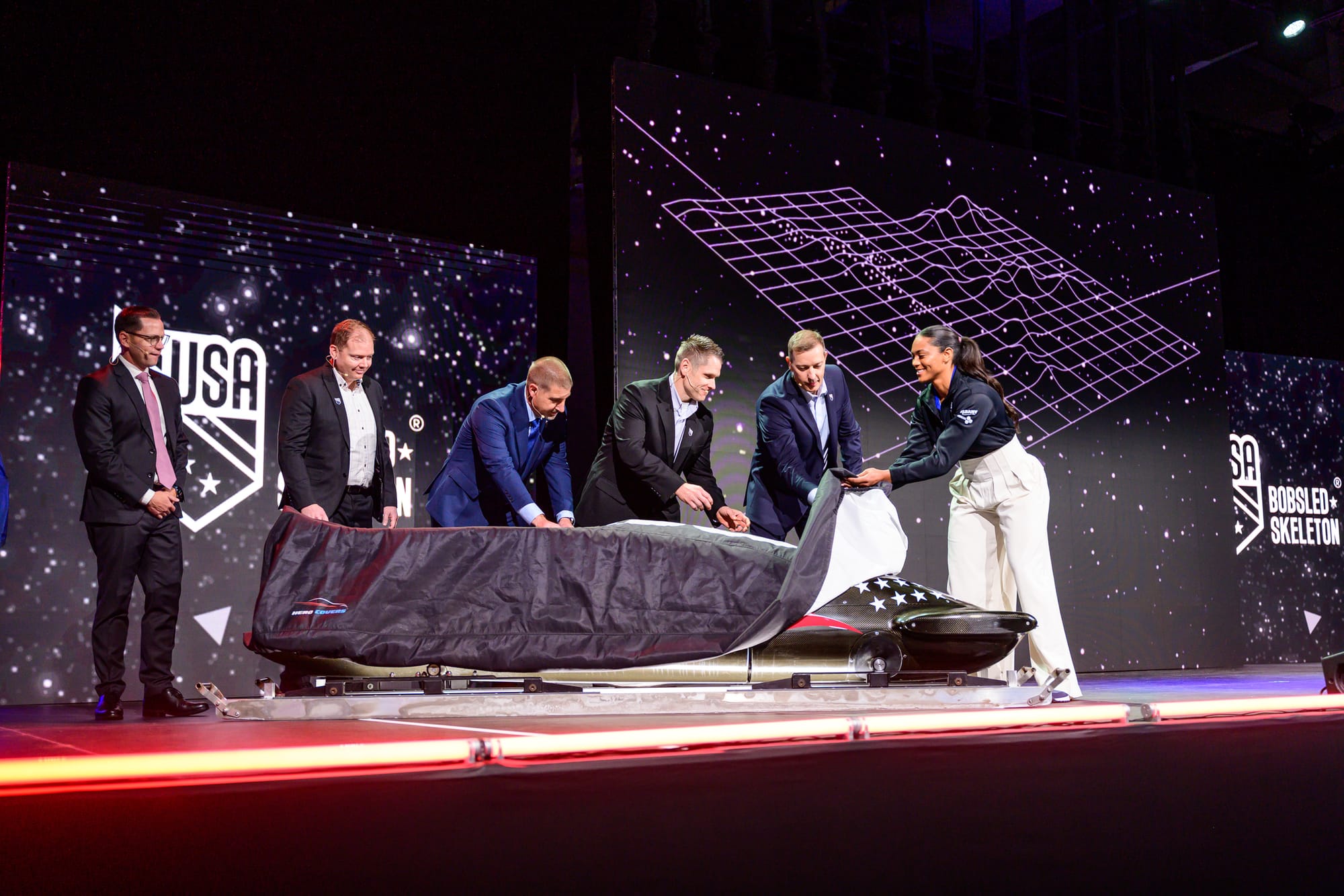
Kesha Love, Team USA bobsled pilot and two-time Olympian, joins Aron McGuire, CEO of USABS, Aaron Starks, CEO of 47G, and industry partners in unveiling the next-generation Team USA bobsled at the Zero Gravity Summit on Oct. 28, 2026. The sled represents a collaboration among USA Bobsled and Skeleton, Albany Engineered Composites, Hexcel and Nammo Composite Solutions to bring aerospace materials and manufacturing expertise to Olympic competition. Photo: daniandcophotos
But getting there requires the integration of materials science, aerodynamics, manufacturing precision, data and human performance.
As Love's comparison to a fighter jet suggests, the underlying engineering challenges are not as different as they might appear. The environment changes, but the demand for precision, strength, efficiency and control remains.
In the race toward 2034, Utah's aerospace companies have found an unexpected new proving ground.