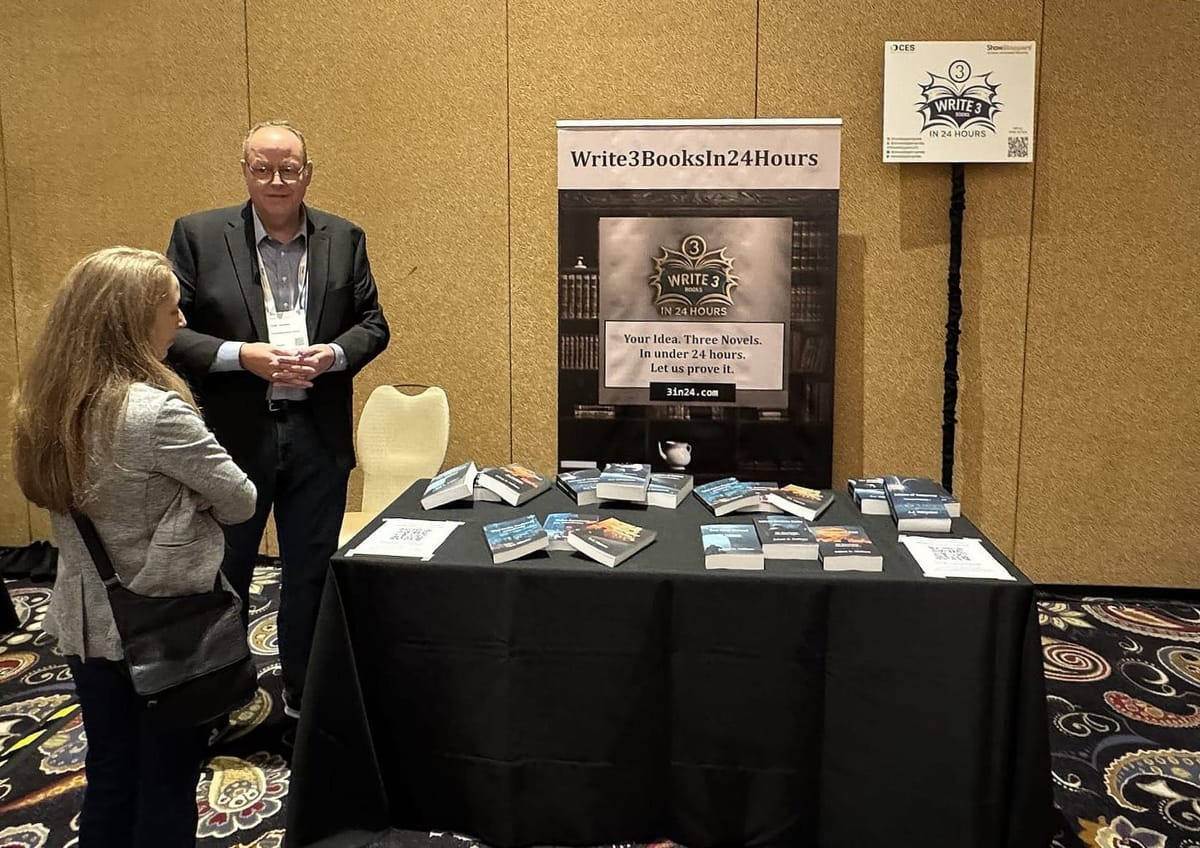
Founder Tyler Jensen built FictionForge (Provo, UT) to solve AI’s hardest storytelling problem: sustaining narrative coherence across long-form fiction, using engineered structure to help creators turn unrealized story ideas into finished novels.
Most AI writing tools break down somewhere between chapter three and character consistency. Plot threads fray, characters forget their own histories, and the internal logic that gives a novel its credibility quietly collapses. Tyler Jensen decided to attack that failure point directly. The result is FictionForge, an AI-assisted storytelling platform designed not to write faster sentences, but to sustain coherent stories across entire books—and, when needed, entire series.
Formed in July 2025 and rebranded on January 20, 2026, Provo-based FictionForge is an AI-assisted media and entertainment company focused on a specific problem most generative writing tools avoid: long‑form narrative coherence. Where many platforms emphasize speed, volume, or stylistic mimicry, FictionForge is built around structure—story arcs, world rules, character continuity, and thematic consistency sustained across hundreds of thousands of words.
Tyler Jensen, Founder and CEO, FictionForge
The premise is straightforward but ambitious. Millions of people carry story ideas for years—characters, conflicts, imagined worlds—without ever turning them into finished work. Time runs out. Confidence falters. Skill gaps feel insurmountable. FictionForge exists to reduce that friction, not by replacing authorship, but by engineering a system that helps ideas survive the long march from premise to completed narrative.
“The hardest part of writing a novel isn’t having ideas,” Jensen shared with TechBuzz. “It’s sustaining discipline, structure, and clarity over time. Most people don’t fail creatively. They fail logistically.”
Jensen’s path to this problem was not linear. A Utah native, he earned a degree in English with an emphasis on technical writing from Utah State University. He began his career as a technical writer, a role he held for nearly a decade, learning to translate complex systems into clear, usable documentation. That early discipline—clarity, structure, audience awareness—would later become central to his approach to software design.
From there, Jensen transitioned into software engineering and systems architecture, building a long technical career across fintech, healthcare, identity services, and consumer technology. As a principal software engineer at Ancestry.com, he developed patented in‑memory graph and data‑processing solutions capable of operating across billions of records. He also served as a chief architect and CTO‑level advisor to multiple startups, recruiting engineering teams and delivering production‑grade platforms from concept through scale.
What distinguishes Jensen among technologists is not enthusiasm for artificial intelligence, but restraint. He is explicit that tools do not create meaning. People do. Technology’s role, as he frames it, is to reduce friction between intent and execution.
That framing became critical when Jensen began experimenting with large language models and creative writing. Like many technologists with literary backgrounds, he tested whether AI could meaningfully assist long‑form fiction. The results were familiar: short passages worked; full novels collapsed. The failure was not prose quality, but memory. Characters drifted. Rules were violated. Narrative logic eroded.
“Can AI be tamed to write long‑form fiction well?” Jensen asked himself. He did not think so. But instead of abandoning the idea, he approached it as an engineering challenge. If coherence failed at scale, the system needed structure—not more prompts.
The earliest versions of FictionForge focused on solving the hardest problem first: sustaining a story arc across a full trilogy. That decision ran counter to market logic but aligned with Jensen’s engineering instincts. If a system could manage three interwoven books without losing continuity, a single novel would be trivial by comparison.
At the core of the platform is what FictionForge calls its Story Profile: a structured representation of a narrative before a single chapter is generated. Rather than prompting an AI to “write a novel,” users build a blueprint—premise, characters, settings, world rules, themes, tone, pacing, and intended audience. This profile functions as a living story bible, governing what the system can and cannot do.
In its latest iteration, launched this week, FictionForge has expanded that concept into a full Story Profile Editor, transforming what was once a static intake process into an iterative collaboration between creators and multiple AI tools. The Wizard expands even minimal ideas into a complete story blueprint. The Advisor operates like a developmental editor, helping resolve plot weaknesses or clarify character motivations. A Review tool evaluates consistency, pacing, and genre alignment before generation begins. Section Enhancement tools allow creators to deepen individual elements—world‑building, backstory, thematic layers—without destabilizing the overall narrative.
“Maintaining narrative consistency across one novel is hard,” Jensen said. “Doing it across multiple books is exponentially harder. Without coherence, nothing else matters.”
Once a Story Profile is approved, FictionForge’s generation engine—internally referred to as BookBuilder—executes a multi‑stage pipeline. It profiles the intended authorial voice, checks consistency across hundreds of thousands of words, applies genre‑specific logic, and performs multi‑pass quality assurance. The result is not a draft in need of wholesale repair, but a complete narrative that users can revise, edit, and publish as they see fit.
Importantly, the Story Profile Editor itself is free. Users pay only when they choose to generate books, a decision Jensen says was deliberate. Skepticism, he believes, should be met with transparency, not lock‑in.
The platform now supports flexible scope. Users can generate a single book for $59, a two‑book arc for $99, or a three‑book series for $129. First‑time users receive a one‑time $59 credit, allowing them to create a single book at no cost or apply a discount to a larger project. The change reflects a recognition that not every idea wants to be a trilogy.
That shift is also reflected in the company’s recent rebrand. Originally launched as Write3BooksIn24Hours, the name emphasized speed and output—an intentional provocation, but also a constraint. FictionForge, Jensen said, better reflects the platform’s philosophy.
“A forge is where raw material becomes something lasting through skill and intention,” he explained. “The creator brings the imagination. We bring the tools. The result is something neither could produce alone.”
The new name also aligns with FictionForge’s positioning. The platform is not aimed at professional authors seeking literary prestige, nor is it framed as a replacement for the craft of writing. Instead, it targets story lovers—people who care about narrative but lack the time, confidence, or technical skill to execute at scale.
FictionForge currently supports more than 20 fiction genres, including romance, fantasy, science fiction, mystery, thriller, and literary fiction, for both adult and young adult readers. According to the company, early users have already generated dozens of novels and multi‑book arcs, with more than 25 books available for free download or online reading through the platform.
Jensen expects skepticism. He welcomes it.
“The fastest way to address skepticism is to let people see what the system can produce,” he said.
That confidence does not stem from claims about creativity, but from architecture. FictionForge is less interested in sounding like a writer than in behaving like an editor—tracking rules, enforcing constraints, and refusing to let a story forget itself.
Outside of his professional work, Jensen is also an accomplished landscape photographer, having captured tens of thousands of images from remote locations around the world. The connection, he says, is not accidental. Both disciplines reward patience, structure, and respect for constraints.
FictionForge is owned and operated by Ioka LLC, a Utah‑based company focused on creative technology. Whether the platform ultimately reshapes how fiction is produced remains an open question. What is clear is that it approaches AI not as a shortcut to authorship, but as an engineering problem—one that treats coherence as a first‑class requirement rather than an afterthought.