A Utah Founder’s Bet on Determinism in a Quantum Age
Resolve Integration Technologies (Roy, UT) uses DOS 2.0™ and the 10th Floor™ interlock to enforce deterministic, auditable AI decision-making, bridging probabilistic outputs with physical safety and post-quantum trust.
Justin Maughan and Dan McLean, Co-Founders of Resolve Integration Technologies, Roy, Utah
Justin Maughan and Dan McLean, Co-Founders of Resolve Integration Technologies, Roy, Utah
January 22, 2026 — Roy, Utah
As artificial intelligence moves into high-stakes domains—from finance and robotics to critical infrastructure—questions about reliability and trust have become urgent. Probabilistic AI models, which make decisions based on likelihood rather than certainty, can be fast and flexible—but even a small error can have catastrophic consequences when physical systems or financial transactions are involved.
Weber County entrepreneur Dan McLean is taking a decisive stance: AI may be powerful, but it must be bound by deterministic guardrails to ensure safety, compliance, and predictability—especially as quantum computing threatens current security frameworks.
From Invention to Infrastructure
McLean is Co-founder of Resolve Integration Technologies, a Roy, Utah-based startup behind DOS 2.0™, a deterministic orchestration engine, and 10th Floor™, a hardware-based safety interlock. The technologies are designed to ensure that AI decisions cannot trigger unsafe or non-compliant actions.
“I’m not coming at this as a career quantum physicist,” McLean said. “I’m coming at it as someone who looks at systems and asks where they break under stress.”
McLean’s entrepreneurial history spans decades, from founding Quantum Marketing in 1989 to inventing the Porchie™ Delivery Box, a secure package solution for last-mile logistics. His exposure to AI as a tool for product development led him to ask bigger questions about reliability, safety, and the looming risks of quantum-level threats.
“Once quantum computing reaches a certain threshold, a lot of the encryption we rely on becomes questionable,” he said. “The challenge isn’t just security—it’s trust.”
Deterministic Orchestration: How DOS 2.0 Works
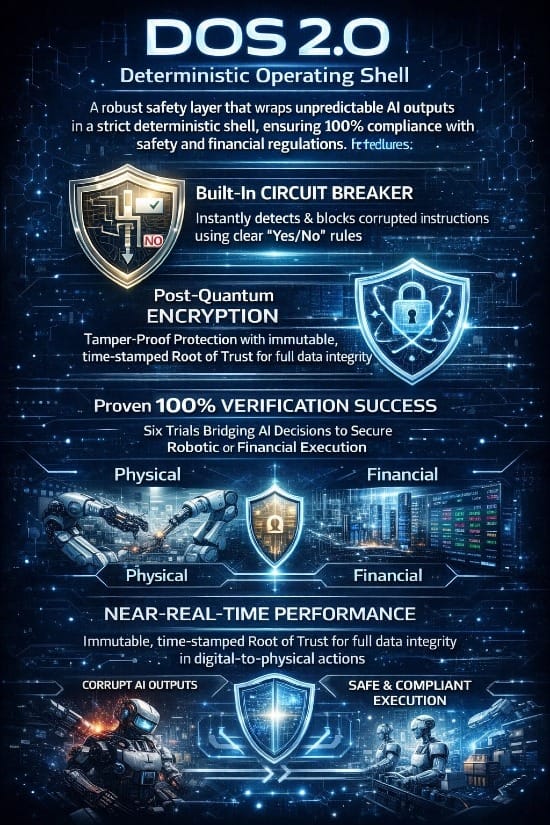
At its core, DOS 2.0™ acts as a deterministic shell around probabilistic AI outputs. Probabilistic AI can still generate predictions or suggestions, but only actions that meet strict, predefined logical and cryptographic rules are allowed to execute.
Boolean Invariant Shell (BISTM): Ensures every output obeys fixed logic, rejecting randomness or drift.
Newtonian Circuit Breaker™: Blocks corrupted or noisy signals before they reach the real world.
QuPINTM Evidence Bus: Records each decision with post-quantum cryptography, creating an immutable, auditable trail.
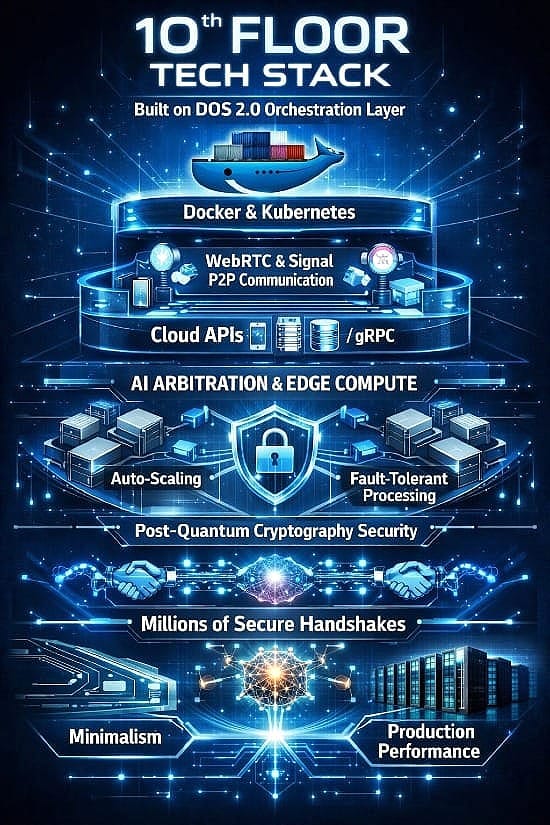
10th Floor™ Physical Interlock: Independent hardware that mechanically isolates systems during faults, with a sub-millisecond trigger response.
“Think of it as a Newtonian circuit breaker,” McLean explained. “If the rules are met, the transaction passes. If not, it doesn’t. There’s no guessing and no improvisation at that layer.”
Testing and Results
Resolve has conducted internal tests to validate determinism, platform consistency, fault tolerance, physical safety, and reproducibility. The system was executed across multiple devices, operating systems, and runtime environments, including laptops, desktops, mobile devices, browser-based runtimes, and Python servers.
Key findings include:
Deterministic Consistency: Identical inputs produced identical outputs over 10,000+ test cycles.
Cross-Platform Reliability: Results were consistent across hardware architectures (x86 and ARM) and operating systems.
Probabilistic Override: Conflicting AI outputs were fully overridden by deterministic rules, with no averaging or majority voting.
Timing and Load Independence: Execution speed—fast, slow, or burst—did not affect decisions.
Safe Failure: System fails closed when faults occur; no unsafe actions were observed.
Physical Safety: The 10th Floor™ interlock successfully isolated systems under simulated 10 GW grid faults within 0.2–0.9 milliseconds.
“By separating probabilistic reasoning from execution authority, the system avoids hallucination, drift, and platform-dependent behavior,” McLean said. “The physical safety mechanisms act independently, providing a layer of protection that software alone can’t guarantee.”
Keeping Humans in the Loop
Despite the automation, McLean emphasizes that humans remain central to decision-making. Transactions that fail deterministic checks are automatically escalated for human review.
“A 99-percent success rate sounds good until you’re dealing with physical machines around vulnerable people,” he said. “Even a single failure can be too costly.”
The Team Behind the Technology
Resolve’s founding team combines entrepreneurial experience, technical skill, and practical operational insight:
Dan McLean: Serial entrepreneur, inventor, and lead developer. Experienced in physics-driven system analysis and real-world problem solving.
Justin Maughan: Engineer and licensed electrician, bringing hands-on infrastructure expertise. Co-inventor of DOS 2.0™ and 10th Floor™.
Miranda L. Yeaman: Entrepreneur and systems contributor, focusing on human-centered design and operational safety. Co-inventor of both technologies.
Looking Ahead
Resolve Integration Technologies is still early-stage, and its claims have yet to be independently verified. Deterministic orchestration faces challenges, particularly in highly complex, distributed environments. Post-quantum cryptography is also maturing, and hardware-based safeguards bring their own operational and supply-chain risks.
McLean is realistic about these limits: “Nothing is future-proof forever. The goal isn’t perfection—it’s systems that fail safely, transparently, and under human control.”
Whether deterministic orchestration becomes a mainstream approach or remains a niche solution, the questions Resolve is addressing—trust, verification, and governance in an AI-driven world—are increasingly urgent.