Utah Declares February as Tech Month, Signaling a Maturing Innovation Ecosystem
Utah leaders unveiled February as Tech Month, highlighting Silicon Slopes’ role, state–industry collaboration, and a pro-human approach to innovation driving one of the nation’s fastest-growing tech ecosystems.
Jefferson Moss, executive director of the Utah Governor’s Office of Economic Opportunity (GOEO), onstage at Silicon Slopes SUMMIT, February 5, 2026, Salt Palace
Jefferson Moss, executive director of the Utah Governor’s Office of Economic Opportunity (GOEO), onstage at Silicon Slopes SUMMIT, February 5, 2026, Salt Palace
Salt Lake City, Utah - February 5, 2026
Utah’s technology sector has spent the past decade proving it can compete nationally. Now, state leaders are moving to formalize that momentum.
Speaking at a Silicon Slopes SUMMIT 2026, Jefferson Moss, executive director of the Utah Governor’s Office of Economic Opportunity (GOEO), announced that February will be recognized statewide as “Tech Month”—a coordinated effort to align Utah’s many tech events, communities, and initiatives under a single banner.
Introducing Moss, Silicon Slopes COO Tiffany Vail and Visit Salt Lake chief development officer, Krista Parry, framed Utah’s rise as an innovation economy as the product of intentional leadership and long-term collaboration. “Utah has become one of the fastest-growing innovation economies in the country,” said Parry said, pointing to the systems that support founders, investors, and emerging talent at scale. She credited Moss with helping shape those systems—spanning startups, investment, and statewide innovation strategy—setting the stage for his remarks on Utah’s next phase of growth.
Tiffany Vail, chief operating officer of Silicon Slopes, and Krista Parry, chief development officer at Visit Salt Lake, introduce Jefferson Moss at the Silicon Slopes Summit, highlighting Utah’s rapid rise as an innovation economy driven by leadership, collaboration, and systems built to support startups at scale.
The move reflects what Moss described as a rare convergence of activity across the state’s innovation economy.
“I’ve had the opportunity just this week to be at the FinTech Exchange, Utah Tech Week, and a number of other events,” Moss said. “As I talk to all these different groups, the thing that resonates with all of them is that we’re all part of building Utah.”
Rather than treating these gatherings as isolated moments, Moss said the state is leaning into the overlap—positioning February as a focal point for celebrating, connecting, and accelerating Utah’s tech ecosystem.
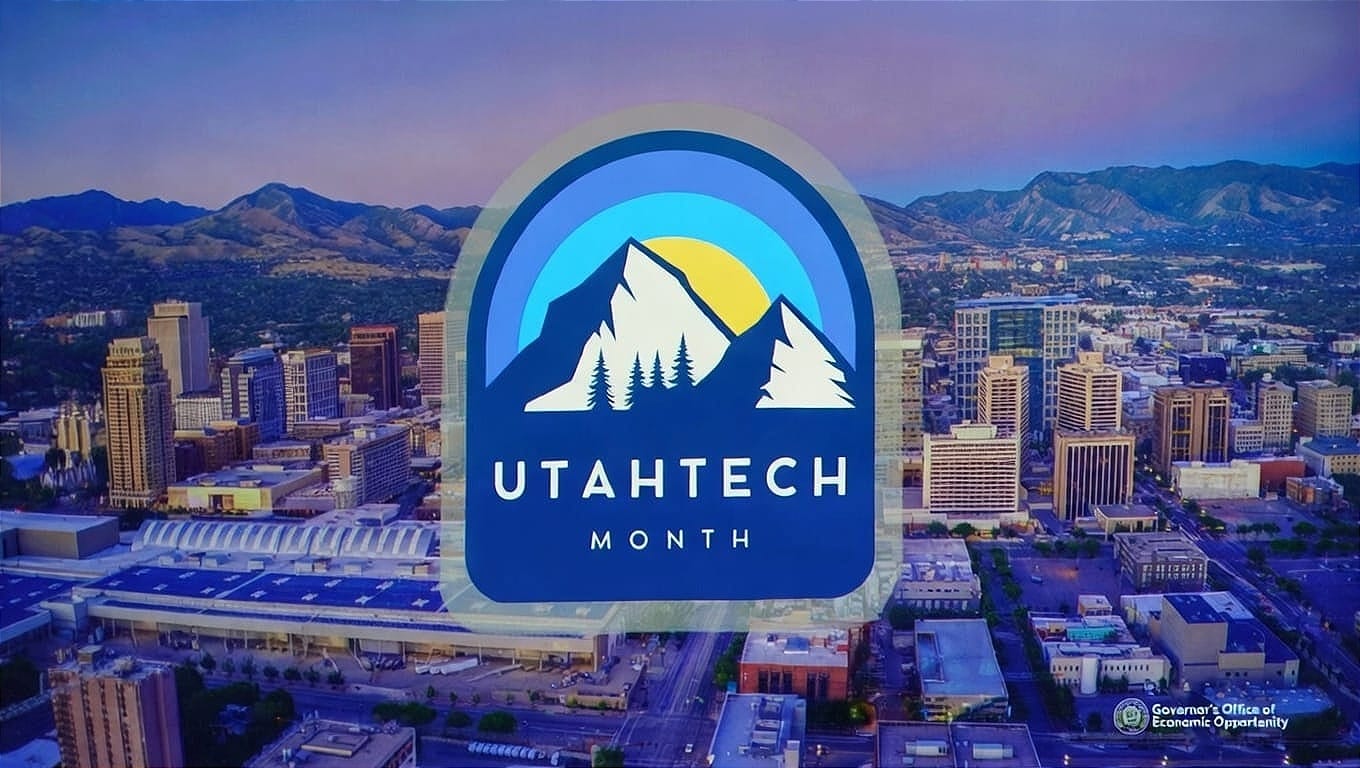
Utah Tech Month branding unveiled: The new mark highlights the state’s growing technology ecosystem—blending innovation, quality of life, and collaboration—as Utah designates February as Tech Month to unify and showcase its tech community statewide.
From Momentum to Movement
Moss framed Tech Month as a recognition that Utah’s tech community has reached critical mass. Over the past five years, he noted, Utah’s tech ecosystem has grown by roughly 10 percent—at a time when many regions across the country have slowed.
“We are bucking the trend across the nation,” he said, crediting entrepreneurs, founders, investors, and support organizations for sustaining that growth.
He singled out Silicon Slopes as a key driver—not just for convening leaders, but for shaping how Utah is perceived beyond its borders.
“When we travel to other states and countries, we ask what we can learn from them,” Moss said. “Without fail, they say, ‘Why are you talking to us? We should be coming to Utah.’ And specifically, they talk about Silicon Slopes.”
That external validation, Moss suggested, is the result of intentional brand-building paired with real economic substance.
An Ecosystem That Lowers the Barrier to Entry
One of the most striking elements of Moss’s remarks was his emphasis on who the ecosystem serves. He pointed to the mix of billion-dollar company CEOs, early-stage founders, students, and first-time attendees in the room.
“Some of you probably have no idea why you’re even here today—you just decided to show up,” he said. “And something could spark in your head to say, ‘I can do that too. I can be an entrepreneur.’”
That accessibility, Moss argued, is Utah’s real competitive advantage—what he described as social capital: multiple ecosystems working together rather than in silos.
Government’s Role: Build, Don’t Replace
Moss was careful to draw a line around government’s role in economic development.
“Government doesn’t create jobs,” he said. “We help support it.”
Jefferson Moss, executive director of the Utah Governor’s Office of Economic Opportunity (GOEO), onstage at Silicon Slopes SUMMIT, February 5, 2026, Salt Palace
He tied Utah’s tech growth to Governor Spencer Cox’s broader “build” agenda—focused on housing, energy, workforce development, and infrastructure—arguing that innovation ecosystems cannot thrive without the physical and human foundations beneath them.
He also highlighted Utah’s long-standing collaboration between government, education, and industry, calling it essential to sustaining innovation at scale.
“We have a government focused on a low regulatory environment,” he said, “education leaders who understand economic development, and industry that works closely with both.”
Quality of Life as an Economic Strategy
Perhaps Moss’s most revealing insight was his framing of Utah’s outdoor and cultural assets as core economic drivers.
According to a recent survey cited by GOEO, 85 percent of people in Utah’s tech ecosystem said the state’s outdoor environment influenced their decision to come, stay, or build a business here.
The survey was conducted by the Kem C. Gardner Policy Institute, a research organization at the University of Utah, in partnership with Utah Outdoor Partners and distributed with help from Silicon Slopes. It sampled tech employees from a broad cross-section of companies and highlighted that outdoor recreation—trails, skiing, canyons, public lands—plays a decisive role in where tech workers choose to live and build their careers.
“That’s a big part of our economy, even if we don’t always talk about it that way,” Moss said.
As part of Tech Month and beyond, the state plans to more deliberately connect outdoor recreation, arts, and creative industries with the innovation economy—what Moss referred to as the “experience economy.”
A Pro-Human Approach to Technology
Moss closed by reinforcing Utah’s commitment to what he called a “pro-human” approach to innovation, referencing the governor’s recent initiatives around human-centered AI.
The goal, he said, is to remain aggressive about innovation while protecting human dignity and opportunity.
Tech Month, in that context, is less about hype than alignment.
“This is about recognizing what’s already happening,” Moss said, “and building it together.”
Share this article
The link has been copied!
Your link has expired. Please request a new one.
Your link has expired. Please request a new one.
Your link has expired. Please request a new one.
Great! You've successfully signed up.
Great! You've successfully signed up.
Welcome back! You've successfully signed in.
Success! You now have access to additional content.