Not Advocacy, Just Answers: Weber County Hosts Utah's Grassroots Nuclear Conversation
Weber County and the Utah Office of Energy Development hosted a grassroots nuclear symposium in Ogden, bringing together industry, regulators, policy-makers, and educators to inform and explore possibilities for potential nuclear energy development in Utah.
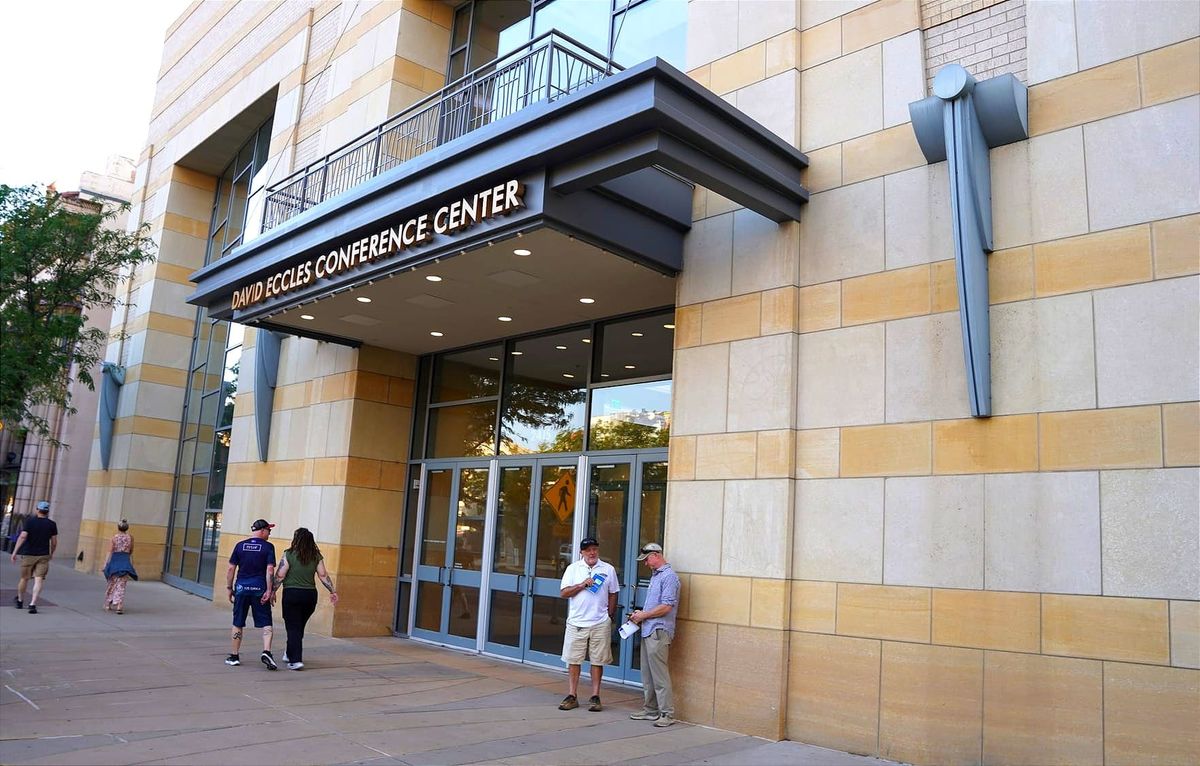
Before a single reactor design is chosen, before a site is selected, before any commitment is made, Weber County wanted its residents to have the facts. That was the explicit premise of a community symposium held Wednesday evening at the Ogden Eccles Conference Center, adjacent to the historic Egyptian Theater on Washington Boulevard, where county leaders, state energy officials, and a roster of nuclear industry executives, regulators-turned-entrepreneurs, and university researchers gathered for what organizers described as one of the first events of its kind in the county.
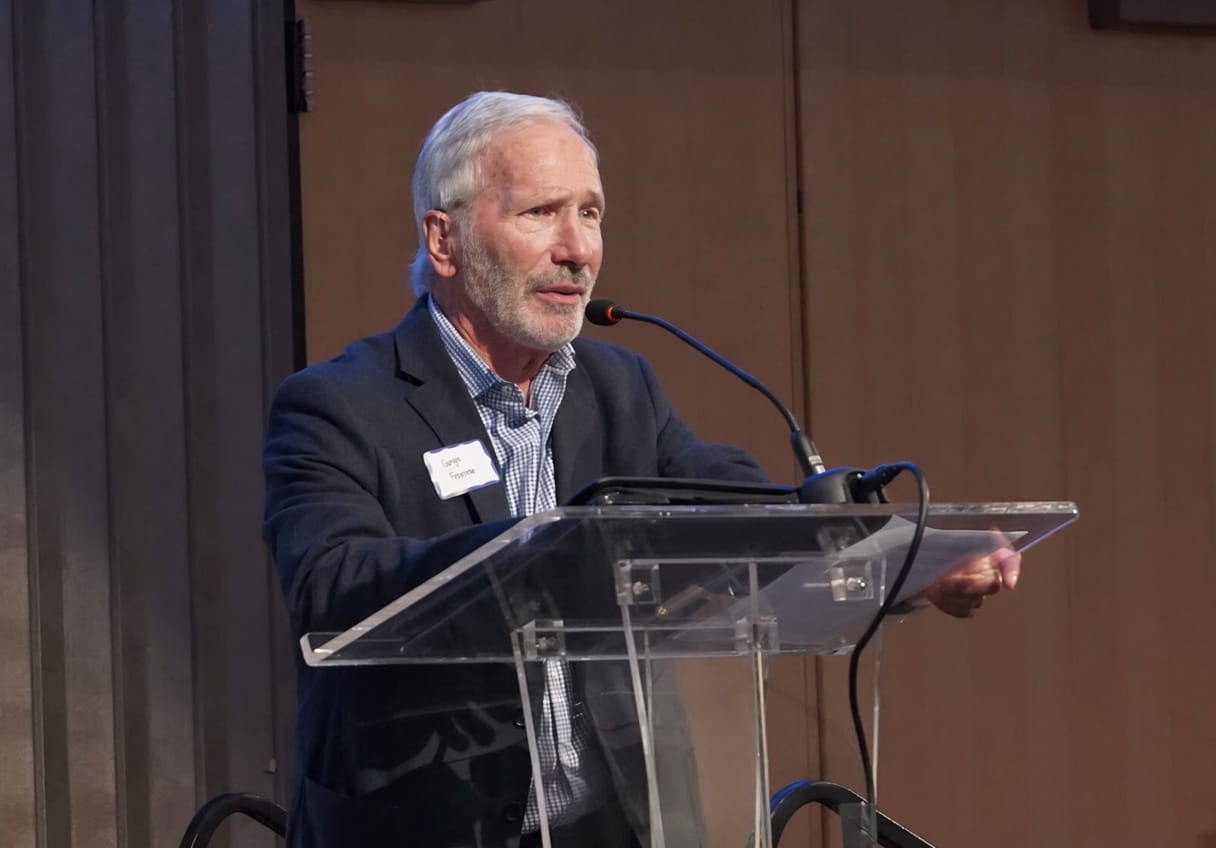
Gage Froerer, Weber County Commissioner, welcoming the audience to the Weber County community nuclear symposium in Ogden, August 5, 2026. Photo: Mark Tullis, TechBuzz
"This workshop, just as a reminder, is about two things: education and asking questions. It's not about advocacy," Weber County Commissioner Gage Froerer told the crowd in his opening remarks. "There's no decisions that would be made by Weber County or probably anybody else in this room today. No projects are going to be discussed."
The distinction mattered. Weber County, like much of the Wasatch Front, is growing fast, and Froerer framed the county's mission in blunt terms: attainable housing and work opportunities for residents "and for their kids and grandkids, and probably even their great-grandkids." Both, he said, depend on reliable, affordable energy that the county doesn't yet have a clear plan for securing.
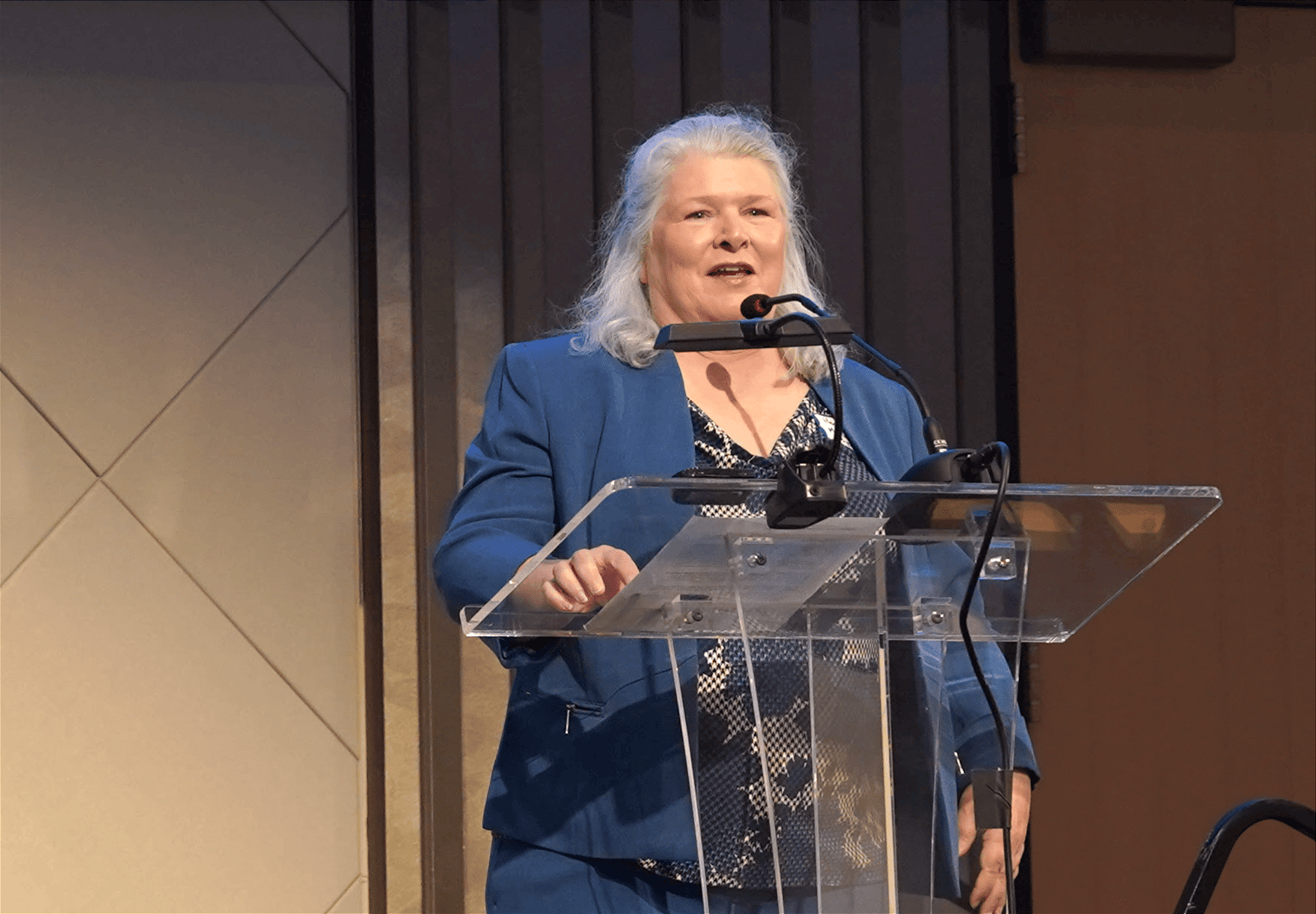
Stephanie Russell, Economic Development Director, Weber County. Photo: Mark Tullis, TechBuzz
The symposium was organized in partnership with the Utah Office of Energy Development (OED) as part of a statewide grassroots outreach effort. Stephanie Russell, Weber County's economic development director, credited OED for bringing the opportunity to the county "a couple months ago," calling the event a chance for "open and honest, transparent dialogue with our community about a very serious topic."
Operation Gigawatt Comes to Ogden
Heather McShane, public information officer for OED, used her remarks to connect the evening back to Governor Spencer Cox's 2024 Operation Gigawatt initiative, which she framed as a response to demand growth the state's grid isn't built to absorb. More electric vehicles, more connected devices, and hotter summers are all pulling harder on the system, she said, and Utah is responding by diversifying rather than betting on a single technology.
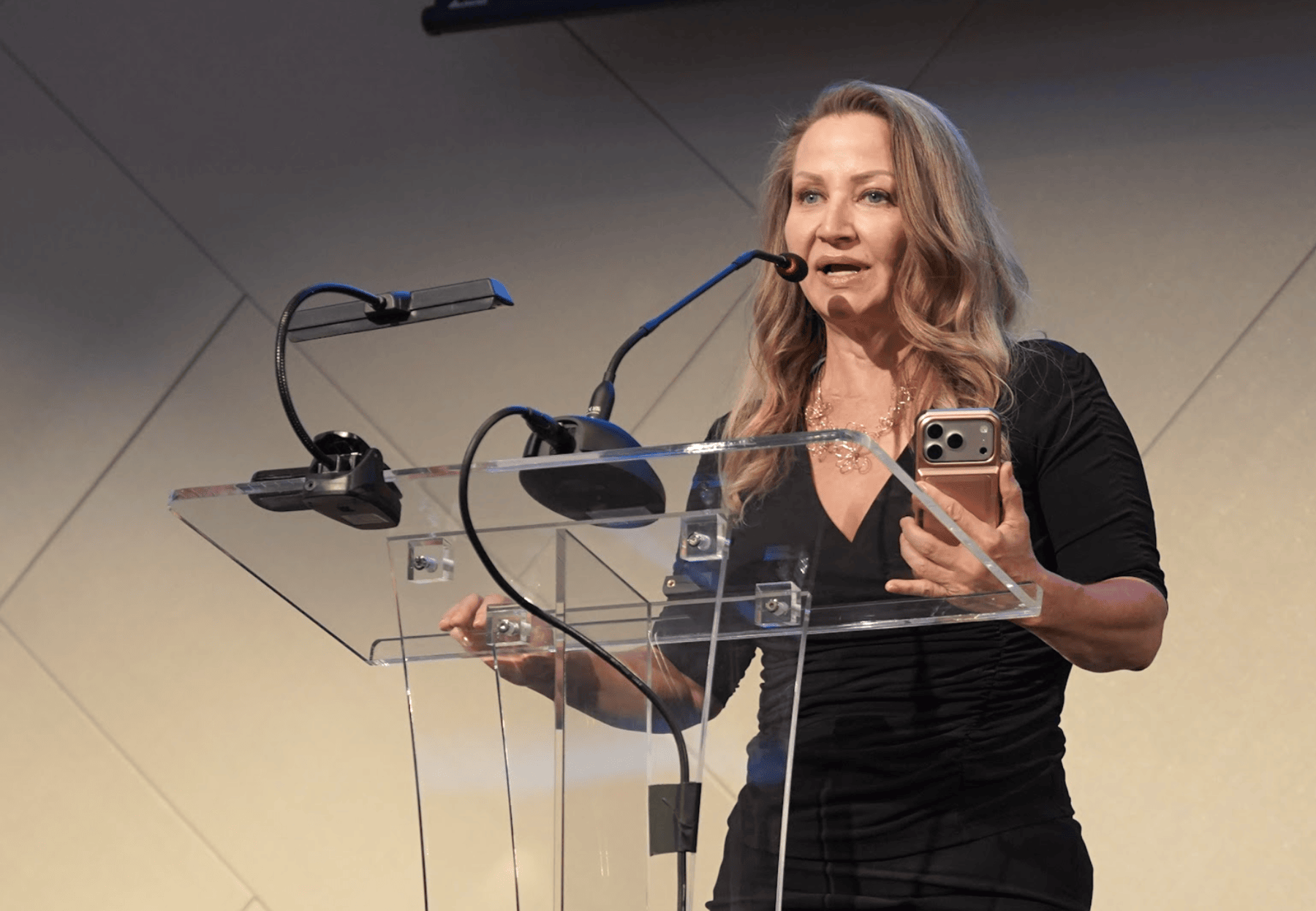
Heather McShane, Public Information Officer, Utah Office of Energy Development. Photo: Mark Tullis, TechBuzz
"We're exploring adding more geothermal power. We're looking at added battery storage and nuclear energy to our already robust coal, oil, and gas industries," McShane said, adding that OED is carrying the same conversation to all 29 Utah counties and tribal nations. "We are not here to promote industry, but we have industry experts available because they are the ones who are best suited to answer your specific technology questions."
That expert bench, assembled by moderator Shannon Kang of Envoy Public Labs, the firm running OED's statewide public education campaign, made up the evening's first panel: Nuclear Energy Development Feasibility.
What Actually Makes a Site "Feasible"
Ethan Bates, founder and CEO of Cambrian Nuclear, opened by explaining what goes into deciding whether a community is even a candidate for advanced nuclear. Bates, who holds a PhD from MIT and previously worked at TerraPower and the nuclear waste-siting firm Deep Isolation, said the technical checklist is extensive and federally mandated: seismic data, FEMA floodplain maps, topography, and, increasingly, water availability, since many advanced reactor designs no longer require the massive cooling infrastructure conventional light-water reactors depend on.
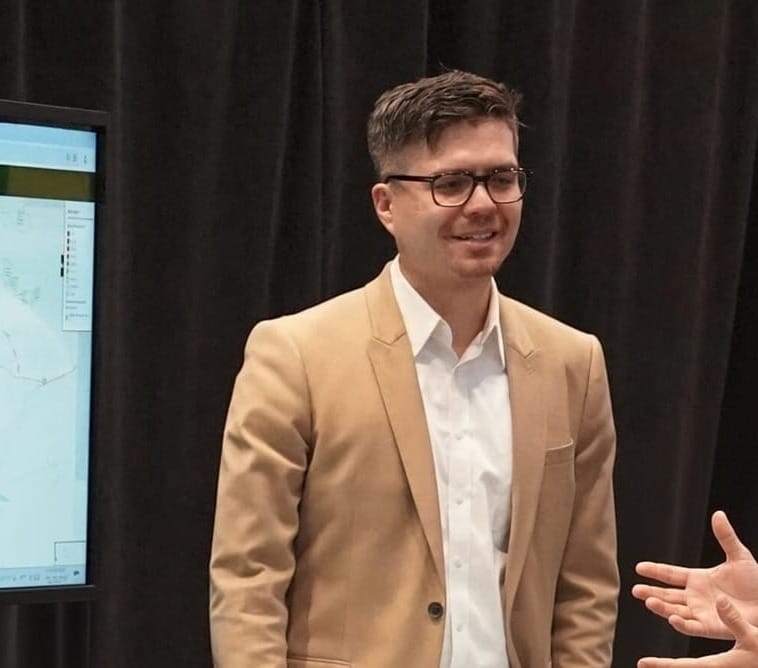
Ethan Bates, Founder and CEO of Cambrian Nuclear, at his booth in the exhibit hall. Weber County and Utah Office of Energy Development community symposium on nuclear energy, Ogden Eccles Conference Center, August 5, 2026. Photo: Mark Tullis, TechBuzz
"This is not a nice-to-have," Bates said. "This is a regulatory requirement. The NRC has applied this to reactors since the 1970s." His company, he said, is building tools to speed up and add transparency to a siting process that has traditionally been slow and consultant-driven.
John Battaglini, Westinghouse's Vice President of New Market Development & Sales for the Americas, gave the panel a global snapshot of the company's current pipeline: six operating AP1000 pressurized water reactors, 14 more under construction across China, Poland, and Bulgaria, and a U.S. push, tied to recent Department of Energy financing, to get ten new reactors under construction domestically by 2030. Westinghouse is also advancing its AP300 small modular reactor design toward regulatory approval and deploying its eVinci microreactor at U.S. military installations.
John Battaglini, Vice President of New Market Development & Sales for the Americas, Westinghouse, speaking on Panel I, "Nuclear Energy Development Feasibility," at Weber County's community nuclear symposium in Ogden, August 5, 2026. Photo: Mark Tullis, TechBuzz
Battaglini was candid about the lessons Westinghouse carried out of its Vogtle project in Georgia, the first new U.S. reactor construction in decades. Starting construction before a design is fully complete, he said, is a mistake the industry has learned not to repeat, even when a design has cleared NRC review. "Our top execs have said that we were about 10% complete when we got that DCD," he said, referring to the NRC's Design Control Document. Equally important, he said, is bringing constructors and communities into the process early rather than negotiating site by site. "You really got to get all parties around the table at the same time... the technology provider, the constructor, the off-taker, the utility, the community."
Mike Squires of the Utah Associated Municipal Power Systems (UAMPS) offered the utility's-eye view, framing the evaluation of any new generation resource around three factors: physics, environmental risk, and cost. Utah's air-permitting constraints, he said, make emissions-free baseload power attractive on regulatory grounds alone, while nuclear's high capacity factor helps offset the volatility utilities see in summer spot-market pricing. "What you're trying to do is, at the end of the day, come up with a balanced portfolio," Squires said — pairing cheap solar with dispatchable resources like natural gas and, potentially, nuclear.
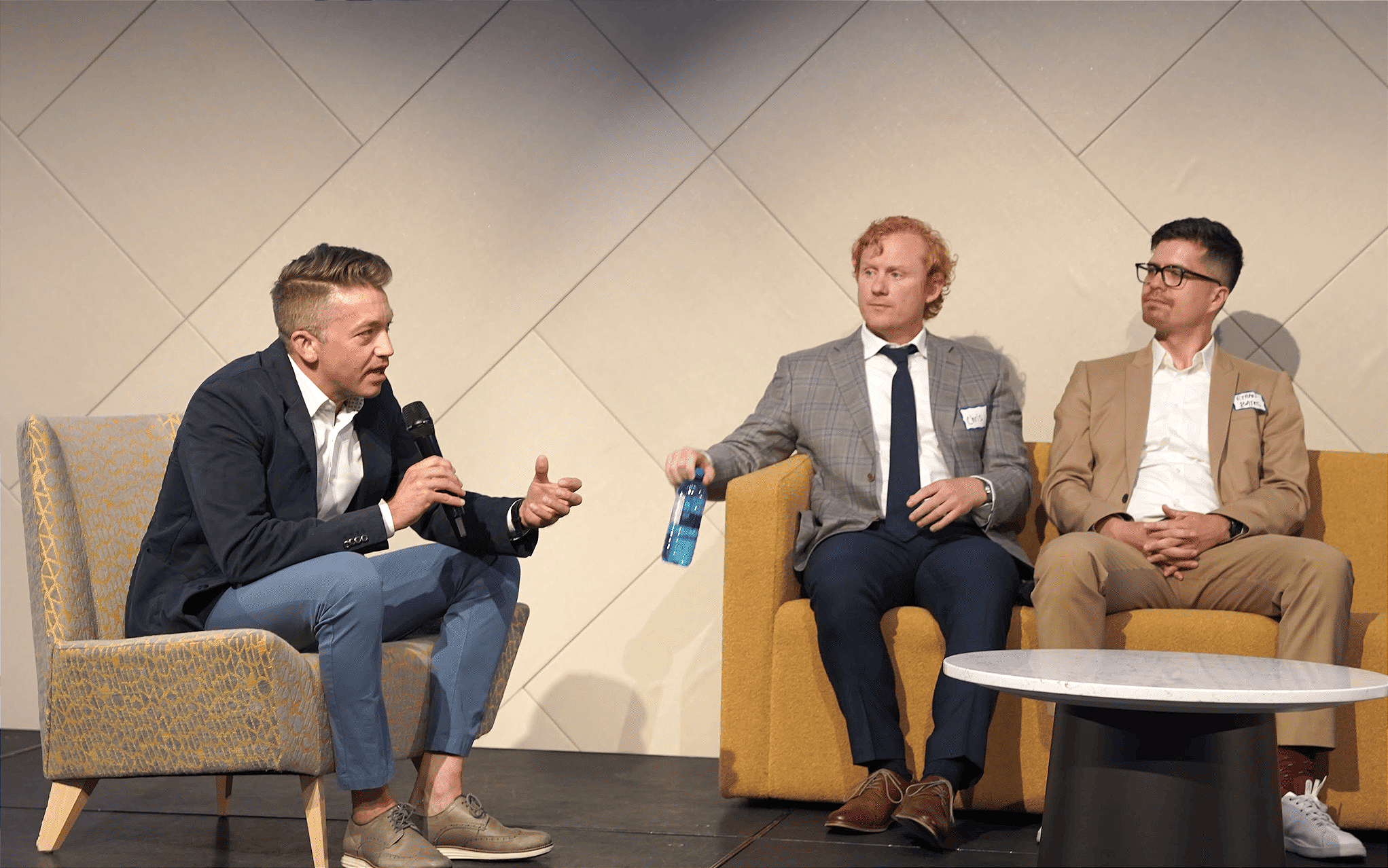
Mike Squires, Managing Director of Government Affairs/Attorney of UAMPS, addresses the audience during Panel I, "Nuclear Energy Development Feasibility," at Weber County's community nuclear symposium in Ogden, with fellow panelists Chris Hayter of Hi Tech Solutions & Fulcrum Point Holdings (center) and Ethan Bates of Cambrian Nuclear. Photo: Mark Tullis, TechBuzz
The Workforce Question, Twice
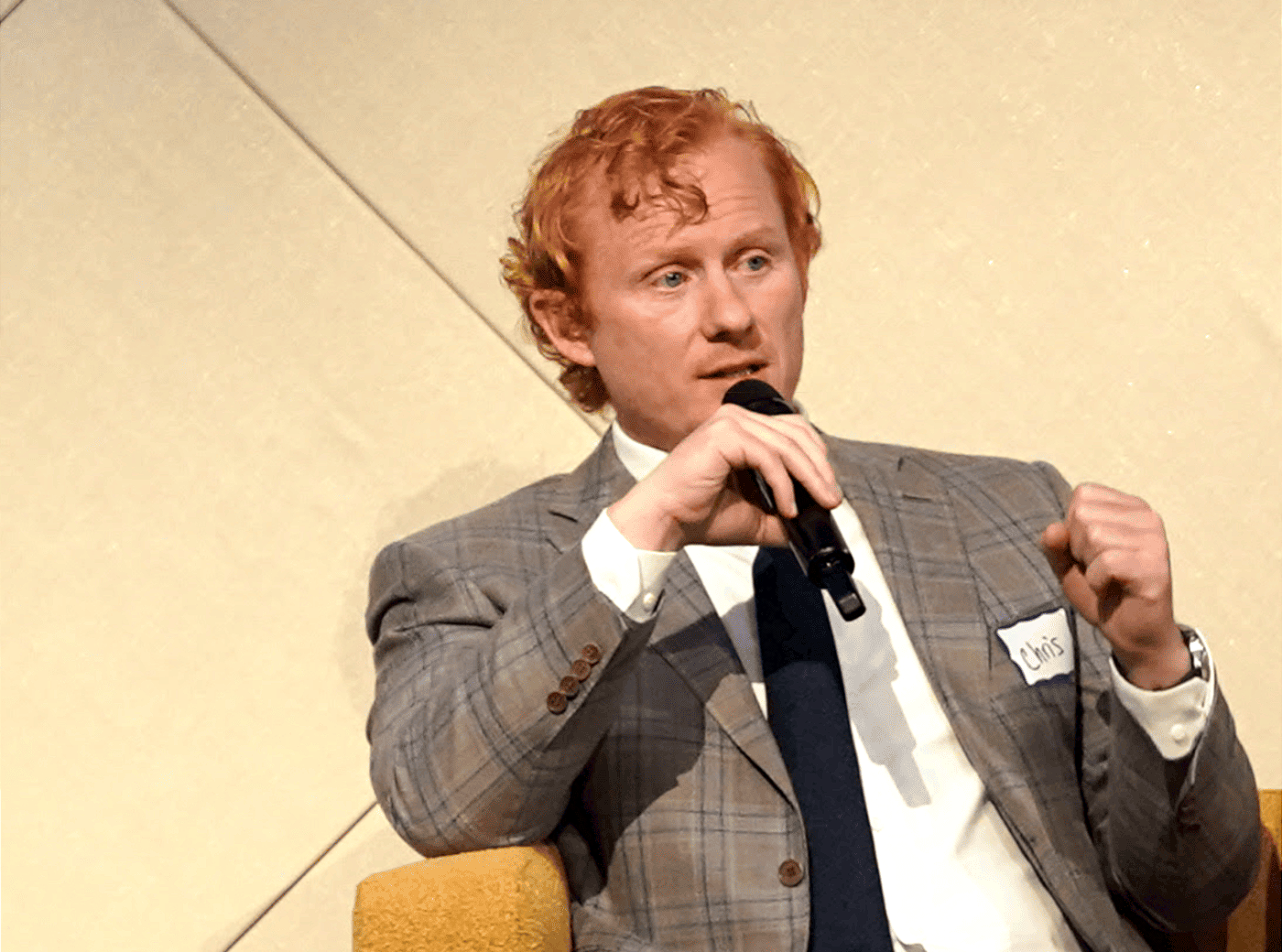
Chris Hayter, President, COO and Co-Founder and Hi Tech Solutions and Founder of Fulcrum Point Holdings, used his time to press a theme that would carry into the evening's second panel: Utah's nuclear ambitions are only as good as its trade and engineering pipeline. A Weber County resident of nearly two decades, a point that triggered applause from the audience, Hayter said workforce development was the subject of his very first conversation with Governor Cox on the topic.
Chris Hayter, President, COO and Co-Founder and Hi Tech Solutions, Founder of Fulcrum Point Holdings. Photo: Mark Tullis, TechBuzz
Hayter pointed to Fulcrum Point's active projects as evidence of momentum, a revived Blue Castle project in Green River, recently covered by TechBuzz and originally proposed years earlier as a NuScale small modular reactor development, and a Box Elder County announcement to deliver small modular reactors to Brigham City, alongside a new workforce and manufacturing campus planned at Utah State University's Brigham City location, which he said is set for a formal reveal on August 24. He also raised nuclear fuel storage as an economic opportunity for the state, arguing Utah should compete to host the nation's spent fuel in preparation for future recycling technology. "It's a travesty we don't do it already, and we're ready to do that," he said.
Michelle Zietlow-Miller of GAIN (the Department of Energy's Gateway for Accelerated Innovation in Nuclear) closed the panel by addressing public misconceptions head-on, citing the conflation of power-plant waste, which is solid or ceramic, with the liquid waste associated with Cold War-era weapons production. She also pointed attendees to the NRC's public meeting process as a concrete way to track and weigh in on licensing decisions, and noted that nuclear consistently ranks among the highest-paying industries by workforce size. "New nuclear. It's real. It's happening. It's safe, reliable, and it's financeable," she said in the panel's closing lightning round.
Building the Pipeline: From Eighth Grade to the PhD
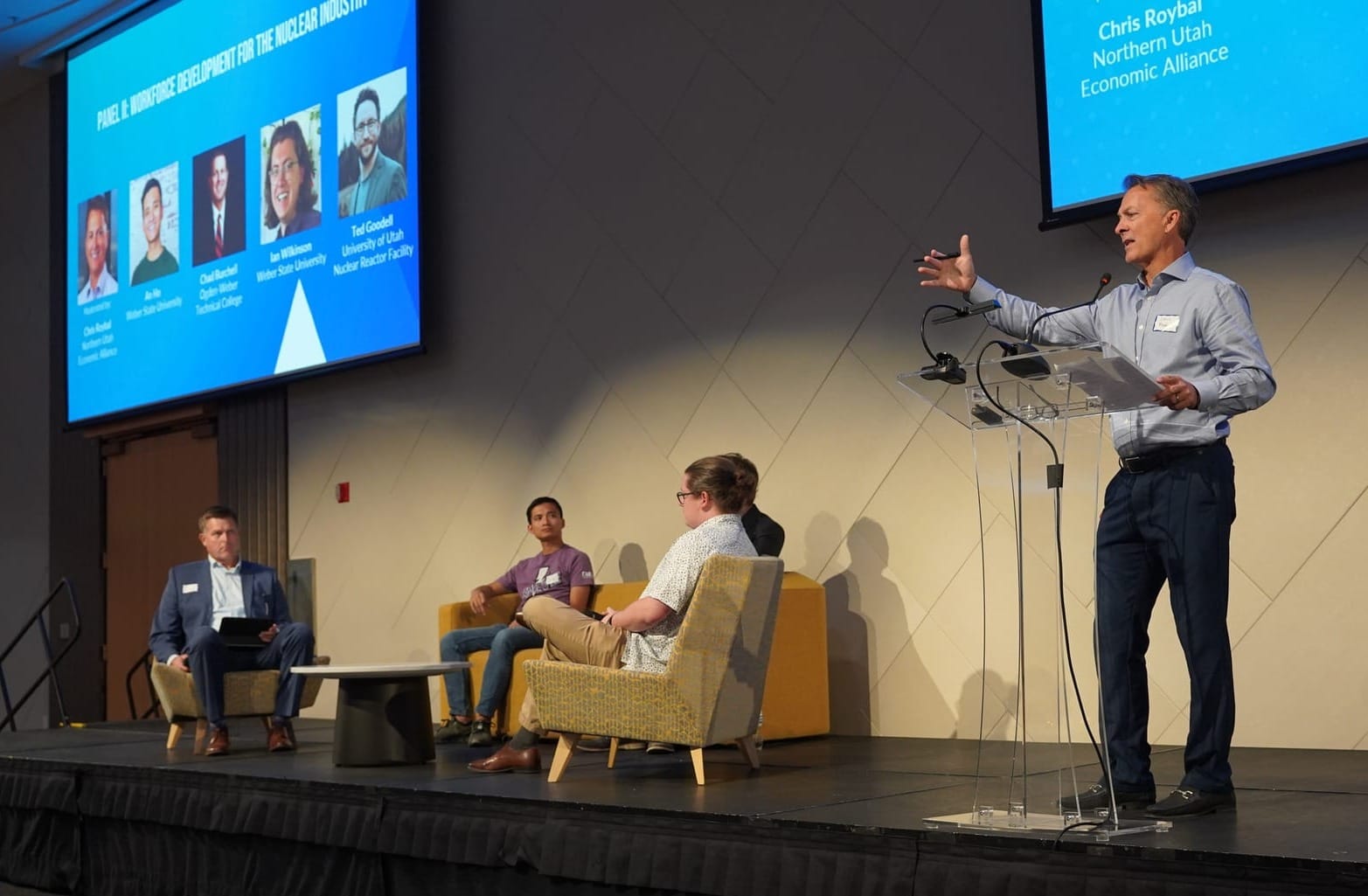
The evening's second panel, moderated by Chris Roybal of the Northern Utah Economic Alliance, turned entirely to workforce development, and it made the case that Weber County is already ahead of most of the state on this front.
Chris Roybal of the Northern Utah Economic Alliance moderates Panel II, "Workforce Development for the Nuclear Industry," at Weber County's community nuclear symposium in Ogden. Panelists included Chad Burchell of Ogden-Weber Technical College; Dr. An Ho, Director of Weber State University's Energy Engineering program; Dr. Ted Goodell, Director of the Nuclear Reactor Facility, University of Utah; and Dr. Ian Wilkinson, Nuclear Engineering Professor, Weber State University. Photo: Mark Tullis, TechBuzz
Chad Burchell of Ogden-Weber Technical College noted that Weber County has the highest rate of technical-education participation among Weber, Davis, Salt Lake, and Utah counties, and said the college's programs, from electricians to non-destructive testing, can train workers for nuclear-adjacent skilled trades in under a year. Dr. Ted Goodell, who oversees the University of Utah's on-campus research reactor (a 100-kilowatt unit he described as "huggable" in size), explained how the facility gives students hands-on experience most nuclear engineering programs can't offer, including a recent full core rebuild that relied on undergraduate labor.
Ted Goodell, Nuclear Reactor Facility Director, University of Utah. Photo: Mark Tullis, TechBuzz
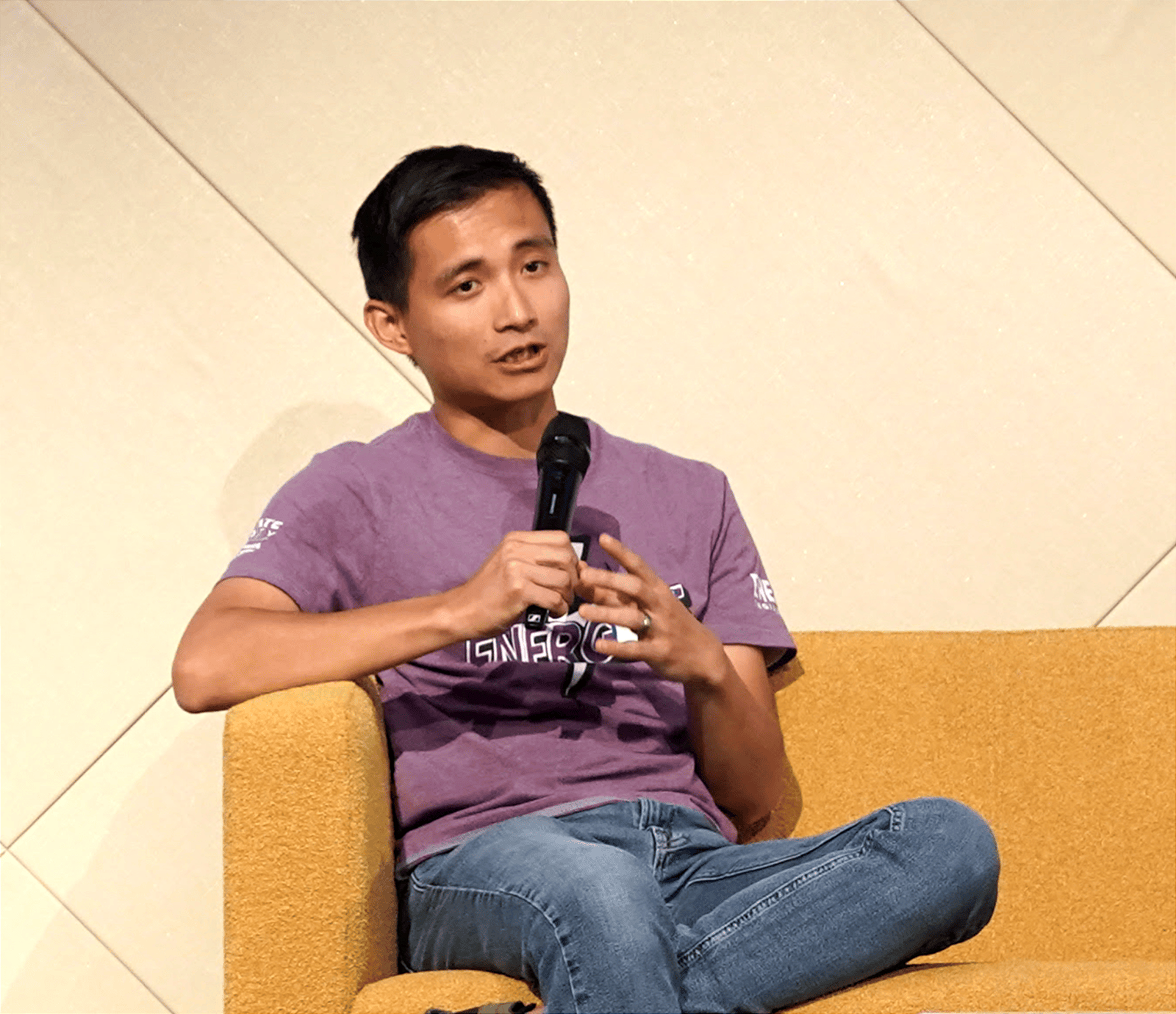
Weber State University's Dr. An Ho, director of the school's Energy Engineering program, which he said is the only ABET-accredited program of its kind in Utah, connected nuclear generation to the demand side of the energy equation, pointing to waste-heat recovery and desalination as underappreciated applications. His colleague, nuclear engineering professor Dr. Ian Wilkinson, predicted the biggest shift over the next decade won't be in fundamental nuclear physics but in the operational playbooks needed to run new reactor types, such as molten salt and small modular designs, safely at scale, alongside continued refinement of the safety-culture practices the industry built after the incident at Three Mile Island.
Dr. An Ho, Director, Energy Engineering, Weber State University. Photo: Mark Tullis, TechBuzz
Asked what they'd tell a high schooler curious about the field, the panelists were consistent: a PhD isn't required. Wilkinson noted that an NRC reactor-operator license only requires a high school diploma, and Goodell encouraged students to weigh their own strengths and interests — hands-on trade work versus analytical engineering — before choosing a path, adding that soft skills, not just technical mastery, determine who succeeds in the industry's team-based culture.
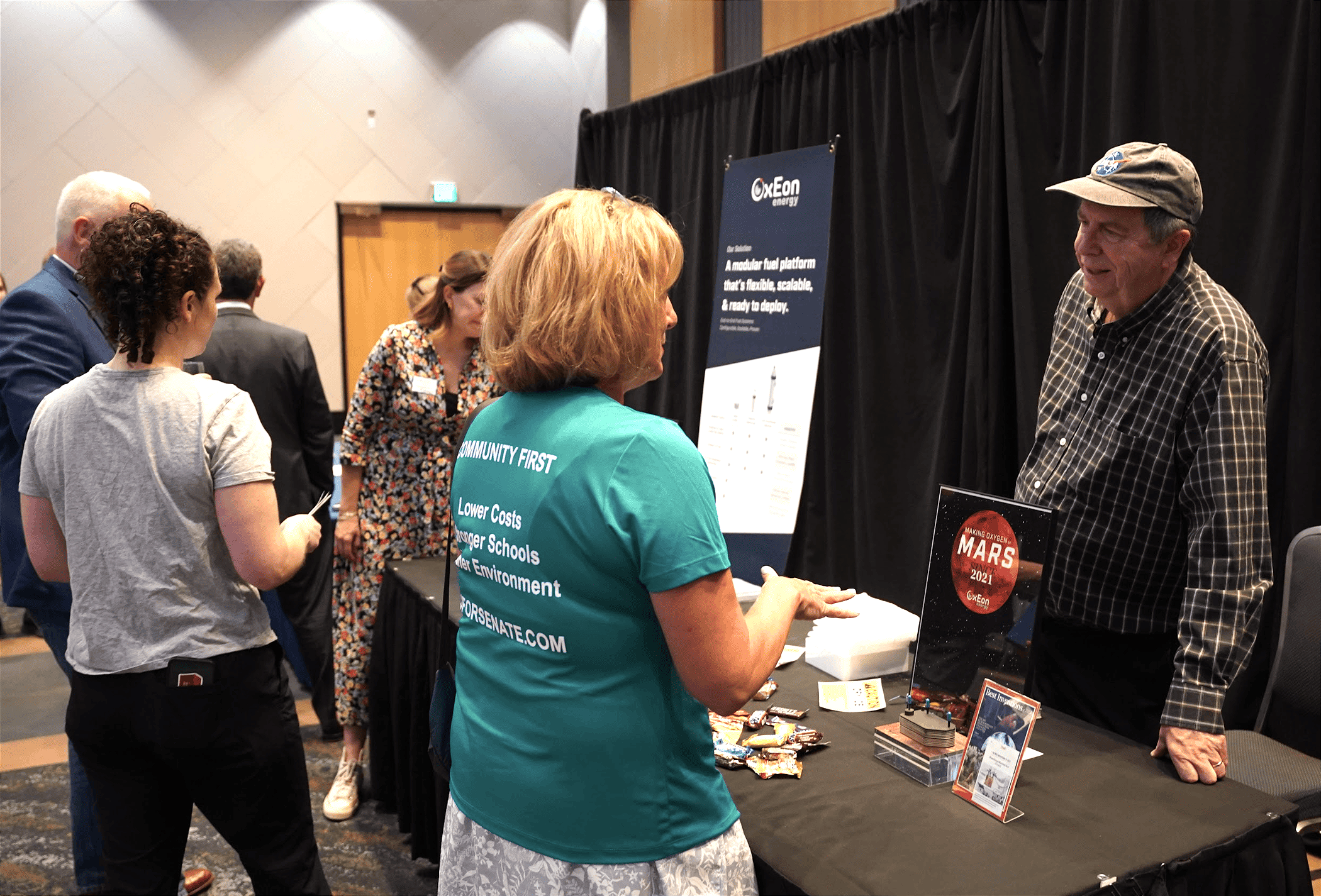
OxEon Energy's CEO and Co-founder, Joseph Hartvigsen, speaking with an attendee in the exhibit hall at the Weber County and Utah Office of Energy Development community symposium on nuclear energy, Ogden Eccles Conference Center, August 5, 2026. Photo: Mark Tullis, TechBuzz
A County-by-County Model
No project was proposed at the event, and organizers were careful to say none was on the table. But the symposium offered a clear look at how Utah is trying to build public understanding ahead of the deals — county by county, panel by panel — before asking any community to weigh in on a specific site. With OED's tour continuing across the state's other 28 counties and tribal nations, Weber County's turn appears to be one early stop in a much longer conversation.
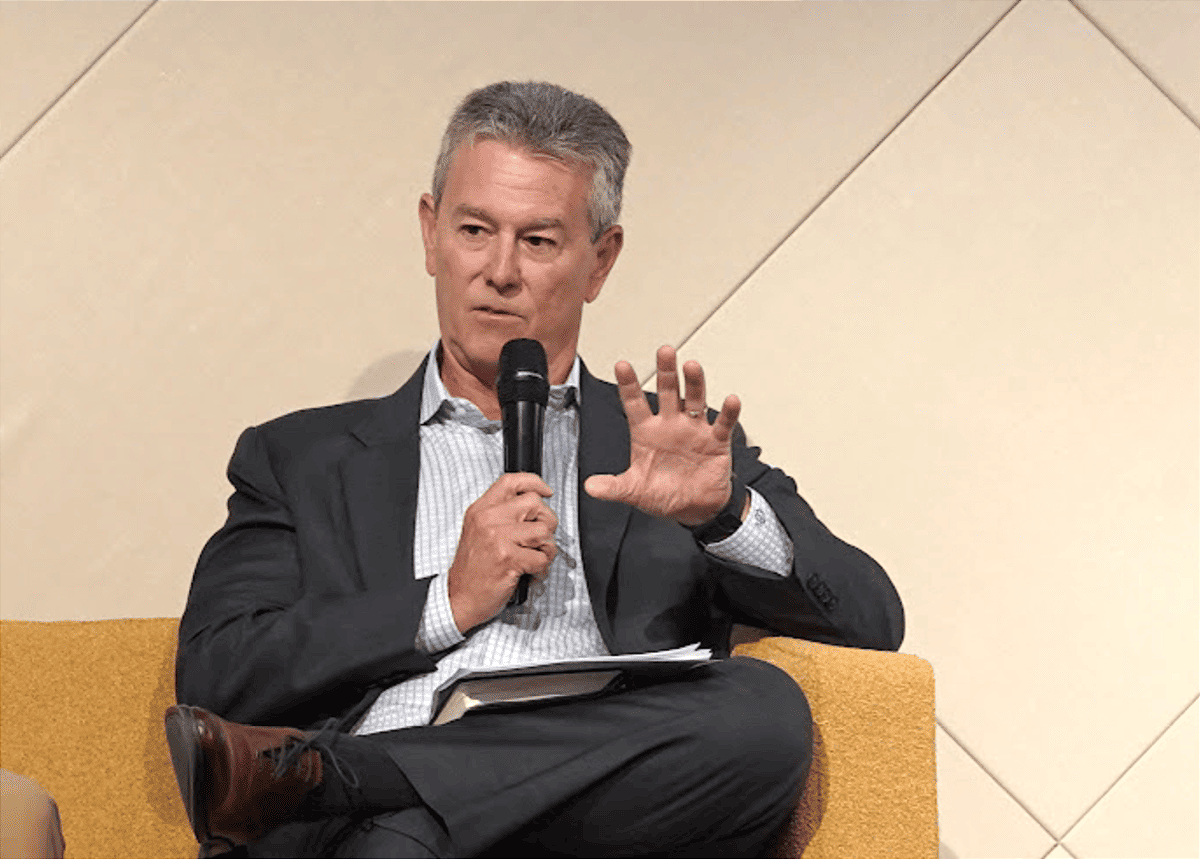
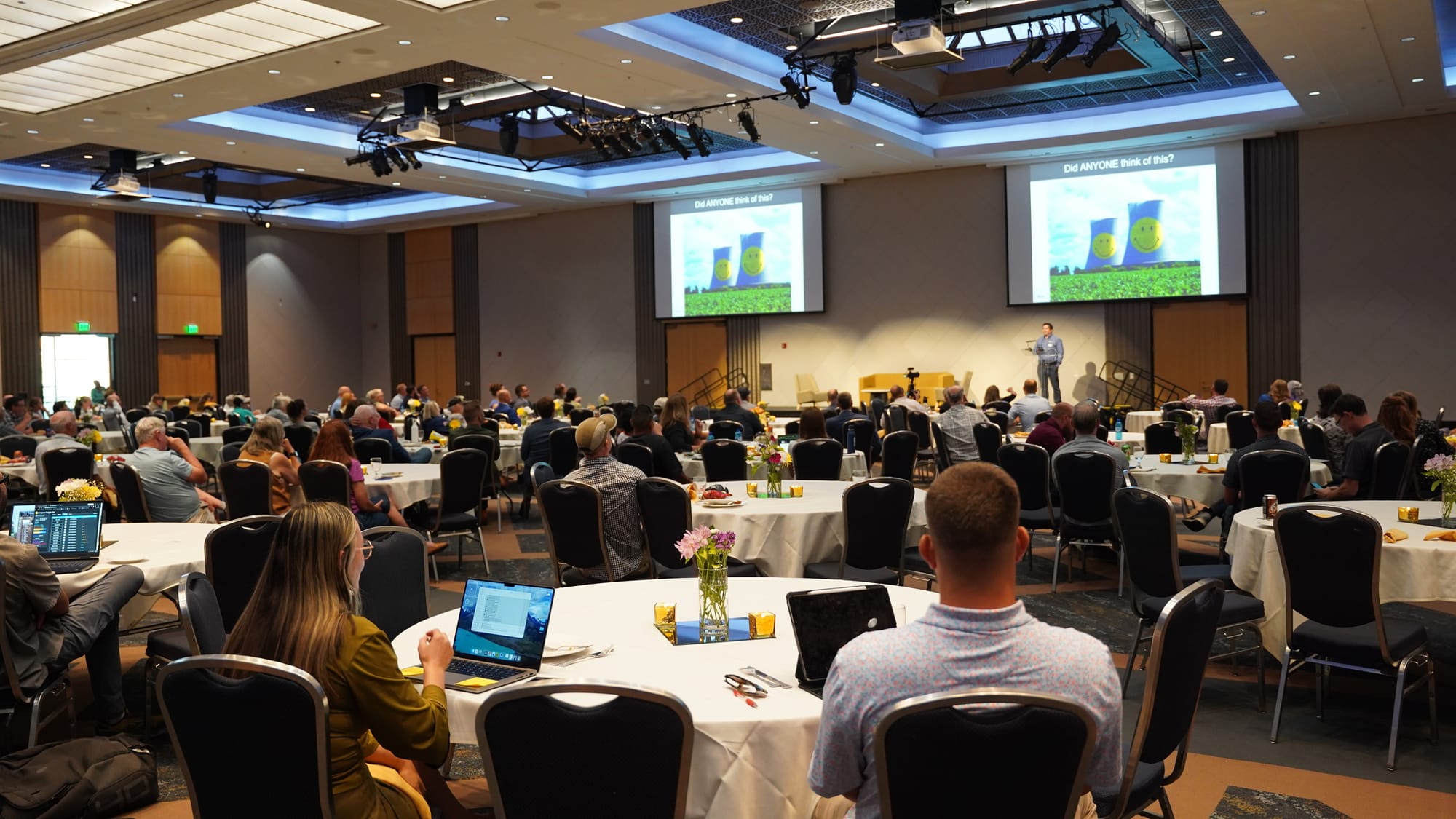
Matt Memmott, CEO of AlphaTech Research Corp and BYU chemical engineering professor, delivers the keynote address at Weber County's community nuclear symposium in Ogden. Memmott laid out the case for nuclear's potential for good — from medicine (20 million U.S. procedures a year, including X-rays, cancer treatments, and diagnostic imaging) to energy. Memmott said nuclear holds the lowest death rate of any major power source at 0.04 annual deaths per terawatt-hour, versus 161 for coal, while supplying roughly 20% of U.S. electricity with no emissions and a reported 343-day-a-year run rate. Ogden Eccles Conference Center, second floor ballroom, August 5, 2026. Photo: Mark Tullis, TechBuzz
Share this article
The link has been copied!
Your link has expired. Please request a new one.
Your link has expired. Please request a new one.
Your link has expired. Please request a new one.
Great! You've successfully signed up.
Great! You've successfully signed up.
Welcome back! You've successfully signed in.
Success! You now have access to additional content.