Built at UVU: Inside the Second Annual SCET Student Expo
UVU's second annual SCET Student Expo showcased dozens of student engineering projects, highlighting an electric hydrofoil watercraft, a CNC pancake printer, and a haptic-feedback walking aid for the visually impaired — demonstrating innovation across disciplines, cost constraints, and human need.
The Grand Ballroom of Utah Valley University's Sorensen Student Center isn't typically where you'd expect to find an electric hydrofoil board, a pancake-printing robot, and a vibrating smart walker for the visually impaired all occupying the same room. But for one afternoon each spring, that's exactly what happens.
The second annual Smith College of Engineering and Technology (SCET) Student Expo brought together more than 50 projects from across the college — Mechanical and Civil Engineering, Electrical and Computer Engineering, Computer Science, Digital Media, Architecture and Engineering Design, and more — into a single, high-energy showcase. The range was wide: some projects tackled pressing human needs, others leaned into pure delight, and a few did both at once. What follows is a look at three that were hard to walk past.
The Electric Hydrofoil That Almost Crossed Utah Lake
Ask a group of mechanical engineering students what they want to build for their capstone project, and "something we could actually ride" is probably not the expected answer. But that's more or less where Sequoia Birch, Mason Taylor, Ethan Parke, Benjamin Harolds, Thomas Cluff, and Daniel Wight landed — and under the guidance of Dr. Matthew S. Ballard, they turned it into a legitimate engineering achievement.
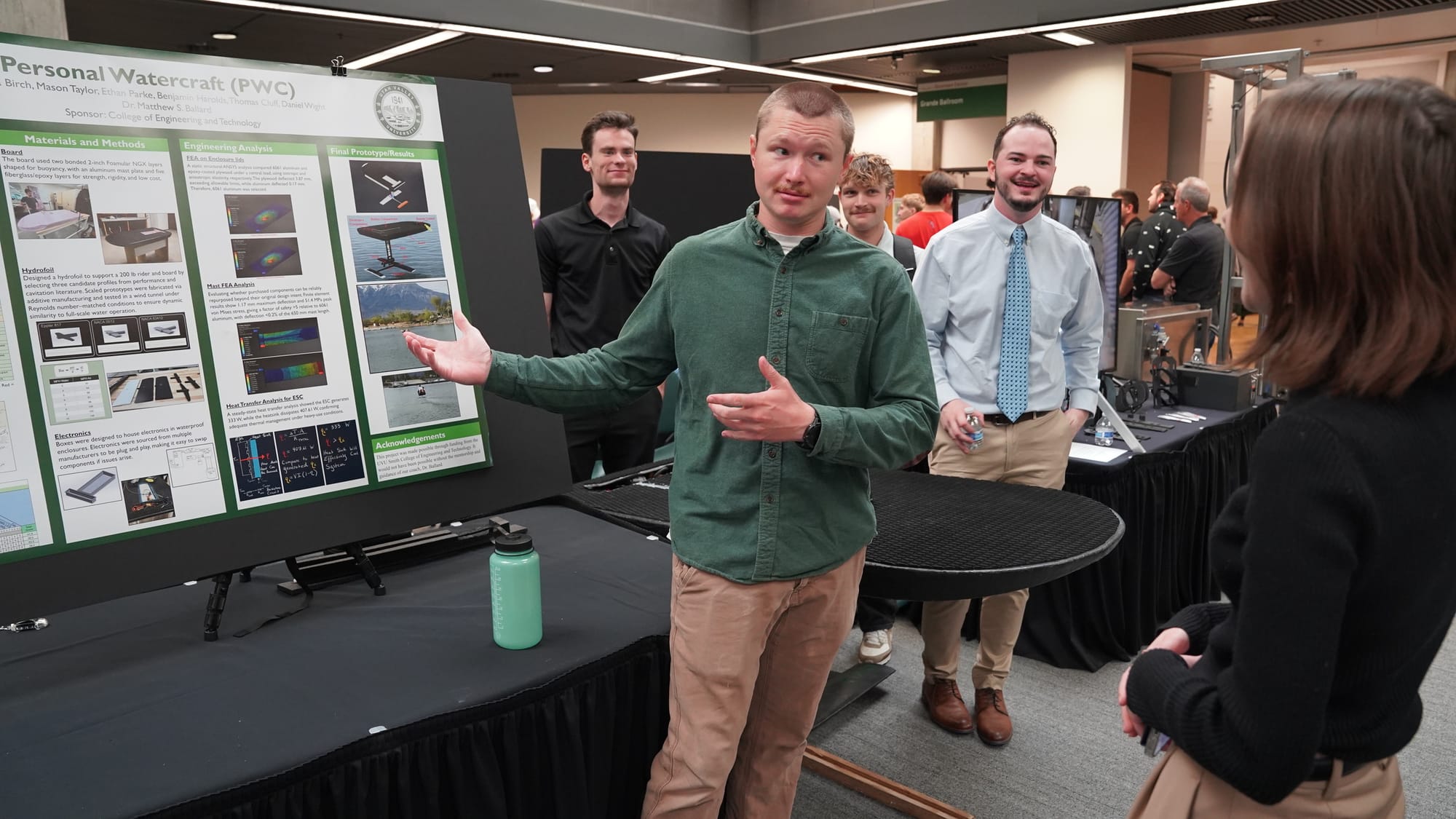
SCET's Personal Watercraft team explaining to a passerby how their hydrofoil works
Their project, a personal electric hydrofoil watercraft, is deceptively simple in concept: a board that behaves like a surfboard at low speeds, then lifts cleanly above the surface once it builds enough momentum. "It rides like a surfboard until it gets enough lift, and then it comes up out of the water," Mason Taylor explained to TechBuzz. "All you have underneath you is the wing." That transition dramatically cuts drag, allowing the craft to move faster while drawing less power — "a lot more efficient for a smaller motor, less battery draw."
The stated goal was ambitious but grounded: design a self-powered, car-top-transportable watercraft capable of handling varied conditions, while keeping cost and complexity accessible. Early design work translated user needs — performance, safety, portability, affordability — into engineering requirements, refined through structured decision matrices and iterative prototyping.
The board itself is a lightweight composite structure built from Foamular NGX foam for buoyancy, reinforced with aluminum and fiberglass-epoxy skins for stiffness. Beneath it hangs the defining feature: a hydrofoil system engineered to lift a rider of around 200 pounds. Multiple foil profiles were evaluated against performance and cavitation criteria, with scaled prototypes tested under controlled conditions to approximate real-world dynamics.
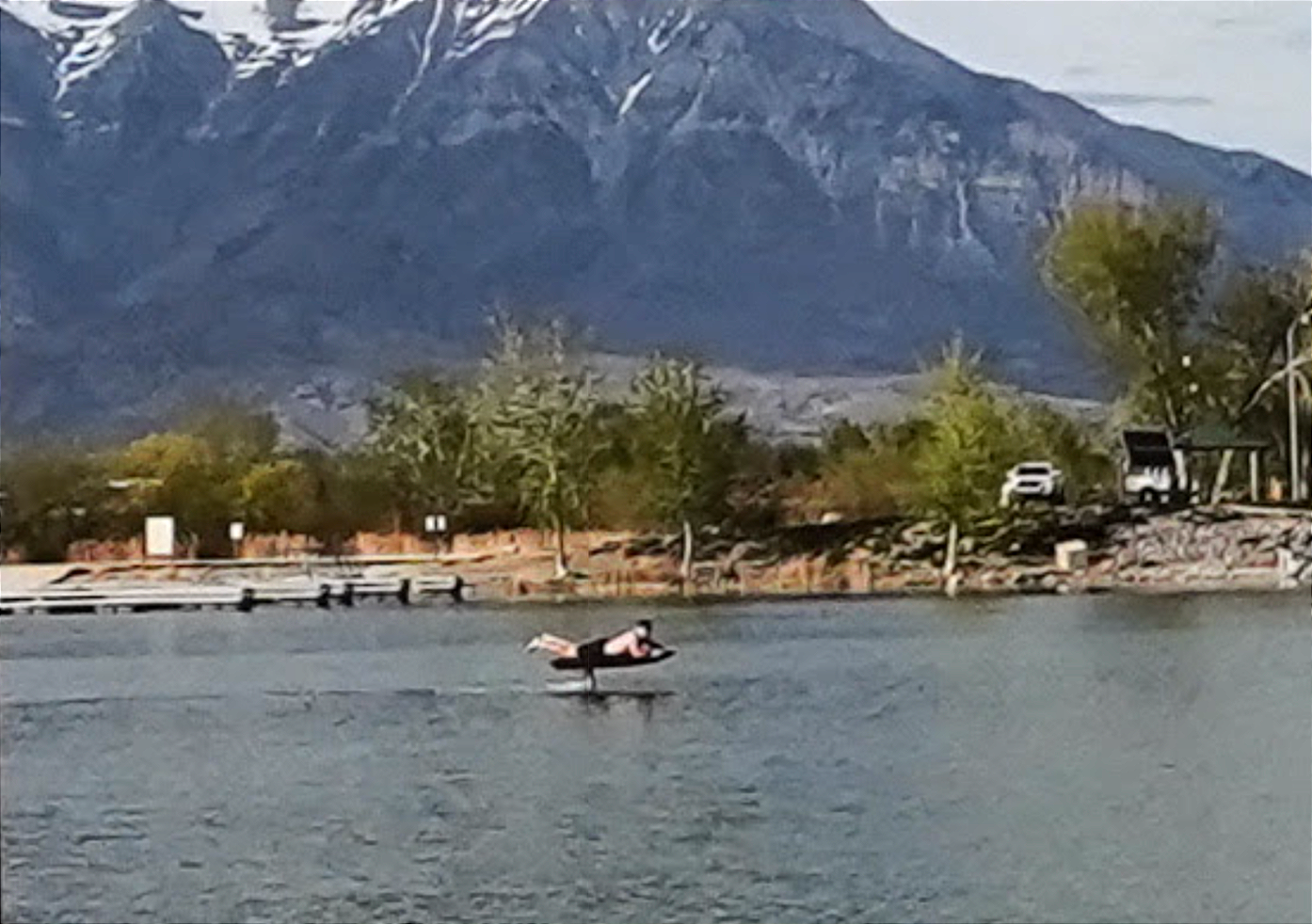
Not quite standing — a UVU engineering student pilots the team's electric hydrofoil prototype on Utah Lake during testing. The craft hit 13 mph in open water. An upright ride, the team admits, remains elusive, at least for test riders to date.
That "200-pound rider" spec, it turns out, had at least one willing test subject. "I'm 205," one team member admitted, "and I rode it." The physics is straightforward: the heavier the rider, the faster they must go — and, inevitably, the harder they fall.
Electronics integration was handled with a mix of caution and practicality. The system uses modular, waterproof enclosures housing commercially sourced components, designed for easy replacement. Asked, half-jokingly, about the risk of electrocution, the team didn't dodge: "It depends on where you source your parts… but we mitigated the risks." Their mitigation strategy was thorough — custom enclosures with gaskets tested to IPX6 standards, epoxy-coated interiors, and silicone-sealed lids to keep battery and electronics dry even under heavy spray.
On the analytical side, finite element analysis and thermal modeling backed every major design decision. Structural simulations favored aluminum for its lower deflection under load. Mast analysis confirmed that repurposed components could still meet safety margins. Heat transfer modeling showed the electronic speed controller would stay within safe operating temperatures under sustained use.
A foldable propeller adds a layer of safety — "if you fall off, you're not going to have the propeller come around" — and the remote includes a shutoff so the craft doesn't continue on without its rider.
Testing at Utah Lake revealed both the promise and the learning curve of the design. Most early runs were done "laying down or on hands and knees," as the team described it. Standing riders are possible — just not yet among the builders. "We can build it," one student joked, "but we can't ride it all the way." They also had one minor regulatory interaction. "We only had the DNR get after us once," they noted, "and it was for not wearing life jackets."
Performance targets were met regardless. Designed to reach 10 mph on foil, the craft hit closer to 13 mph in testing. Stability, control, and durability were validated across multiple outings.
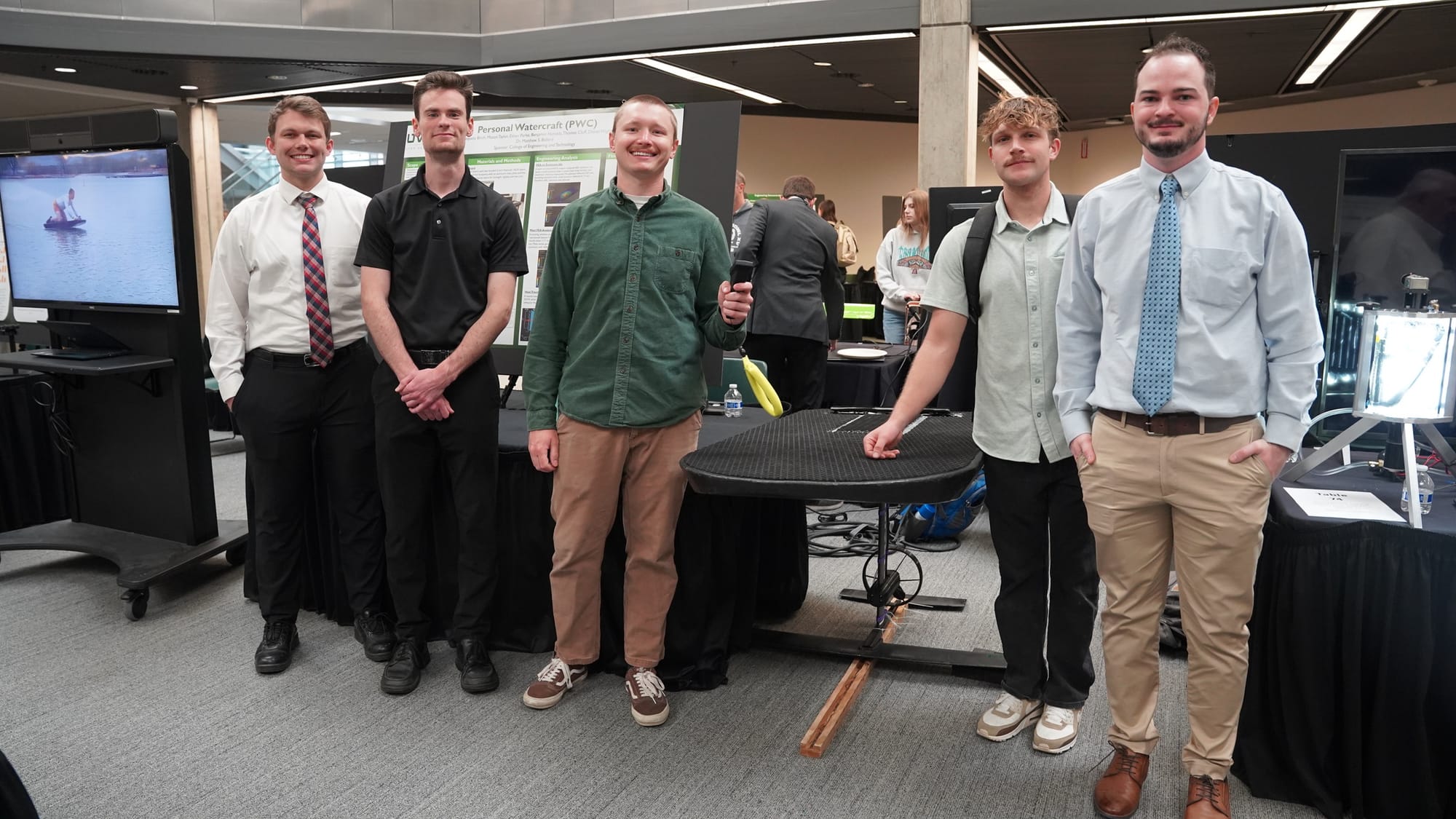
SCET's Personal Watercraft team: Mason Taylor, Ethan Parke, Benjamin Harolds, Thomas Cluff, Daniel Wight, and Sequoia Birch
Perhaps the most compelling aspect of the project is what it costs. Commercial e-foil boards typically sell for around $10,000, putting them firmly out of reach for most casual users. This team built a working prototype from largely off-the-shelf components for an estimated $1,500 to $1,800 — a fraction of the market price, and a meaningful proof of concept for making the technology accessible.
Asked whether the craft could cross Utah Lake, the answer was cautious but honest: "If you were good enough… probably." Skill, it seems, is the one thing the team hasn't fully engineered yet.
Pancakes as Engineering Problems (and Solutions)
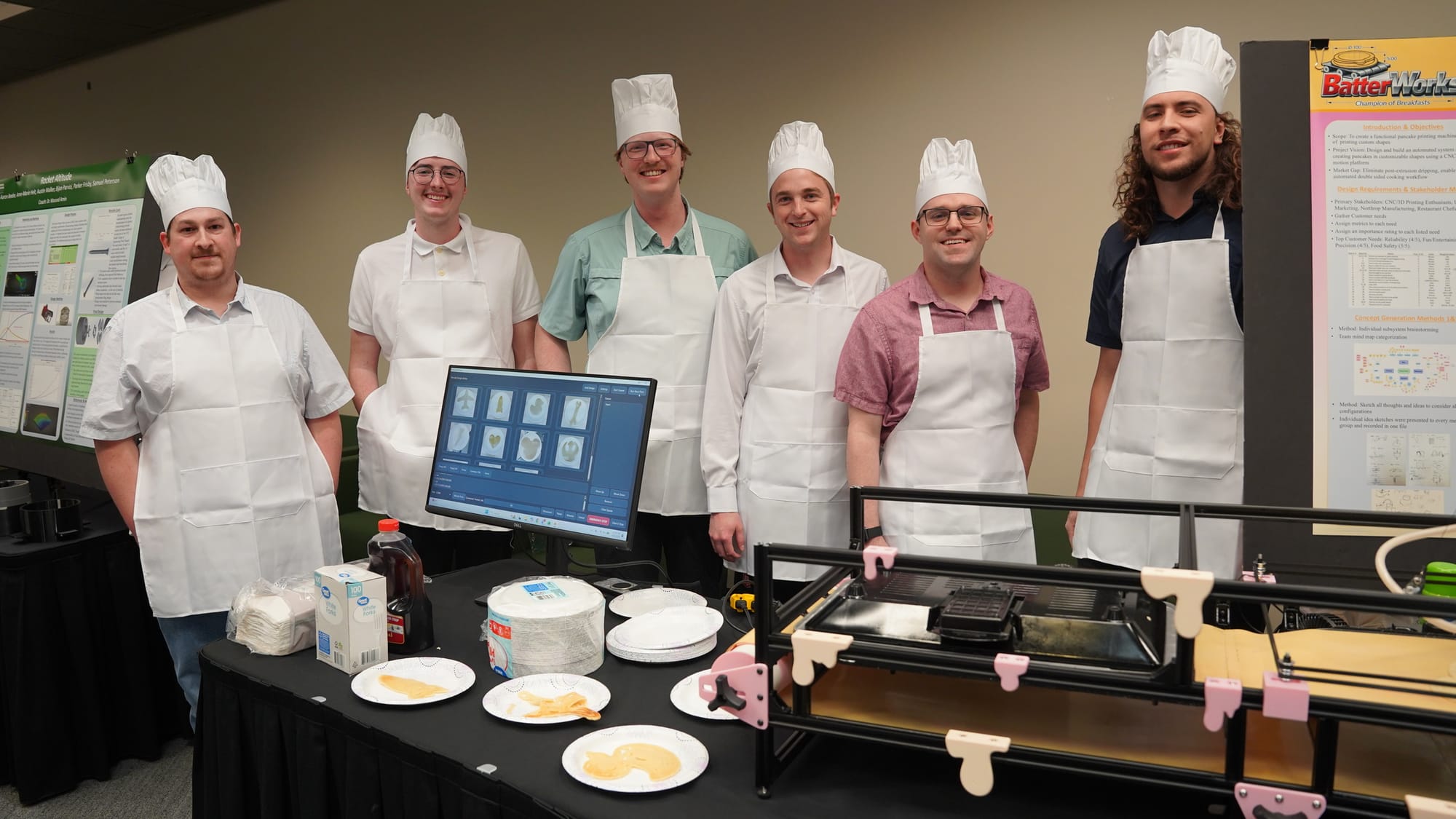
Not every showcase project needs to solve a global problem. Some just need to make people stop, smile, and ask how it works. The team behind "BatterWorks: Champion of Breakfasts" — Garrett Bagley, Tyler Ritchie, Lucas Eliason, Bo Salazar, Savinata Suguturaga, and Travis Berrett, coached by Dr. Sean Tolman — built exactly that: a CNC pancake printer capable of producing intricate, programmable shapes directly onto a griddle.
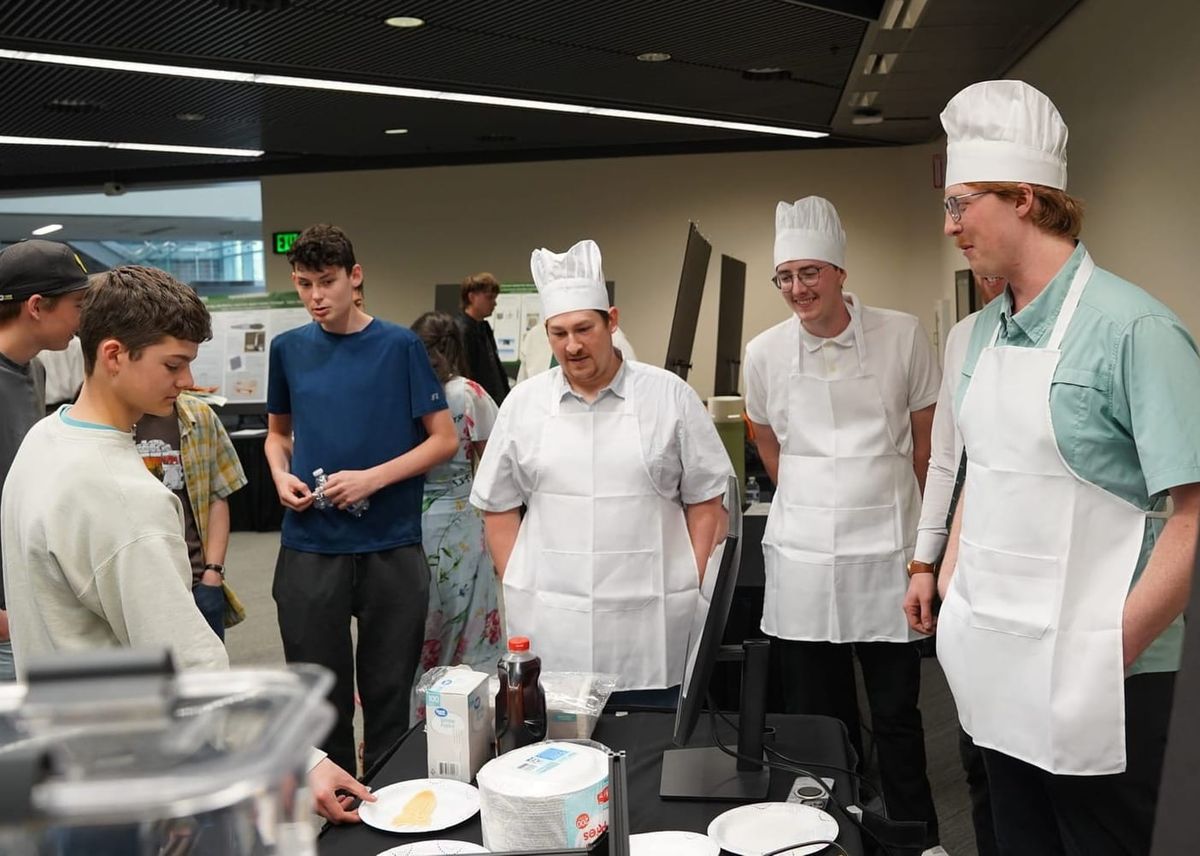
The Batterworks Team showing off their novel pancake printing machine: Garrett Bagley, Tyler Ritchie, Lucas Eliason, Savinata Suguturaga, Bo Salazar, and Travis Berrett
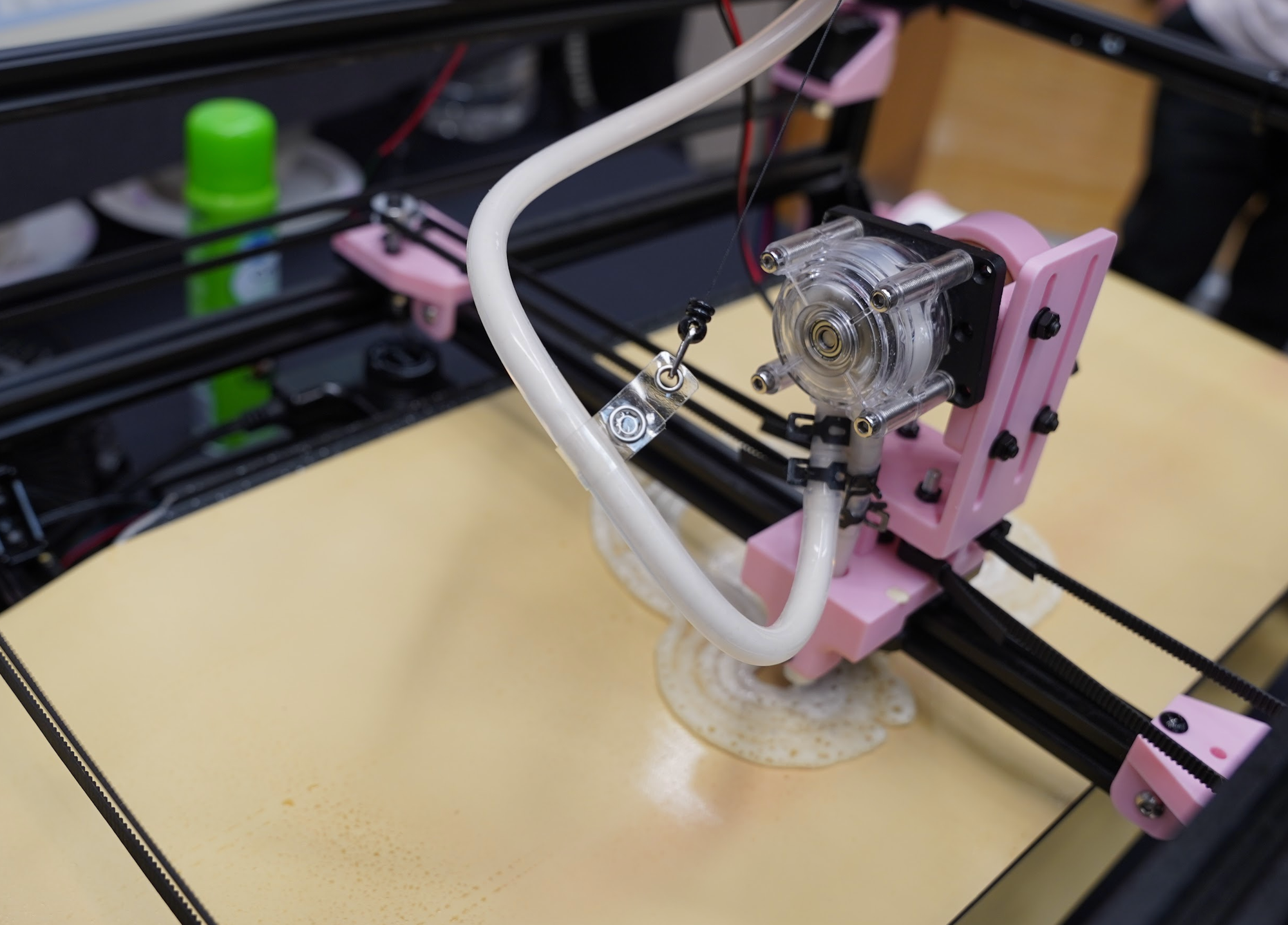
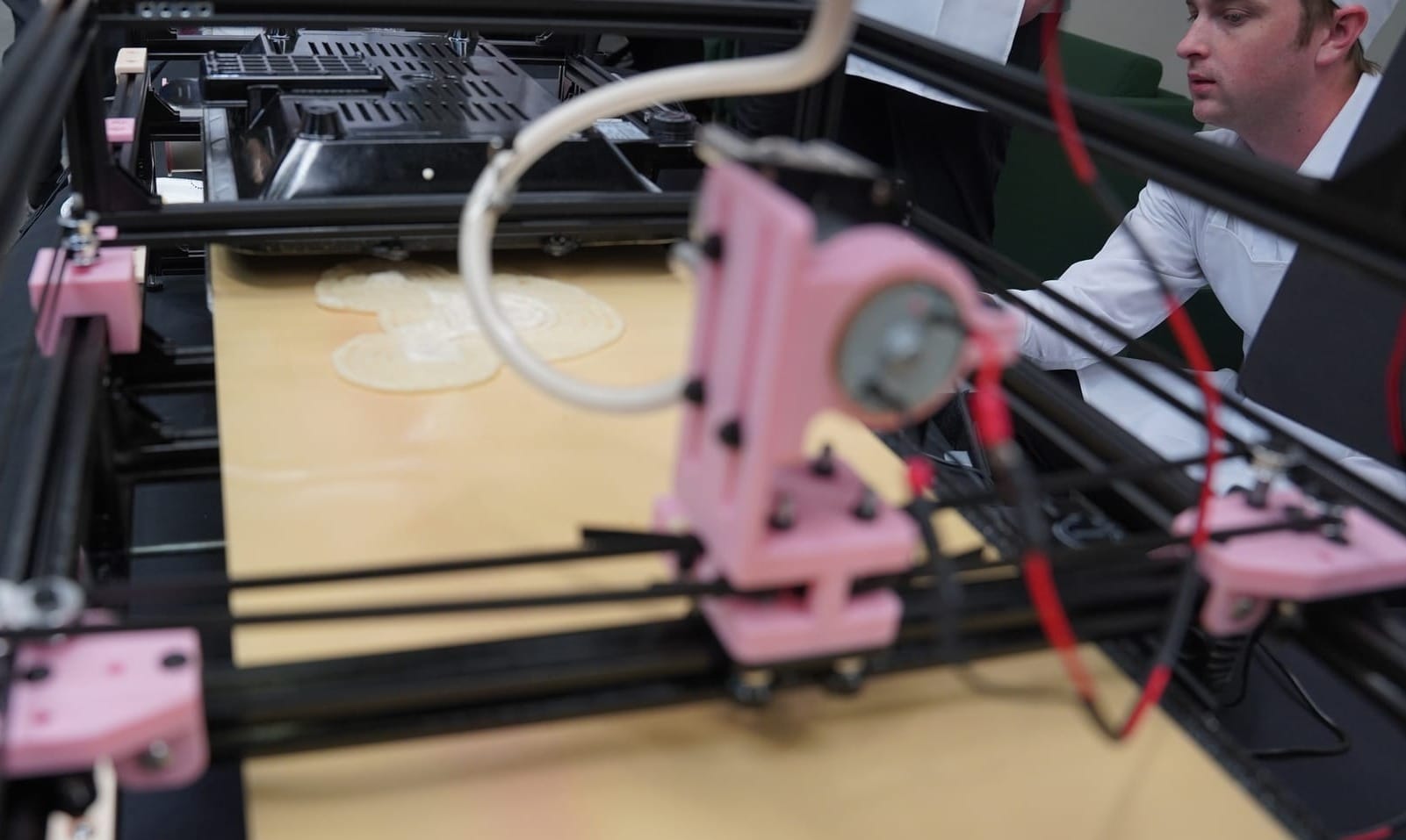
At a glance, it looks like a compact gantry-style CNC system mounted over a cooking surface. Instead of cutting or milling material, it precisely deposits pancake batter through a controlled extrusion mechanism, "printing" designs layer by layer. The results range from simple geometric shapes to highly recognizable graphics — including the Star Wars Rebel Alliance logo. The machine's design library has already grown to 1,211 distinct patterns, which raises a mildly urgent question about what exactly the team was doing between deadlines.
Ask them why they built it and the answer comes fast: "Because it's fun. Let's be honest, who doesn't like pancakes?"
That sense of play is central to the project — but don't mistake it for simplicity. Managing batter viscosity, preventing post-extrusion drip, and maintaining clean lines at low extrusion speeds are genuinely nontrivial problems. The team approached them with the same structured design process seen across the rest of the showcase. The pancake printer just happens to smell better than most senior projects.
The team is candid about its current status: "Definitely not ready for someone's kitchen table… yet." In its present form, it's a demonstration platform — something UVU's marketing and outreach teams might use to engage prospective students and show how engineering principles translate into something tangible, memorable, and edible. The university's award-winning Culinary Arts Program and the elegant new campus restaurant atop the Smith Building are, one imagines, already circling.
There's also something the team identified that's harder to quantify: the theater of watching it work. "There's something about watching it that's almost as fun as eating it," they agreed. The large crowd of salivating onlookers also appeared to agree. That's not a trivial observation — it points to a side of engineering that often goes unacknowledged: the ability to create moments of curiosity. A machine that draws your breakfast in real time has a built-in audience. Whether it ends up as a teaching tool, a marketing centerpiece, or a niche culinary attraction, the pancake printer proves that technical rigor and lighthearted creativity don't have to be at odds.
Giving the World a New Way to Feel Its Surroundings
Not every project at the expo was chasing novelty or spectacle. One electrical and computer engineering team — WeiQing Zhao, Bayley Parkinson, and Jackie Belnap, working under Dr. Afseneh Minaie — turned their attention to a problem with global scale and deeply human stakes: mobility and spatial awareness for the visually impaired.
Their starting point was a number that stopped people in their tracks. "There's 2.2 billion people in the world that are visually impaired," the team noted. "So we wanted to make something to help."
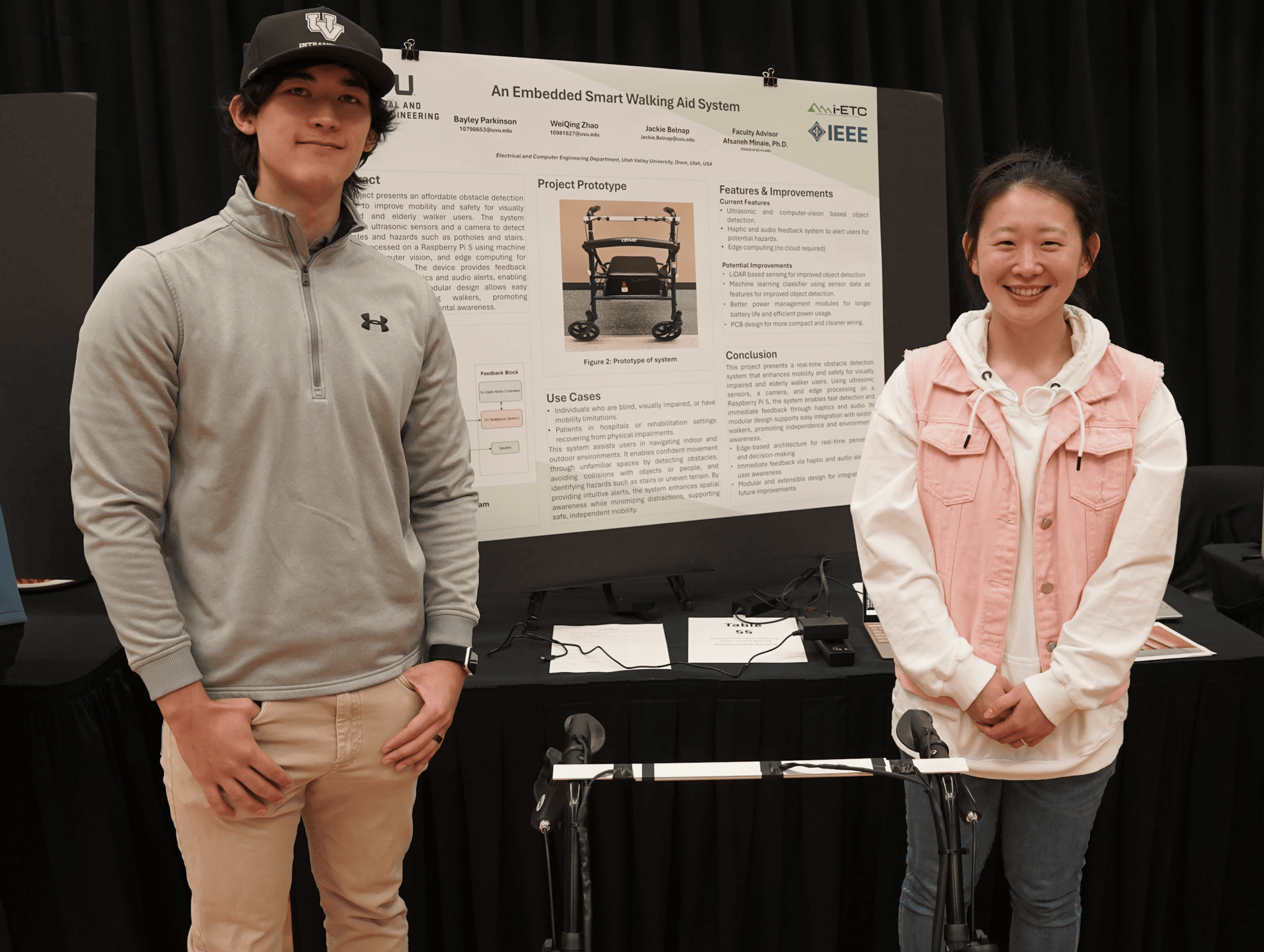
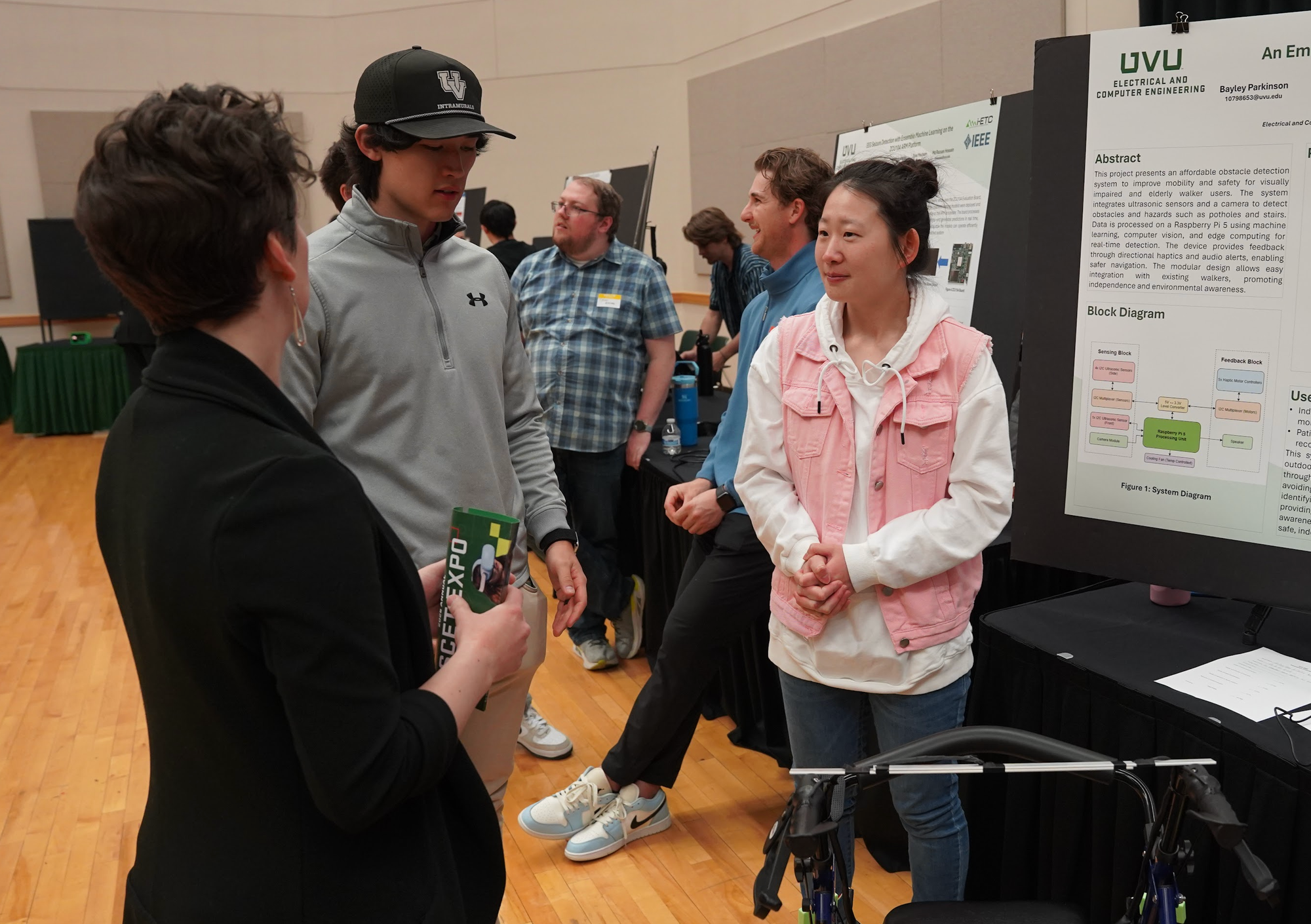
Jackie Belnap and WeiQing Zhao, electrical and computer engineering students, UVU
The result is a sensor-rich walker that translates environmental information into physical feedback. The system combines proximity sensors and a forward-facing camera, feeding data into an onboard processor. When obstacles are detected, haptic motors embedded in the handles activate, giving the user directional cues through vibration. The concept is clean, but the execution is carefully structured: obstacles aren't just detected, they're categorized by distance and position. Objects to the sides trigger alerts at around 40 centimeters. Corners register at 1 meter. Frontal obstacles at up to 1.5 meters. That graduated awareness lets a user build a real-time mental map of their surroundings — not through sound or sight, but through touch.
"The idea is to get a feel of direction… of where the obstacle is through where the vibration is coming from," the team explained. It's a subtle but meaningful shift in interface design: moving from alerts that interrupt to feedback that integrates naturally into how a person already uses the device.
Jackie Belnap and WeiQing Zhao, electrical and computer engineering students, talking about their tech-enabled walking system
The long-term vision is more disruptive still. The team sees the system as a potential lower-cost alternative to guide dogs and high-end assistive technologies, which are frequently out of reach — financially or logistically — for the people who need them most. By their estimates, retrofitting an existing walker with the system could cost between $100 and $200, with individual sensors priced at roughly a dollar each. That's orders of magnitude cheaper than most current solutions.
It's a quiet project, in the best sense. No flashy demo, no theatrical moment. Just a carefully considered system that could meaningfully expand independence for millions of people — built by three students who saw the number 2.2 billion and decided to do something about it.
What the Expo Actually Shows
Taken together, these three projects — a flying surfboard, a pancake-drawing robot, and a haptic walking aid — don't have a lot in common on the surface. One is about speed and hydrodynamics. One is about batter viscosity and Star Wars logos. One is about improving the daily lives of people who are too often an afterthought.
But they share something important: each one started with a genuine question. What if we could ride it? What if we could print it? What if we could help? The engineering came after the FEA and the thermal modeling and the decision matrices, but the animating spark in every case was curiosity. Not just academic curiosity, but the kind that makes you show up at Utah Lake with a handbuilt hydrofoil (but no life jackets), or spend your semester refining the extrusion properties of pancake batter, or decide that 2.2 billion is too large a number to ignore.
That's what the SCET Student Expo captures, now in its second year. Not just polished results, but the thinking — and the stubborn enthusiasm — behind them.