Utah's Education System Is About to Face Its Biggest Test. How Leaders Plan to Meet It.
At the Envision Utah Higher Education Summit (Millcreek, UT), education leaders confronted converging pressures — demographic decline, AI disruption, and eroding public confidence — but emerging data and reforms suggest Utah is uniquely positioned to respond.
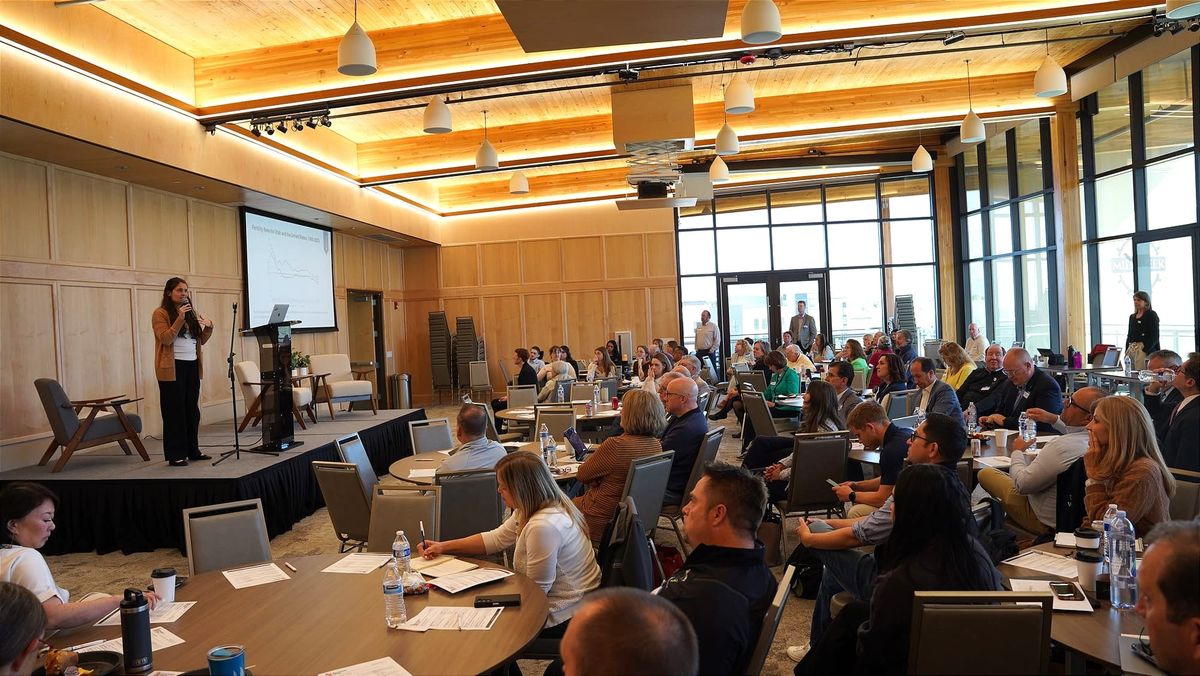
Leaders from across Utah's education ecosystem gathered today for a higher education summit at the Grandview at Millcreek Common sponsored by Envision Utah to wrestle with the future of higher education. What they said, taken together, amounts to both a warning and a blueprint.
What Utahns Actually Value
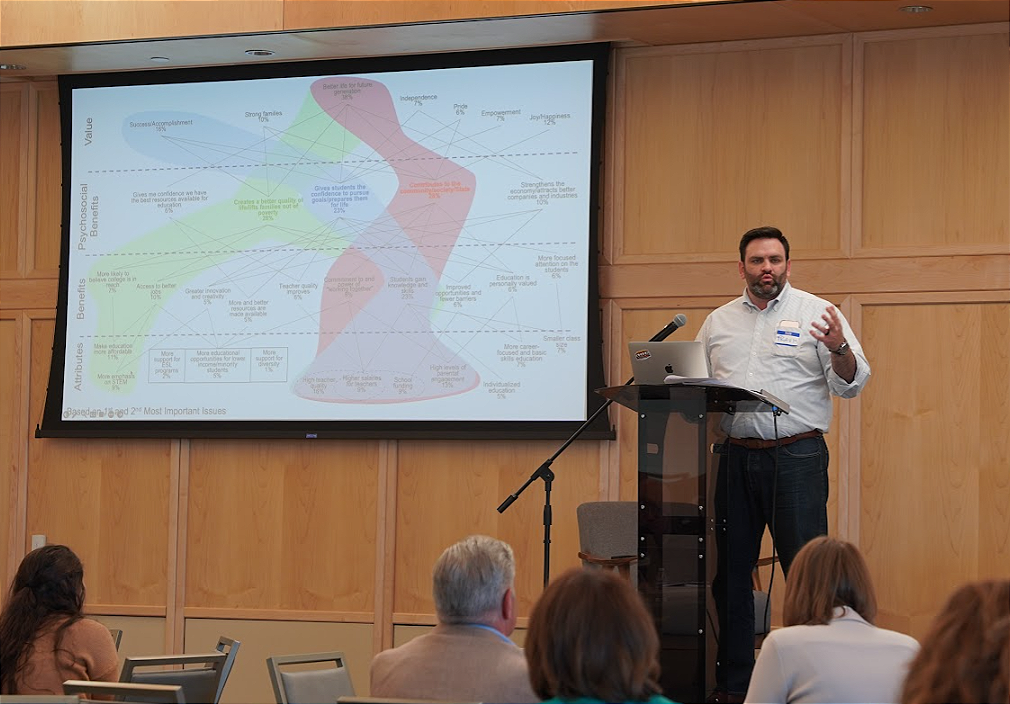
Before anyone talked about demographic cliffs or artificial intelligence, Travis Allred of Envision Utah laid down the data that would anchor everything else: a decade of research into what Utah residents actually want from education.
The short answer is that Utahns want three things, in roughly this order. They want education to create a better quality of life — to lift families, including out of poverty. They want students to gain the confidence to pursue their goals and be agile enough to handle whatever life throws at them. And they want education to produce citizens who contribute to a stronger community.
What's striking about this research, conducted first in 2016 (with Heart+Mind Strategies) and recently refreshed, is how little has changed. Utah's values around education are durable. What has changed is the gap between those values and what the system is currently delivering.
Travis Allred of Envision Utah presents a decade of values research at the organization's higher education summit, that took place today in Millcreek, Utah, showing that Utahns' priorities for education have remained remarkably consistent — even as the system's ability to deliver on them has not.
When Allred asked Utahns to identify their single highest priority for fixing higher education, nearly a third pointed to affordability — even though Utah already ranks among the lowest four states in the country for tuition and fees. Allred's read on this is important: people aren't necessarily asking for the cheapest colleges in the country to get cheaper. They're feeling financial pressure everywhere — housing, health care, transportation, food — and higher education sits in that context. The perception of risk is the problem as much as the actual cost.
The second most common answer was striking: fix high school. Even when asked specifically about higher education, Utahns said the K-12 pipeline is the broken link. They're not drawing a bright line between the two systems — they see education as a single continuum. And they want that continuum to produce students who are, as Allred put it, "agile, mobile, and ready for whatever life throws their way."
One more finding is worth noting before moving to the pressures bearing down on that system: 79% of Utahns — and 82% of college graduates — say technical and trade education is extremely or very valuable, rating it more favorably than graduate school in terms of return on investment. Utah has built what may be the best technical college system in the country. Most of the people who could benefit from it don't know it exists.
The Numbers Nobody Is Talking About
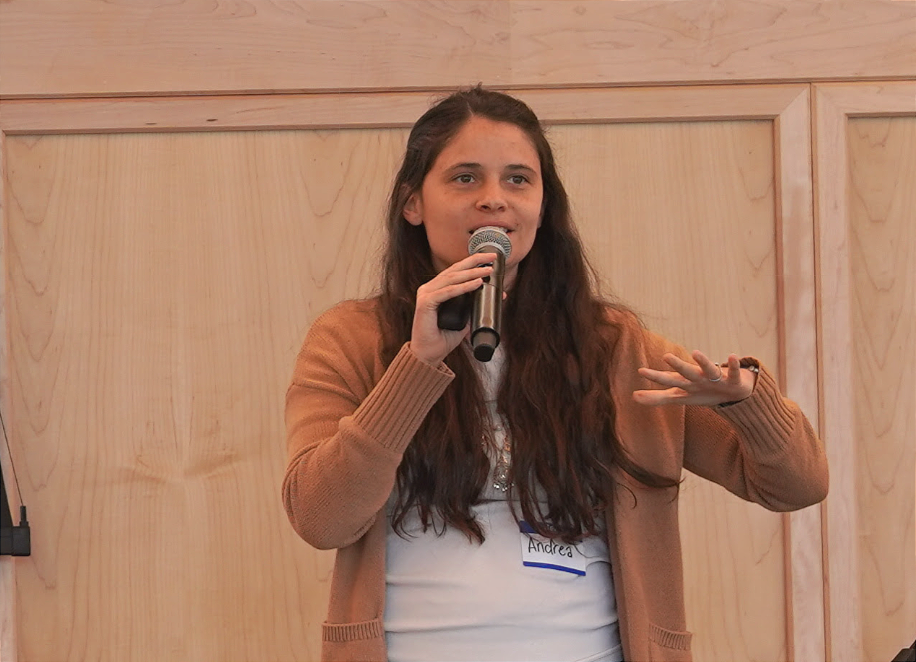
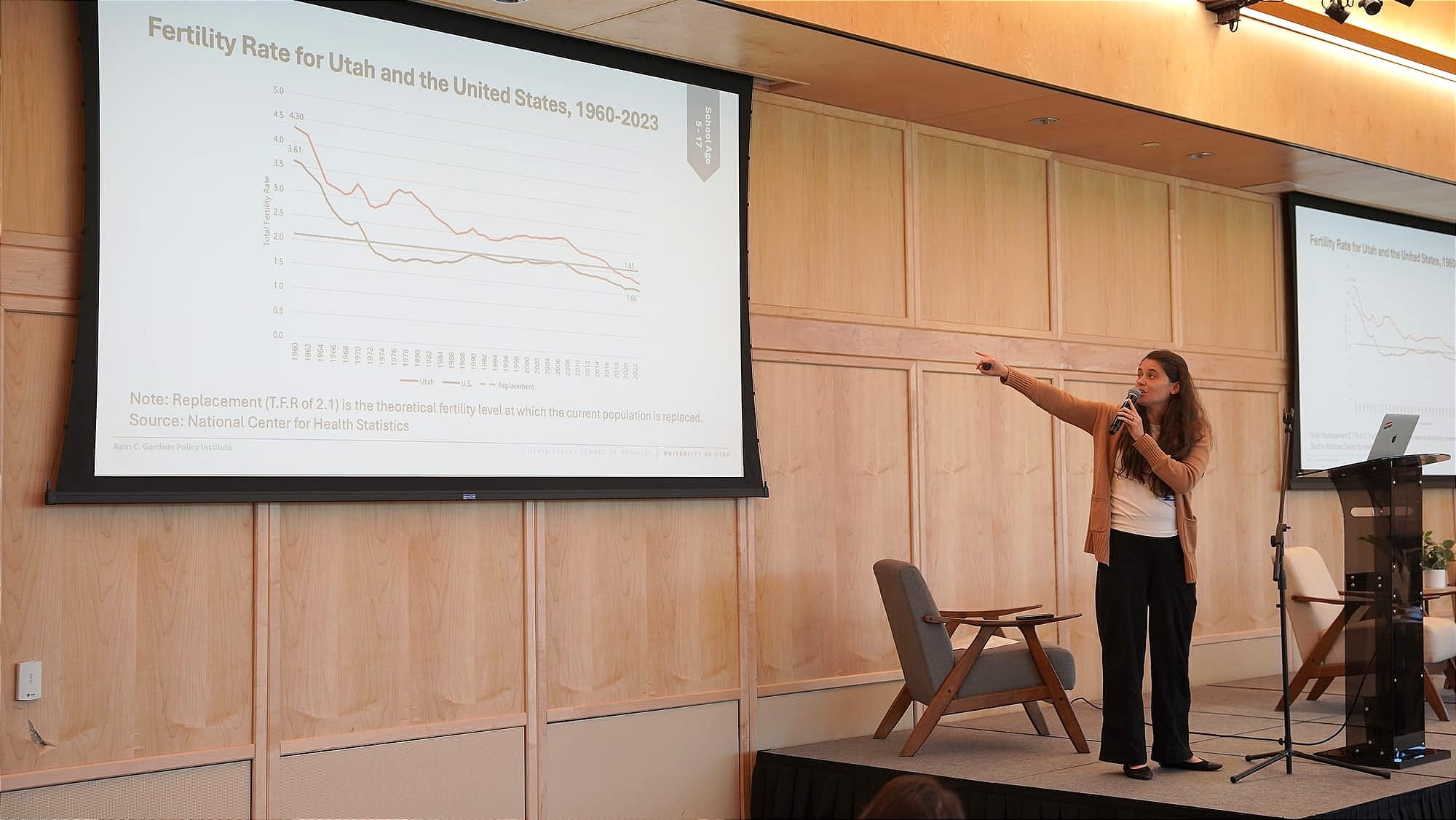
Andrea Brandley, a senior education analyst at the Kem C. Gardner Policy Institute, delivered the summit's most data-dense presentation — and arguably its most urgent.
Andrea Brandley, Senior Education Analyst, Kem C. Gardner Policy Institute
Utah is in the early years of an unprecedented demographic shift. For roughly 25 consecutive years, the state's school-age population grew. More kids, every year, reliably. That era ended approximately three years ago. The state is now losing somewhere between 5,000 and 10,000 school-age children annually, and that trend is projected to continue for roughly a decade before reversing.
The driver is fertility. In 1960, the average Utah woman had four children. By the 1990s that had settled around two and a half, and for years demographers assumed it had stabilized. Then, starting in 2008, both Utah and the nation began a significant decline. Utah now sits at approximately 1.8 children per woman — below the replacement rate of 2.1. The state that was ranked first in the nation for fertility for years has fallen to tenth. Utah is no longer the state having the most babies, and the cultural identity built around that fact is quietly dissolving.
The geographic picture is more complicated than a single statewide trend suggests. Salt Lake and Davis counties face significant declines. Many rural counties face drops of 30 to 40 percent over the next four decades. Utah County, by contrast, is projected to gain 72,000 school-age children — a 44% increase. The "demographic challenge" looks completely different depending on where in the state you're standing.
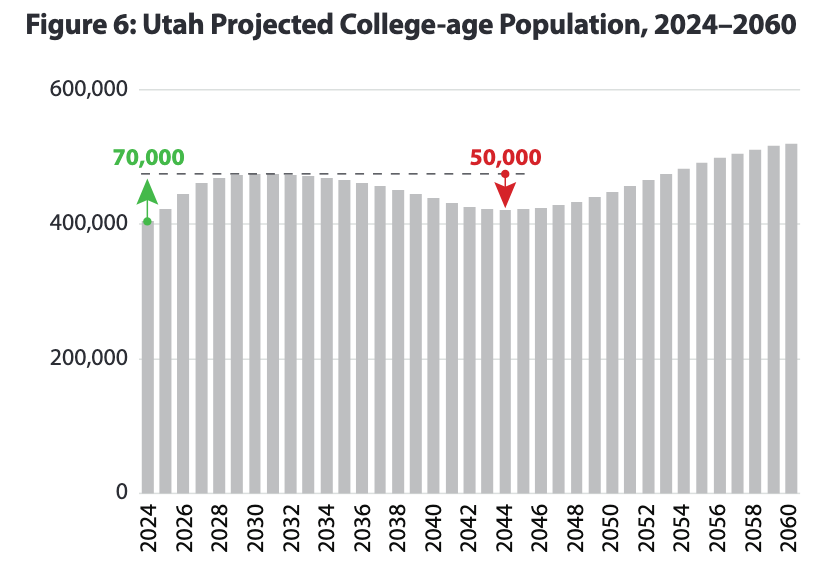
Source: Andrea Brandley, Heidi Prior, and Phil Dean, Navigating Utah’s Demographic Dip: Strategically Positioning Utah Higher Education Amid College-age Population Declines, a Kem C. Gardner Policy Institute report from October 2024. See full report at Navigating-HigherEd-Oct2024.pdf
For higher education, the relevant window is the college-age population — roughly 18 to 24. Nationally, that decline began in 2025. Headlines have been calling it a "demographic cliff." Brandley is more measured: it's more of a slope than a cliff, but a slope that runs downward for about 20 years before recovering.
Utah's version differs from the national pattern in an important way. The state is still projected to see a few more years of growth in its college-age population, peaking around 2028 at roughly 475,000. Then comes the decline — followed, unlike the national trend, by a genuine recovery. Utah is projected to return to near-peak levels after the trough.
Andrea Brandley presenting population data at Envision Utah's Higher Education Summit 2026, Grandview at Millcreek Common
That recovery window is the most important planning insight in Brandley's presentation. The decline is real, but it is not permanent. Institutions that make irreversible decisions based on the trough — cutting programs, closing facilities, abandoning ambitions — may find themselves badly positioned when growth resumes. The question is how to navigate the next two decades without either panicking or sleepwalking.
The Full Value of What Could Be Lost
Before turning to solutions, two researchers reframed the stakes.
Susan Madsen, founder and director of the Utah Women and Leadership Project at Utah State University and Melanie Heath, strategy director of the Lumina Foundation approached the question of higher education's value from different angles, and their answers turned out to be complementary rather than competing.
Dr. Madsen's argument is that the conversation around higher education almost always collapses into economics, and that collapse leaves most of the value on the table. The research connecting higher education to civic engagement, intergenerational upward mobility, reduced crime, improved public health, lower reliance on public assistance, and stronger family stability is robust and spans decades. A more educated society is a healthier, safer, more civically engaged one. When institutions or legislators talk only about job placement rates, they're making the case for higher education with one hand tied behind their back.
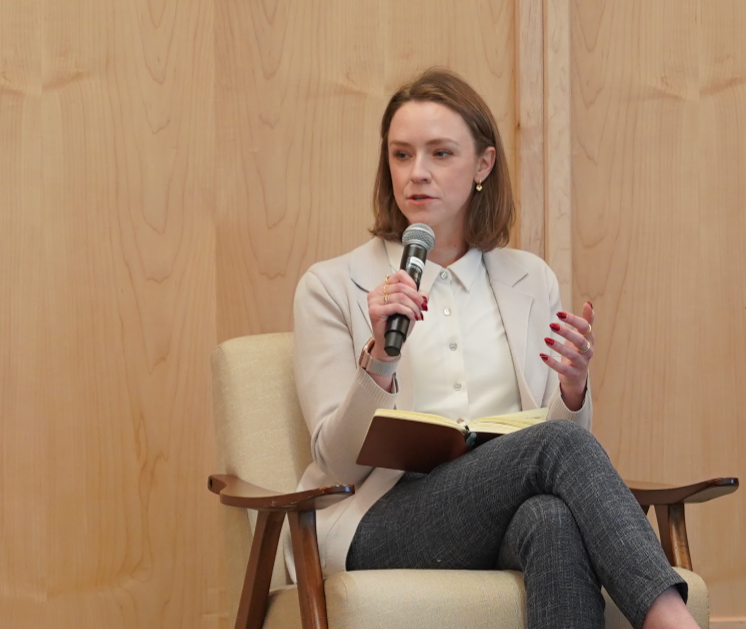
Susan Madsen, PhD, Founder and Director, Utah Women and Leadership Project and Professor of Leadership at Utah State University
Dr. Heath's counter-point is not a rebuttal but a clarification: economic stability isn't the enemy of these broader values. It's the foundation on which they rest. Lumina's research with Gallup found that 84% of students say they go to college to get a good job, or more specifically, the research refers to current or prospective students citing employment factors as a reason to enroll or consider enrolling. Heath's response to this is not to lament it but to take it seriously. Students who are first-generation or low-income aren't being shallow when they focus on employment — they're being rational. Without economic stability, civic engagement and personal growth remain luxuries. Job preparation is the enabling condition, not the ceiling.
Melanie Heath, PhD, Strategy Director for Access, Lumina Foundation
What AI changes in this picture, Heath argued, is not the goal but the timeline. Half of current college students are already reconsidering their majors because of AI. The stable four-year-to-career pathway that higher education was built around is giving way to something she calls "collaging through work" — students and workers returning repeatedly to education throughout their lives to upskill as conditions change. Institutions designed around a single traditional cohort are not built for this reality.
The most actionable insight from this panel, however, was about system design rather than values. Students aren't choosing to skip college because they've weighed long-term value against short-term cost and made a rational calculation. They're choosing certainty over uncertainty, and the higher education system has been designed to manufacture uncertainty at every step. The application process, the financial aid labyrinth, the opaque admissions criteria — all of it signals risk to students who can least afford to take risks.
Heath's proposed inversion is simple and powerful: treat post-secondary entry as opt-out rather than opt-in. Tell students they're admitted. Tell them upfront what financial aid they qualify for. Change the question from "Should I go to college?" — which for many students feels unanswerable — to "Which college should I go to?" That is a question students can engage with.
Envision Utah CEO Jason Brown moderates a discussion with Dr. Melanie Heath of Lumina Foundation and Dr. Susan Madsen of the Utah Women and Leadership Project at the Envision Utah higher education summit. The two researchers argued that higher education's value extends far beyond job placement — but that economic stability is the foundation on which every other benefit rests.
Madsen closed this section of the discussion with a story that illustrated both the power and the fragility of the current approach. In Kanab, during focus group research years ago, 25 women independently named the same high school counselor as the reason they went to college. One person, in individual moments of encouragement, changed the trajectories of dozens of lives. Heath's response was pointed: that's inspiring, and it's also a system failure. You cannot build an educational pipeline on the heroism of individual counselors. You build it into the structure.
The Structural Response
Commissioner of Higher Education Geoff Landward and Utah State Board of Education member Cindy Davis offered the most concrete vision of what a reformed system could look like — and the most candid assessment of what has been preventing it.
Geoff Landward, Commissioner of Higher Education, Utah System of Higher Education (USHE)
Landward's central argument is that Utah's 16 public higher education institutions have been structured as competitors, and competition has been producing the wrong decisions. When institutions vie for the same finite pool of students, state funding, and prestige, the incentives push toward program duplication, territorial resource allocation, and industry partnerships driven by competitive advantage rather than student or state outcomes. Landward is careful not to blame institutions for behaving this way — the system was designed to incentivize exactly this behavior. But the consequences are real.
His vision is to replace competition with alliance. Rather than 16 institutions each trying to build comprehensive excellence across every domain, he envisions a system in which institutions have distinct missions and roles, make concentrated investments to develop genuine centers of excellence, and then share access to those centers across the system. A student at one institution could access specialized programs at another through institutional partnership rather than geographic relocation. The resources saved through administrative consolidation could be reinvested in instruction and program quality.
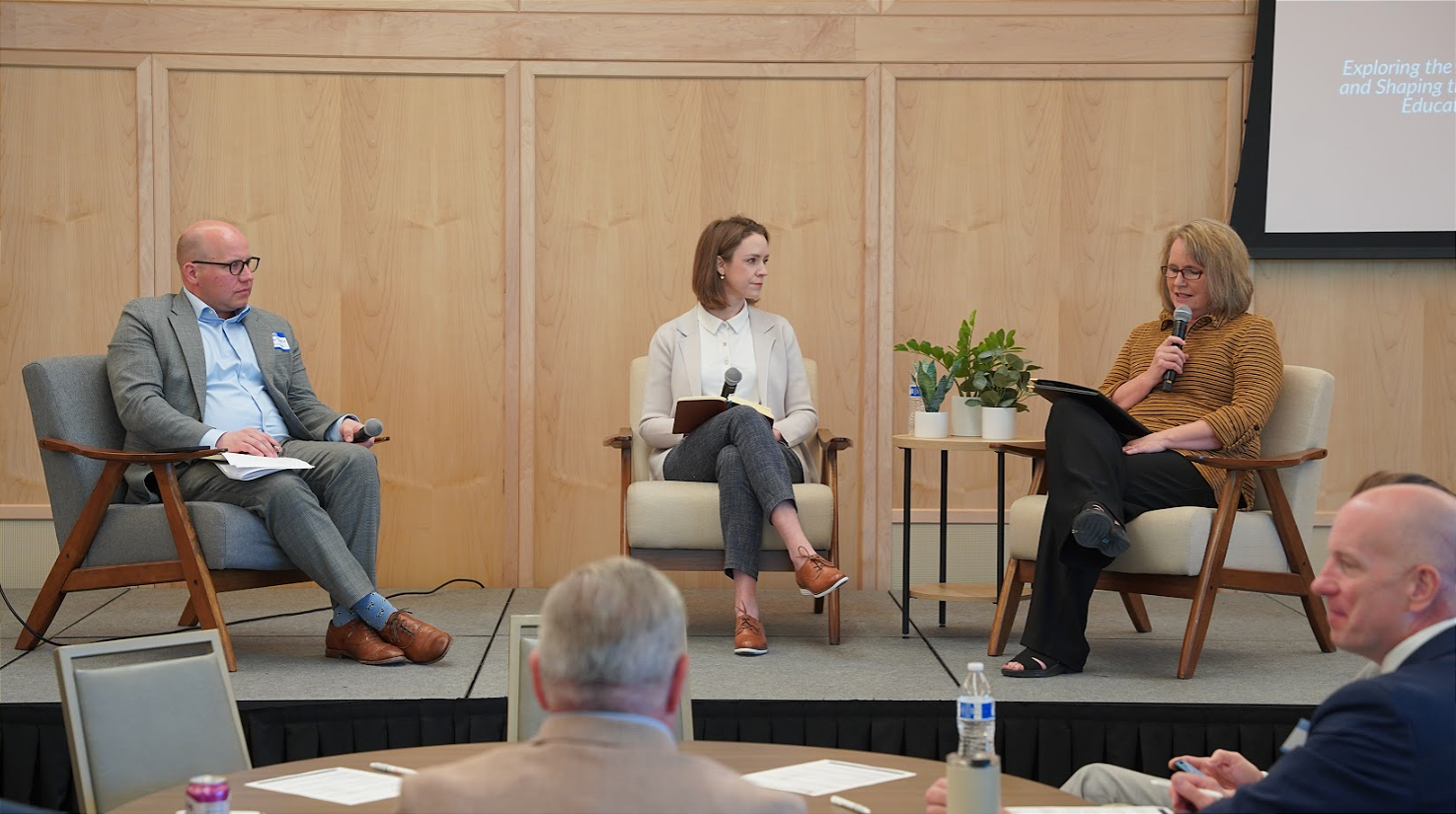
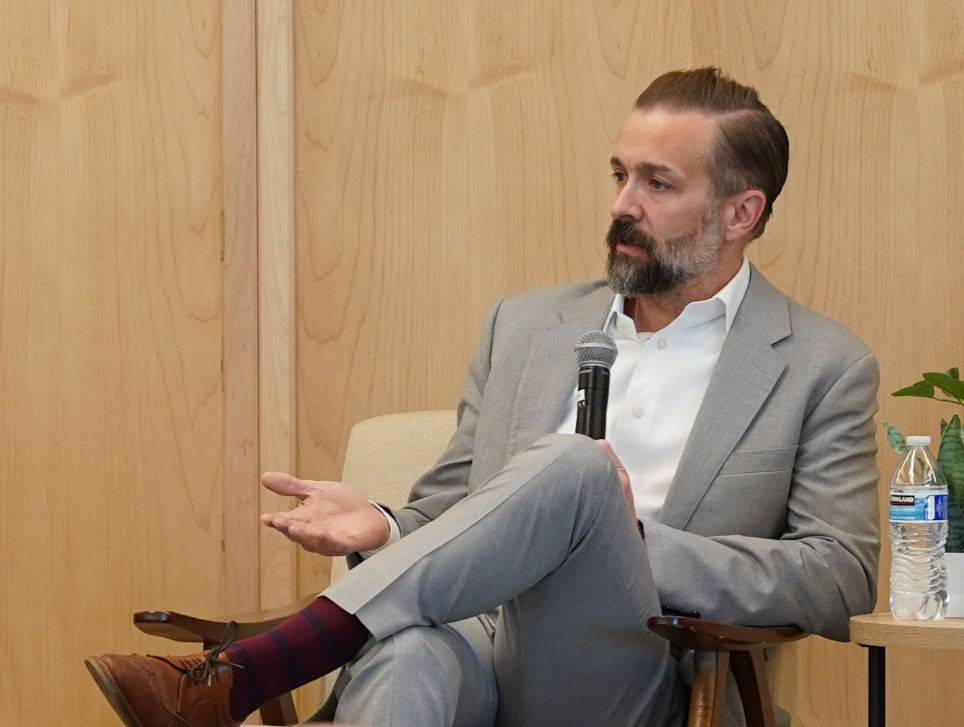
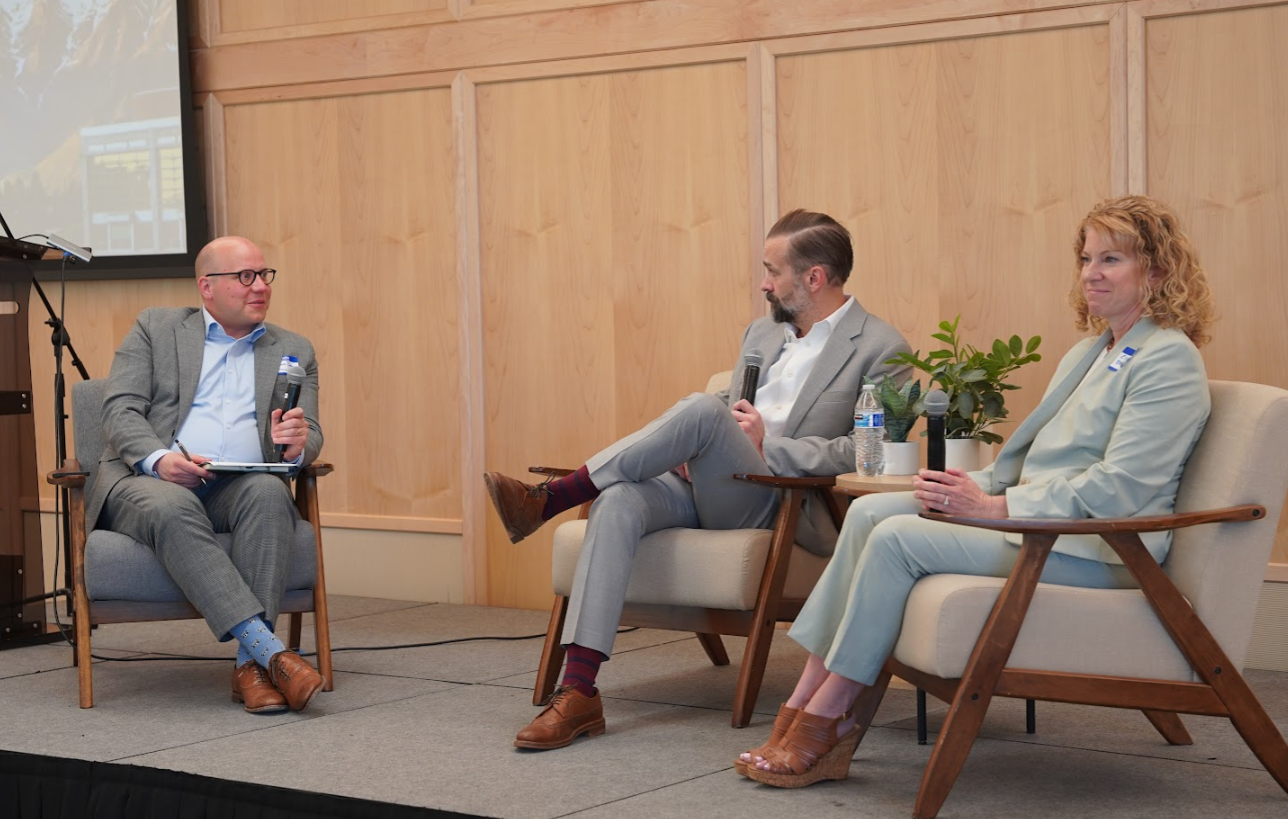
Jason Brown, CEO of Envision Utah, moderates a discussion with Commissioner of Higher Education Geoff Landward and Utah State Board of Education member Cindy Davis at the Envision Utah higher education summit.
States across the country are beginning to recognize this model's value and scrambling to implement it. Landward believes Utah is well positioned to lead — not because the work is easy, but because the relationships and governance structures needed to make it work are already being built.
The K-12 dimension of this vision may be even more consequential. For years, higher education institutions measured success partly by how many high school graduates they could recruit into their systems. And for years, that number kept declining despite significant investment in recruitment. Landward's diagnosis: the strategy was wrong. The question was never "How do we get students to come to us after graduation?" The right question is "How do we bring higher education to students while they're still in high school?"
If students can earn meaningful college credit, complete a certificate, or make significant progress toward a degree before they graduate from high school, the barrier of "starting college" largely disappears. They're not entering an unfamiliar system — they're continuing in one they already know.
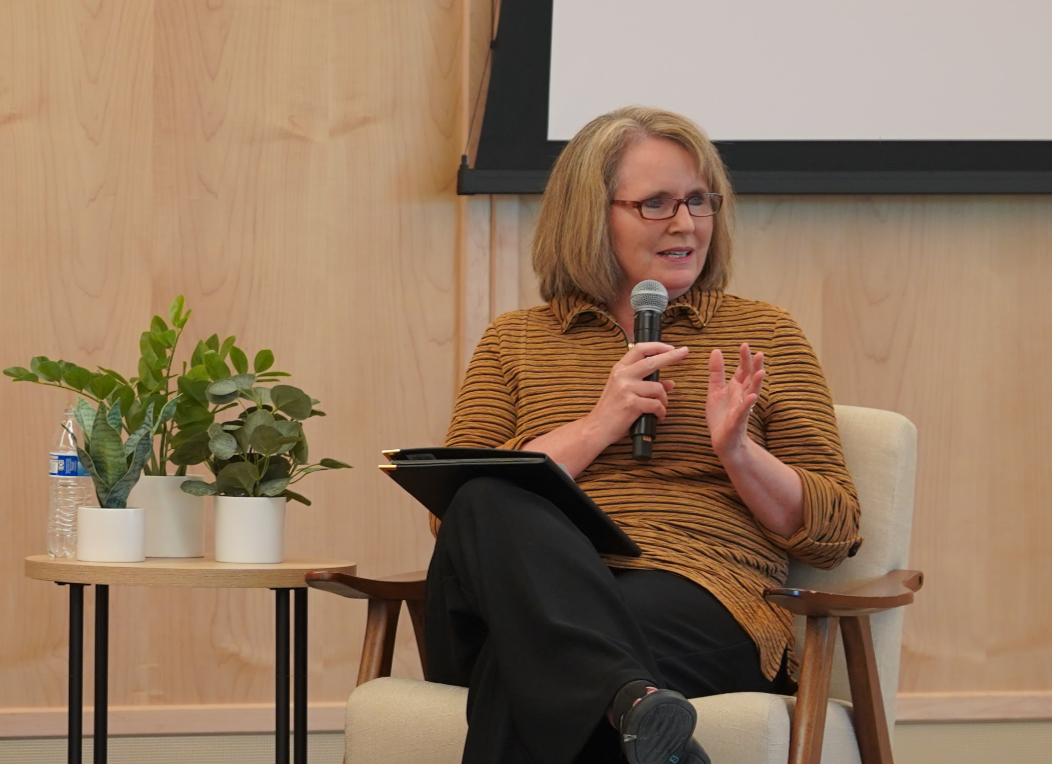
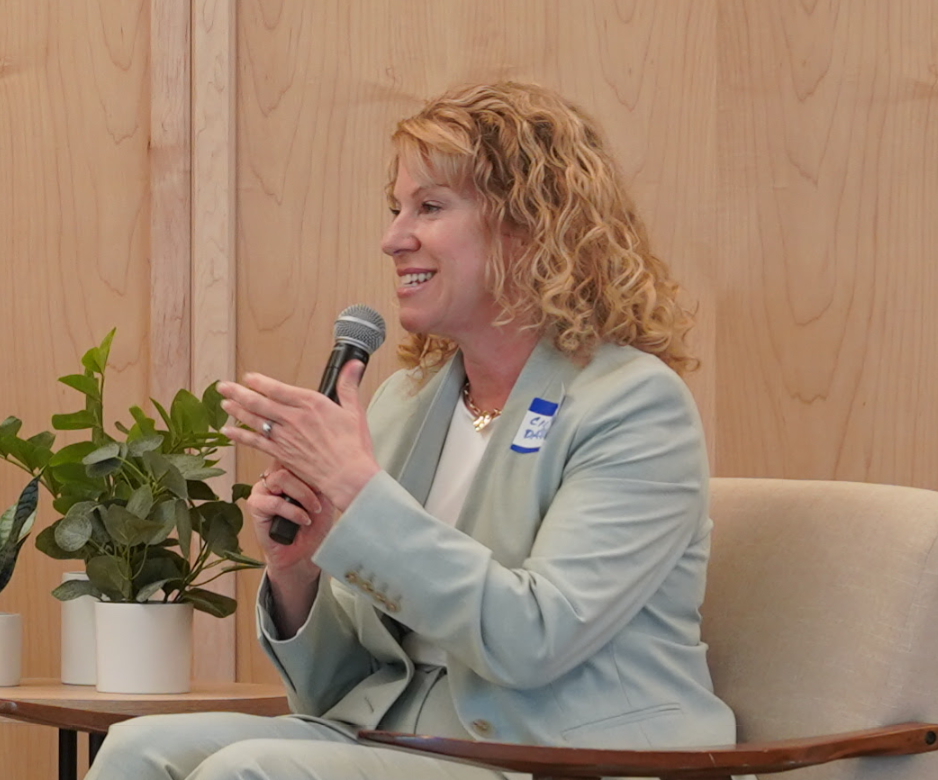
Cindy Davis, Member Utah State Board of Education, representing District 11
Davis, who has spent her career across both systems, named the obstacle directly: territorialism. It has existed between higher education institutions competing for the same students. It has also existed between higher education and K-12, where each system has sometimes guarded its turf against the other. A high school worried that concurrent enrollment students won't enroll later. A university worried that high school partnerships will cannibalize on-campus enrollment. Davis, who sits on the state board of education, was willing to name it and claim responsibility for both sides. An elected official, Davis represents district 11, which includes Lehi, American Fork, Alpine, and Bluffdale.
The practical examples of what progress looks like were illuminating. One district, with a waiver from the state board, is now requiring every junior to take a college math course through concurrent enrollment — not because college math is the goal, but because too many students were avoiding higher education because they feared math. Building success experiences in high school changes the story students tell themselves about what they're capable of.
Utah also holds genuine advantages worth naming. The state ranks among the lowest four nationally in tuition and fees and is the absolute lowest in student loan debt. Those facts are not reaching the students who most need to hear them. Envision Utah research found students estimating the cost of college at roughly four times the actual figure. The state has built an affordable system and has not told anyone.
The Question Underneath All of It
Barclay Burns, Chief AI Officer at Utah Valley University, shared an argument that reframed everything that came before it.
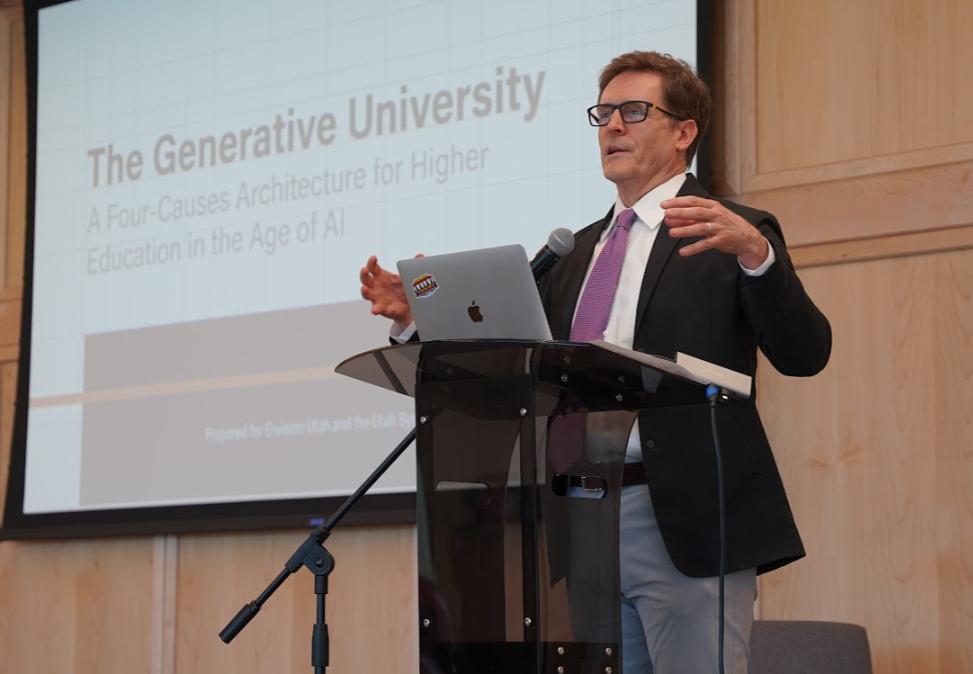
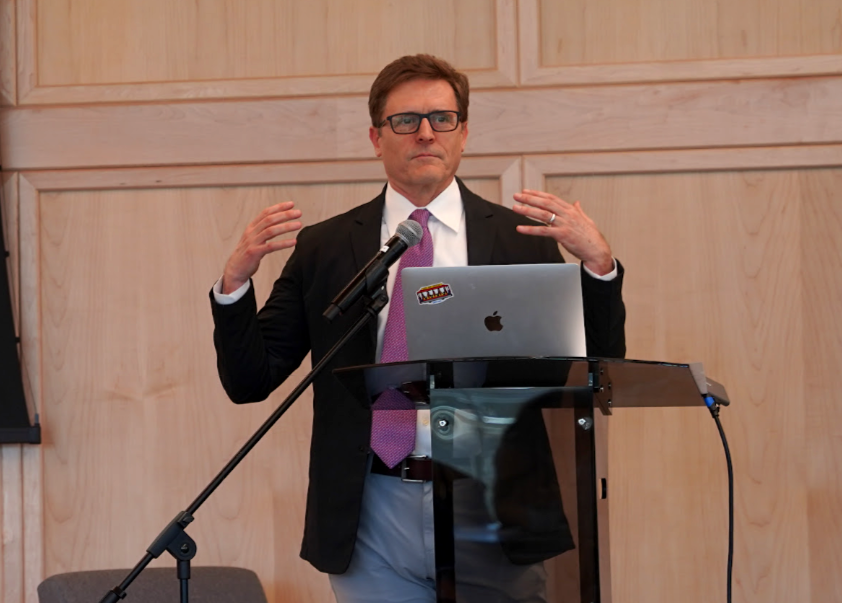
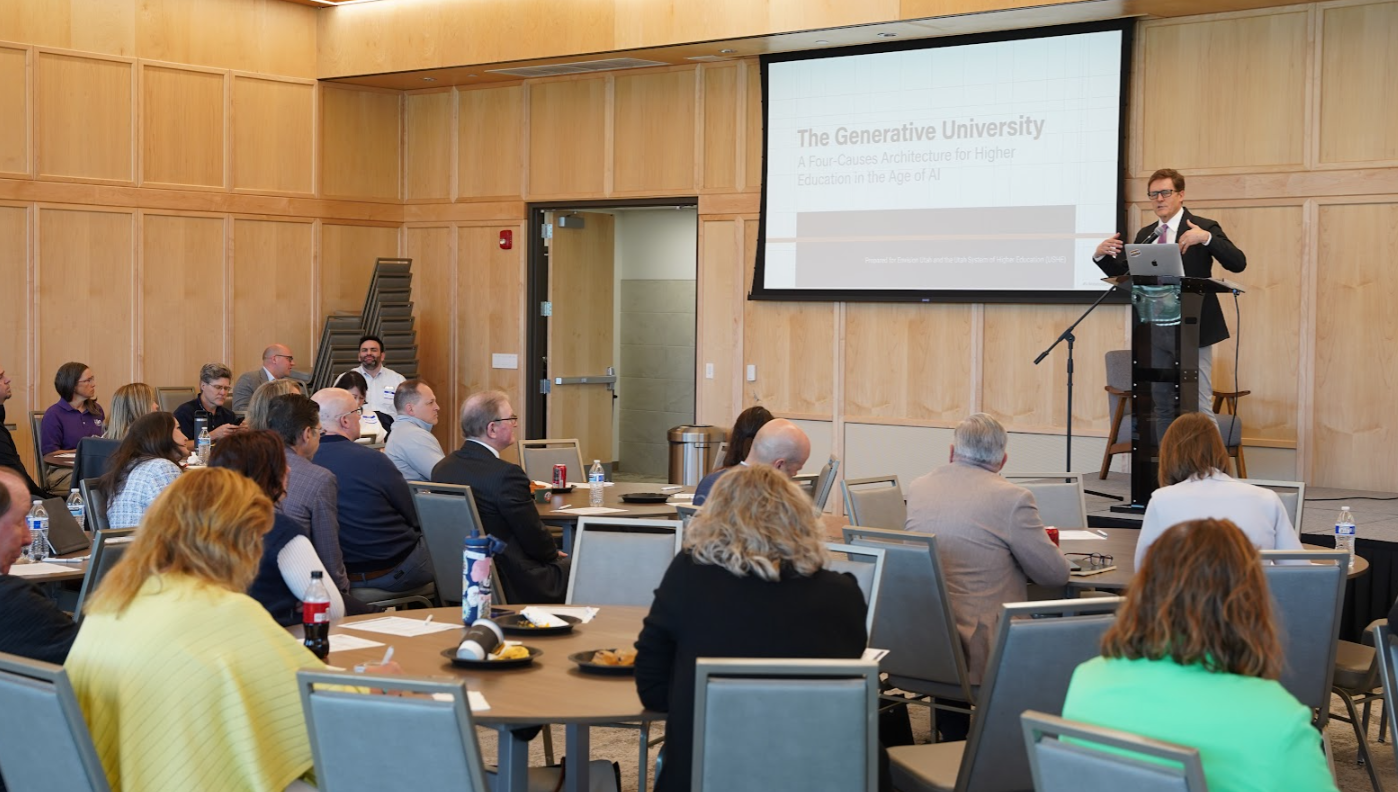
Dr. Barclay Burns of Utah Valley University at the Envision Utah summit: "Humans are generative. Organizations are generative. Systems are generative. The question is whether we design them that way.
His opening move was disarming: generativity — the capacity to create new and novel things from existing materials — is not something artificial intelligence introduced to the world. Aristotle was wrestling with it 2,400 years ago. Humans are generative by nature. The question raised by large language models and the broader AI revolution is not whether machines can now be generative. They can. The question is whether we will allow that capability to quietly replace human generativity rather than amplify it.
Dr. Burns's concern is concrete. If students are given access to generative AI tools without deliberate pedagogical design, the tools will do their thinking for them. The output will look like work. The thinking will not have happened. And institutions will have graduated students who are skilled consumers of AI output rather than independent generators of ideas, solutions, and judgment. That is not a future that serves students, employers, communities, or the broader project of human flourishing.
His response in his role at UVU has been methodical. Rather than issuing campus-wide AI mandates — which tend to trigger faculty anxiety and produce compliance without understanding — Burns's team works department by department. They sit with faculty in chemistry, in accounting, in marketing, in mechanical engineering, and ask a simple question: what do you value in this discipline, and how could AI serve that 5% better? The answers are different for every department, and they should be. A chemistry professor's relationship to AI tools is not the same as an English professor's. Pretending otherwise produces confusion. Working through the specifics produces ownership.
Utah Valley University's Dr. Barclay Burns bringing a philosopher's framework and an economist's caution to the question of AI in education, warning that machines don't just accelerate good decisions — they accelerate bad ones, at speeds humans can no longer track.
The deeper argument Burns is making is about institutional design. A generative university, in his framework, is one that is intentional about four things: what it values, how it governs itself and creates incentives, what resources it brings to bear, and what it wants students to be able to do when they leave. These are not abstract questions. They are the questions that determine whether AI becomes a tool for human development or a substitute for it.
Burns added a warning that deserves attention beyond the campus. AI doesn't just accelerate good decisions — it accelerates bad ones, at machine speed, with no human friction to catch errors. A bad clinical decision, a flawed policy assumption, a biased algorithm: any of these can cascade through interconnected systems at a scale and speed that has no precedent. The argument for human generativity is not sentimental. It is a systems engineering argument. Humans need to remain in the loop not because machines can't be fast, but because speed without judgment is catastrophic.
His vision connects to everything Landward and Davis described: a continuous system running from K-12 through higher education through the workforce, with businesses and society woven into universities rather than waiting at the exit for graduates to arrive. UVU is working to bring employers and community institutions into the educational experience rather than treating them as downstream customers of it. The goal is students who can engage generatively with a world in which AI is everywhere — not students who have been handed AI and told to succeed.
Dr. Barclay Burns, Chief AI Officer at Utah Valley University, addressing education leaders at the Envision Utah summit, arguing that the real challenge of artificial intelligence isn't what it can do — it's whether we will allow it to replace the human thinking it should be amplifying.
What the Moment Requires
Set these five perspectives side by side and a coherent picture emerges.
Utahns have clear and consistent values: they want education that lifts families, builds confidence, and produces capable citizens. They are not getting the message that Utah's system — affordable, technically excellent, and increasingly integrated across K-12 and higher education — is actually well positioned to deliver on those values.
The demographic pressure is real but not catastrophic, and Utah's version of the story includes a recovery arc that many states won't see. The window between now and that recovery is the planning horizon that matters.
The value of higher education is simultaneously more economic than critics of vocationalism want to admit, and far richer than simple job-placement metrics capture. Both truths need to be in the conversation, and students need to hear both — especially the students most at risk of opting out because the system feels too uncertain and too expensive.
The structural changes required — treating K-12 and higher education as a single system, replacing institutional competition with strategic alliance, moving higher education into high schools rather than waiting for students to arrive at college — are not theoretical. They are already underway in Utah, haltingly and imperfectly, but with genuine momentum.
And underneath all of it is a question about what kind of humans we are trying to produce. Not just employed humans. Not just credentialed humans. Generative humans — people who can think, create, adapt, and lead in a world where the machines are getting very good at doing everything else.
That is what this moment requires. Utah, if the people in that room are right, may be better positioned than most to deliver it.