Fortem Lands DHS Prime Contractor Slot on $1 Billion + Counter-Drone Contract
DHS named Fortem Technologies (Lindon, UT) the only small business among seven prime contractors on a five-year, $1B+ counter-drone IDIQ. CEO Jon Gruen discusses the win, subcontractors Lockheed Martin and Microsoft, and plans to scale Utah manufacturing.
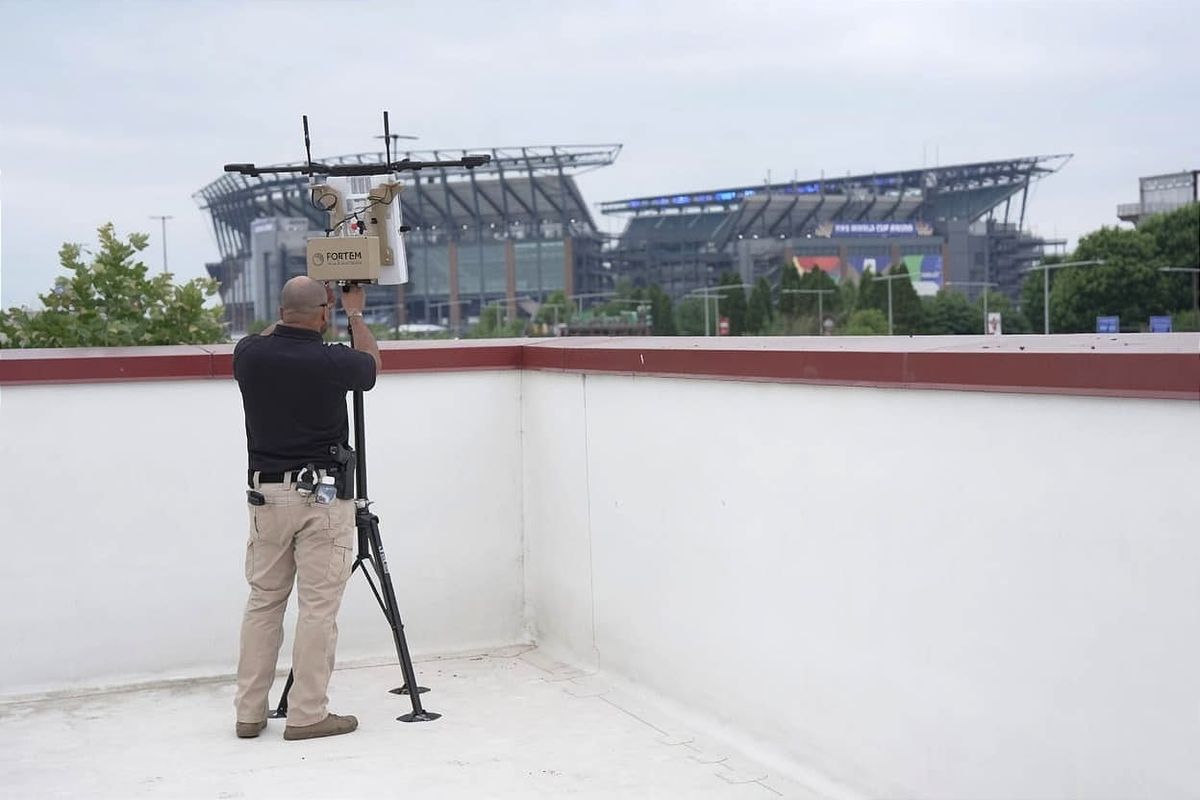
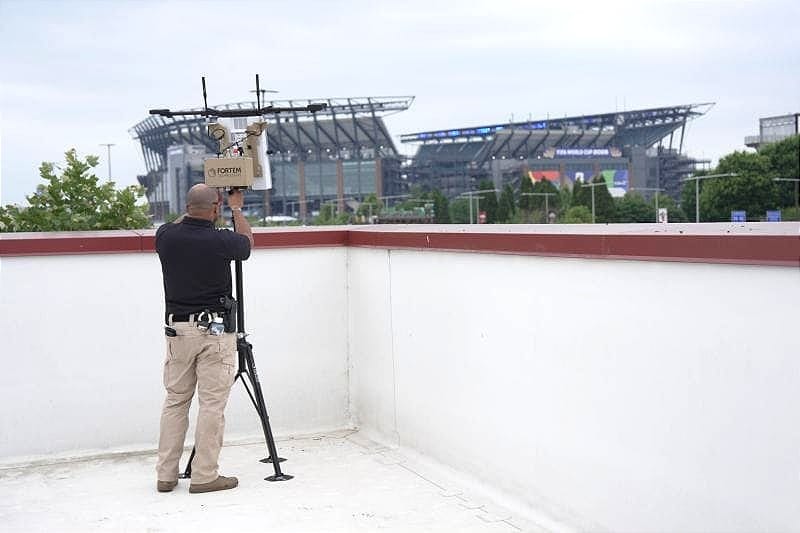
A law enforcement officer positions a Fortem TrueView® R40 radar sensor on a rooftop overlooking Lincoln Financial Field in Philadelphia, one of 11 U.S. venues for the 2026 FIFA World Cup. Fortem's radar and command-and-control systems monitored airspace around DHS-designated World Cup sites throughout the tournament. Photo courtesy of Fortem Technologies
A law enforcement officer positions a Fortem TrueView® R40 radar sensor on a rooftop overlooking Lincoln Financial Field in Philadelphia, one of 11 U.S. venues for the 2026 FIFA World Cup. Fortem's radar and command-and-control systems monitored airspace around DHS-designated World Cup sites throughout the tournament. Photo courtesy of Fortem Technologies
Lindon, Utah — August 4, 2026
Jon Gruen was in Salt Lake City on July 29, on a panel about Utah's defense tech economy hosted by The Salt Lake Tribune, JPMorganChase, and the Kem C. Gardner Policy Institute, giving no sign that anything was imminent. The next morning, his phone told a different story: the Department of Homeland Security had selected Fortem Technologies as a prime contractor on its five-year Counter-Unmanned Aircraft Systems (C-UAS) indefinite-delivery/indefinite-quantity contract — a vehicle with a starting ceiling north of $1 billion.
"We literally didn't know," Gruen, Fortem's CEO, said in an interview with TechBuzz News. "The next day is when we found out."
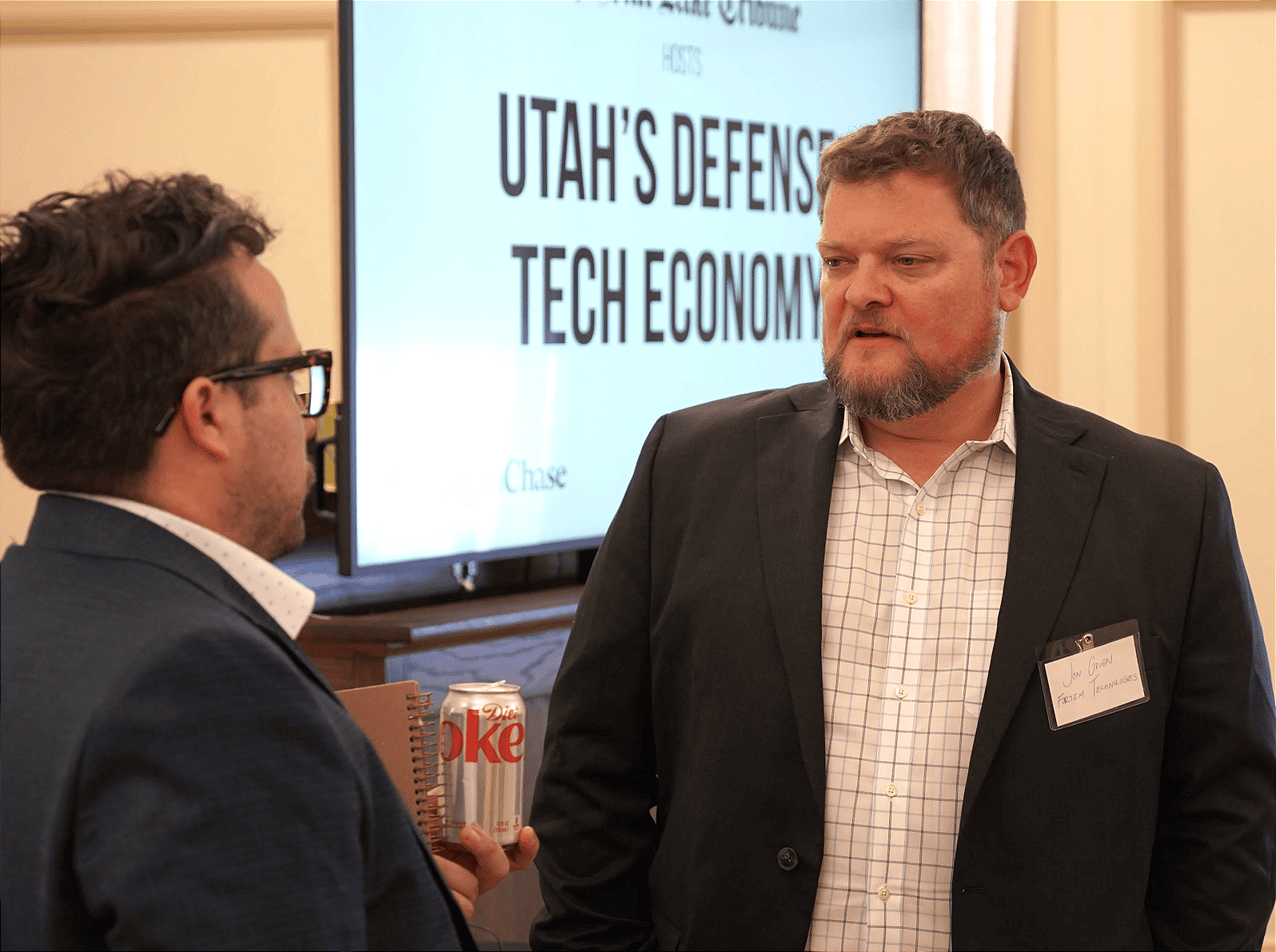
Jon Gruen, CEO, Fortem Technologies speaks with an attendee following the July 29 "Utah's Defense Tech Economy" panel, hosted by The Salt Lake Tribune, JPMorganChase, and the Kem C. Gardner Policy Institute in Salt Lake City. Photo: Mark Tullis
Fortem was the only small business selected among seven companies on Track 1 of the contract, DHS's hardware, software, and ancillary-services lane. The award means every DHS component — Customs and Border Protection, the Secret Service, the Coast Guard, the Federal Protective Service, and others — can now issue task orders directly to the Lindon-based company for its DroneHunter® net-capture interceptors, TrueView® radars, and SkyDome® command-and-control software. Fortem's technology has been validated in operational deployments in Ukraine, the Middle East, and East Asia.
It's the latest, and largest, in a string of federal wins for Fortem over roughly the past year and a half: selection under the Pentagon's Replicator-2 initiative, an $18 million, three-year U.S. Army contract, a role protecting DHS-designated venues during the 2026 FIFA World Cup, and a $25 million investment from Lockheed Martin announced in April.
"We've been waiting for this one for over six months," Gruen shared with TechBuzz. "It's great! We finally got it."
A law enforcement officer positions a Fortem TrueView® R40 radar sensor on a rooftop overlooking Lincoln Financial Field in Philadelphia, one of 11 U.S. venues for the 2026 FIFA World Cup. Fortem's radar and command-and-control systems monitored airspace around DHS-designated World Cup sites throughout the tournament. Photo courtesy of Fortem Technologies
Gruen offered a rough, self-described "bottoms-up" estimate of what the $1.011 billion DHS contract could mean for Fortem specifically. He described current demand for DroneHunter, drone hangar, and radar products "approaching $100 million" over the next few years. However, he was explicit that Fortem doesn't yet have strong visibility into the actual number and the $100 million figure is a base-case estimate.
Beating out billion-dollar rivals
Fortem's competition on Track 1 wasn't small. Two of the other six awardees are now backed by public companies with deep pockets in the counter-drone space: Axon, which acquired airspace-security firm Dedrone in 2024, and Motorola Solutions, which agreed in June to acquire counter-drone company D-Fend Solutions for $1.5 billion.
"We're the only true small business on there," Gruen said of the group. "Those are multibillion-dollar corporations, obviously."
He credits Fortem's selection to a combination of product differentiation and a longer relationship with DHS than the specific contract announcement suggests. The company's DroneHunter interceptor uses a net-based capture system rather than kinetic destruction, paired with what Gruen described as small, lightweight sensor hardware. But the deeper factor, he said, is trust built over years of working directly with the agency.
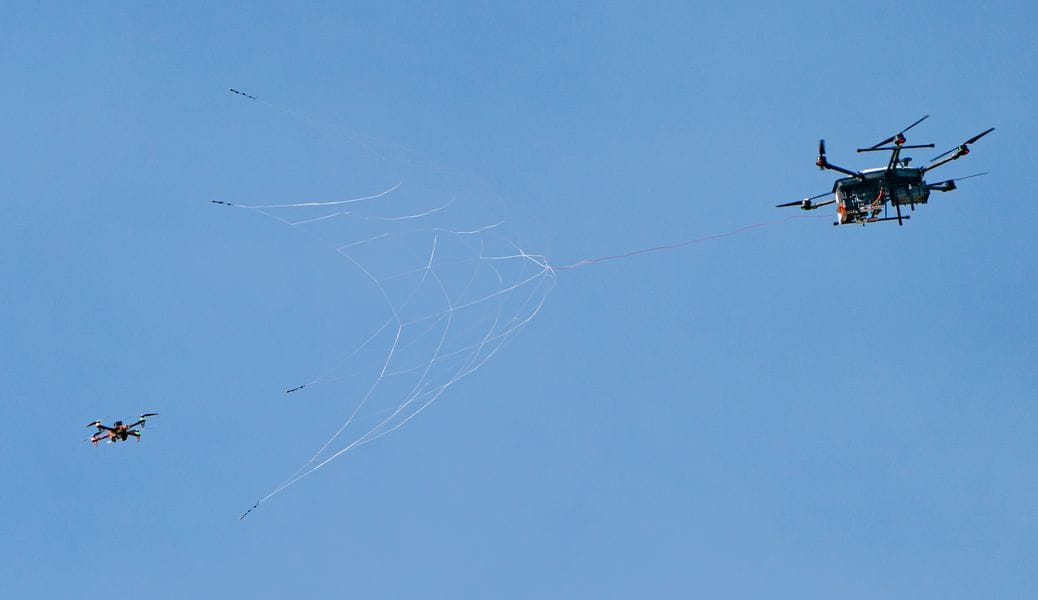
A Fortem DroneHunter® interceptor fires its net-based capture system at a target drone during a test flight. The approach — netting drones out of the sky rather than destroying them kinetically — is designed to bring threats down intact and away from populated areas without falling debris. Photo courtes of Fortem Technologies
"We've been working with DHS for five, six years — coming out of COVID in an accelerated way," Gruen said, "everything from writing mitigation regulations for U.S. airspace to getting the systems approved for use, and that's everyone from DHS testing to the FAA to Congress."
That relationship has included what Gruen called "emergent needs deployments," or in other words, being asked to bring equipment to protect specific events on short notice, then repeating that successfully enough times to build a track record. Fortem's approach of working alongside other counter-drone vendors, rather than positioning itself as a sole-source alternative, also played a role, he said. Beyond Lockheed Martin and Microsoft, named as exclusive subcontractors in DHS's announcement, Fortem has relationships with more than a dozen other companies in the counter-drone space it can pull in as needed, explained Gruen.
What Lockheed and Microsoft actually bring
The DHS announcement named Lockheed Martin and Microsoft as Fortem's subcontractors on the award, but didn't detail their roles. Gruen filled in some of those details in the interview.
Lockheed Martin's own materials confirm Microsoft's Azure cloud and AI stack is "foundational to the Sanctum ecosystem," with Azure IoT Hub ingesting sensor data from distributed sites, Azure Synapse and Azure AI Foundry powering real-time threat detection and multi-sensor tracking, and Azure Monitor underlying the unified interface operators use to manage the system.
"When we look at how we develop our software, how we host our software, how we network sites together, that's really Microsoft's bailiwick," Gruen said, describing Microsoft's "modern data architecture" for hosting and networking Fortem's software as a key component in the project.
Lockheed Martin's role builds directly on the $25 million investment TechBuzz reported in April, which centered on integrating Fortem's systems with Lockheed's Sanctum C-UAS mission management software — an integration Lockheed itself has publicly described as providing "persistent, layered airspace defense" combining Fortem's TrueView radar and DroneHunter interceptors with Sanctum's command layer. Gruen confirmed DHS components will have access to Sanctum under the new contract.
Beyond that confirmed integration, Gruen went further in the interview, saying Sanctum also connects to a Lockheed laser system he said DHS has expressed interest in, and to Golden Dome America, the national missile-defense initiative Lockheed is involved in.
A quiet World Cup
Fortem's systems were also in place at DHS-designated World Cup venues this summer. It was a deployment that, by Gruen's account, ended up being uneventful in the best possible way.
"When we're not used, it's oftentimes a good thing," Gruen said. "The DroneHunter didn't have to be used. That meant a drone didn't get close enough to the stadium that a nefarious drone response was necessary."
Fortem's radars and command-and-control software tracked drone activity around World Cup venues throughout the tournament, while electronic-warfare and RF-based systems from Fortem's partners helped identify where operators were flying from, information passed to law enforcement. No threat rose to the level that Fortem's interceptors needed to be deployed, he said.
Inside an IDIQ: what the contract structure actually means
The DHS award is structured as an indefinite-delivery/indefinite-quantity contract, a term that shows up in nearly every federal contracting announcement but isn't always explained. Gruen broke it down in practical terms.
The "indefinite quantity" piece means DHS components can now request and buy systems as needs arise, without renegotiating pricing or terms each time. They are already locked in through the contract vehicle. The "indefinite delivery" piece, despite the name, doesn't mean an open-ended timeline; the contract runs five years. What it does mean is that individual components can commit to recurring purchases across that window rather than a single one-time buy.
"Secret Service can say, 'I'm going to need 20 systems a year for the next five years,'" Gruen said. "It's not like it's a one-time buy; indefinite delivery really just means it's constant buying for those five years."
He added that while the contract's starting ceiling is $1.011 billion, ceilings on this type of vehicle are commonly raised over the life of the contract, while the five-year duration and list of awardees rarely change once set.
Secret Service: first in line
Asked which DHS components are likely to move first, Gruen pointed to the Secret Service, which he said has had a pending requirement for Fortem's systems for some time.
"They've had pent-up demand because they use us everywhere POTUS goes, basically," Gruen said, listing recent deployments including the presidential inauguration, the National Christmas Tree lighting, the Masters golf tournament, and a recent UFC event. Fortem typically has staff on-site to support Secret Service agents operating the systems, he said, even though agents run the equipment themselves.
Scaling up in Lindon
The new contract adds to a production ramp already underway at Fortem's Lindon headquarters. Gruen said the company is already outgrowing the building it moved into during last year's facility expansion. Its landlord is adding roughly 15,000 additional square feet, but that buildout will take about a year to complete.
In the meantime, Fortem is shifting some functions — shipping, receiving, and production of components like integration boxes and drone hangars, though not the radars or DroneHunter interceptors themselves — to off-site facilities to free up capacity at its main plant. Gruen said he's also weighing a move to second and third manufacturing shifts, running production closer to 24/7.
Flight testing tied to the expanded workload is taking place at Cedar Valley Airport, on the west side of Utah County.
Fortem has grown headcount roughly 60% so far this year, according to Gruen, a trend he expects to continue as the new contract ramps up.
About Fortem Technologies
Fortem Technologies is privately held and headquartered in Lindon. The company is the only firm authorized to deploy a drone-on-drone kinetic interceptor in U.S. airspace, and its technology has been validated in operational deployments in Ukraine, the Middle East, and East Asia. Fortem is backed by Lockheed Martin, DCVC, Toshiba, AE Industrial Partners, AIM13, Signia Venture Partners, and other investors.
Success! You now have access to additional content.
Fortem Technologies, Jon Gruen, DHS, counter-drone, IDIQ, DroneHunter, TrueView, SkyDome, Lockheed Martin, Microsoft, Lindon Utah, Secret Service, FIFA World Cup, Replicator-2, small business contractor