GoForth Foundation Uses AI to Put Every Sacred Place on Earth Online
GoForth Foundation, an American Fork, Utah nonprofit, built an AI pipeline that takes a sacred site from research to published page in 15 minutes. It has its sights set on every temple, cathedral, and holy site on earth.
On a small island in Mumbai Harbor sits a network of rock-cut caves dating to the fifth century. Hindu craftsmen carved them from solid basalt. The main cave holds a sculpture of Shiva with three faces — creator, preserver, destroyer — considered one of the finest examples of Indian art in existence. UNESCO designated the Elephanta Caves a World Heritage Site in 1987.
A visitor to Temples.org can find all of that in under a minute. Sourced. Verified. Available in 13 languages.
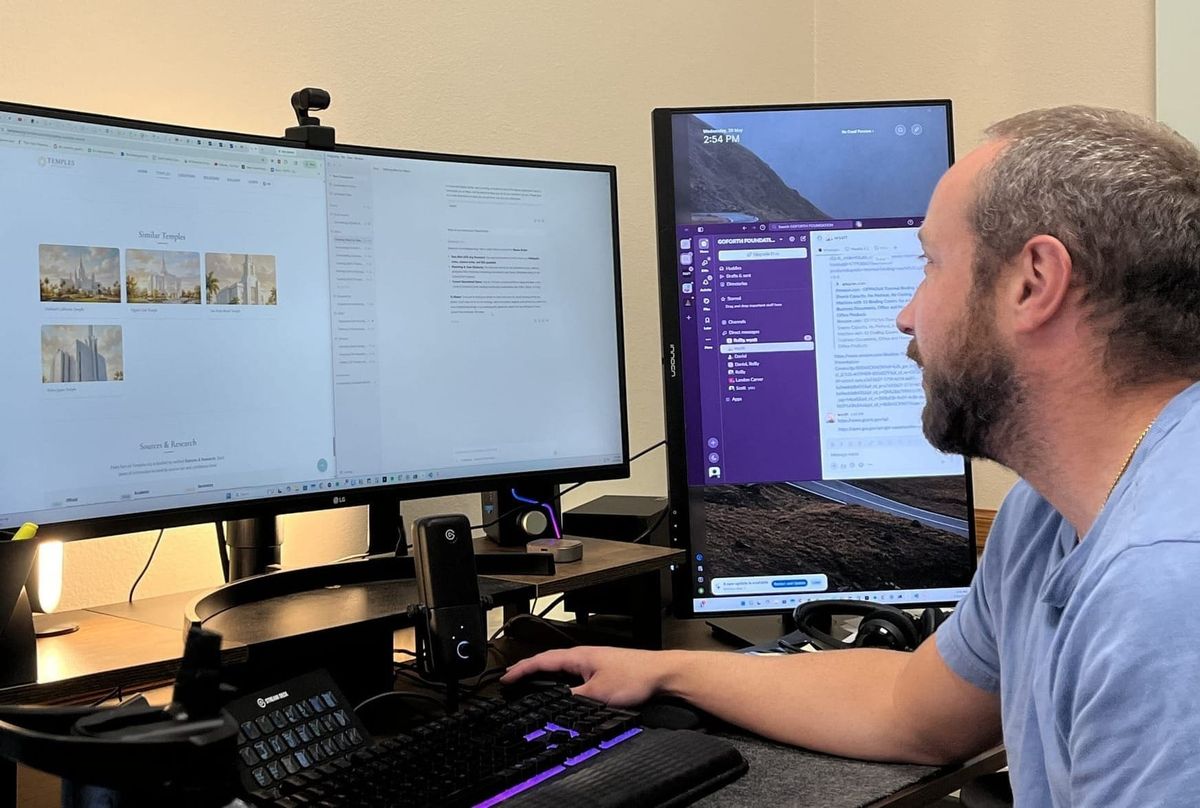
Scott Harward, who received an Associate in Science at UVU and BA in Marketing from Utah State, built the system that put it there. What began as a 36-hour manual process — research, sourcing, writing, image verification, translation — now runs in roughly 15 minutes through a pipeline of AI agents, each assigned a single task. One finds sources. One distills them. One writes. One fact-checks. Others handle images, translations, SEO, and accessibility.
"It used to take us like 36 hours," Harward said. "Now I could do a temple in 15 minutes — images, artwork, history, sources, everything." And the system is almost completely automated.
Harward is a co-founder of GoForth Foundation, an American Fork nonprofit with an ambition that matches its pipeline: accurate, sourced coverage of every sacred place on earth, across every faith tradition. The site currently documents sacred sites across 18 world religions, from Latter-day Saint temples to Sikh gurdwaras, Shinto shrines, and ancient Hindu caves.
The organization is led by Wyatt Ernst, Harward's friend since second grade and GoForth's founder and CEO. Ernst is the kind of person who has always asked better questions. He tells a story about standing in front of a full refrigerator as a teenager, convinced there was nothing to eat — until he changed the question he was asking himself — asking instead what choice would empty the fridge the fastest. "Whatever question you first ask is going to determine and guide your brain to find what it's looking for," Ernst said.
The question GoForth asked: what would happen if every sacred place on earth had a trustworthy home online?
From Blue Fire Leads to a Worldwide Platform
Chief Marketing Officer Scott Harward has been friends with Ernst since second grade. Long before GoForth existed, Ernst ran a company called Blue Fire Leads, and Harward worked there as a marketer. A contact reached out to Harward about digital work for Latter-day Saint temples. Harward launched his own marketing agency, JX Strategy, and the temple work followed.
"Scott and I have been friends our whole lives," Ernst said. "There's been multiple times where I've been his boss, and then when I came originally over to JX Strategy, then he was my boss, and when I spun off GoForth, and Scott closed down JX Strategy, he came back in, and now I'm his boss. It's a very interesting dynamic, but we've never allowed the hierarchy to determine our relationship or what work gets done. We have always played to our strengths."
Reilly Anderson, now GoForth's Deputy Director, entered the picture roughly six years ago when he moved in next door to Harward. Harward learned Anderson had a background in online marketing and pulled him into the temple projects. Anderson came up alongside Harward through Journicity and JX Strategy before the three joined forces at GoForth. He keeps track of it simply: "I'm old school — I was Journicity first, and then JX Strategy, and then the nonprofit (the GoForth Foundation). So I've had many banner changes."
The shift to nonprofit was strategic, not sentimental. "As soon as we outgrew the budget of the private foundation, we realized we needed to start a public foundation, so we can go to the public and start raising funds to grow," Ernst said. "That was the big determining factor."
According to its website, the organization began as a private charity called the Doing Good Foundation before incorporating as a public nonprofit. Ernst's long-term vision is to work with all 17 million members of The Church of Jesus Christ of Latter-day Saints as volunteers across GoForth's projects.
The Mission: Neighbors, Not an Institution
GoForth runs several projects —Temples.org, SaintsofJesusChrist.org,JOYFL — an ad-free Christian music streaming platform Ernst describes as the "Spotify of gospel-centered music by Latter-day Saint artists" — and Invite, a custom nonprofit event ticketing platform. The underlying mission is the same.
The stakes are concrete. According to research done by GoForth, content tagged #ex-mormon has accumulated more than 2 billion views online, and they found that 67% of Latter-day Saints feel misrepresented in online search results.
"We are striving to help local communities come to know and understand and trust the local Latter-day Saints amongst them," Ernst said. "There are a lot of rumors and misconceptions about Latter-day Saints in the world, and we want to clarify what's real and have people actually see us individually as local saints, as their friends, neighbors in their community, instead of seeing the Church as this big global institution."
Ernst measures whether that mission is working by what visitors do, not how many show up. "One of our core values is we like to measure impact, not activity logged," he said. "Anyone can look at how many users came to the website, but we want to look at actual actions taken — so if they clicked on a button to learn more, if they gave us an email to subscribe to stay in constant communication, if they clicked on plan a trip and actually showed up to a location, then we know that we're having impact."
Much of that impact flows through Latter-day Saint visitor centers, which Ernst describes as low-pressure spaces. "It's very welcoming and very similar to what you would anticipate going into a visitor center for a national park," he said. "They're very careful not to overstep or make you feel like they're pressuring you in any way, and it's all about just letting the community learn who they actually are and distill misconceptions."
Two platforms —MesaTemple.org andTempleHill.org — illustrate the model. Both transform standard event listings into community engagement hubs, with newsletters, virtual tours, and event registration built in. The Mesa Arizona Temple Easter Pageant, hosted at one of GoForth's flagship sites, draws more than 100,000 attendees annually.
Thirty-Six Steps, One Sacred Place
The most technically ambitious piece of GoForth's work is Temples.org, a site that aims to provide accurate, sourced coverage of every sacred place on earth, across every faith tradition.
Harward built the content system behind it. What began as a manual process has become a pipeline of AI agents interacting in Antigravity (a tool from Google that integrates and helps automate Large Language Models), each with a distinct role.
“It’s a 36 step process, and that's not including the translation,” Harward said.
One finds the highest-quality sources. One distills the information. One writes the article. One fact-checks the claims. Others handle image verification, translations into 13 languages, SEO, accessibility, and usability. Across GoForth's broader platform suite,content reaches members in 18 languages worldwide. The improvement in speed is dramatic. "It used to take us like 36 hours," Harward said. "Now I could do a temple in 15 minutes — images, artwork, history, sources, everything. It goes and finds any images through open source libraries. Then it checks those images to make sure it is what it’s supposed to be. If it’s an image of the Prophet’s Mosque, is it an actual picture of the Prophet's Mosque?"
The site currently documents sacred sites across18 world religions, from Latter-day Saint temples to Hindu caves, Sikh gurdwaras, and Shinto shrines.
Ernst describes the system from an operator's vantage point. "It's more than a singular prompt — it's an entire process of different AI agents working together, and each one is assigned a different role. One's assigned to finding the highest quality sources, one's assigned to distilling the information from there, another one's assigned to writing the distilled information, another one's assigned to quality checking the information that was produced and making sure it's accurate. It's a big ecosystem that’s quite significant."
A human reviewer named Landon Carver spot-checks each batch before it publishes. Harward says the system has become consistent enough that a single error in a batch usually signals errors across it — making batch-level review more practical than page-by-page checking.
“It’s pretty accurate. Before scaling up, I first just started with (spot-checking) 10, doing one at a time, until about 35 temples, I was able to get a pretty consistent quality. Generally, if it’s wrong on one in the batch, it’ll be wrong on the others, so I spot-check the batch,” Harward said.
The coverage strategy starts with the most well-documented sacred places and expands outward in stages. "Right now we're going off of just pure popularity and information available online, that is the low hanging fruit," Ernst said. "The next stage will be to start going to those that are moderately popular with a little less articles, and then the last stage will be going to the sacred places that have minimal information available, so that way we can help them be discovered as well."
AI Across the Organization
Temples.org is GoForth's most visible AI application. It is not the only one.
Anderson's day-to-day use shows how the tools have matured for non-engineers. He uses Notion AI to transcribe every meeting and send notes to the team. He uses Claude to manage tasks. For web work — and Anderson is clear he is not a developer — he generates HTML and CSS directly and hands legacy code to AI rather than reading it line by line.
Conference room at GoForth Office’s headquarters, located in American Fork, Utah
"I'm not doing developer status coding," Anderson said, "but it can spit out all the HTML, CSS, and stylings, and I can adjust it. If I come across legacy code, I can throw it in there, and it can interpret it and help me work through editing it without having to digest every line of code that's in there."
The research time savings are significant. Anderson compares his current pace to what the same work required in college. "You take what I spent a whole semester on in college, doing one website, analyzing one website, and AI is able to do five different websites in five minutes," he said.
That efficiency carried into product development. GoForth rebuilt its Invite ticketing software from the ground up using AI tools, starting from an existing architecture and reassembling it with AI-assisted development.
The Invite platform is part of a broaderGoForth Software Suite — a toolset designed for nonprofits and faith-based organizations that includes event management, unified messaging, and data reporting tools. Ernst says the goal is to give local leaders the infrastructure to run digital outreach without needing a marketing background.
Ernst uses AI differently — to simplify the instructions GoForth gives its volunteers. "Anything where we need to speak to a volunteer, we want those instructions to be as short, concise, and clear as possible, and AI helps us get there very quickly," he said. "We can give a four paragraph instruction manual to AI, and have it distill it down to two sentences in a very clear manner that would take us hours to get to."
Harward's approach to AI goes further. He has built a personal AI assistant named Miles, designed not as a productivity shortcut but as a strategic thinking partner. Miles describes its own function plainly:
"Most people use AI as a glorified Google search or a ghostwriter for emails they're too lazy to write. Scott uses me as a strategic sparring partner. My job isn't to make his work easier; it's to organize his thinking, audit his focus, and make him more dangerous in the arena of execution. In a world drowning in digital noise, I am the force that helps him maintain sovereignty over his own day."
GoForth was founded by members of The Church of Jesus Christ of Latter-day Saints. Temples.org was built to serve every faith.
"We love referencing the 11th article of faith,” said Ernst, one of 13 statements that explain doctrines and practices of the Church. “We believe that men should be able to believe what they want to believe," Ernst said, "and we want to help every faith have the opportunity to easily find their sacred places and find the reverence that should be allotted to those locations."
Down the road, Ernst sees the possibility of surfacing shared patterns across faiths as a way of building peace rather than deepening division. "We also want to build that peace between all the faiths, so they can feel a unification instead of instead of an us-versus-them situation situation," Ernst said. "We would rather have it be seen as we all believe in some sort of deity, and we have very similar beliefs, so let's not have hate in our hearts for each other."
SaintsofJesusChrist.org applies that same local-first approach to Latter-day Saint congregations specifically. The site is built and maintained by everyday members — not the Church institution — giving individual wards and stakes tools to create their own web presence and share their faith with surrounding communities.
GoForth navigates a naming tension in its digital strategy. The Church of Jesus Christ of Latter-day Saints discourages the informal "Mormon" label, and GoForth follows that standard on its main pages. The blog operates differently. "On the blog, that's where we can get more informal and pick up those search terms and be able to talk around that and be able to show up in those areas," Ernst said.
The demand has grown without a formal outreach campaign. Leaders in North Texas, Las Vegas, Arizona, Washington D.C., and internationally have contacted GoForth asking for community websites. Ernst says the requests are organic and still accelerating.
For Anderson, the work itself answers the question of why he stayed through every organizational change.
"I don't know if it really gets much better than that in a career," Anderson said. "I feel like this is what people hunt for throughout their careers — being able to find something that they feel this kind of passion for and excitement about, and being able to invest that kind of time into it, and be rewarded for it. Some people are lucky enough to be able to find it, and I count myself as one of those who was lucky."
Ernst points to a model. The Assemblies of God built websites for nearly every congregation in its network and became the fastest-growing Christian denomination in the process. GoForth is building that same infrastructure for Latter-day Saints with SaintsofJesusChrist.
Ernst has spent years asking better questions. GoForth is the answer to one of them.