The Camera Feels Safer Than the Guard: Inside LVT's 2026 Public Safety & Privacy Benchmark
LVT's 2026 Public Safety & Privacy Benchmark, backed by a Harris Poll of 2,089 U.S. adults, finds Americans trust visible AI cameras more than armed guards, support behavior-detection technology, but draw a firm bipartisan line against tracking at civic events.
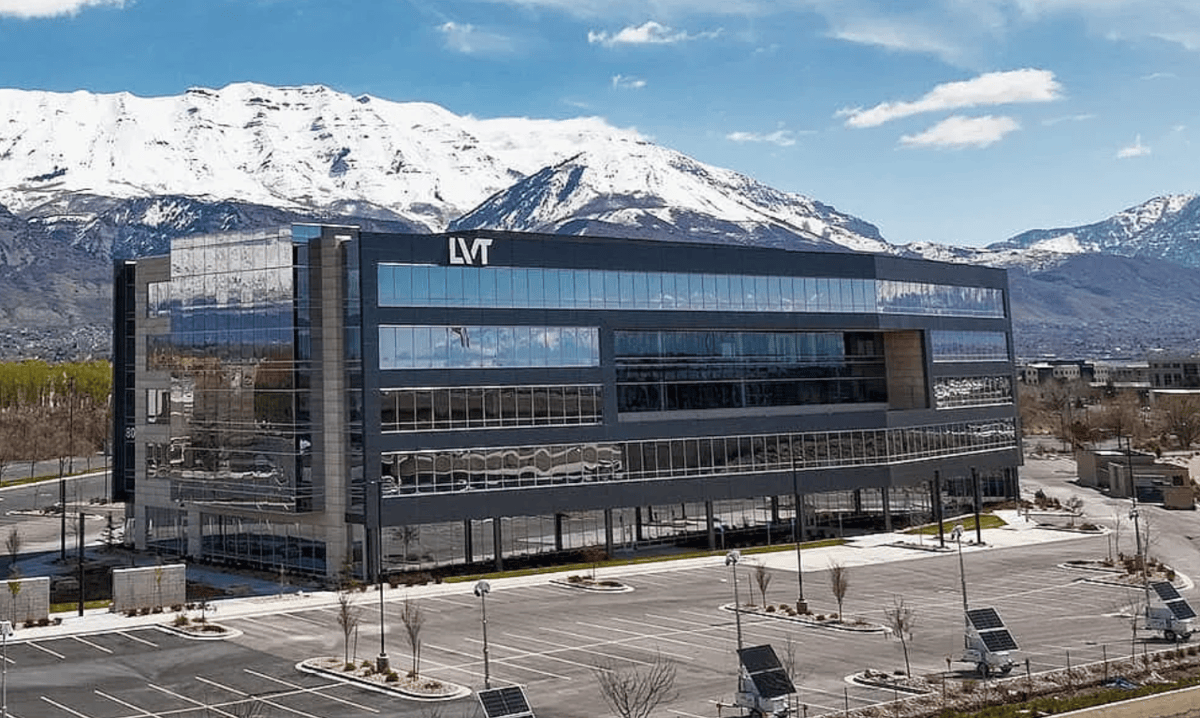
American Fork-based LiveView Technologies' new Harris Poll-backed report finds Americans trust a camera more than an armed guard — and draws a sharp, bipartisan line between safety monitoring and political tracking.
Americans want to feel safer in public spaces, but they don't necessarily want to be watched everywhere they go.
That tension runs throughout a new national survey commissioned by American Fork-based LiveView Technologies (LVT), which found that a large majority (60%) of Americans support visible security cameras and increasingly accept artificial intelligence as a tool for detecting suspicious behavior. The same survey also found substantial concern about surveillance, facial recognition and data retention.
The result is less a blanket endorsement of surveillance technology than a picture of Americans drawing boundaries around how it should be used.
The survey, 2026 Public Safety & Privacy Benchmark Report, conducted by The Harris Poll on behalf of LVT, found that 81% of Americans say they would avoid at least one type of public destination after dark because of safety concerns. That includes 52% who said they would avoid large, open-air retail parking lots, according to LVT's supplemental findings.
There's a moment in a recent conversation with LiveView Technologies (LVT) co-founder and chief strategy officer Steve Lindsey that captures the whole thesis of the report better than any chart in the document itself.
Talking about why people feel safer around a visible security camera than around an armed guard, Lindsey put it plainly: "It also feels more aggressive and proactive, whereas a camera seems more passive." His colleague, also in the TechBuzz interview, head of marketing communications Matt Deighton, finished the thought: "Now I feel less safe. They need a gun here — what kind of environment is this?"
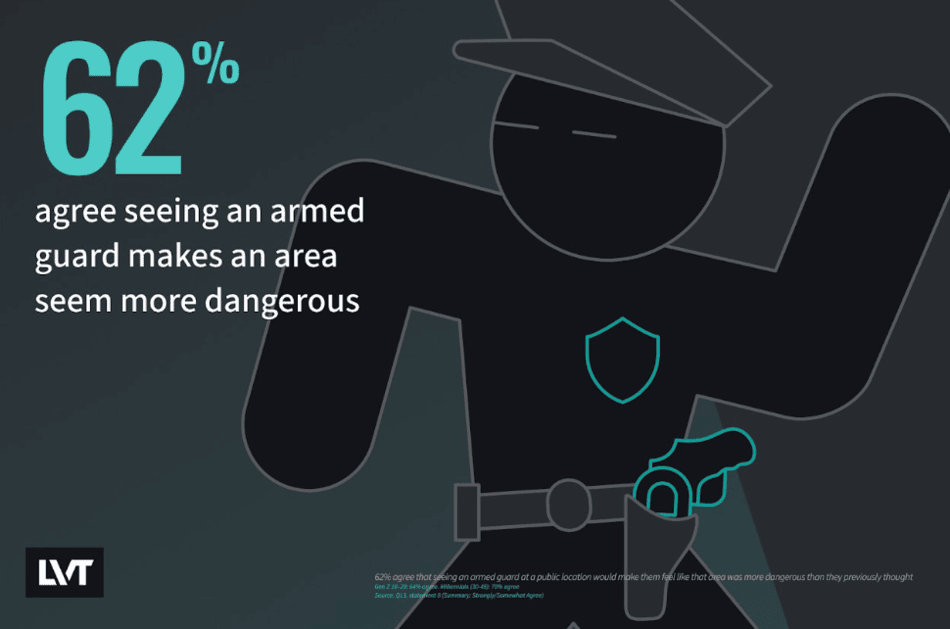
It's a small exchange, but it's the emotional core of a report built on 2,089 responses gathered by The Harris Poll on LVT's behalf between March 23 and 25, 2026. The topline finding — that 62% of Americans say an armed guard's presence makes a location feel more dangerous, not less — is the kind of counterintuitive result that reframes an entire industry's sales pitch. LVT, headquartered in American Fork, sells mobile security towers, AI-assisted cameras, and license plate readers to retailers, campuses, and municipalities. A report showing customers prefer the machine to the man with a gun is, unsurprisingly, useful to LVT. And per the underlying Harris Poll numbers — it's also true.
The Gas Station Test
Deighton's anecdote sets the scene better than any survey cross-tab: women who say they'll put off filling their gas tank until morning rather than do it after dark, specifically because the station doesn't feel safe. That instinct shows up at scale in the data. According to the report, more than half of women (52%) and 41% of men would avoid large, open-air retail parking lots after dark specifically due to concerns about personal safety, and 81% of all Americans would actively avoid at least one public destination after dark specifically due to personal safety concerns.
The daytime numbers are smaller but still notable: 21% of all American adults report they'd feel somewhat or very unsafe in large, open-air retail parking lots during the day, a figure that rises to 34% among women aged 18–34, compared to 19% of men in the same age bracket.
Deighton says that in LVT's own conversations with retail partners — big box, quick-serve restaurants, convenience stores — the pattern is consistent: when customers feel unsafe, they simply stop shopping in person, and any nudge toward that decision competes directly with the already-present pull of online shopping. He was candid that he didn't have hard revenue figures on hand, but described the trend as something LVT hears "consistently across hundreds and hundreds of customers. When customers feel unsafe, they don't shop," Deighton said.
The Campus Paradox
Asked what surprised him most in the results, Lindsey didn't point to the guard finding; he pointed to something the report itself surfaces but doesn't dwell on: Americans feel safer on university and school campuses than almost anywhere else the survey asked about, yet still rank campuses among the top locations needing more security.
The numbers back him up. Among locations Americans selected as most needing immediate security reinforcement at any time of day, school or university campuses ranked second at 43%, just behind open-air public events at 44% — well ahead of large open-air retail parking lots at 33%. Yet daytime unsafety on campus is comparatively low: only 24% of Gen Z respondents report daytime campus safety concerns, a fraction of the daytime discomfort reported in retail settings.
"That one kind of had us scratching our heads a little bit," Lindsey said. His working theory, echoed by Deighton: people may answer campus-safety questions less about their own daily experience and more about wanting maximum protection for a place where children and students are concentrated — a parental-concern effect rather than a personal-fear effect.
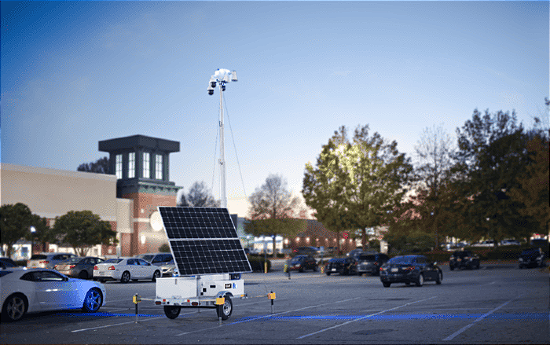
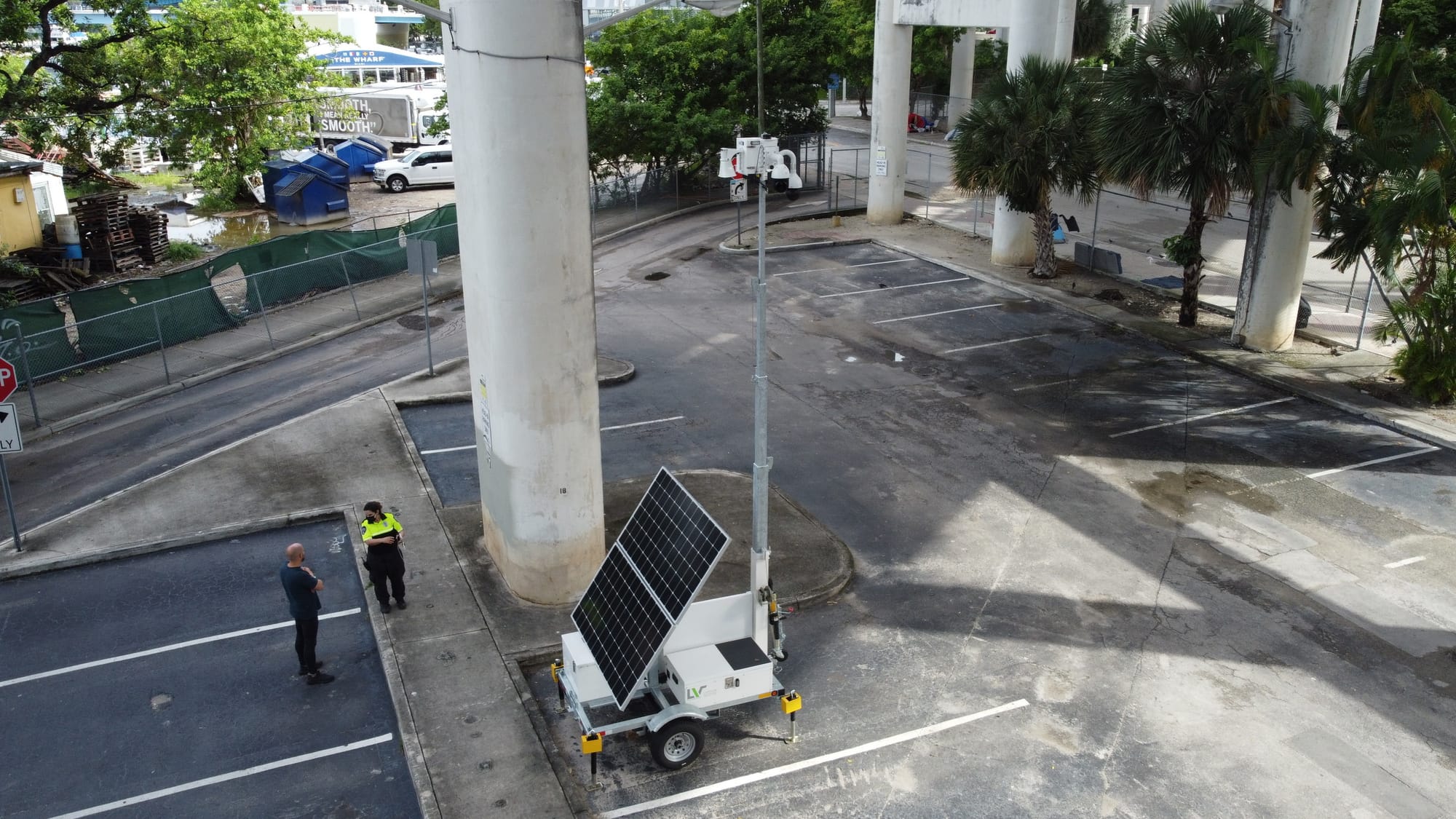
An LVT Mobile Security Unit (MSU) parking lot providing security in retail parking lot. The LVT MSU is designed to deter crime before it happens.
Not a Computer Vision Problem Anymore
A compelling part of the interview was Lindsey's description of how LVT actually trains its systems to flag "suspicious" behavior.
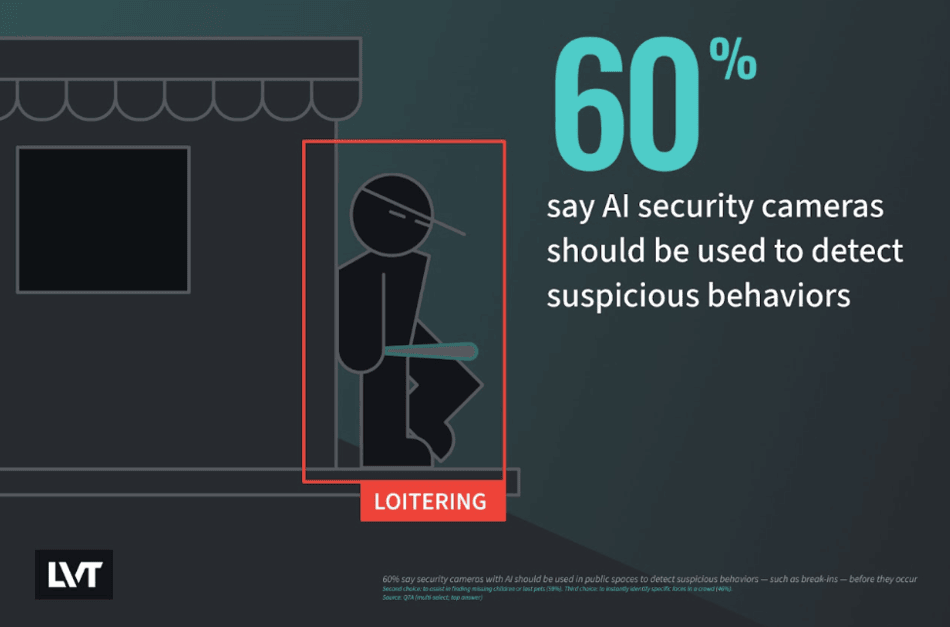
His framing: this isn't primarily a computer vision problem anymore. Multimodal video-language models generate a running behavioral description of what's happening in frame, and that description is then run through separate contextual models trained to recognize deviations from normal patterns — not by identifying who someone is, but by identifying what they're doing that doesn't fit. Lindsey's examples ranged from the mundane (a driver parking "serpentine," weaving through the middle of a lot instead of pulling into a stall) to the specific: a customer-submitted video of a man loitering outside a store with a bag, waiting for the right moment to attempt a return fraud with stolen merchandise, flagged by the system before he acted.
Lindsey was direct that the system is not trained to weight demographic characteristics: "It doesn't care about who is doing it. It doesn't care about anything that most people would be concerned about from race, racism, or any types of stereotypes. It doesn't care. It's looking at behaviors." He described that as a deliberate, ongoing product commitment rather than an incidental byproduct — LVT's stated position is that safety and privacy shouldn't be treated as being in tension with each other.
TechBuzz pressed them on a related edge case — cars that sit occupied and stationary in a lot for long stretches (with occupants staring at screens), a pattern LVT hasn't specifically built detection around, according to Lindsey. Rather than name a fixed list of red-flag behaviors, LVT says it largely takes cues from what individual customers flag as concerning at their own sites, which Lindsey described as making a single universal definition of "suspicious" hard to pin down.
The Line Nobody Crosses: Detection vs. Tracking
If there's a single organizing principle to the whole report, it's this: Americans have made a clear distinction between technology that detects behavior in the moment and technology that identifies or tracks who they are over time — and that distinction, not general AI skepticism, is what actually predicts public support.
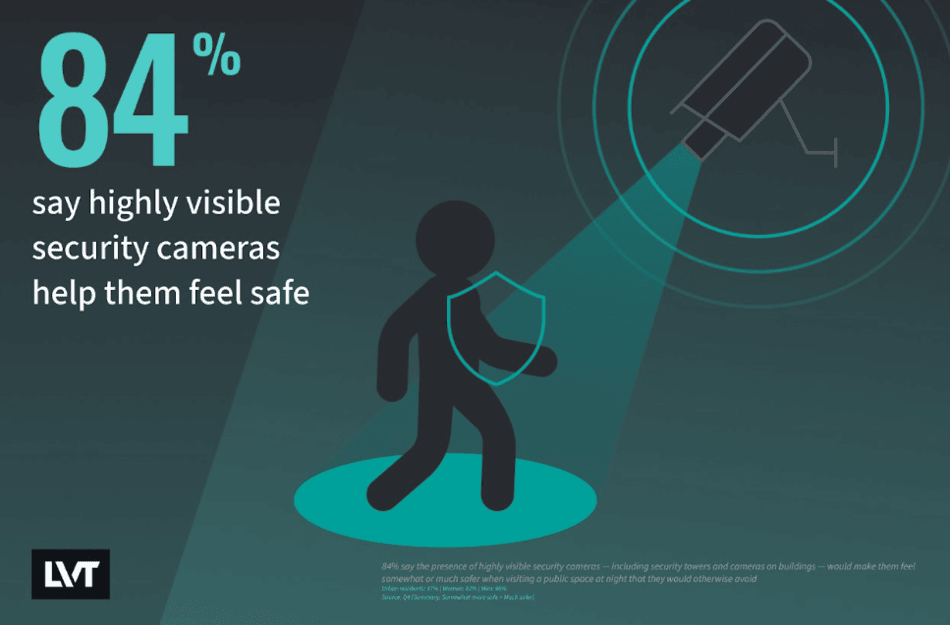
The numbers are stark. 84% of Americans say highly visible security cameras help them feel safe. 60% of them say security cameras with AI should be used in public to detect suspicious behaviors — such as attempted break-ins — before they occur, and only 12% believe AI should never be deployed in public spaces to improve community safety. Support climbs even higher for identifying known offenders: 79% of Americans agree it's acceptable for businesses to deploy facial recognition that matches faces against a list of known violent offenders the highest acceptance rate for any automated identification question in the survey.
But flip the use case from "known threat" to "ordinary citizen going about their life," and the numbers invert just as sharply. A staggering 45% of U.S. citizens say they actively avoided participating in at least one political or civic activity in the past six months because they felt unsafe or feared potential confrontation, and 63% of Americans express explicit concern that facial recognition technology could be used to track them if they exercised civic rights like attending a protest, town hall, or political rally concern shared by 72% of Democrats and 55% of Republicans.
That's a genuinely bipartisan finding heading into a midterm cycle, and it's the part of the report that reads less like a retail security vendor's marketing material and more like a data point about the state of American civic life. Lindsey's read on it tracks with the numbers: people aren't rejecting the technology, they're rejecting a specific use of it. A camera watching a parking lot for a break-in is welcome. The same camera's facial recognition capability pointed at a protest crowd is not — even among respondents who, elsewhere in the survey, express high comfort with AI-assisted security generally.
Data Governance
Lindsey was specific and fairly candid about data governance, which is worth including for readers weighing LVT's claims against the report's own emphasis on transparency. Recorded footage is stored for a maximum of 30 days by default, he said, though customers can request longer retention — a policy LVT finds "painful" in the rare cases where state or local regulation mandates year-long storage, given the cost. He said LVT itself does not have standing access to customer footage; law enforcement seeking footage must obtain a subpoena directed either to LVT's customer directly, or to LVT, which then notifies the customer of the request.
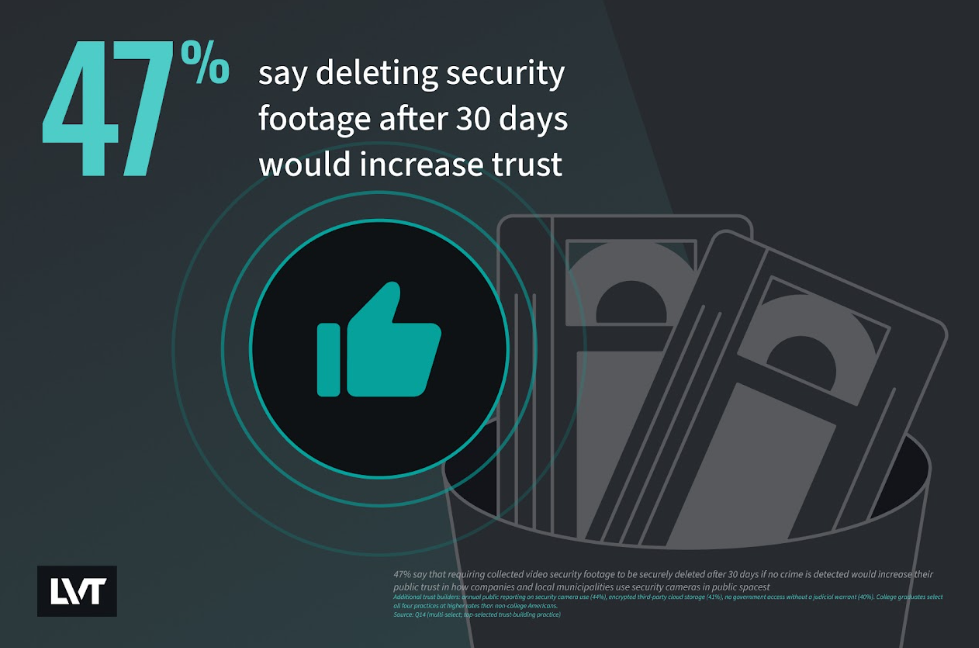
That aligns with what the report's own survey data suggests people want: 47% of Americans say requiring general public video footage to be securely deleted after 30 days, if no crime is detected, would directly increase their trust in how companies and municipalities use security cameras, and 74% somewhat or strongly agree that municipalities and business owners must retain an on/off switch — the explicit ability to activate or deactivate specific AI features of a public camera based on their own needs.
On the harder question — does putting up cameras actually reduce crime, or just push it elsewhere — Lindsey cited an internal figure of roughly 70% average crime reduction at LVT installation sites, with results ranging from 40% to 100% depending on location, and pointed to two prior "Access Task Force" research studies LVT conducted across cities in Indiana, Kentucky, and Alabama examining displacement effects. His summary: crimes of opportunity tend to disappear rather than relocate, while planned crime is more likely to be displaced to nearby areas outside camera coverage. That 70% figure is not part of the Harris Poll benchmark data and should be treated as an LVT-sourced case-study claim rather than third-party-verified survey data.
LVT is also preparing a follow-up survey with the University of Florida's Loss Prevention Research Council specifically examining how visible camera resolution affects where shoppers choose to park. TechBuzz will present that research in a future LVT article once that data is public.
Topdown view of an LVT Mobile Security Unit (MSU) in an urban parking lot
The Bottom Line
The most interesting finding in LVT's survey may not be that Americans want more security cameras. They already do.
The more interesting question is what conditions they place on that acceptance.
They want security to be visible.
They want AI to identify behavior that may signal danger.
They are willing to accept some targeted forms of identification.
But they also want limits: short data-retention periods, transparency about surveillance and meaningful control over AI capabilities.
Taken together, the survey data and LVT's own account of how its technology works describe a public that is neither uniformly pro-surveillance nor uniformly opposed to it.
Respondents appear substantially more comfortable with visible security, behavioral detection and narrowly targeted identification of known threats than with systems designed to track ordinary people indiscriminately.
See the full report here:
Share this article
The link has been copied!
Your link has expired. Please request a new one.
Your link has expired. Please request a new one.
Your link has expired. Please request a new one.
Great! You've successfully signed up.
Great! You've successfully signed up.
Welcome back! You've successfully signed in.
Success! You now have access to additional content.