Most business owners can't tell if they're busy or growing. A Utah company's new study explains why.
Scaling.com (Lehi, UT) published a national study of 1,000 business owners. It found that 59% mistake activity for growth, with founders themselves identified as the primary barrier to scaling.
Most business owners can't tell the difference between being busy and making progress. A new national study by Lehi-based Scaling.com finds that 59% of U.S. business owners with $1 million or more in annual revenue admit they've mistaken activity for growth. The data suggests the obstacle is almost always the owner themselves.
The study, conducted by the Center for Generational Kinetics and released in March 2026, surveyed 1,000 business owners, CEOs, and executives at U.S. companies generating $1 million or more in annual revenue. Based in Austin, Texas, The Center for Generational Kinetics is a generational research, consulting, and keynote-speaking firm that helps organizations understand and engage different generations through data-driven insights and original research. The March 2026 study found that 61% of owners say they are a major or moderate bottleneck in their own sales and marketing, 54% in strategic focus and prioritization, and 54% in talent decisions. At the same time, 67% report that they currently employ at least one team member they know is limiting the company's growth. 47% say they've kept an underperforming leader so long it damaged the business.
"Many leaders assume growth will continue if they just work harder or invest more," said Dr. Benjamin Hardy, co-founder of Scaling.com and author of Who Not How and 10X Is Easier Than 2X. "What this study shows is that scaling is a fundamentally different phase, one that requires new systems, new thinking, and often difficult structural changes."
Scaling.com defines the inflection point as the "Scaling Gap." This is the phase at which companies with early traction struggle to transition into sustained, exponential growth. The firm distinguishes sharply between growth, which is incremental and linear, and scale, which is exponential and nonlinear. The study found that 80% of business owners agree growth and scaling are fundamentally different concepts, but the data reveals a gap between that understanding and action: only 7% of respondents are targeting 100% or more revenue growth in the next 12 months.
"Scaling isn't about adding more; it's about removing what no longer works," shared Blake Erickson, co-founder of Scaling.com recently with TechBuzz. "The businesses that break through are the ones willing to fundamentally change how they operate, not just optimize what they've already built."
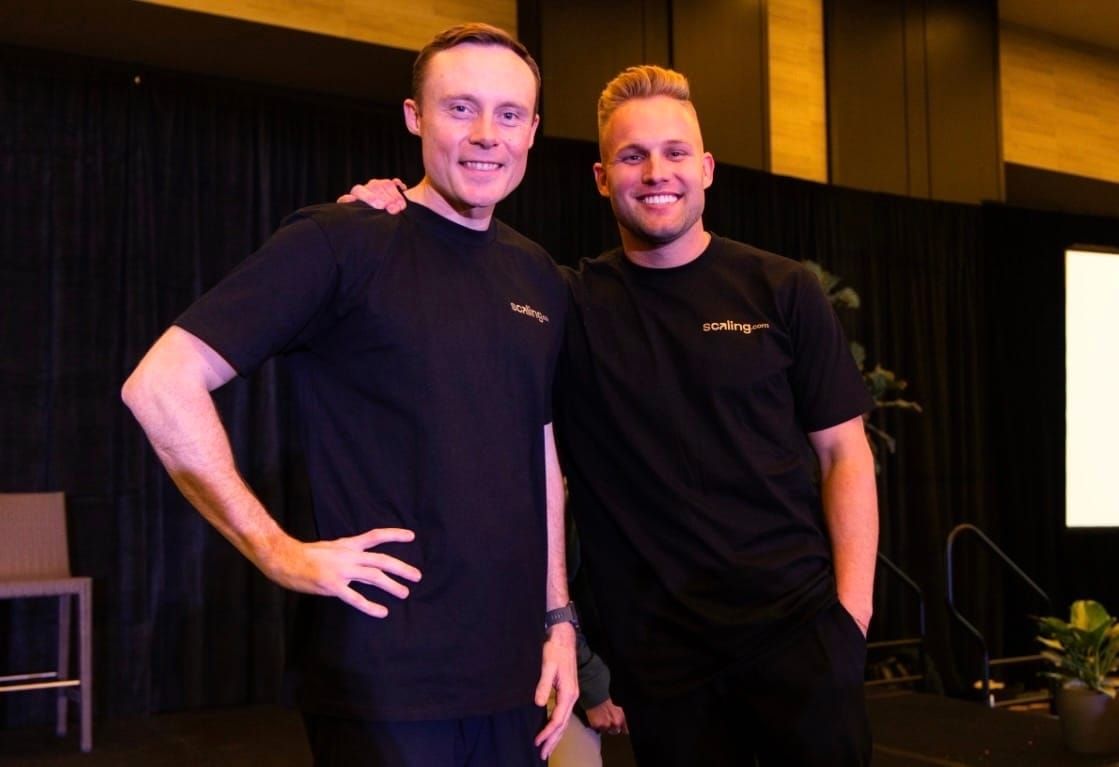
Co-Founders of Scaling.com: Blake Erickson and Dr. Benjamin Hardy
Erickson, who lives in Mapleton and built Scaling.com as a fully remote operation, co-founded the firm in 2024 with Hardy after the two connected at a ClickFunnels conference in 2021. Erickson's background is in door-to-door sales, where he ran an organization of 300 to 400 sales reps across the country under Hawks Pest Control. He describes that period as his real education in people management and leadership at scale. The company launched its advisory practice in May 2025 and its companion book, The Science of Scaling, in July 2025. It now advises more than 530 companies.
The national study identifies three categories of barriers that compound the Scaling Gap. The first is the founder as bottleneck. Beyond the self-reported bottleneck data, 54% of owners say they believe they are the most talented person at their company. It is a perception Erickson says is itself a scaling problem, because it discourages delegation and prevents the hiring of people capable of exceeding the founder's own performance. The second barrier is talent inaction. On average, owners believe only half of their current team could effectively deliver a 10X growth goal within the next two to three years, yet the risk of operational disruption (56%) and the difficulty of replacing roles (51%) are what most often prevent timely personnel changes when someone is underperforming. The third is complexity and distraction. The study found that 69% of owners have said yes to an opportunity that ultimately slowed their growth, and that owners spend only 36% of their personal time on activities directly tied to the financial growth of their company.
Erickson frames the solution in what he calls three laws of scaling: a complex system cannot scale, a divided team cannot scale, and you cannot serve two masters. He illustrates each with client cases, including two Utah-based companies he works with directly. In the first, a solo accounting firm generating $1 million in annual revenue committed to reaching $10 million within three years. Getting there required abandoning a high-volume, low-margin client base in favor of fewer, higher-value engagements. The owner resisted initially — those clients represented years of relationship — but made the shift. He is now on pace to hit $10 million by the end of 2026, a year and a half ahead of schedule. In the second, a Utah company that had taken 12 years to reach $10 million in revenue came to Scaling.com targeting $30 million in three years. The firm identified a family member on the team whose misalignment was creating a structural bottleneck. The owner let the person go. Within six months, revenue had risen from $10 million to $22 million.
"The goal is simply a tool," Erickson said. "It's a psychological tool to force the best thinking, decision making, and leverage. When you truly commit to scale, you ask: is this going to get me to that goal? Is this person I'm hiring going to get me to that goal? Everything below that standard has to go."
The study also examined what owners say must change to reach the next phase. Talent and staffing ranked first (155 open-ended responses), followed immediately by technology and AI (153), ahead of operations and systems (141), strategy and product (131), and sales and marketing (115). Finance ranked sixth. The finding runs against the conventional assumption that capital constraints are the primary scaling barrier — and aligns with Scaling.com's thesis that the limiting factors are structural and human, not financial.
On AI specifically, Erickson cited vibe-coding platform Lovable as a tool that has compressed development timelines his firm uses from months to weeks, and pointed to Claude Code as a platform enabling reporting, automation, and administrative tasks that previously required dedicated headcount. "Every individual in the workplace can now be focused on their zone of genius," he said. "You don't have to worry about all the other noise if you know how to use AI correctly."