Scaling.com, Blake Erickson, Benjamin Hardy, Scaling Gap, business scaling, entrepreneurship, Utah tech, Mapleton, Center for Generational Kinetics, CGK, national study, business growth, founder bottleneck, talent decisions, operational efficiency, revenue stagnation, 10X growth, Science of Scaling, advisory firm, small business, mid-market, business strategy, leadership, delegation, organizational design, AI tools, Claude Code, Lovable, vibe coding, Hawks Pass Control
HydroBlok Advances Simplified Wall Construction with New Direct-to-Stud Capability — Contractor Perspective from Utah Builder Highlights Real-World Impact
HydroBlok’s direct-to-stud HB One Backer CI simplifies wall assemblies, reducing labor, curing time, and construction layers while improving straightness, insulation performance, jobsite efficiency, safety, and contractor workflow outcomes.
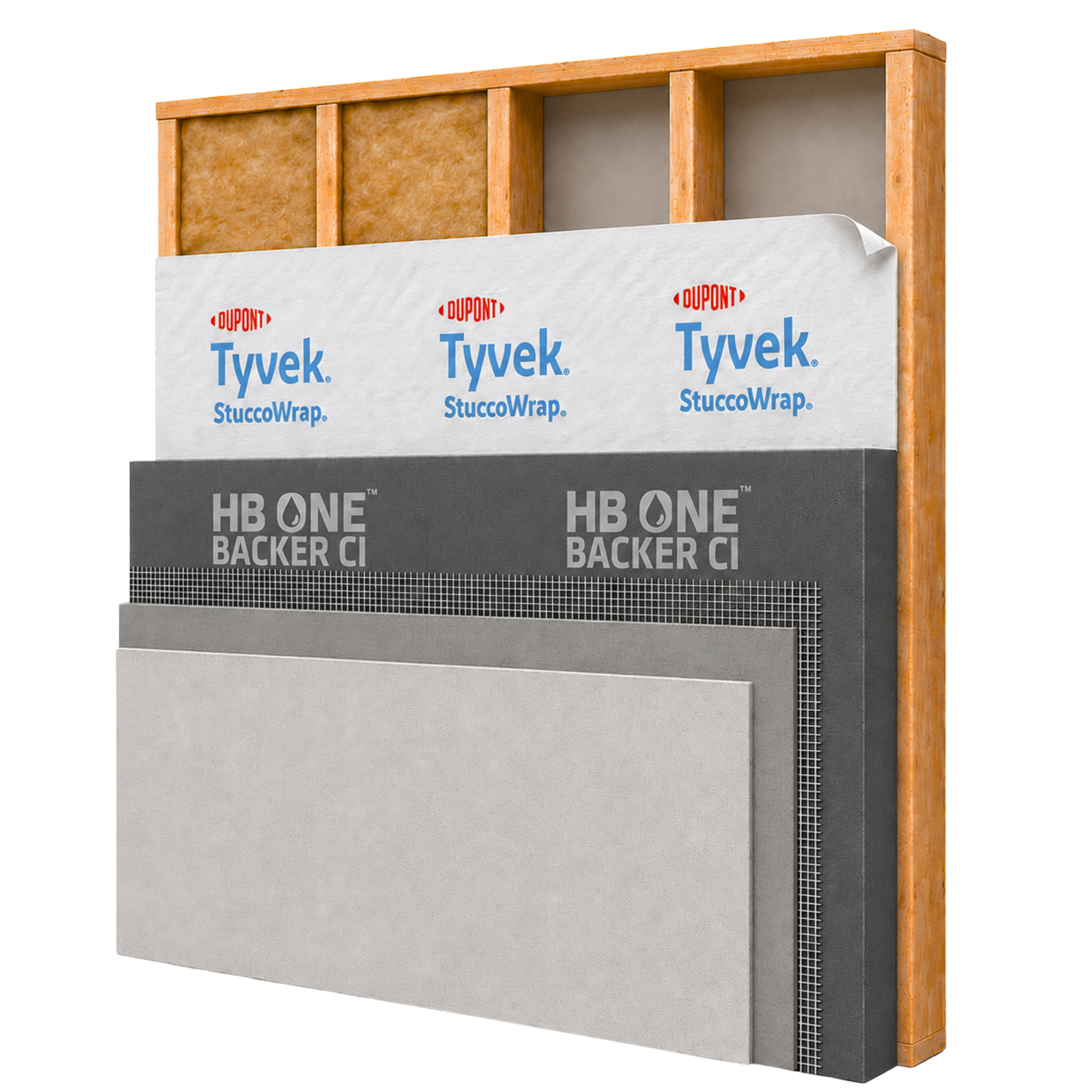
HydroBlok, a Draper, Utah-based manufacturer of lightweight waterproof construction systems, has announced that its HB One Backer CI panel has passed testing for direct-to-stud installation in non-shear wall applications. The update allows the system to be installed directly to framing in approved areas, eliminating layers from traditional wall assemblies while maintaining continuous insulation (CI) performance.
Rendering of HB|ONE direct-to-stud wall system with stucco finish Photo: HydroBlok
The change is positioned as a response to a broader industry problem: wall assemblies that have grown increasingly complex under tightening energy codes, labor shortages, and rising demands for continuous insulation under standards such as the 2024 IECC. In non-shear sections, HB One Backer CI can now be installed directly over wood framing, while structural sheathing remains in place where required by engineering or code.
But beyond the code language and product claims, field contractors are already forming their own conclusions about what the system does—and does not—change.
One of those contractors is Juan Martinez, founder of Home Innovations Utah, a Spanish Fork, Utah-based exterior contractor specializing in stucco, siding, stone, and related envelope systems who sat down recently with TechBuzz. Martinez has installed HydroBlok on multiple homes and says the most noticeable benefits show up not in theory, but in execution.
“I’ve done a couple of houses with HydroBlok, and from a contractor standpoint it feels very similar to the systems we already use. It doesn’t force us to relearn everything. But I think the bigger impact will come as the system evolves further, especially if it eventually replaces more traditional layers like OSB in more applications. That’s where you really start to see efficiency gains and cost improvements for builders.”
Finish quality and wall consistency
For Martinez, one of the most immediate differences shows up in the finished surface rather than the installation process.
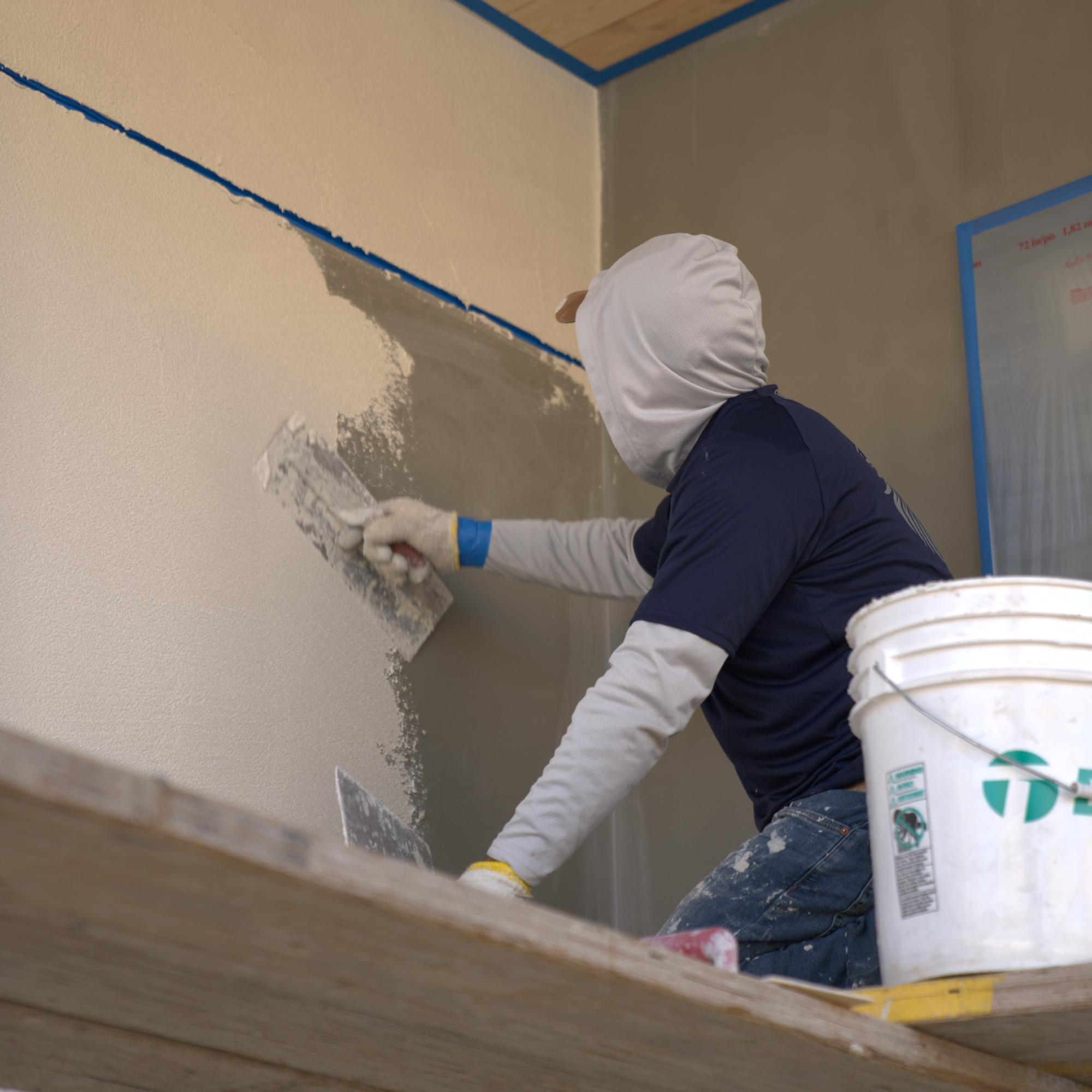
“One of the first things I noticed is how much more consistent the finished walls look. With traditional stucco systems, a lot of the final appearance depends on hand floating, and that naturally follows whatever imperfections exist in the framing. With HydroBlok, the board is rigid enough that it doesn’t really follow those small irregularities. Even when framing isn’t perfect, which is pretty common, you end up with walls that look straighter and more uniform once everything is finished.”
He emphasizes that framing variability is a constant in real-world construction, not an exception.
“Framing is never perfect. You’re dealing with wood, weather, and timing, and all of that introduces small variations. Sometimes houses sit in framing for weeks, and moisture or weather affects the material. So you always end up with some level of inconsistency. Traditional systems tend to reflect those imperfections in the finish, but this system helps reduce how much of that carries through.”
Applying stucco finish over HB|ONE panels Photo: HydroBlok
Labor, weight, and jobsite strain
Beyond aesthetics, Martinez points to labor intensity as one of the clearest operational differences.
“For my crews, one of the biggest differences is the physical labor. Traditional stucco work involves mixing heavy bags, dealing with dust, and constantly moving material up scaffolding. It’s demanding work. Anything that reduces that load makes a real difference on the jobsite. It saves their backs and makes day-to-day work more manageable.”
Schedule compression and curing time
Where traditional stucco systems require extended curing periods, Martinez says HydroBlok changes the pacing of the job entirely.
“With conventional stucco, the process is very time-intensive. You apply the material, float it, and then you’re waiting several days, often five to seven days, for it to cure before you can move forward. With HydroBlok, that timeline compresses significantly. You install the panels, apply the base coat, and it sets much faster. That allows you to move crews onto the next project instead of sitting idle waiting for curing to finish.”
That shift, he notes, directly affects project turnover.
“Time is everything in construction. If you’re not waiting on curing cycles, you can cycle through jobs faster and keep crews productive.”
Warranty exposure and crack reduction
One of the most persistent issues in exterior systems is cracking, and the downstream warranty work it generates.
“Cracking is one of the biggest issues in exterior work because homeowners see it and immediately assume something was done wrong, even though it’s just part of how concrete behaves over time. When you reduce those crack issues, it changes the warranty equation. If I don’t have to keep going back to fix cracks, I’m not losing time and money on repeat visits, and that stabilizes the business side a lot.”
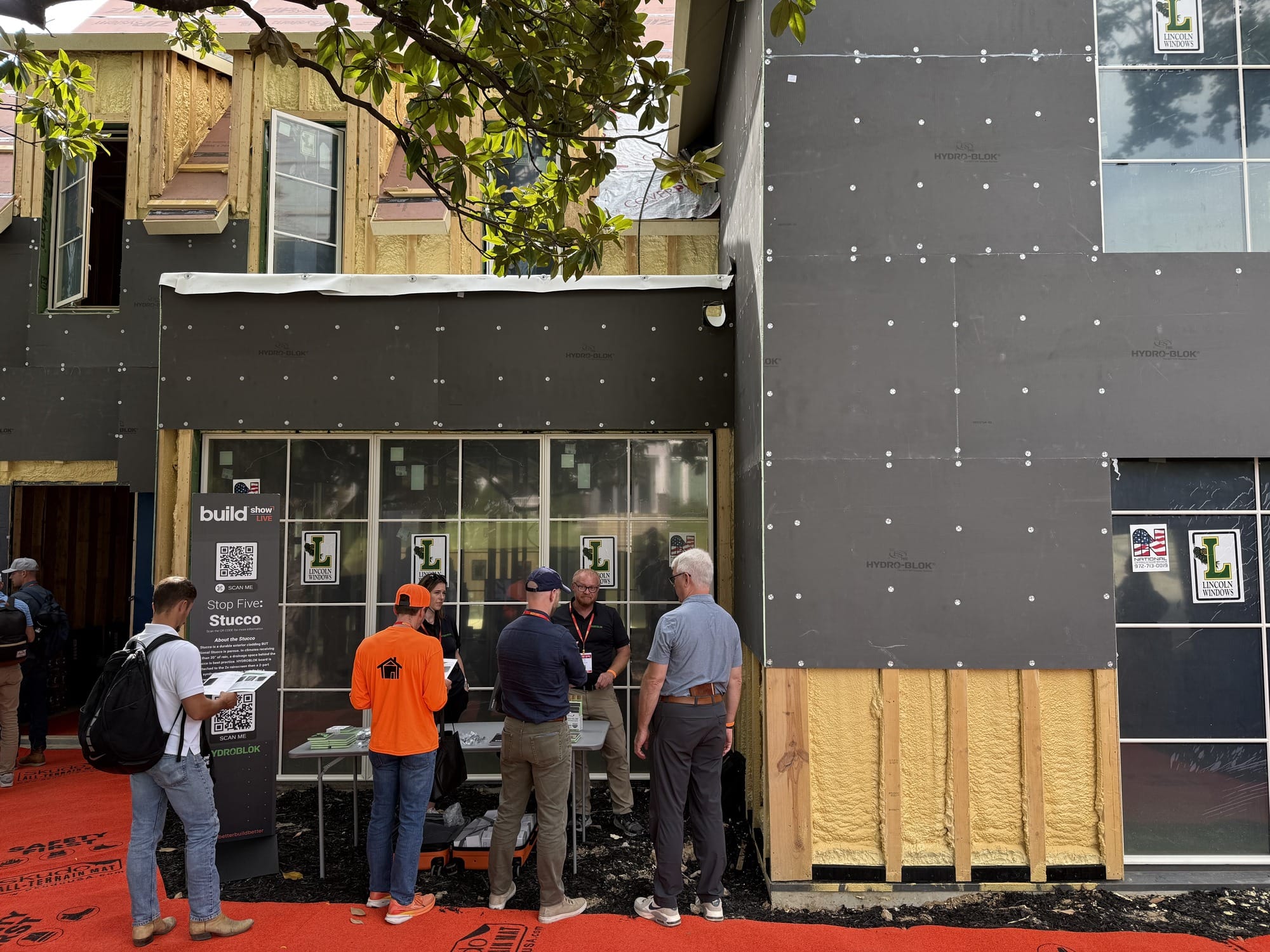
Builders explore HydroBlok at Build Show Live event Photo: HydroBlok
Winter construction and safety risk
Martinez also highlights winter construction as a less visible but important pain point.
“In winter, we often have to heat job sites to keep materials from freezing and to allow proper curing. That usually means propane heaters inside partially built homes. It works, but it introduces real safety risks, including fire hazards. If a system reduces or eliminates the need for that kind of heating, it’s not just about efficiency. It also improves safety on site.”
Value distribution: builders vs. homeowners
While HydroBlok emphasizes both performance and compliance, Martinez frames the benefits through the lens of who feels them first.
“I think the benefits are shared between homeowners and builders. Homeowners get a better finished product and improved insulation, and builders can potentially reduce costs and improve efficiency. But from what I see in the field, a lot of the immediate operational benefit really shows up on the builder side because it simplifies how the work gets done.”
He adds that homeowners still benefit in more subtle but important ways.
“At the end of the day, you’re getting better insulation, straighter walls, and a higher-quality finish. It all adds up.”
Broader industry disruption and automation
The conversation also touches a wider concern across construction: automation and labor displacement.
“Construction is already changing with technology. I can see a future where even bidding and estimating get handled mostly by AI systems, which would reduce the need for some roles. Robotics is the same story. There are companies working on automated roofing systems. They’re slow right now, but the direction is obvious.”
On structural work, he sees gradual replacement rather than sudden change.
“Framing is one of the areas I think will change a lot. There are already machines producing pre-formed wall components, especially for production housing. Custom homes will probably stay traditional longer, but standardized builds are going to move toward prefabrication.”
Outlook on HydroBlok
As previously covered by TechBuzz in “HydroBlok’s Big Bet: Reinventing Building Materials for the 21st Century,” the company’s core ambition extends beyond incremental improvement to a structural rethink of how walls are built, consolidating multiple construction layers into a single, high-performance composite system that replaces legacy materials like OSB and drywall.
That earlier analysis emphasized HydroBlok’s broader thesis: that construction has lagged behind other industries in materials innovation, and that gains in speed, durability, and moisture resistance come from reducing system complexity rather than stacking additional components. In that context, the newly announced direct-to-stud capability represents less a product upgrade than a continuation of that original direction—pushing the material further into the structural logic of the wall itself.
For builders like Juan Martinez of Home Innovations Utah of Spanish Fork, that trajectory is visible in practice rather than theory. His experience underscores the same theme raised in the original coverage: simplification at the system level produces downstream effects in labor, scheduling, and finish quality that compound across a project.
Taken together, HydroBlok’s evolution suggests a company still operating on the same foundational premise outlined in its earlier TechBuzz feature, but now moving from concept validation into broader field application, where performance claims are tested not in isolation, but in the daily realities of construction timelines, crews, and cost pressures.
To learn more, or to schedule a tour of HydroBlok’s Innovation Experience Center in Draper, Utah, visit HydroBlok.com.
Share this article
The link has been copied!
Your link has expired. Please request a new one.
Your link has expired. Please request a new one.
Your link has expired. Please request a new one.
Great! You've successfully signed up.
Great! You've successfully signed up.
Welcome back! You've successfully signed in.
Success! You now have access to additional content.
HydroBlok, HB One Backer CI, direct-to-stud, continuous insulation, wall assembly, stucco system, construction innovation, Utah construction, Home Innovations Utah, Juan Martinez, energy codes, IECC 2024, building envelope, waterproof panel, labor reduction, jobsite efficiency, curing time, crack resistance, stucco cracking, framing tolerance, exterior cladding, siding compatibility, water-resistive barrier, thermal bridging, construction automation, contractor workflow, modular construction, building materials, residential construction, Brian Bertha, Draper, commercial construction