Hypercraft (Provo, UT) unveiled its Razorback autonomous ground vehicle at a West Jordan briefing with Fortem, Base Case, and 47G, pairing a software-defined UGV platform with Fortem's counter-drone payload amid Utah's fast-growing aerospace and defense sector.
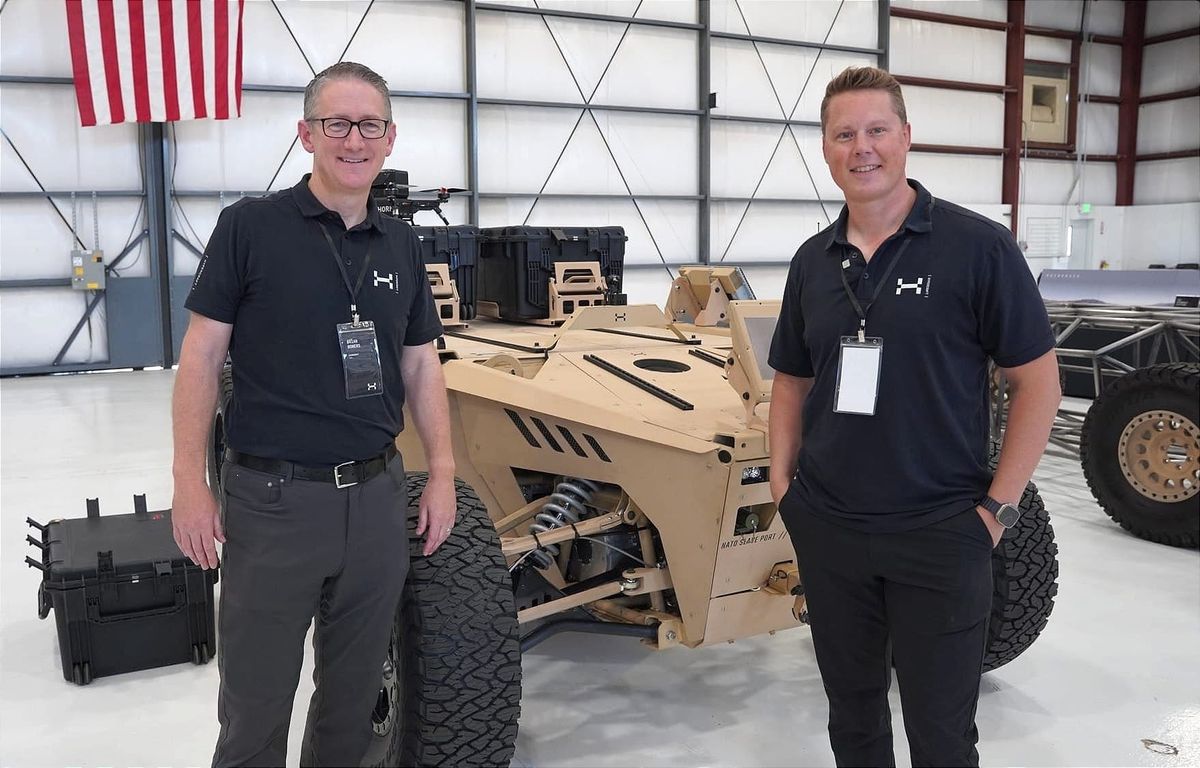
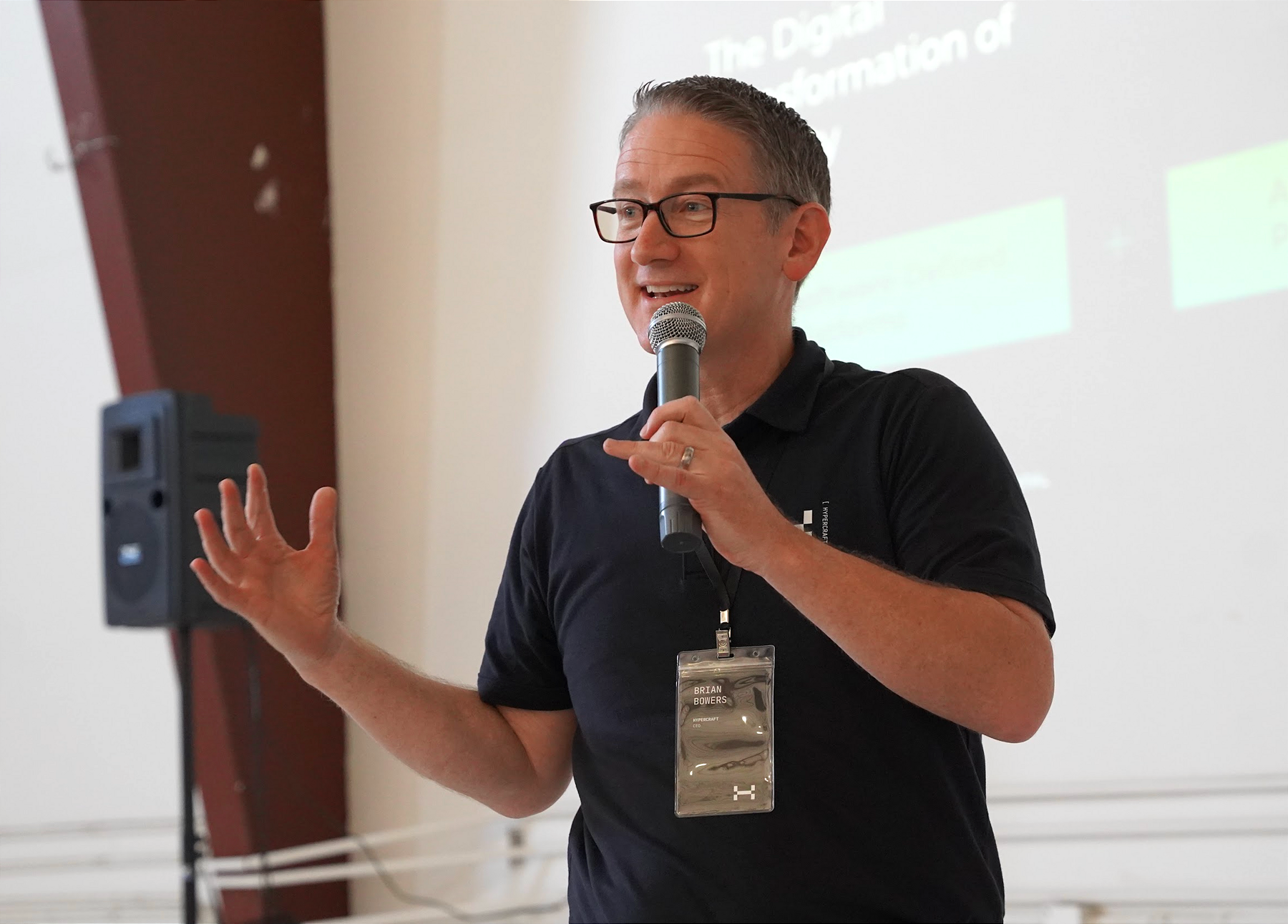
Brian Bowers (left), CEO of Hypercraft, and Jake Hawksworth, executive chairman and co-founder, with the Razorback autonomous ground vehicle at the company's briefing at South Valley Regional Airport in West Jordan on Aug. 7, 2026. Photo: Mark Tullis, TechBuzz
Brian Bowers (left), CEO of Hypercraft, and Jake Hawksworth, executive chairman and co-founder, with the Razorback autonomous ground vehicle at the company's briefing at South Valley Regional Airport in West Jordan on Aug. 7, 2026. Photo: Mark Tullis, TechBuzz
West Jordan, Utah — August 7, 2026
Today at South Valley Regional Airport about 70 legislators, federal and state officials, investors, and media gathered at a Skyshare hangar for a look at the Razorback — Hypercraft's new autonomous ground vehicle platform — and the counter-drone payload Fortem Technologies is building for it.
The event, hosted by Provo-based Hypercraft in partnership with Base Case, 47G, and Fortem Technologies, paired a technical presentation with a "state of autonomy in defense" panel and a live vehicle demonstration. It's the most public step yet for Hypercraft's shift from a broad hybrid-and-electric powertrain supplier into a dedicated defense platform company — a pivot formalized in December when the board named Brian Bowers, a former Maersk executive who joined Hypercraft as president in 2024, as chief executive officer. Founder Jake Hawksworth moved into the role of executive chairman and chief product officer.
West Jordan sets the stage
Dirk Burton, Mayor, West Jordan. Photo: Mark Tullis, TechBuzz
West Jordan Mayor Dirk Burton welcomed the audience, noting the city's growing footprint in advanced manufacturing and its roughly 600 football fields' worth of vacant industrial land in the city's southwest quadrant — an implicit pitch to the room's investors and site-selection watchers. Councilmember Sophia Shelton also attended, alongside Jim Grover, who helped organize the event.
Rep. Candice Pierucci, R-Herriman, the Utah House majority whip who represents Riverton and Herriman, followed with remarks tying Hypercraft and Fortem to the state's broader aerospace and defense buildout. Citing figures she attributed to state economic data, Pierucci said Utah's aerospace and defense employment has grown 23.4% over the past five years, industry wages are up 31%, the sector now accounts for 19.2% of Utah's GDP, and Utah ranks first nationally in five-year aerospace and defense growth at 62%.
Rep. Candice Pierucci, R-Herriman, Utah House Majority Whip. Photo: Mark Tullis, TechBuzz
A software-defined platform, not just a vehicle
Hawksworth framed Hypercraft's pitch around a shift already visible in Ukraine and the Middle East: ground operations remain, in his telling, the most dangerous domain in modern conflict, and militaries are moving away from vehicles engineered around protecting a human crew toward unmanned platforms engineered around completing a mission.
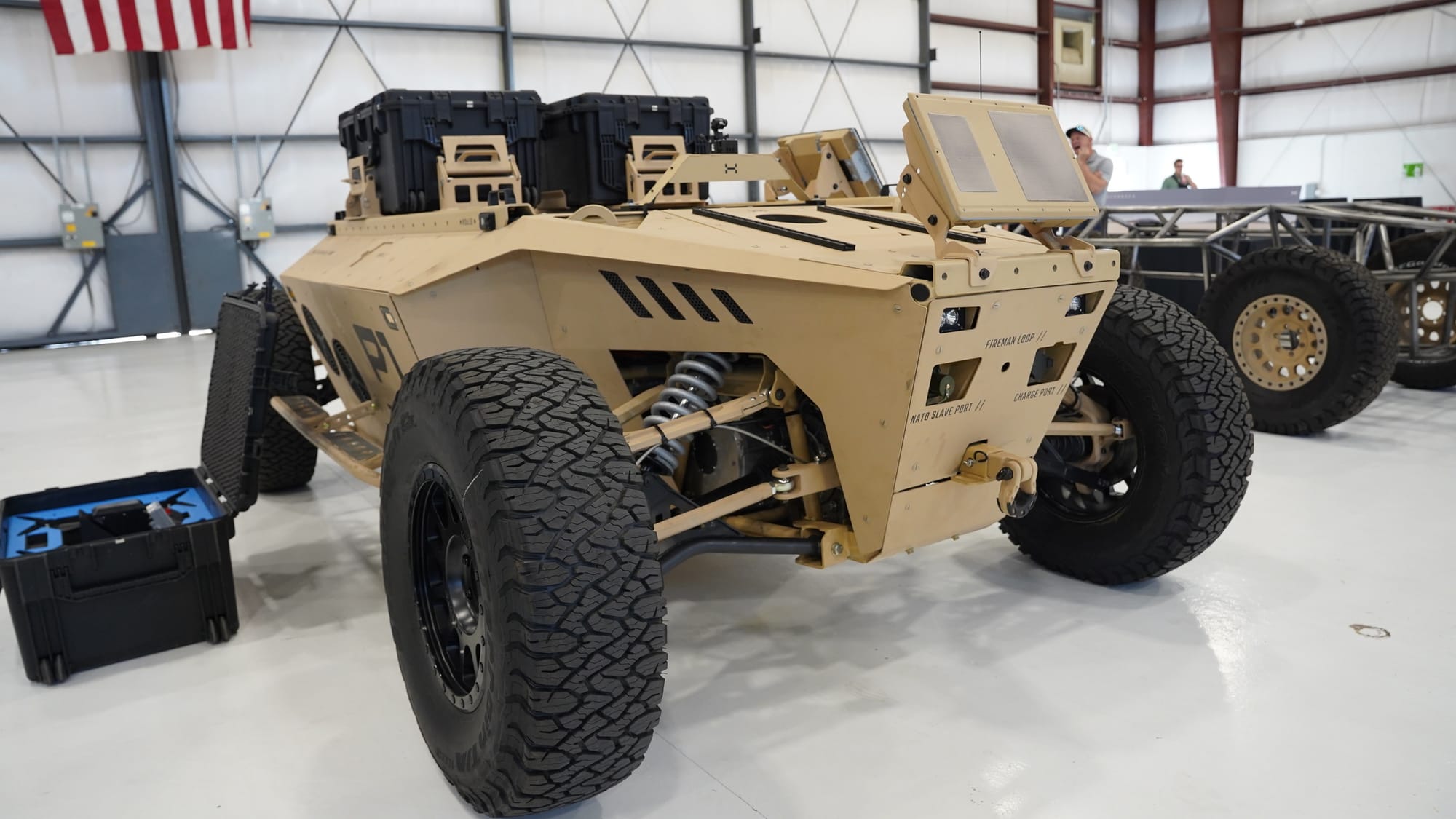
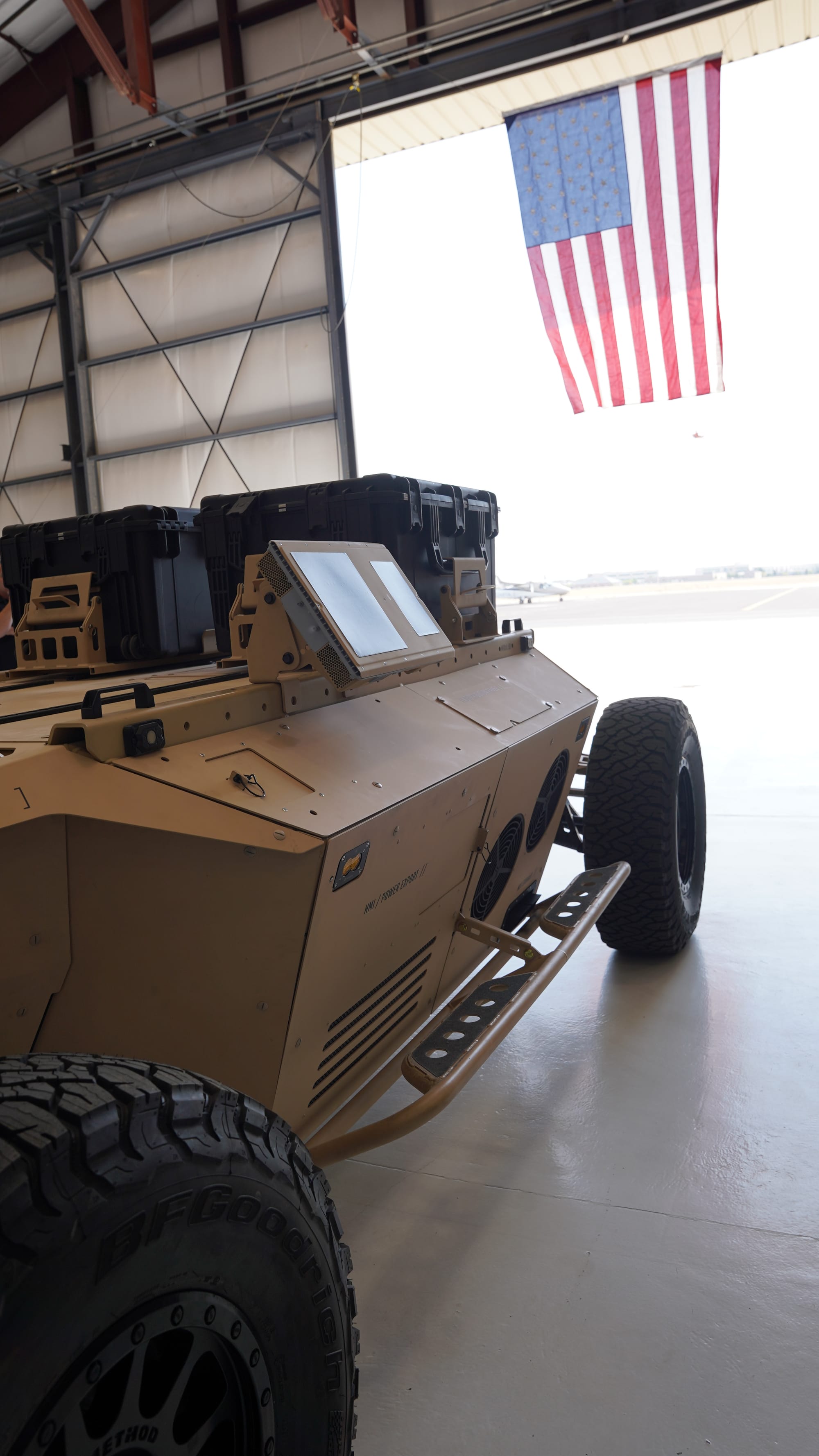
The Razorback is Hypercraft's answer — a medium-class, high-speed unmanned ground vehicle built on what the company calls "Carbon Architecture," an in-house computing and software stack designed to host third-party autonomy and payload software on a single unified system. Specifications shared at the briefing:
Dual Razorback autonomous ground vehicles (one operational and the other a bare frame and drivetrain) on display at the company's briefing at South Valley Regional Airport in West Jordan on Aug. 7, 2026. Photo: Mark Tullis, TechBuzz
Power export: roughly 38 kilowatts, which Hawksworth said is well above the 1–3 kilowatts typical of current military vehicle platforms and necessary to run power-hungry payloads like radar systems
Range: 280 miles with payload, drawing on a diesel-electric hybrid architecture — a range-extended EV design in which a diesel engine charges a battery pack that drives electric motors at each wheel
Payload capacity: up to 2,400 pounds
Top speed: 60 mph, rated to allow the vehicle to travel in convoy alongside manned vehicles
Autonomy: SAE Level 4, drive-by-wire, with the ability to run silently on battery power alone for stealth operation
Front-to-back and side-to-side symmetry, intended to simplify manufacturing and reduce cost
Hypercraft frames the Razorback's mission platform as three stacked layers rather than a single product: Hypercraft's own vehicle platform layer handles mobility, power, the software stack, high-performance computing, and GPS/GPS-denied positioning; Forterra's autonomy and orchestration layer sits above that, handling the autonomous system, mission orchestration, and communications; and Fortem's payload and systems layer sits on top, covering logistics payloads, sensors and effectors, and "software as a payload." Hypercraft describes its broader partner ecosystem — beyond Forterra and Fortem — as including Alien Control Systems, Hoverfly, SDF, AEON, Ghost Robotics, and Stratom.
Fortem's FireThorn payload and the DHS backdrop
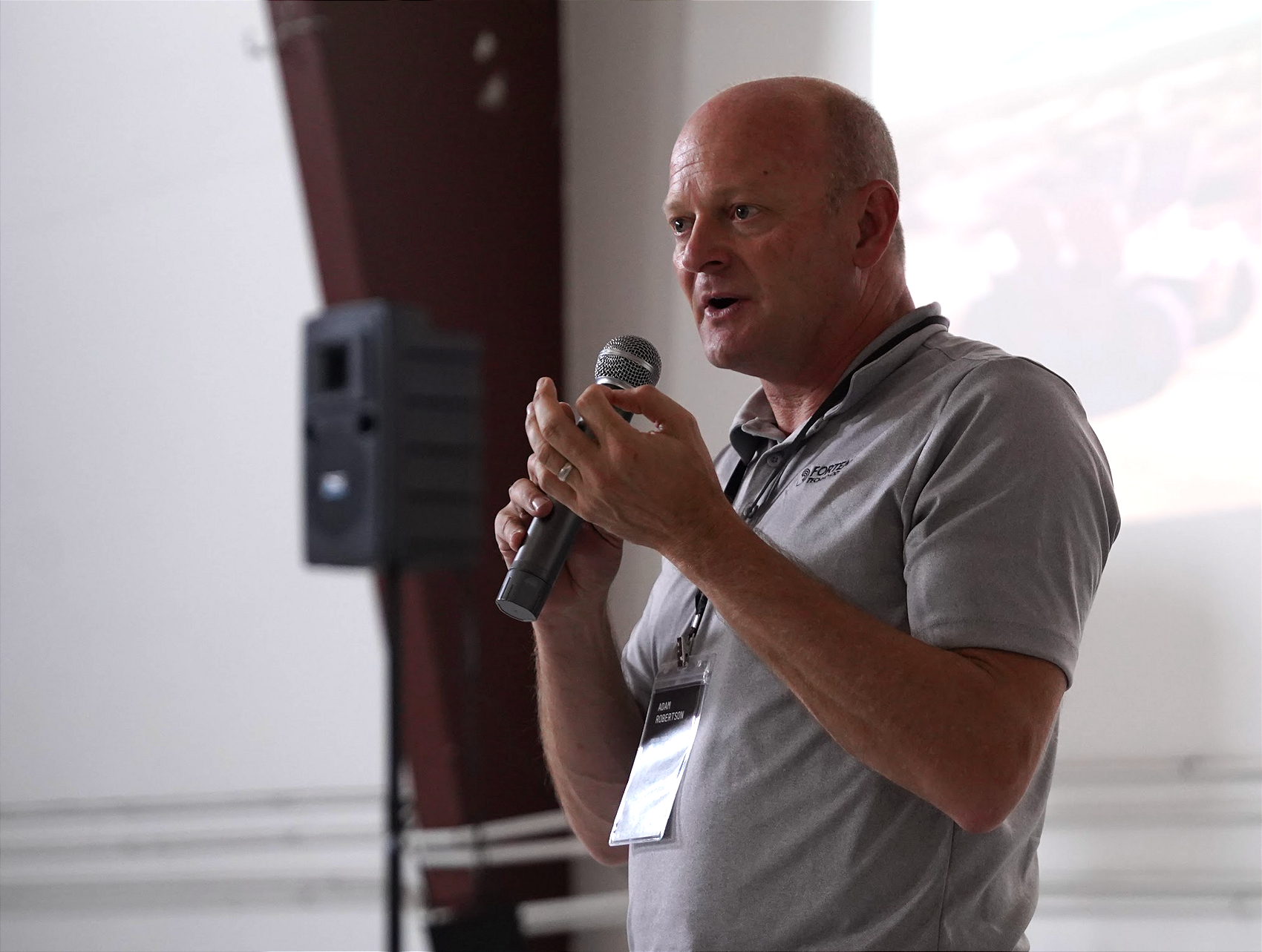
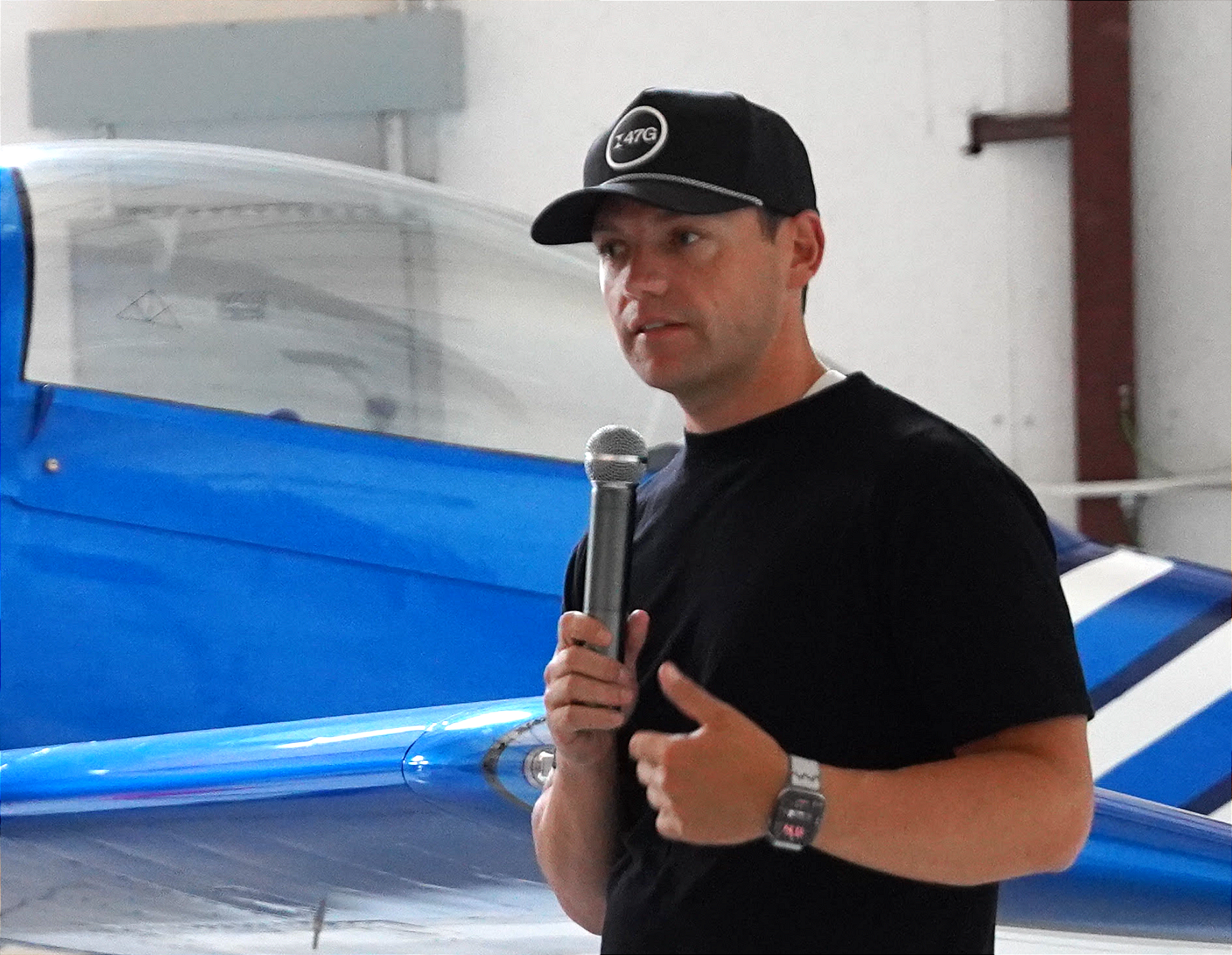
Adam Robertson, Fortem's co-founder and chief technology officer walked the room through a use case built specifically for the Razorback: a counter-drone interceptor Fortem calls FireThorn, purpose-built against Shahed-136-style one-way attack drones and the Geran-family variants Russia now produces domestically based on that Iranian design.
Adam Robertson, Fortem's Co-founder and CTO, speaking at the Razorback briefing at South Valley Regional Airport in West Jordan on Aug. 7, 2026. Photo: Mark Tullis, TechBuzz
Per Fortem's slides, FireThorn is a distinct product from the company's better-known F700 DroneHunter® (a net-capture interceptor drone) — FireThorn instead carries a warhead. Specs shown at the briefing:
Detection: Fortem's radar panels can pick up a small, Group 1-class hobbyist drone from about 4 km out and a larger Group 2/3-class threat from 8–12 km
FireThorn interceptor: 8.8 kg gross takeoff weight, AESA radar seeker, top speed of 144 km/h (40 m/s), 4 km engagement range
Guidance/kill mechanism: radar terminal guidance with a proximity fuse and a 1.8 kg warhead, designed to intercept targets flying up to 180 km/h at altitudes of 50–1,000 meters
On the Razorback, the sequence Robertson described runs: the vehicle's onboard radar detects a threat, FireThorn launches from the Razorback (stationary or in motion), and the interceptor's own radar seeker takes over for terminal guidance and detonation.
A separate slide gave a fuller picture of Fortem itself: founded in April 2016 with more than $100 million in venture capital raised to date, headquartered in Lindon (a roughly 51,500-square-foot facility, and soon to expand) with a secondary Eagle Mountain test site, about 150 employees holding 66 technical degrees among them, and a customer list that includes DHS, the Army, Navy, USMC, AFRL, DARPA, and DTRA alongside commercial and international partners like Toshiba, Hanwha, CACI, and Parsons.
Robertson also mentioned that Fortem was awarded a Department of Homeland Security contract earlier in the week worth roughly $1 billion, a reference to the five-year DHS counter-drone IDIQ that TechBuzz reported in detail on August 4, in which Fortem was named the only small business among seven prime contractors. He told the room the contract covers DHS components including Customs and Border Protection, TSA, the Coast Guard, and the U.S. Secret Service, and referenced a text message he'd received from a Coast Guard contact tied to World Cup security operations as an example of Fortem's technology already in active federal use.
The retired general's pitch: platforms that adapt to warfare, not the other way around
Retired Brig. Gen. Paul Peters, Deputy Commanding General of 1st Special Forces Command, US Army, speaking at Hypercraft's Razorback briefing at South Valley Regional Airport in West Jordan on Aug. 7, 2026. Photo: Mark Tullis, TechBuzz
Retired Brig. Gen. Paul Peters, who served roughly 27 years in Army Special Forces and was most recently deputy commanding general of 1st Special Forces Command — an organization of about 23,000 soldiers — gave the briefing's clearest framing of why the Pentagon might want a vehicle like the Razorback at all.
Peters argued that legacy defense acquisition assumed a vehicle platform would serve for 40 or 50 years, built around a fixed mission, pointing to the C-130, which entered service in the 1960s and remains in the fleet today. That model, he said, doesn't fit a battlefield now reshaped in a matter of weeks by drone warfare in Ukraine, the Middle East, and elsewhere. His framing: "the platform has to adapt to warfare," not the reverse. Hypercraft's open, flexible, software-defined, and modular approach is built for exactly that kind of continuous adaptation.
Hypercraft's Razorback autonomous ground vehicle getting ready to exit the hangar and begin its live demonstration outside on a dirt field at South Valley Regional Airport in West Jordan on Aug. 7, 2026. Photo: Mark Tullis, TechBuzz
Five missions, one platform
Display panels at the venue laid out five specific mission sets Hypercraft has designed and built the Razorback for, beyond the counter-drone pairing with Fortem:
Counter-UAS: operating alongside convoys or forward bases, the Razorback carries kinetic effectors or RF jammers and can intercept drone swarms while running high-power radar and target-tracking systems, without pulling a separate support vehicle off mission to do it
ISR: pushed ahead of friendly lines into contested or uncharted territory to establish a silent observation post, using optical, thermal, and ground-penetrating radar sensors to feed real-time targeting data back to command without risking a human scout
Export power: used as a silent, mobile power station that plugs directly into tactical tents, command centers, or field medical units, replacing loud, vulnerable towed generators and battery banks during extended field operations
Comms & EW: deployed as a mesh network node and electronic warfare platform, using its onboard power to bridge communications over difficult terrain and support satellite uplinks or high-bandwidth radio masts
Contested logistics: running autonomous resupply and casualty evacuation through high-risk corridors — transporting ammunition, fuel, and medical gear through anti-access/area-denial zones, or doubling as an unmanned evacuation platform for wounded soldiers
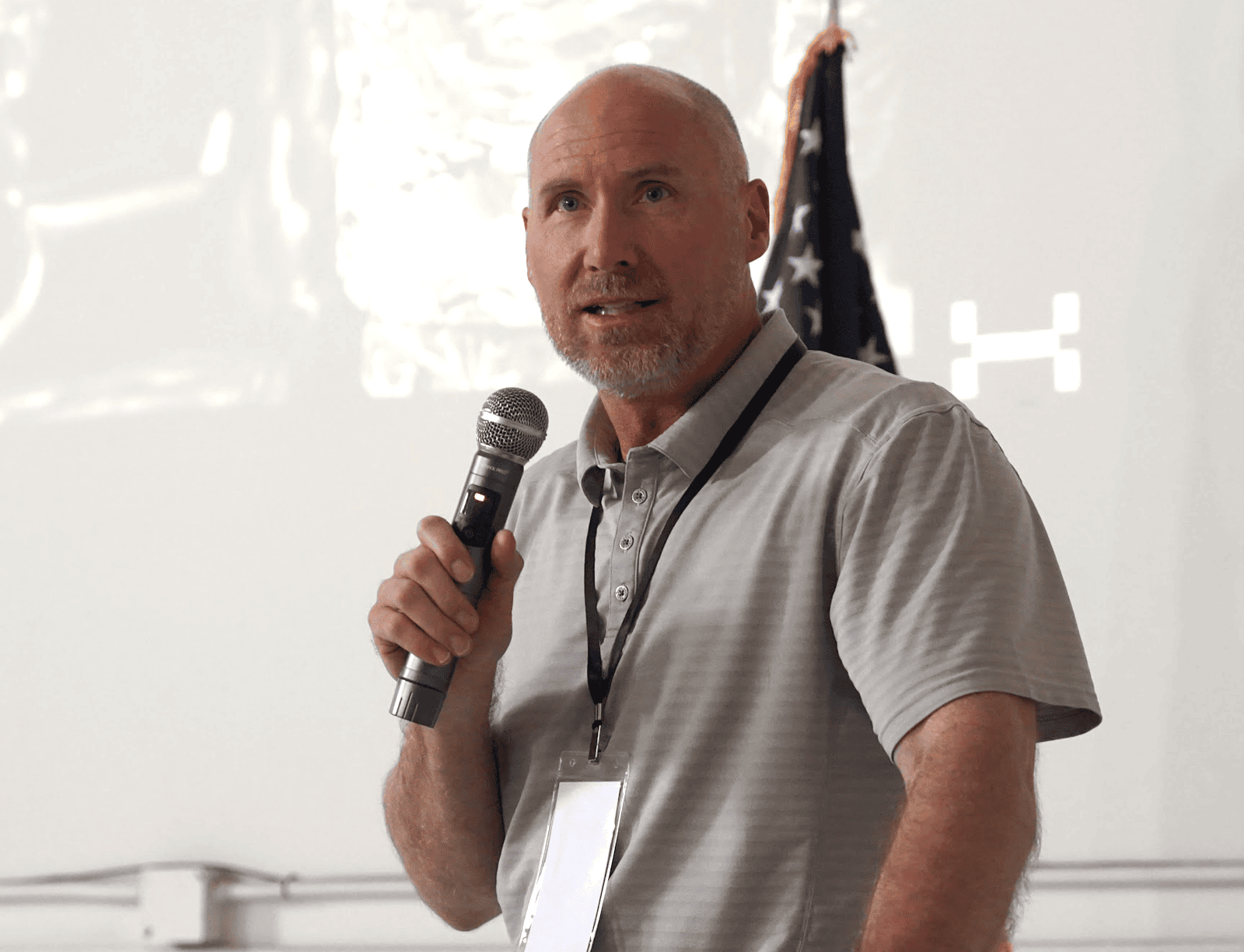
Brian Bowers, CEO of Hypercraft, addresses attendees during the company's Razorback briefing at South Valley Regional Airport in West Jordan on Aug. 7, 2026. Photo: Mark Tullis, TechBuzz
Why now: Utah's piece of a $1 trillion-plus defense budget
A slide framing "the moment for the Utah defense ecosystem" put hard numbers behind Bowers' closing pitch. The FY2027 NDAA carries an authorized budget of $1.14 trillion, and Hypercraft argued Utah is positioned to capture a larger share of it as defense spending expands beyond the air domain, where the state's aerospace base is already strong, into ground autonomy. Bowers posed the question directly to the room: how much of that $1.14 trillion finds its way to Utah, versus the traditional defense spending centers of Texas, California, Washington state, and Alabama?
On unmanned ground vehicles specifically, the same slide cited a projected $45 billion in UGV market growth over the next decade, noted that less than 1% of ground vehicles currently in operation are autonomous, putting the category in "early adoption," and pointed to Ukraine as evidence adoption is already underway, projecting that Ukraine will purchase 50,000 UGVs in 2026. Bowers said Hypercraft intends to compete for that growth both through Razorback vehicle sales and by licensing its underlying Carbon Architecture across other companies' UGV programs.
Aaron Starks, President and CEO, 47G, speaking at Hypercraft's Razorback briefing at South Valley Regional Airport in West Jordan on Aug. 7, 2026. Photo: Mark Tullis, TechBuzz
47G President and CEO Aaron Starks closed the event, tying Hypercraft's trajectory back to the broader ecosystem 47G has spent roughly four years building around Hill Air Force Base, Camp Williams, Dugway Proving Ground, and the state's roughly 600 companies holding defense contracts. Starks, who spent time earlier in his career at Fortem before leading 47G, argued that the defense industrial base's real gap isn't weapons platforms like the F-35, but the supply chains behind them, and that Utah's density of aerospace and defense companies is what lets a young company like Hypercraft plug into partners like Fortem and Base Case "just down the street."
Base Case's ruggedized 4-screen set-up
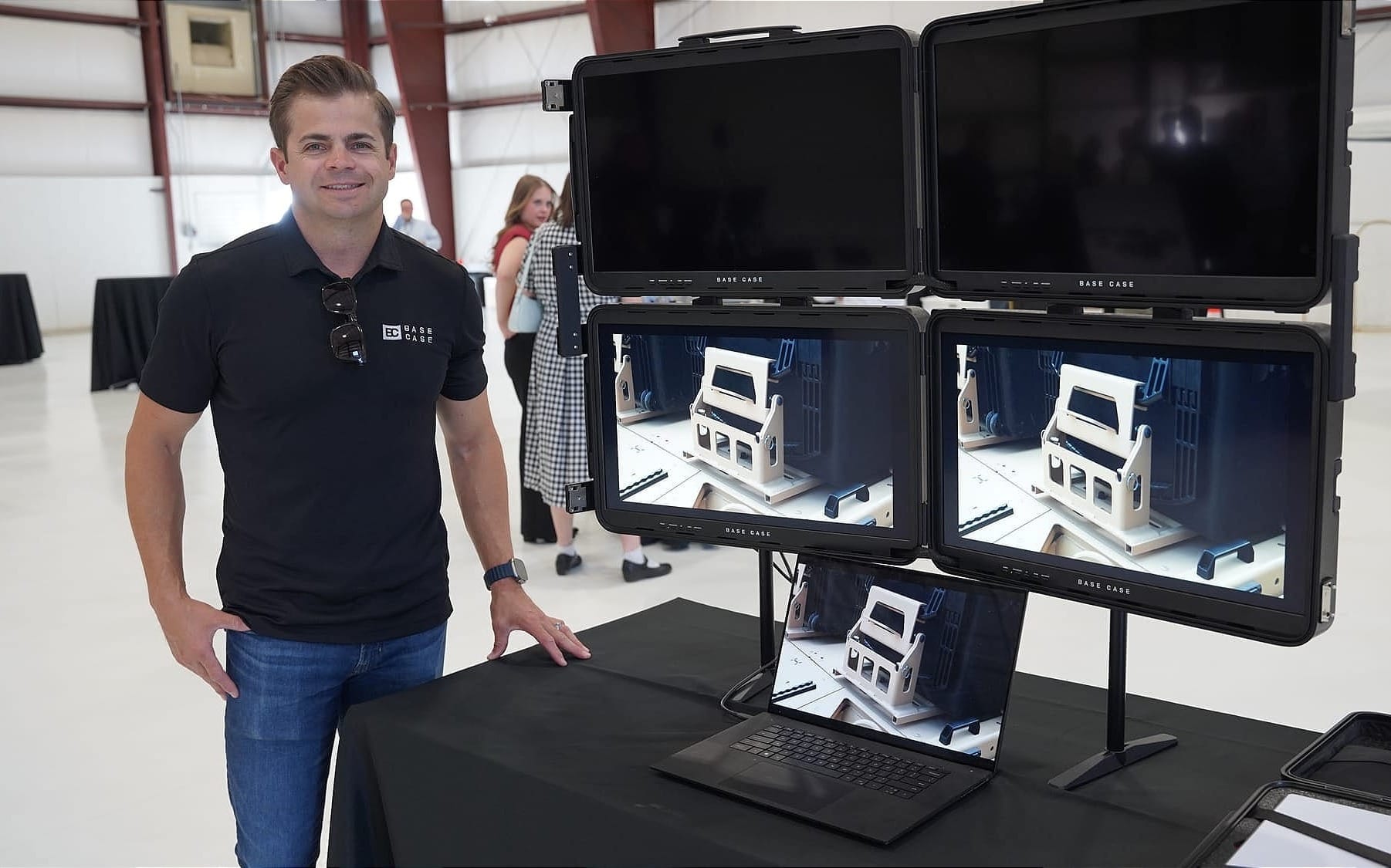
Base Case, the Draper-based portable workstation maker TechBuzz first covered in March 2025 as a crowdfunded suitcase-turned-dual-monitor setup, also had a table at Friday's briefing — this time showing a the company's latest innovation, a double-stack four-screen version built for its now-dominant customer base of military and law enforcement buyers. It can be converted back to the dual-screen version and collapsed back into a carry-on size rollerboard in a matter of seconds.
Arthur Jessop, founder and CEO of Base Case, with the Draper company's ruggedized, double-stack four-screen workstation at Friday's briefing in West Jordan. Jessop. Photo: Mark Tullis, TechBuzz
Founder and CEO Arthur Jessop said the company has sold over 3,000 units since that first article and has refined nearly every feature of the product in the time since. Where early Base Case units came in a range of colors, including brighter options, Jessop said black and white are now the most popular finishes — he calls the white version the "storm trooper" model. The company continues to develop new configurations to suit federal and defense customers, which Jessop said now make up the bulk of Base Case's business.
What's next
Friday's briefing ended with a live demonstration of the Razorback in a dirt field outside the hangar, in front of the roughly 70-person crowd. The vehicle ran through its paces on both power modes — silent on battery power alone, then with its hybrid diesel engine engaged — and showed off crab-walking, instant braking, and rapid acceleration, giving attendees a direct look at the maneuverability and stealth capability Hawksworth and Peters had described inside the the hangar.
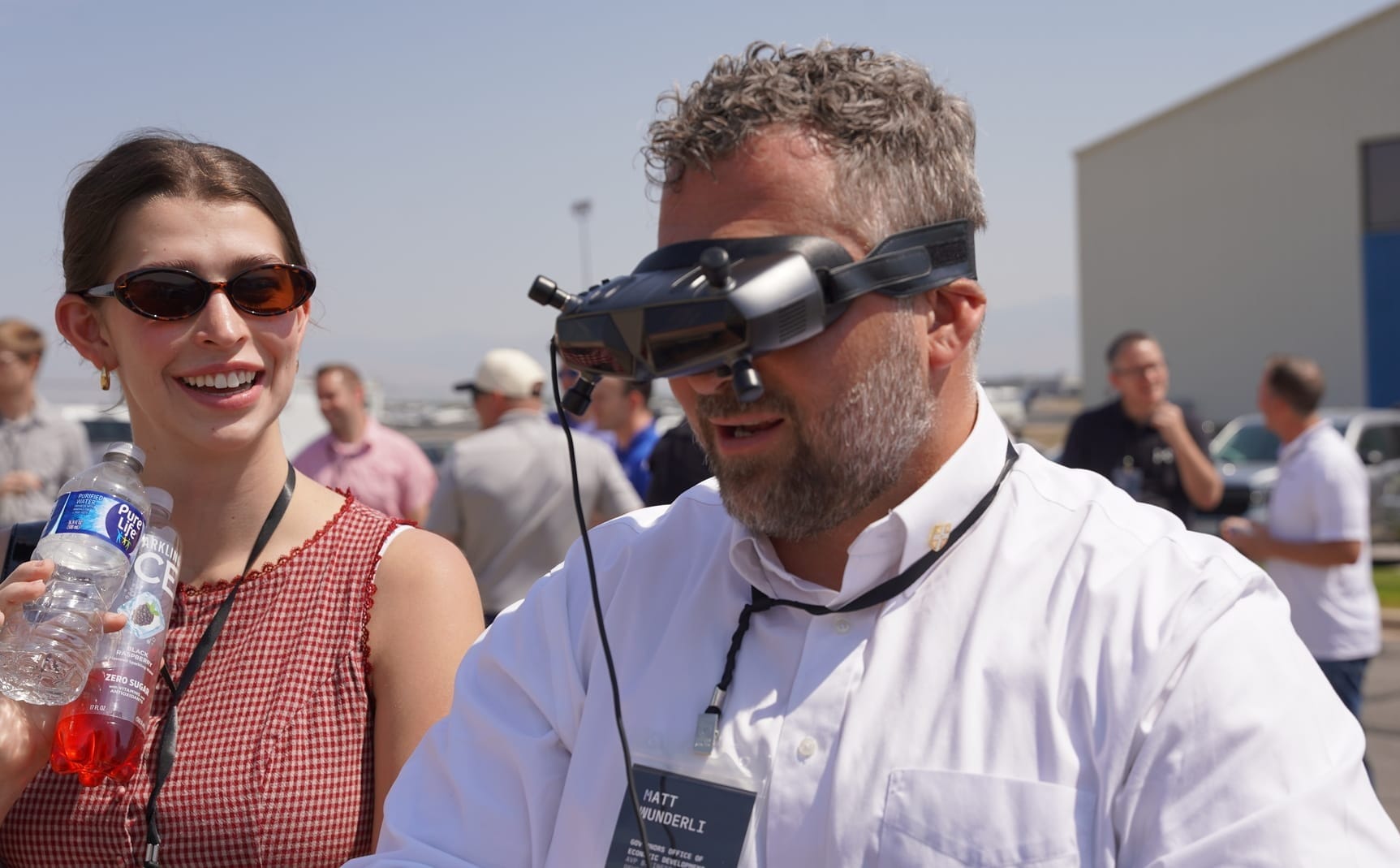
Matt Wunderli of the Governor's Office of Economic Opportunity looks through a headset streaming the Razorback's live sensor feed during an outdoor demonstration at Friday's briefing in West Jordan. Photo: Mark Tullis, TechBuzz
Share this article
The link has been copied!
Your link has expired. Please request a new one.
Your link has expired. Please request a new one.
Your link has expired. Please request a new one.
Great! You've successfully signed up.
Great! You've successfully signed up.
Welcome back! You've successfully signed in.
Success! You now have access to additional content.