Jump Aero Brings Rapid-Response eVTOL Aircraft to West Jordan, Pitching Utah on a New Kind of Emergency Response Aircraft
Jump Aero (Petaluma, CA) brought its all-electric Pulse aircraft to South Valley Regional Airport in West Jordan, pitching Utah on a rapid-response eVTOL designed to get a single paramedic to rural emergencies faster than an ambulance or helicopter.
Today a strange-looking, all-electric aircraft appeared at South Valley Regional Airport, part of a bid by California startup Jump Aero to convince Utah's communities that the future of emergency response might not be a helicopter — or an ambulance — at all.
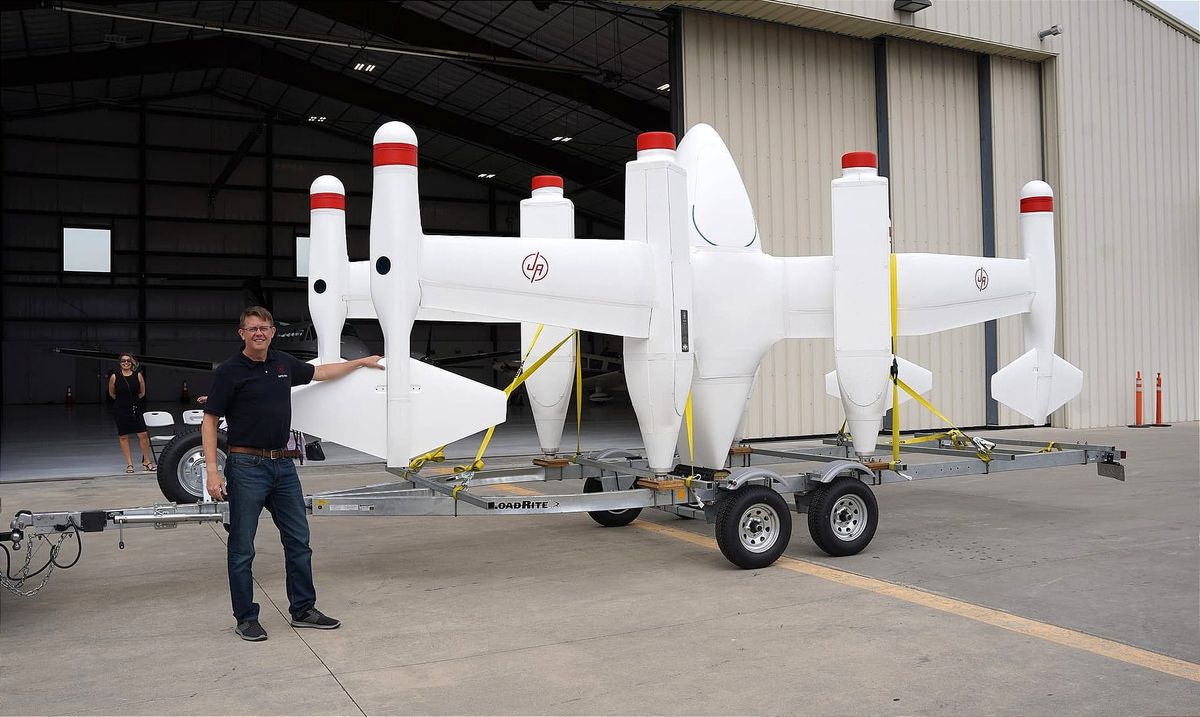
Jump Aero founder and CEO Carl Dietrich brought the company's JA1 Pulse aircraft to the West Jordan airport, giving guests an up-close look at a novel vehicle designed to get a single paramedic to the scene of a rural emergency faster than any existing option.
A New Category of Aircraft, Built for One Job
Pulse is not meant to replace an ambulance or a medevac helicopter. It's designed to do neither. That, Dietrich told TechBuzz, is the point.
The aircraft carries a single pilot-paramedic and a load of stabilization gear: a heart monitor or AED, a trauma kit, an oxygen tank, and a mechanical CPR device capable of sustaining chest compressions for an hour or more. It does not transport patients. Instead, the pilot lands as close as possible to an emergency, stabilizes the patient on scene, and either stays with them until a ground ambulance arrives or accompanies them during transport, leaving the aircraft behind to be retrieved later.
The mission profile is built around what Dietrich calls the "golden minutes" of emergency response. This is the critical several-minute window in which restoring oxygen to the brain or stopping severe bleeding can be the difference between a full recovery and permanent injury or death. Because Pulse is fully electric, it can be airborne within roughly a minute of a call, without the multi-minute engine warm-up required by a conventional helicopter.
Carl Dietrich, Founder and CEO, Jump Aero, standing beside a plaque crediting the Jump Aero team and development partners behind the JA1 Pulse. Photo: Mark Tullis, TechBuzz
"If you're sitting there on the ground for three minutes waiting for your oil to warm up, those are minutes ticking away," Dietrich stated. "This is really designed to get a paramedic or an EMT to the scene of a rural emergency — a time-critical situation — and get professional help there."
The Numbers
According to Dietrich and figures the company has published, Pulse has a dash speed of 250 knots and can reach anywhere within roughly a 30-mile radius in under eight minutes. This is the response window many ambulance services are contractually held to. At slower cruise speeds optimized purely for range, the aircraft could travel significantly farther, but Dietrich said that's not the mission Jump Aero is designing for.
"This is all optimized for rapid response missions," he said. "If you need to go far, use a helicopter, or use somebody else's longer-range vehicle. This vehicle is optimized to do things a helicopter can't."
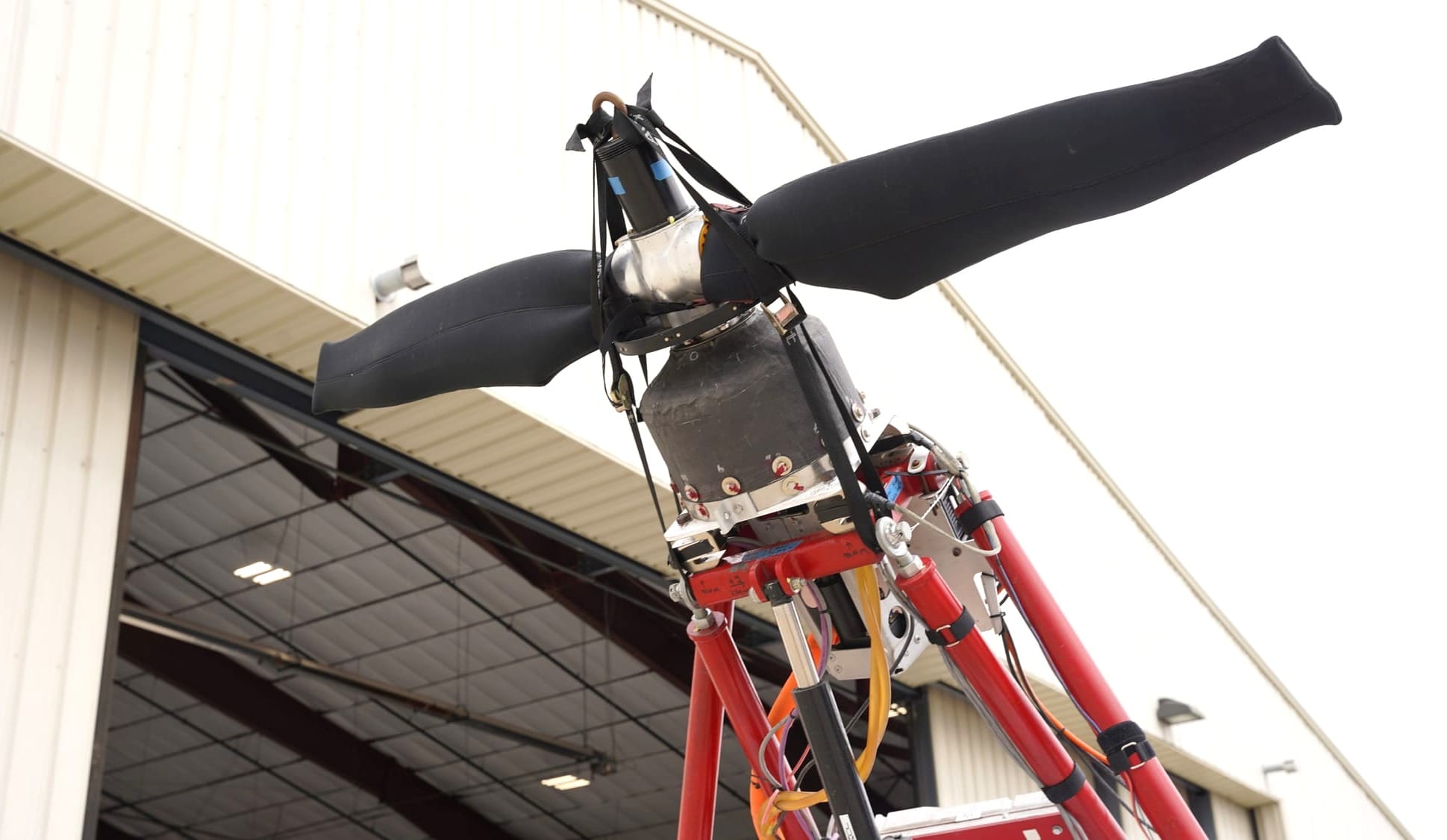
The aircraft's eight electric motors and tilting-propeller control system were developed and tested using a custom propulsion test stand, and Jump Aero has flown quarter-scale subscale prototypes to validate its flight controls, according to Dietrich. Full-scale flying prototypes are expected within roughly a year, contingent on funding, with fielded aircraft potentially following within a couple of years after that.
One of Jump Aero's electric motor-and-propeller units, mounted on a custom rack connected to the bed of Dietrich's support truck. Dietrich said the rig lets engineers drive the setup down a runway and tilt it to different angles, simulating the loads the propeller experiences in flight — including the high-lift, high-drag conditions created when the aircraft translates quickly sideways in hover mode. Data collected from load cells on the stand is used to determine real-world load cases before the aircraft's airframe is designed around them. Photo: Mark Tullis, TechBuzz
Dietrich estimated a purchase price in the range of $1.8 million to $2 million, a figure less than the roughly $2.4 million cost of the least expensive helicopter air ambulances on the market today, and well below the roughly $5 million cost of top-selling models, according to his figures. He argued the real cost advantage shows up when the aircraft's cost is spread across a coverage area: because a single pilot can reach roughly 2,800 square miles within an eight-minute response window, he said, the per-capita cost in a rural county can undercut a traditional ambulance crew even though the aircraft itself costs more.
Carl Dietrich describes the propulsion test rig mounted on his truck to guests at South Valley Regional Airport. Photo: Mark Tullis, TechBuzz
Jump Aero, founded in 2019 and headquartered in Petaluma, California, with composite aircraft parts fabricated at co-founder Jeff Myjak's manufacturing facility in Chelsea, Massachusetts, has been in development for about seven years. A plaque mounted on the aircraft displayed in West Jordan credits a development team of roughly 30 engineers and staff alongside a list of outside development partners, including the Air Force's Air Force's AFWERX Agility Prime program, emergency-services firm Falck A/S, and several aerospace suppliers: Electro.Aero, Airmaster Propellers, Hartzell Propeller, EMRAX, NX Technologies, and Ultra Motion, among others.
A plaque mounted on the JA1 Pulse credits the aircraft's development team and its outside partners, including the U.S. Air Force's AFWERX innovation office and emergency-services firm Falck A/S. Photo: Mark Tullis, TechBuzz
The company's first-responder niche has drawn interest in part because it avoids the heavier FAA certification burden faced by air-taxi eVTOL developers, since Pulse carries no passengers. It's classified instead as what Dietrich described as a "mosaic" light sport aircraft, which requires manufacturer self-certification against FAA standards rather than a full agency certification process.
Why Utah
Dietrich said the pitch to Utah centers on the state's rural geography, where an ambulance response can run 30 to 45 minutes in some areas. Jump Aero has signed non-binding memoranda of understanding with the Utah Department of Transportation and with counterparts in Oregon, as well as with several tribal nations and county governments, according to Dietrich — agreements he described as general statements of support rather than purchase commitments.
"Governments don't put down deposits," he said. "That's one of our challenges as a startup." He said the West Jordan display, along with a recent stop at EAA AirVenture in Oshkosh, Wisconsin, is part of an effort to build public awareness and support ahead of a larger capital raise Jump Aero says it needs — on the order of $50 million — to finish development.
The Design
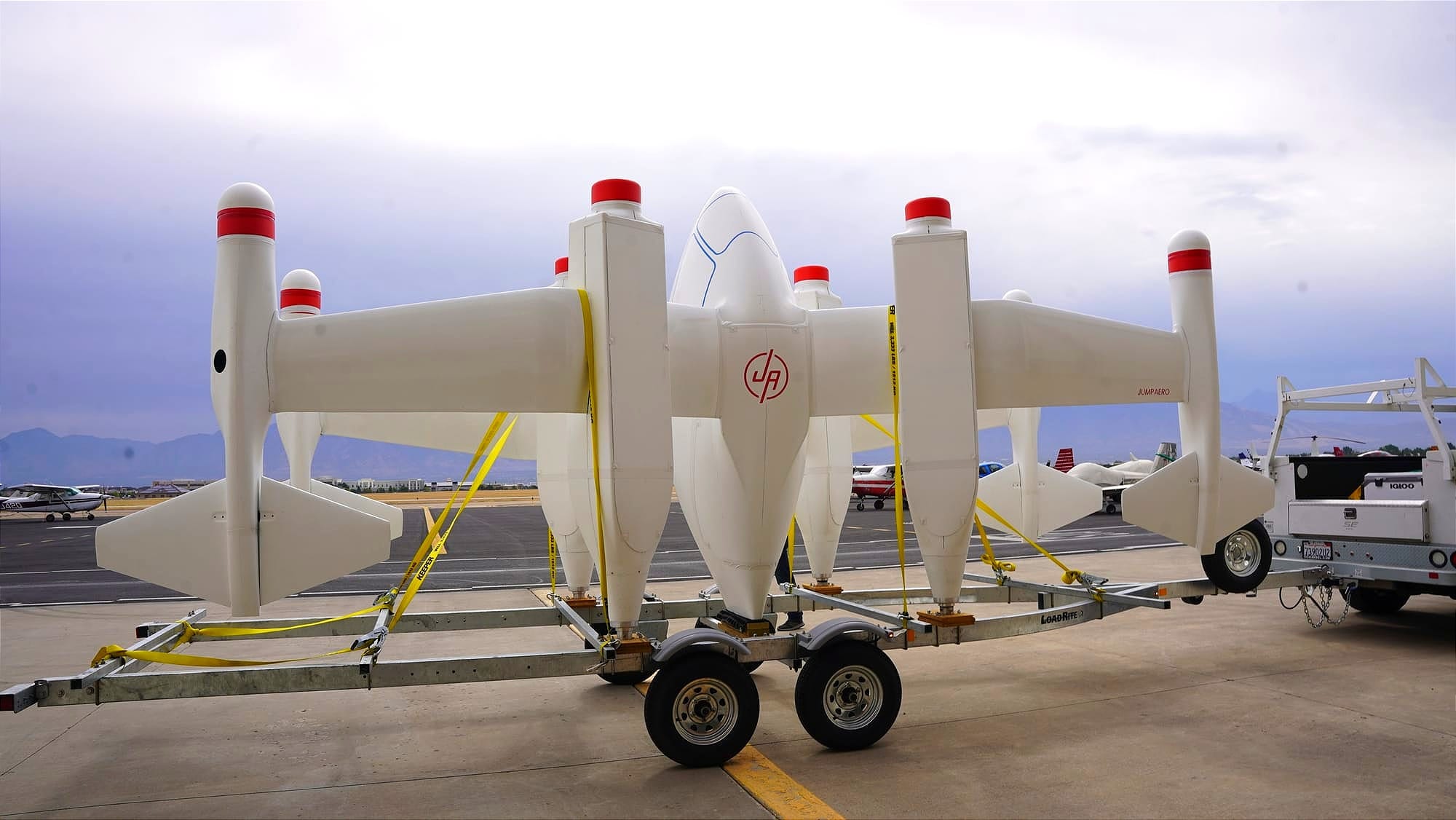
Jump Aero describes Pulse as a biplane-configuration "standing tail-sitter." The aircraft takes off and lands vertically on its tail, then tips forward into horizontal flight. Batteries are housed in outer wing pods, kept separate from the pilot compartment for weight distribution and crash-load reasons, and the design includes a large canopy window that gives the pilot an unusually expansive view of the landing zone, full flight-envelope protection, a ballistic airframe parachute, and, according to the company, no single point of failure that would be catastrophic. Four widely spaced landing legs with integrated heavy shock-absorbing springs (not pictured on the prototype) are built to handle landings on unimproved ground, a rural road, a driveway, a backyard, including slopes of up to 10 degrees, since Pulse is not expected to ever land on an actual helipad.
ump Aero's JA1 Pulse aircraft sits on its transport trailer at South Valley Regional Airport in West Jordan under gathering clouds of a late July storm. Photo: Mark Tullis, TechBuzz
According to Jump Aero's published specifications, the aircraft carries a 330-pound (150 kg) payload of one pilot plus equipment, can be quietly airborne in under 60 seconds, and can reach any point within 50 km (about 31 miles) in under eight minutes. It's rated to hover at up to 2,900 meters (about 9,500 feet) density altitude even with a failed propulsor, and can hold an all-azimuth hover in winds up to 20 knots. Eight independent, cross-linkable 11 kWh batteries feed the aircraft's motors, and it recharges through a single high-voltage DC fast-charging port. It operates under day or night visual flight rules, with operational limits around wind and visibility similar to other light aircraft, though Dietrich said its higher wing loading gives it somewhat more margin than a typical light aircraft of comparable size.