He Went Viral, Sold 45,000 Units — Then Found His Own Face Selling Knockoffs on Amazon
Utah entrepreneur Joshua Ahlstrom built Tilted Spray Co. into a viral success, selling 45,000 units worldwide — then discovered counterfeiters using his own face and photos on Amazon to sell knockoffs, exposing a systemic crisis facing American product startups.
Joshua Ahlstrom had about $20 in his bank account when he started his first company. It was the spring of 2020, COVID had just shut down the country, and Ahlstrom — a door-to-door salesman recently out of a job — had a car cleaning kit his cousin had gifted him for Christmas and not much else. He started knocking on doors in his neighborhood, asking if he could detail people's cars for $20 a pop.
Five years later, Wild Detail has serviced roughly 4,000 vehicles. But it's the second company Ahlstrom built out of that detailing hustle — a small product startup called Tilted Spray Co. — that has become both his biggest success and his most frustrating fight.
The idea behind Tilted is almost embarrassingly simple. Anyone who has ever used a spray bottle knows the problem: tip it at an angle, and it stops spraying. There's not enough liquid to cover the dip tube intake. For a home cleaning enthusiast, that's a minor annoyance. For a professional detailing shop burning through a dozen trigger heads every two months, it's a persistent, expensive headache.
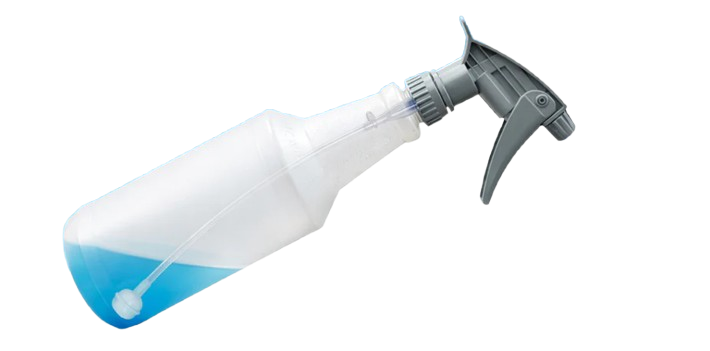
The core of Tilted Spray Co.'s product: a small polypropylene adapter fitted with a weighted, flexible silicone tube that follows liquid to the bottom of the bottle no matter the angle. The design solves a problem anyone who has used a spray bottle knows well — tip it sideways, and the fixed dip tube loses contact with the liquid and the sprayer stops working. For professional detailers burning through a dozen trigger heads every two months, that's an expensive nuisance. Ahlstrom spent three years refining the adapter, working through failed resin-printing attempts before landing on an injection-molded version
Ahlstrom's solution was an adapter, a small polypropylene piece that fits inside any standard spray bottle and uses a weighted, flexible silicone tube to follow the liquid no matter how the bottle is tilted. It sounds simple because it is. But finding a version that was affordable, durable, and universal took him three years of tinkering, a failed resin-printing operation, and a lucky connection to the founders of Utah belt-and-wallet maker Grip6, whose injection molding equipment made the final design possible.
"The versions that already existed cost about $20, and when the trigger head stopped working, the whole system needed to be replaced," Ahlstrom said. "We brought that down to two or three dollars. That was the idea: make 360-degree spray bottle accessibility five times cheaper."
From the Garage to a Million Views
By September 2024, Tilted had packaging, a website, and a product ready to ship. Ahlstrom and his business partner Cole Correa, who had merged his own detailing business with Wild Detail the previous spring, drove to Las Vegas for SEMA, one of the largest automotive trade shows in the world. They didn't have a booth. They just walked the floor, showed the adapter to anyone who would look, and collected feedback.
They forgot to film almost any of it.
The real launch happened the day after they got home, in Ahlstrom's garage. He made a simple video: a spray bottle before the adapter, struggling to spray on its side; a spray bottle after, working at any angle, getting every last drop. The video cracked a million views. Then another video did. Then another.
"It seemed like every video we put out was getting tens of thousands to even millions of views," he said.
Orders followed. Within a few months, Tilted had sold roughly 45,000 units and shipped more than 10,000 packs to customers around the world. Revenue surpassed, then doubled, what the detailing business was bringing in. Ahlstrom, who was running both companies while raising three kids, had built something real.
He just hadn't gotten around to listing it on Amazon yet.
Nine Pages of Fakes
Ahlstrom had a theory about Amazon: if he waited until the product's reviews and return rates were dialed in before listing it there, the early reviews would be strong enough to matter. It was a reasonable idea. It cost him.
One afternoon, sitting with his uncle Paul — a business connection who had warned him about manufacturers in China copying successful products and undercutting their originators — Ahlstrom decided to search Amazon for "360 spray bottle adapter," just to see what was out there.
"I go on there, and I see my face," he said. "A sponsored video of my face being used to sell a tilted adapter. With my product photos. My face, with their watermark on the video, where they used AI to change the background. It was my garage and my ceiling, but they had added a new couch and some plants."
He kept scrolling. He found nine pages of listings. Every one was slightly different: a product image copied and pasted three times, or an AI-distorted version of his own photography, or a lifestyle photo lifted directly from the Tilted website, sometimes showing one of his employees. In the descriptions, competitors had been careful: no mention of "Tilted Spray Co." by name. Just close enough to pass.
Entire Facebook pages had been built around his videos, with usernames like "josh.hedishin." a fake Chinese storefront that was racking up hundreds of thousands of views by reposting his content with altered backgrounds. In the comments, automated or human responders posed as Ahlstrom, answering customer questions. When someone asked whether the adapter worked with bleach, the fake "Josh" said yes. It doesn't.
"It kind of just stopped my heart a bit," Ahlstrom said.
The listings, he estimates, were diverting more than $10,000 in monthly sales, sales from customers who, having seen nearly 7 million views of Ahlstrom's face demonstrating the product, likely believed they were buying the real thing.
The Takedown Math Doesn't Work
Ahlstrom spent a weekend submitting 265 takedown notices to Amazon. Five were approved. To date he has submitted over 500 takedown notices to Amazon.
The ones that succeeded were straightforward: listings that used the trademarked names "Tilted" or "Tilted Spray Co." For the rest, Amazon's position was that the alterations to the images, a copied photo duplicated three times, or an AI remix of an original, were sufficient to make them distinct. No copyright violation, no takedown.
"You can take someone's product photo, copy and paste it three times, add a bottle from another lifestyle photo, and now it's its own image no longer covered under copyright," Ahlstrom said. "And even if the photo gets disabled, all they have to do is upload a new one. As long as it doesn't say 'Tilted Spray Co.' in the description, there's nothing we can do."
Professional takedown services quoted him $50 per listing. With hundreds of listings being added faster than they could be removed, the math was impossible. The time it took to successfully remove five listings, Ahlstrom said, more than a hundred new ones had appeared.
"The amount of effort it takes to take down a product," he explained, "is exponentially more effort than it is to list one. You'll just never catch up."
Ahlstrom believes the listings are being generated using AI agentic tools, automated systems that scrape product data, generate variations on images, and bulk-upload listings across platforms. It's not just Amazon. Fake storefronts selling counterfeit or nonexistent versions of Tilted have appeared on Alibaba, AliExpress, Temu, and across Meta's platforms. Ahlstrom purchased a couple of the Amazon listings. After several weeks they arrived.
"They weren’t even real copies," he said. "They didn't even match the photos that were on the listing. It was just a ploy to knock us down while they worked on it. And it shows in the Amazon reviews," he shared with TechBuzz.
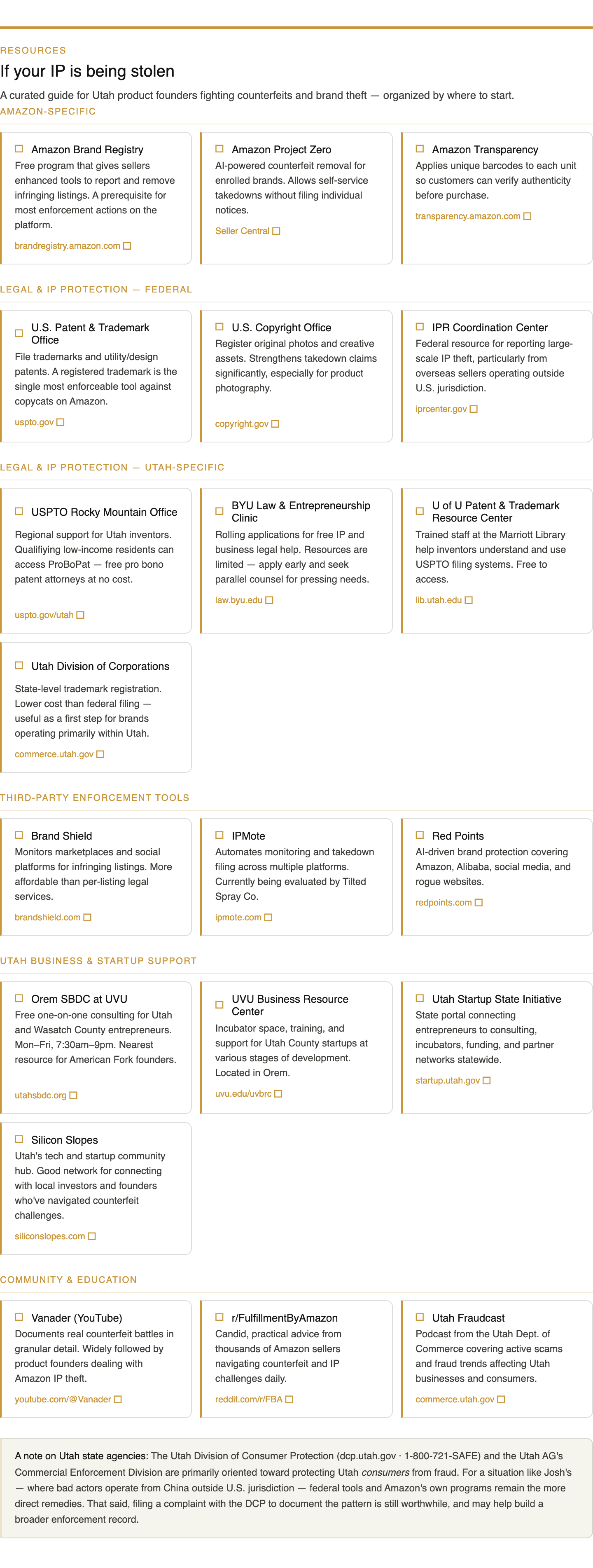
The broader problem, Ahlstrom argues, is structural. Chinese counterfeiters operate largely outside the reach of U.S. patent, copyright, and trademark law. Legal action against individual sellers means, in practice, suing Amazon for allowing them to operate. It is a slow, expensive process with uncertain outcomes.
He referenced a YouTube creator named Vanader who faced 184 copycat listings of a patented product and spent 11 months and hundreds of thousands of dollars getting them removed — only to find the same product still available, this time with a different logo.
"I believe almost every single product market in the world has some form of this," Ahlstrom said. "China just doesn't follow U.S. patent, copyright, or trademark laws. And Amazon prioritizes customer experience, because happy customers spend more money. The problem is, that comes at the expense of the sellers."
What You Can Do (And What You Can't)
Ahlstrom is not without advice for founders in similar positions. Get on Amazon early, he recommends, as early as you possibly can. Build an email list, run a pre-order, and direct every one of those customers to your Amazon listing before any competitor can get established. Reviews in the first weeks matter enormously to how the platform ranks you, and a well-reviewed listing with traction is harder to bury under a flood of fakes.
Beyond that, he's candid: the options narrow fast. Drive organic content to Amazon so the algorithm prioritizes you. Make clear in your listing that you are the original. And then, largely, outcompete. For most small product companies, he said, that's the only realistic path.
He and his brother, a senior software engineer, have begun working on something more ambitious: an automated tool to scan marketplaces, identify infringing listings, generate takedown notices, and file them at scale. It's early, and Ahlstrom acknowledges the same fundamental limitation applies. If a seller is careful enough to avoid explicit trademark use, there may simply be nothing actionable to file.
"There's just nothing you can do," he said, "until Amazon steps up their ability to keep illegal competition from hitting the marketplace."
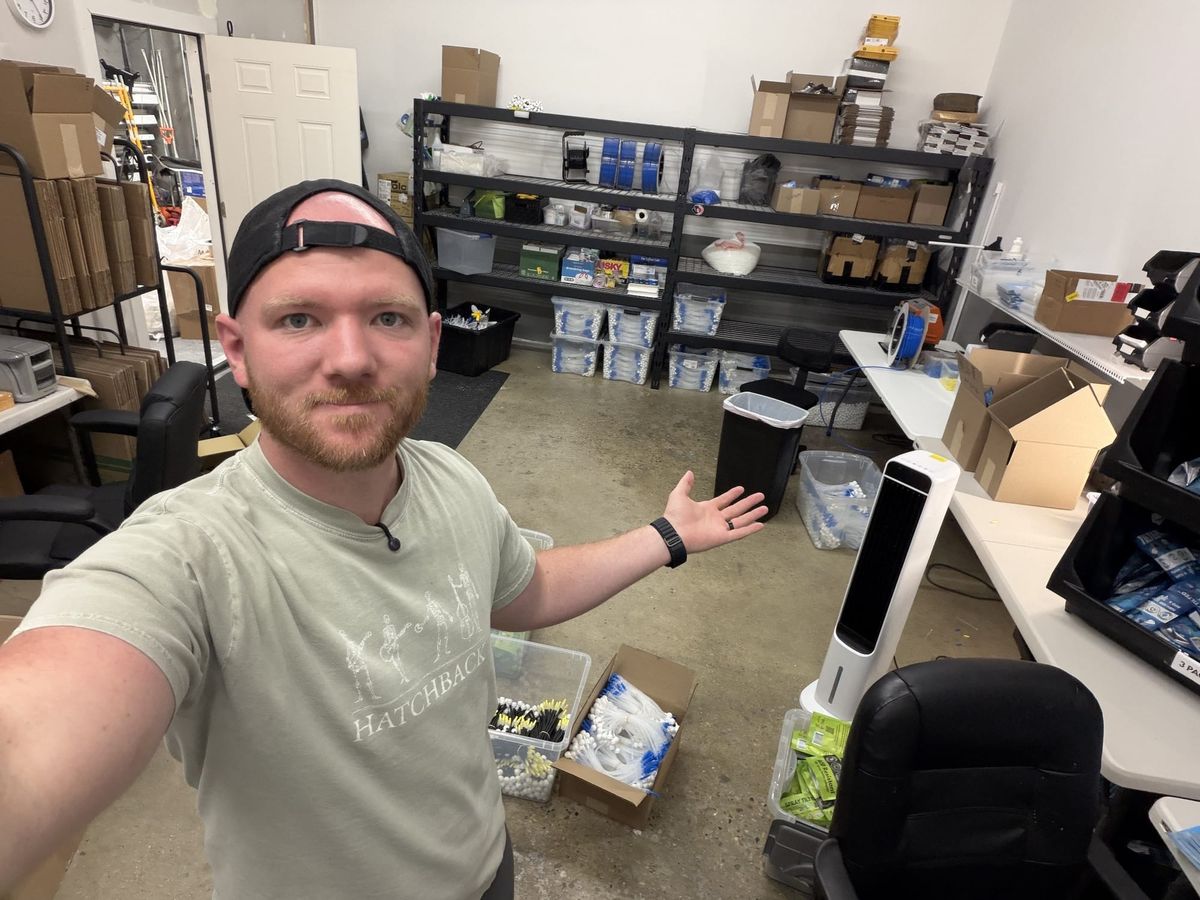
For now, Tilted is still growing. Ahlstrom and a small team run fulfillment out of a warehouse in American Fork, where they assemble and package the adapters. The polypropylene top piece is manufactured in Utah. The silicone tubing is sourced from China (at one-fortieth the domestic cost). Packaging is split between U.S. and overseas printers. It's a bootstrapped, unglamorous, genuinely useful operation.
And Ahlstrom, who started the whole thing with a $20 cleaning kit and a door-to-door pitch, is not giving up.
"I love competition," he said. "I expected competition. I just thought it would be in the form of competitors with their own product, advertising it their own way, and not companies illegally using our content, pretending to be us, and scamming people outright."
Tilted Spray Co. is based in American Fork, Utah. The company's adapters are available at tiltedsprayco.com.
Share this article
The link has been copied!
Your link has expired. Please request a new one.
Your link has expired. Please request a new one.
Your link has expired. Please request a new one.
Great! You've successfully signed up.
Great! You've successfully signed up.
Welcome back! You've successfully signed in.
Success! You now have access to additional content.