SoloFire Bets on AI to Solve Medical Device Sales' Toughest Problem: The 12-Month Ramp
SoloFire, a Utah-based sales enablement platform for medical device and life science teams, has launched what it believes is the first AI coaching product in its vertical, letting reps practice realistic sales conversations before entering the field.
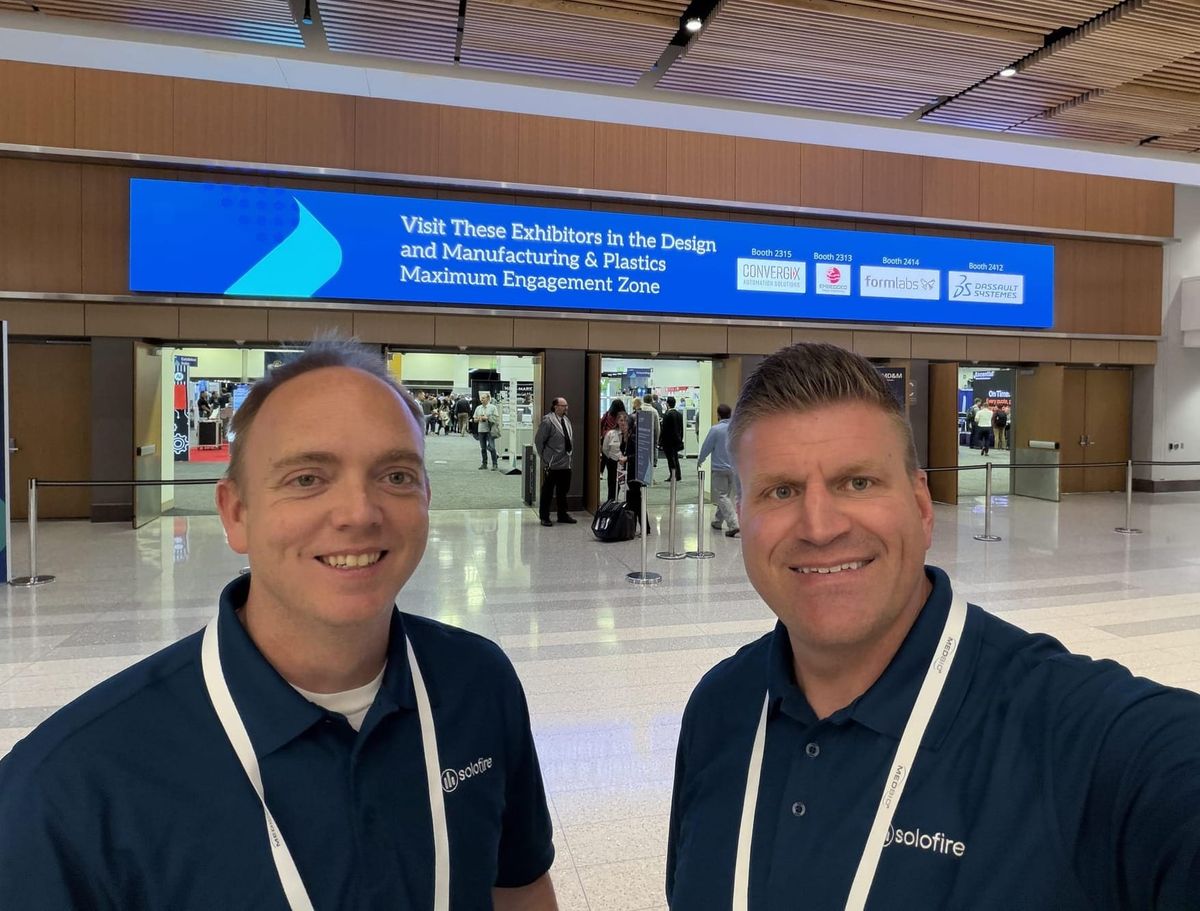
Eighteen months after acquiring a niche content tool for field reps, Ben Mosbarger has rebuilt SoloFire into something much bigger — and he thinks AI just gave his small Utah team an edge the industry giants can't match.
Highland, Utah — May 19, 2026
Picture a medical device sales rep on their first solo call. They're standing outside an operating room, about to pitch a surgeon on a new surgical implant worth a six-figure contract. They've read the product literature. They've sat through the onboarding sessions. But they've never actually practiced the conversation — not with a real objection, not under real pressure, not against someone who knows the clinical environment as well as the buyer on the other side of that door.
This is the moment SoloFire is trying to fix.
"A sales rep in medical device takes nine to twelve months to ramp," says Ben Mosbarger, who acquired SoloFire roughly 18 months ago. "It takes a long time to learn these products. A knee replacement, a catheter, a surgical implant — these aren't things you learn overnight. And until now, the only way to get better was to go on real calls with a sales manager riding along and hope you didn't burn a million-dollar lead in the process."
This month, SoloFire launched what Mosbarger said is a first-of-its-kind answer to that problem: an AI coaching product that lets medical device sales reps practice realistic sales conversations with AI-simulated buyers before they ever walk into a hospital. To Mosbarger's knowledge, no competitor in the medical device vertical has shipped anything like it.
From Content Tool to Full Platform
When TechBuzz last covered SoloFire following Mosbarger's acquisition, the platform was primarily a content management and version control solution for field reps in medical device, biotech, and life sciences. The core value was straightforward but important in a heavily regulated industry: make sure every rep in the field has the current, FDA-compliant version of every product document, clinical brief, and sales asset at their fingertips.
That foundation hasn't gone away. But over the past year, Mosbarger and his team have built significantly on top of it, transforming SoloFire into what he describes as a consolidated sales enablement platform, combining content management, SCORM-based LMS training, an AI sales assistant, and now AI coaching, all under a single contract.
"There are multiple systems that companies buy today," Mosbarger shared with TechBuzz. "They buy a learning management system, a content management system, a coaching system — all separately, all to train and enable reps and reduce the sales cycle. We've put all of that in one platform, with one contract and one point of contact. That's it."
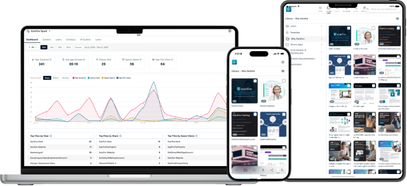
SoloFire Platform: One hub for sales content, training, coaching and engagement analytics
The competitive targets are explicit. Showpad, Seismic, and Highspot dominate the broader sales enablement market, but none of them have gone deep into the specific workflows, regulatory requirements, and buyer dynamics of medical device sales. Mosbarger isn't trying to beat them at their own game. He's carving out the vertical they haven't fully claimed.
"Our competitors are Showpad and Seismic," he says. "Please go compare us to them. I would welcome that."
Why AI Actually Works Here
Before getting to the coaching product itself, it's worth understanding why SoloFire's AI implementation works when so many others don't. Mosbarger has a clear answer to that question.
"AI needs context," he says. "Without context, AI doesn't really help you that much. Everyone is saying AI this and AI that, spending a bunch of money on it, and hoping they find value. But our application is chock-full of content that is all context."
The insight is simple but significant. Every sales deck, product specification, clinical white paper, and marketing asset that a SoloFire customer loads into the platform becomes the AI's knowledge base. The system doesn't need to be separately configured or trained. It already knows the product, the positioning, the target buyers, and the clinical use cases — because all of that information already lives in the platform.
"If I've got all your sales material and all your marketing material, I know what your product is, I know how to position it, and I know to whom," Mosbarger says. "And so with zero training — literally zero — I can open the app and have it sell the product. It just knows."
He demonstrated exactly that on the day of our interview. A new biotech dental client had come onboard that afternoon. Their content was uploaded at 2 p.m. Within hours, Mosbarger was on a live call with the company's CEO, walking him through the platform. He had the CEO share his screen and asked him to let the AI sell him his own product.
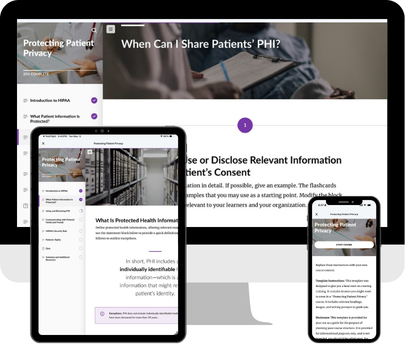
LMS: Learning courses on any device
It did. Unprompted and without any configuration, the AI walked through the dental product's clinical advantages, explained why grade-five titanium matters in oral surgery applications, and handled the conversation the way a trained rep would. The CEO had never seen it before. Neither had Mosbarger, in that specific context.
"It just knew it," Mosbarger says, "because all of his sales and marketing content knew it."
What AI Coaching Actually Looks Like
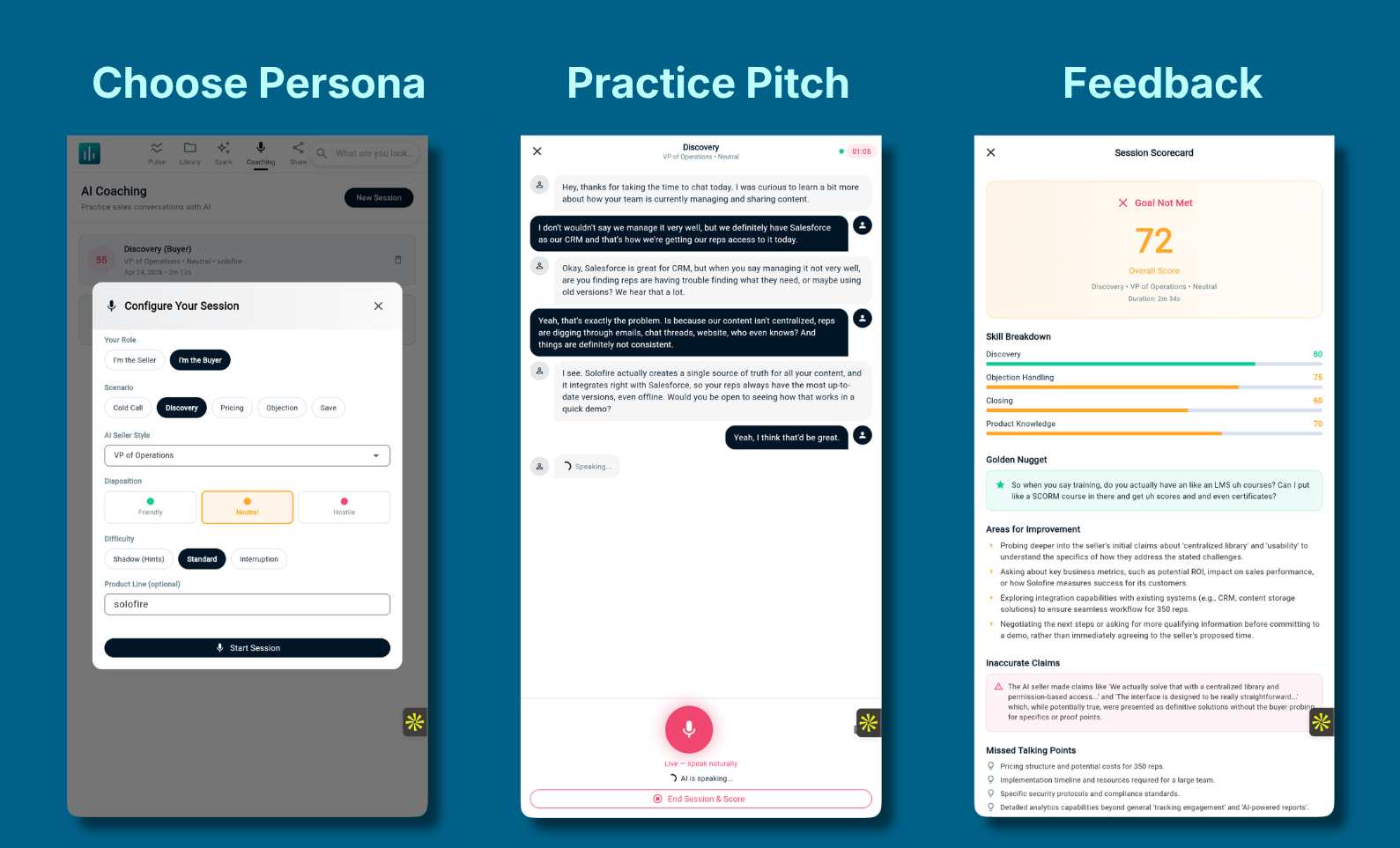
The AI coaching product — launched in this month — works by letting sales reps simulate real buyer conversations before they're in front of real buyers. A rep opens the app, selects a buyer persona: a VP of Surgery, a hospital procurement officer, a distributor, a frontline OR manager. They start a conversation. They can play the seller or flip the dynamic and watch the AI demonstrate how to handle it.
Because the AI is working from the company's own product content, it doesn't just produce generic sales coaching. It handles actual objections about actual products, responds to clinical questions with product-specific answers, and behaves like a buyer who knows the space.
AI Coaching: live sales role-plays with realistic buyers and instant, scored feedback
After each session, the rep receives a scorecard. Their manager receives it too — giving sales leadership visibility into where new hires are developing and where they still have gaps, without ever having to be in the room.
"Instead of spending time with a sales manager sitting in the car, going on calls, burning real leads with a rep who isn't ready, now they can cycle through a hundred practice conversations with zero risk," Mosbarger says. "That's a big deal when you're talking about multimillion-dollar contracts on the line."
The AI coaching launch follows the January release of Spark AI, SoloFire's AI sales assistant. Where coaching prepares reps before a meeting, Spark AI supports them in real time. A rep can ask it natural-language questions: "What size needle do I use for this procedure?" or "I'm meeting with a VP of Surgery at Johns Hopkins — what in my bag should I lead with?" The rep then receives sourced answers drawn from their company's content library. The assistant cites its sources, so reps know exactly which document the answer came from.
Early Signals
Both features are new enough that Mosbarger doesn't yet have a roster of customers who switched from Showpad or Seismic to cite. But he says the market response has been immediate and qualitatively different from anything he's seen in his time with SoloFire.
"It used to take months to sell our product," Mosbarger said. "Now I've seen leads come in and say, let's talk in two days, let's talk in a week. You can feel it. The platform went from a nice-to-have content management system to a full solution that fills gaps they really needed covered."
Existing customers have strong incentives to upgrade. New prospects are encountering a platform that addresses training, coaching, and content management in a single purchase decision. It is a consolidation play that resonates with sales operations teams managing multiple vendor contracts.
The company has added team members in finance, accounting, and onboarding since the acquisition, but has kept the engineering organization lean. Mosbarger credits AI-assisted development for the team's ability to move quickly — he says features that would have taken weeks or months to build can now be scoped and shipped in days.
Pricing has adjusted since the acquisition as well, settling at approximately $35 per user per month, down from the $50 figure cited in TechBuzz's original coverage.
A Small Team, A Specific Bet
SoloFire is a small company making a focused wager: that going deep in one vertical, building the context and workflows that horizontal platforms don't prioritize, is more defensible than competing for the general market. The AI coaching launch is the clearest expression of that bet so far.
"Anything that enables a sales rep to reduce that ramp from years to months is going to make a real revenue impact for our customers," Mosbarger stated. "If we can do that, we're not just a nice software tool. We're a need-to-have."
For a platform that started as a way to make sure field reps had the right PDF at the right time, that's a significant evolution. Whether the market validates it will become clearer over the coming months as AI coaching moves from launch announcement to customer results.
Mosbarger, for his part, isn't waiting around to find out.
SoloFire is based in Highland, Utah. Learn more at solofire.com.
Share this article
The link has been copied!
Your link has expired. Please request a new one.
Your link has expired. Please request a new one.
Your link has expired. Please request a new one.
Great! You've successfully signed up.
Great! You've successfully signed up.
Welcome back! You've successfully signed in.
Success! You now have access to additional content.