Where Art Meets Innovation: Inside the Salt Lake Art Show and the X5 Vision
Utah's first Salt Lake Art Show, launched under the X5 convergence platform, showcased extraordinary artists including a keyboard-key pop artist, a Navajo-Anishinaabe jeweler, a Burning Man sculptor, and a feng shui painter, signaling Salt Lake City's emergence as a major creative destination.
On the evening of May 14th, in a building that has witnessed more than 130 years of Utah history, a group of innovators gathered to imagine the state's creative future.
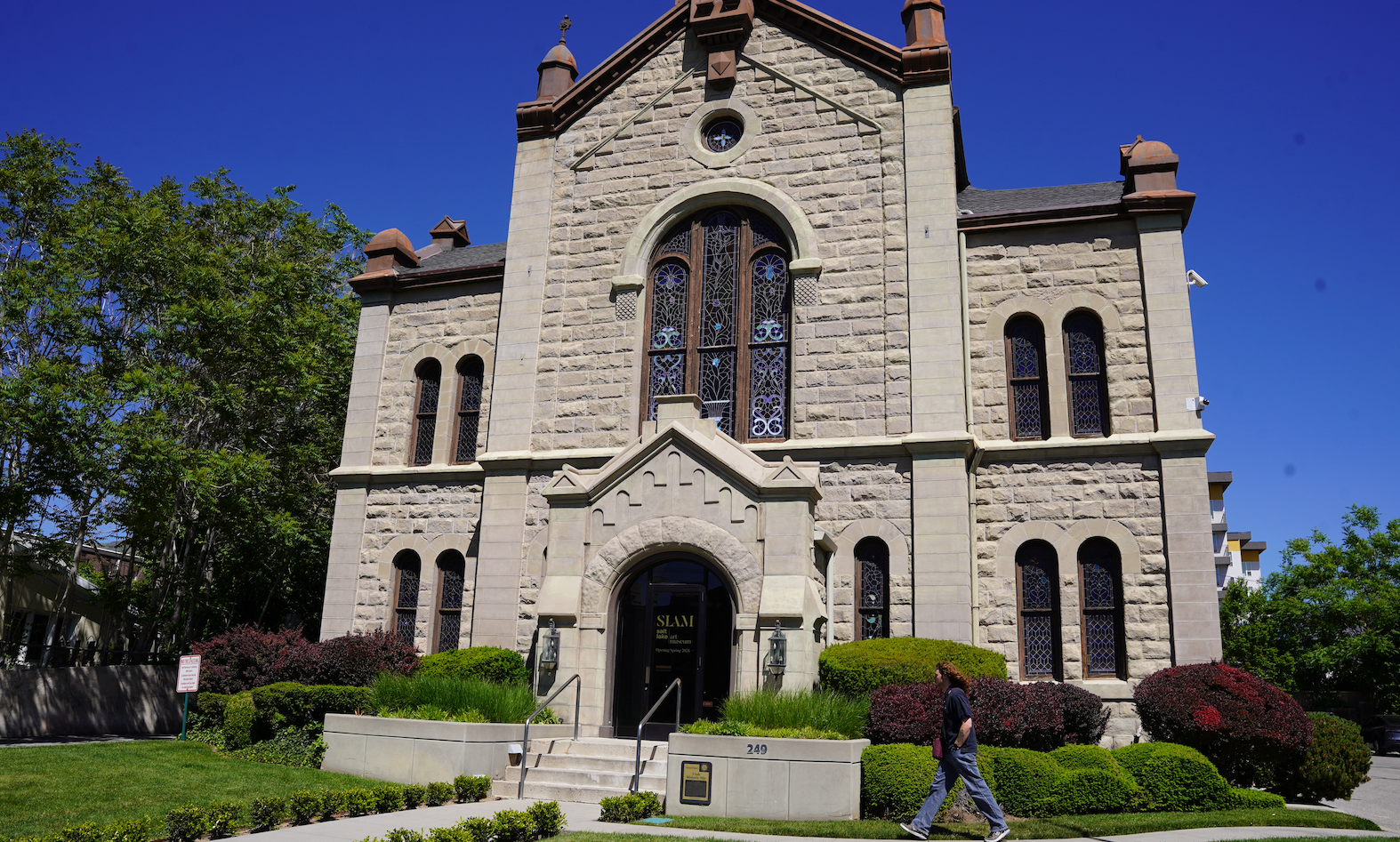
The Salt Lake Art Museum (SLAM) is housed in the historic B'nai Israel Temple, a Romanesque Revival landmark completed in 1891 and built by Utah's early Jewish pioneer community. Opening July 2026, SLAM marks a new chapter for a building that has witnessed more than 130 years of Salt Lake City history. X5 chose this location for its May 14th launch event, the night before the Salt Lake Art Show opened its doors. Utah has more fine artists per capita than anywhere else in the nation, per the SLAM's website
The Salt Lake Art Museum (SLAM), still in its pre-opening phase, occupies the historic B'nai Israel Temple at 249 South 400 East in Salt Lake City — a striking Romanesque Revival structure completed in 1891, built by Utah's early Jewish pioneer community. Its rusticated sandstone facade and distinctive dome have anchored that corner of the city for generations. Now the building is becoming something new: a home for Utah art, past, present, and future.
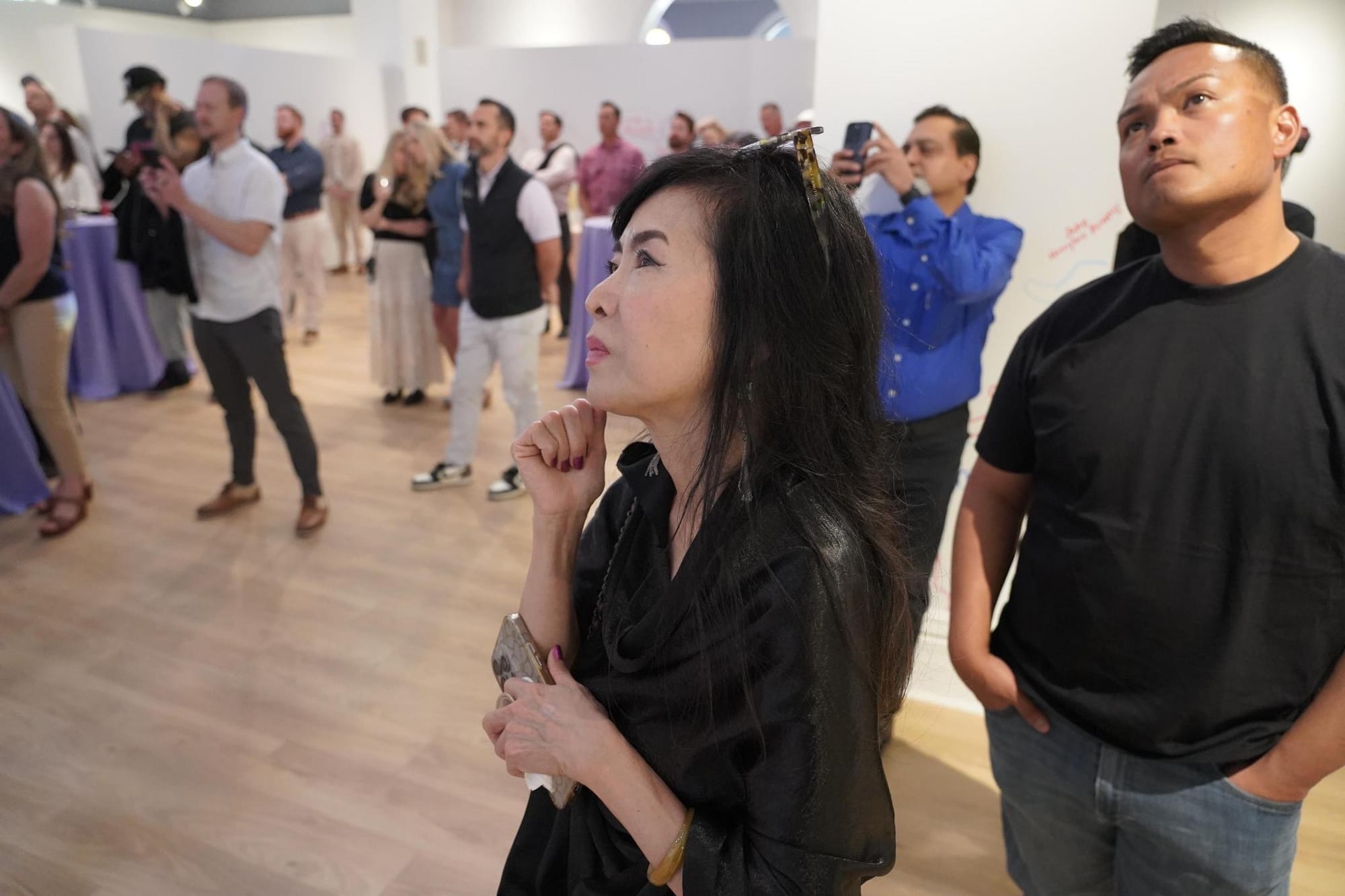
That evening, the museum's walls were still bare white, unfinished, waiting. So organizers did something inspired: they invited early supporters to draw on them. Silhouettes were traced, messages written, names left behind — a human layer that will eventually be painted over and invisible, but permanent nonetheless.
Guests take in the remarks at the Salt Lake Art Museum's May 14th X5 launch event, held inside the freshly renovated galleries of the historic B'nai Israel Temple. The bare white walls — soon to be painted, with the silhouettes of that evening's attendees hidden beneath — framed an intimate gathering of artists, collectors, and innovators who came to hear the vision for what X5 and SLAM are building together in Utah.
"When we paint over it," said SLAM's director, Dr. Micah Christensen, "we'll be able to tell everyone there's a drawing room underneath the Salt Lake Art Museum. You're a masterpiece — you just can't see it underneath there."
It was an apt metaphor for what X5 aims to build across Utah.
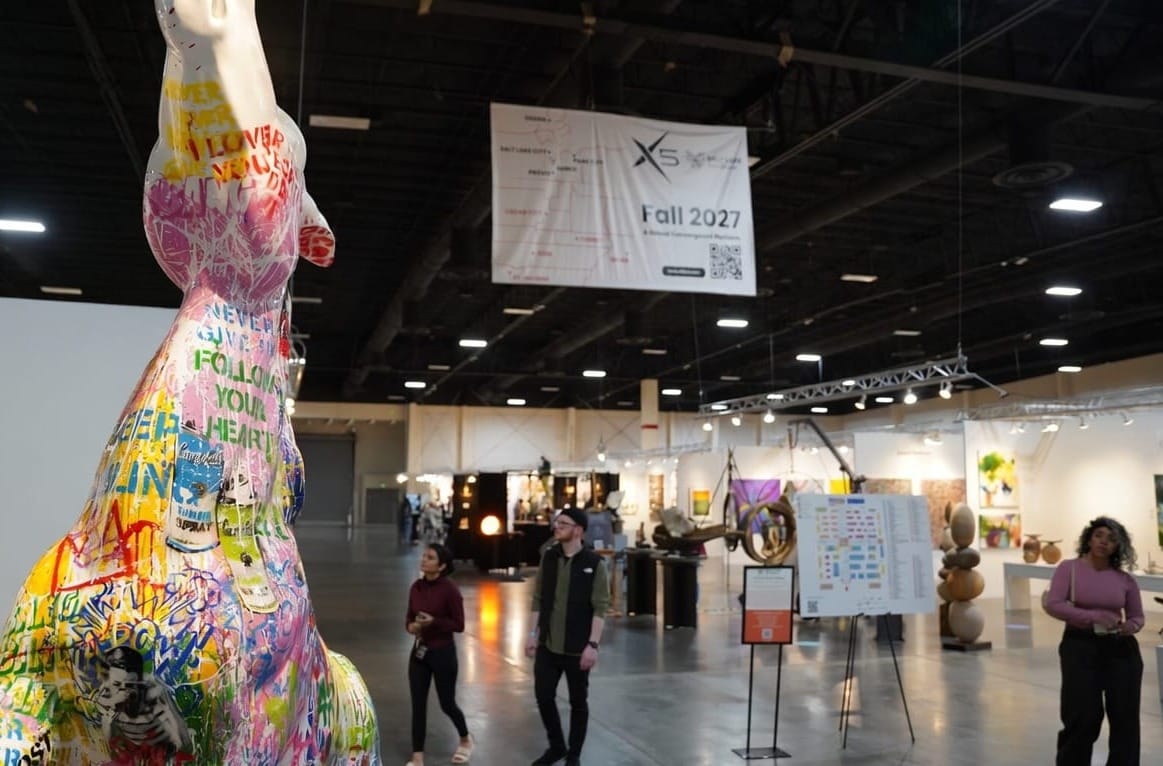
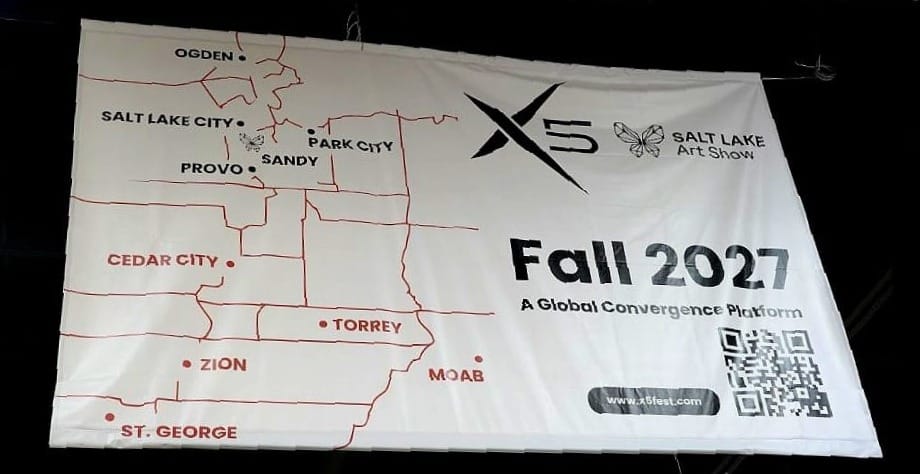
A graffiti-covered horse sculpture reaches toward the ceiling of the Mountain America Expo Center in Sandy, welcoming visitors to the Salt Lake Art Show. The X5 banner overhead — announcing a full convergence event for Fall 2027.
X5 — a convergence platform anchored symbolically in Utah's five national parks and designed to connect creators, technologists, entrepreneurs, and capital — chose that evening to lay out its vision to early supporters. The Salt Lake Art Show, running May 14–17 at the Mountain America Expo Center in Sandy, was X5's first public activation, and the leaders who would shepherd it gathered at the museum beforehand to explain what they were really after.
Joe Ross, Vice Chair and Chief Innovation Officer, was direct about the stakes. Sundance, he noted, had historically generated over $130 million in annual economic impact for Utah, with the majority coming from out-of-state visitors. With Sundance's departure, that impact needed a successor — and X5 was designed to be something larger and more durable than a film festival replacement.
Kevin O'Keefe, President of Platform Operations, X5; Reno Tahoe International Art Show, Salt Lake Art Show, and parent company Peaks Art Fairs LLC
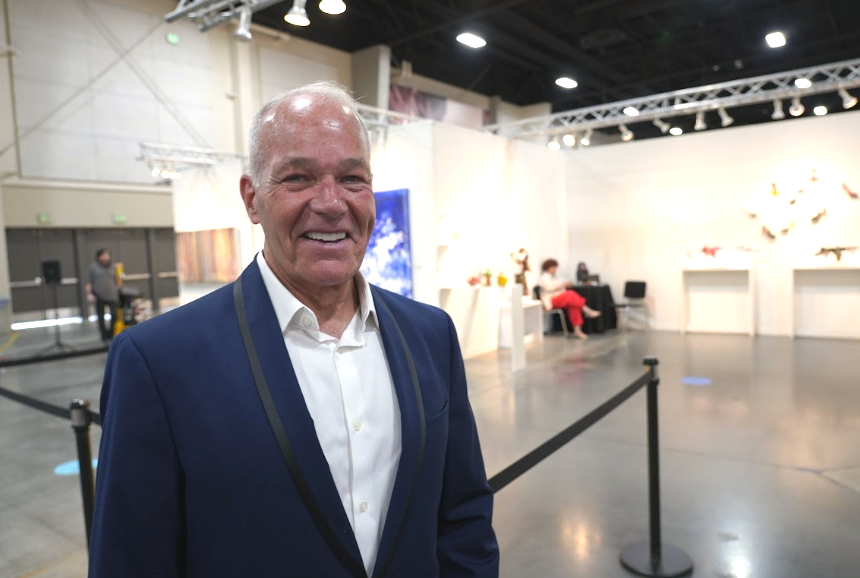
Kevin O'Keefe, President of Platform Operations, X5, Founder and CEO of Peaks Art Fairs LLC and the organizing force behind the Salt Lake Art Show, had spent the days before the event staring at thousands of square feet of bare white exhibition walls. He spoke about the ambition in practical terms: reaching an audience of 40 million people through existing media channels, drawing private equity and venture capital toward Utah creators, building a platform that makes Salt Lake City a destination the world returns to year after year.
"We want people to know they have to come to Salt Lake," O'Keefe said. "Not just to see what's happening, but because what's happening here is the future. When innovators, creators, and capital all come together in the same place, that's when things actually move."
SLAM's director is Dr. Micah Christensen. Notably, he's also a partner at Anthony's Fine Art & Antiques, a 30,000-square-foot Salt Lake institution that O'Keefe described as arguably the largest secondary art gallery in the western United States, if not the country. "You have to go look at that place," he urged the audience with enthusiasm. "On its own, it's its own museum."
David Steenhoek, Vice Chair and Chief Creative Officer, closed the evening on a more philosophical note, and a personal one. Steenhoek, who has deep Utah roots, spoke about what X5 is ultimately for.
"Now is the new renaissance," he said. "And the renaissance is us: creators and founders who have the support, the inclusion, the network, and the access to finance and innovation that they've never had before. Our society has become too focused on ego and competition. X5 is about the golden rule, about building something together. The ocean thrives because the coral and the fish are alive and healthy. We've been doing this wrong. It's time to work together."
He ended with a challenge: "Ninety-nine percent of people don't follow through or follow up. If you are just the one percent who does — it changes everything."
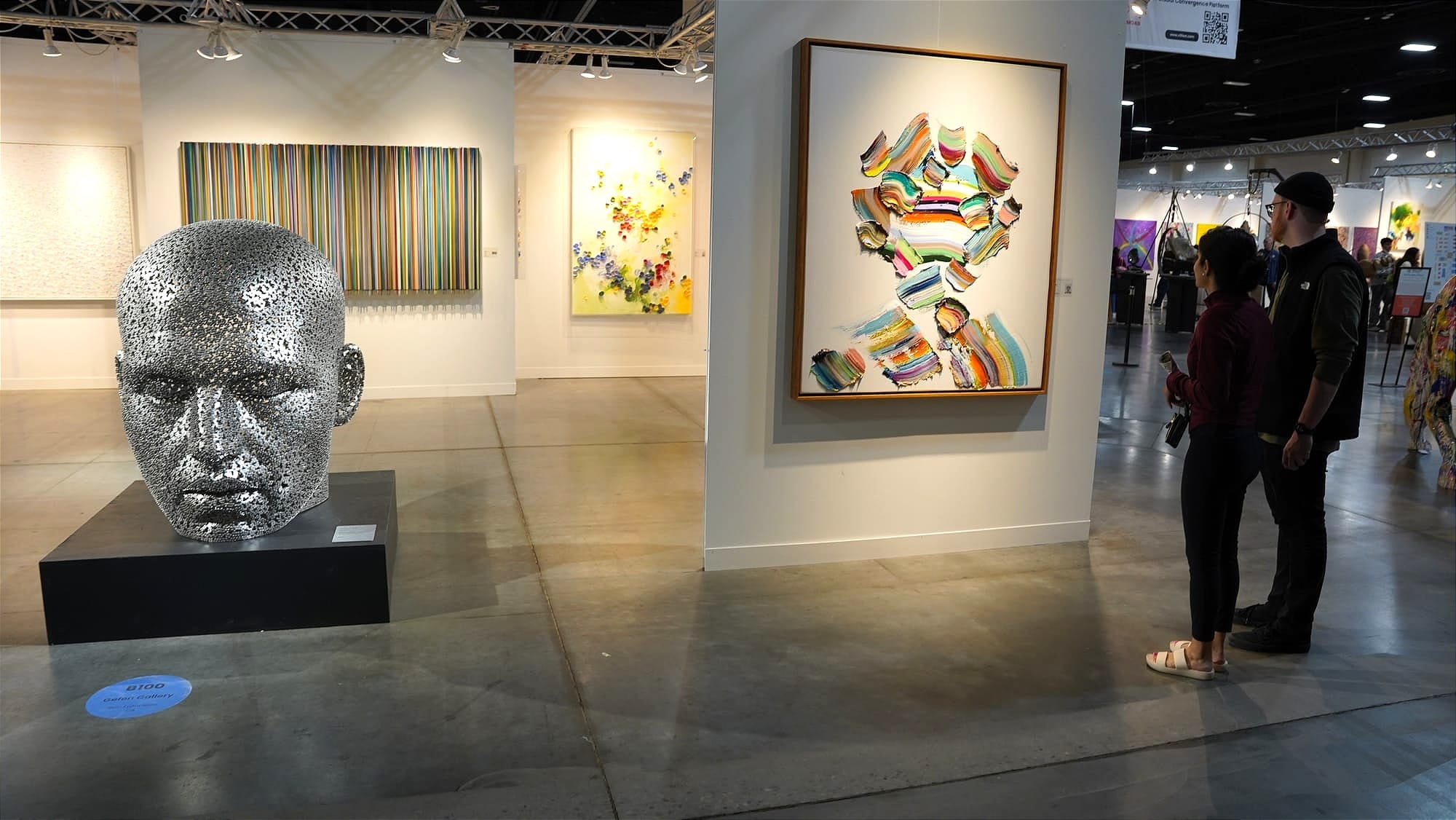
A couple pauses before a wall of vibrant, large-scale paintings near the entrance of the multiple exhibits while a monumental perforated steel head commands the floor. The Salt Lake Art Show brought together work across every scale and medium, from intimate canvases to sculpture that stopped foot traffic cold.
From West Valley to Amsterdam: Erik Jensen
Not every artist at the Salt Lake Art Show traveled far to get there. Erik Jensen grew up in West Valley City — still living, he noted with a laugh, in the home his grandfather built. Today he travels the world selling fine art. The bridge between those two facts is a pile of old computer keyboards.
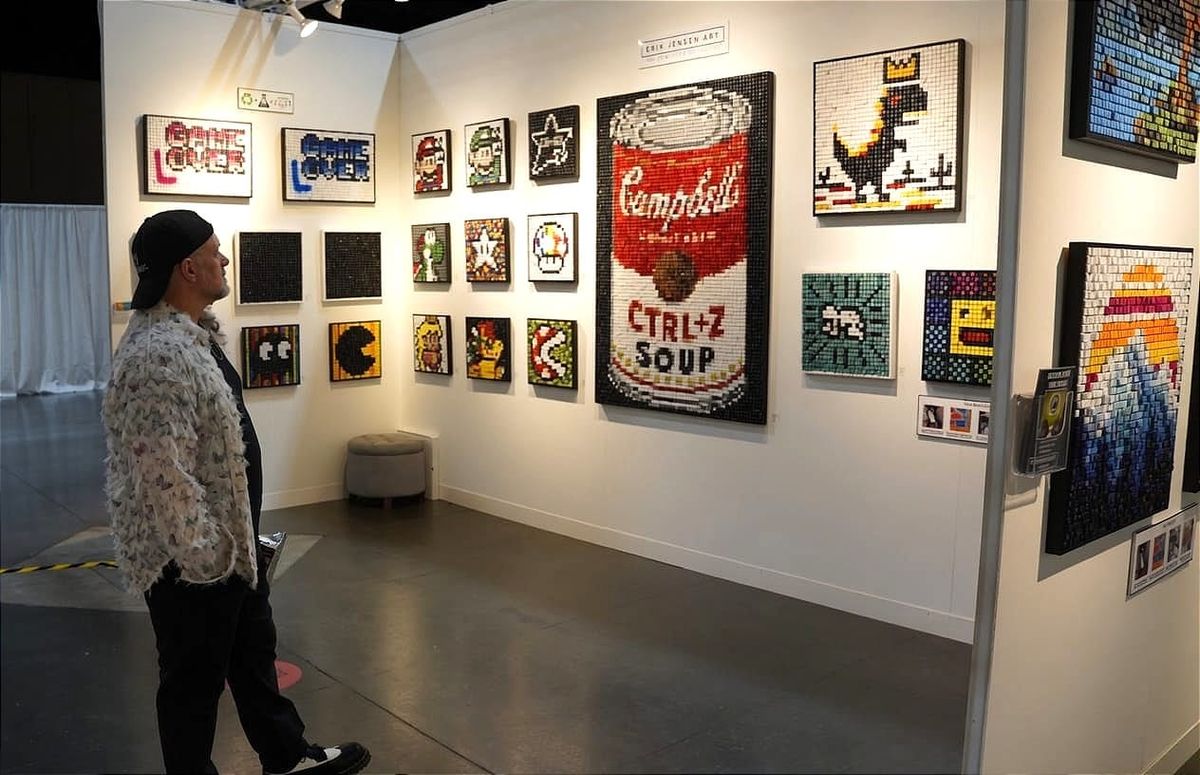
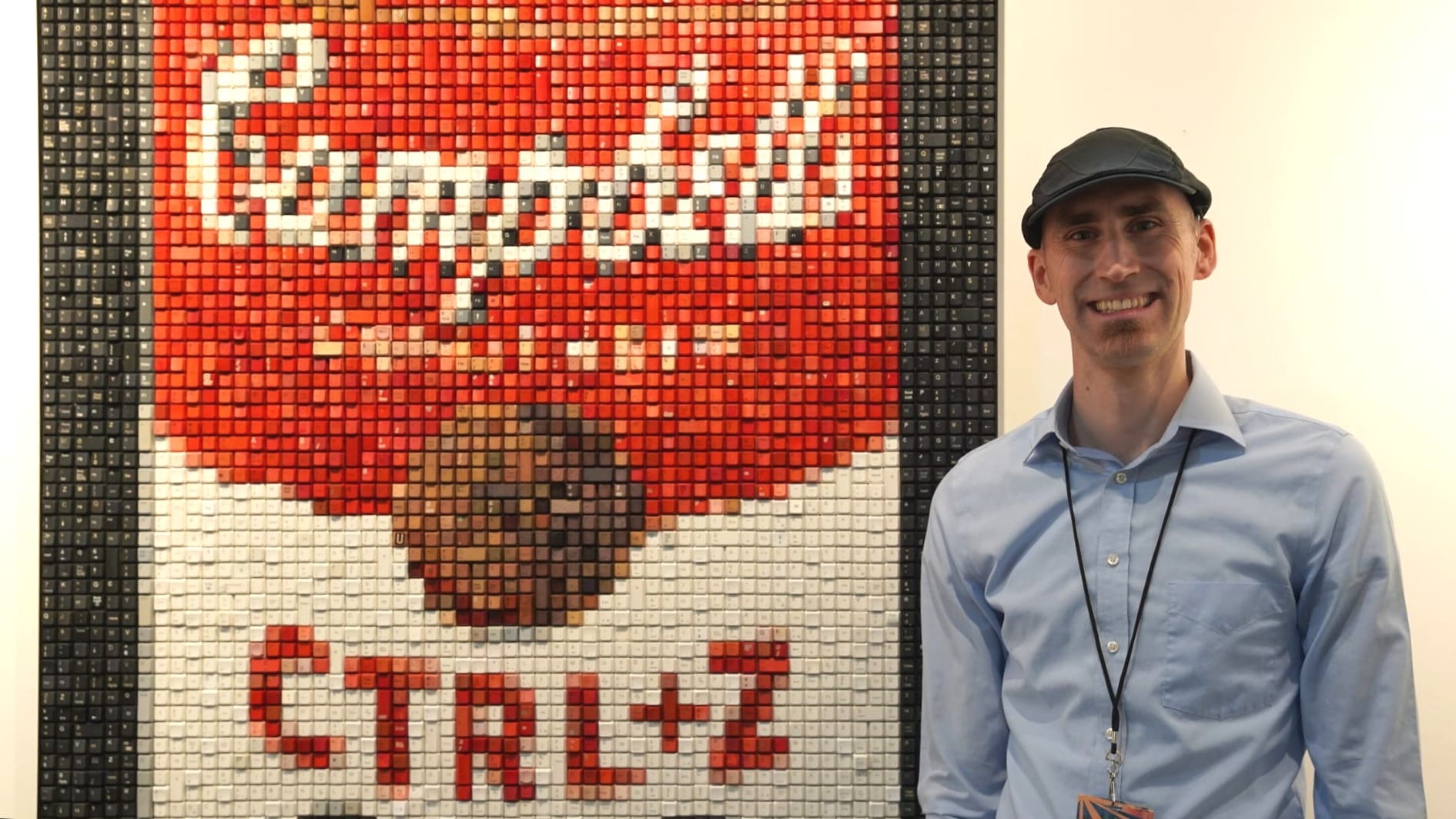
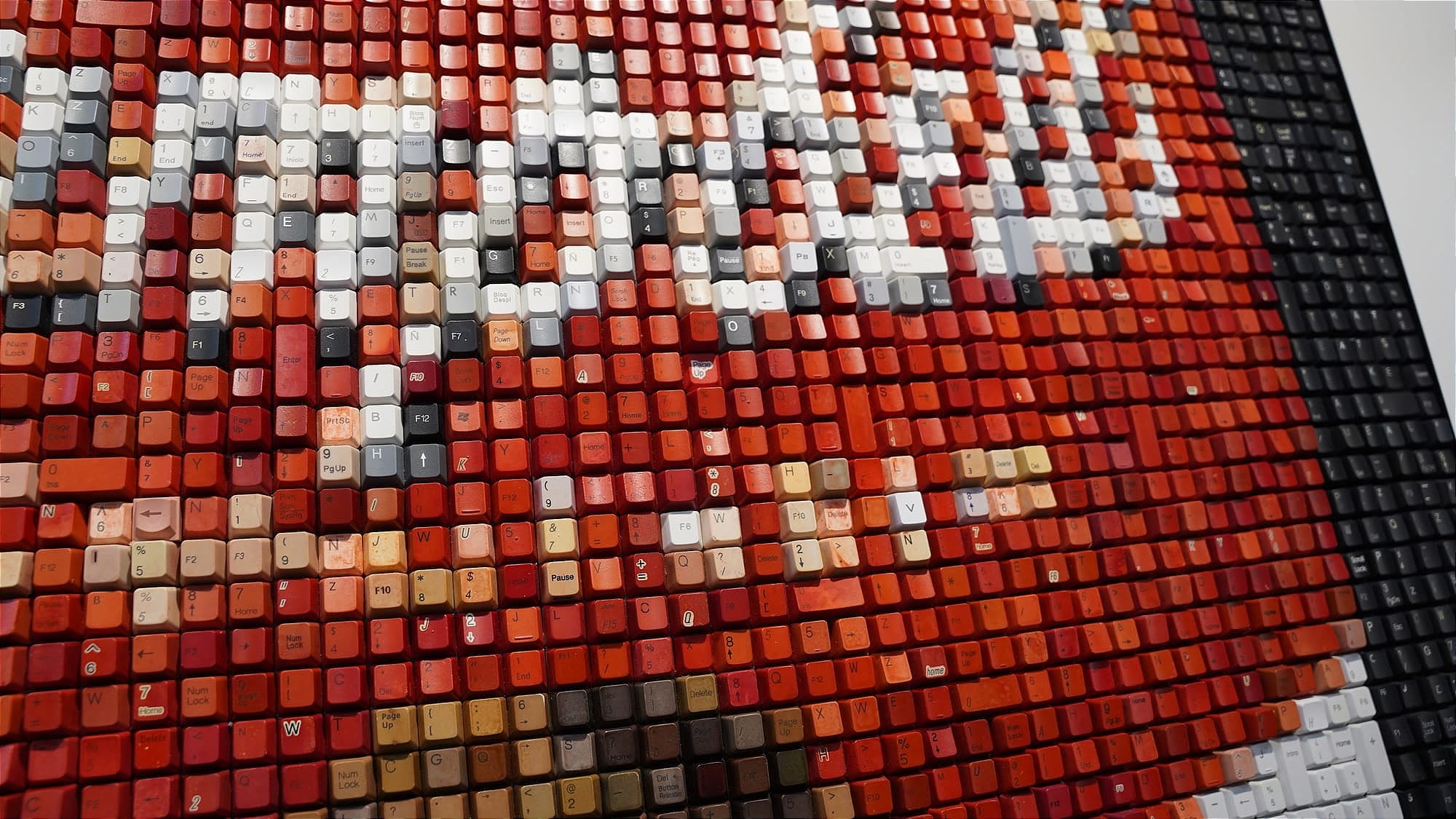
Jensen is the founder of Erik Jensen Art, and his work is made entirely from recycled keyboard keys. Not decorative keyboard-themed art, but actual keys, sourced in bulk, sorted by color, and painstakingly arranged into portraits and compositions that reward a close look. Hidden within many pieces are words and messages, legible only to viewers who lean in.
Erik Jensen of West Valley City stands beside one of his keyboard-key works at the Salt Lake Art Show. The piece — a Campbell's Soup can rendered entirely in recycled keyboard keys — nods to Warhol while hiding Jensen's signature secret: look closely and hidden words emerge from the mosaic of keys.
"They're all recycled keyboard keys," Jensen explained, standing next to one of his pieces at the show. "Mostly from the '90s. And there are hidden messages, words worked into the art that most people don't notice at first."
The color palette is where Jensen's process gets particularly inventive. Black keys are plentiful, he said, but the beige, white, and gray keys from older machines are what he's always hunting for. The tan keys of the 1990s — once aesthetically unappealing — become highly desirable raw material for his color work. Jensen spent roughly a year researching plastics and chemistry before developing a soaking-and-dyeing process that transforms those drab keys into rich, varied hues. The longer they soak, the darker they get; pull them early for lighter tones.
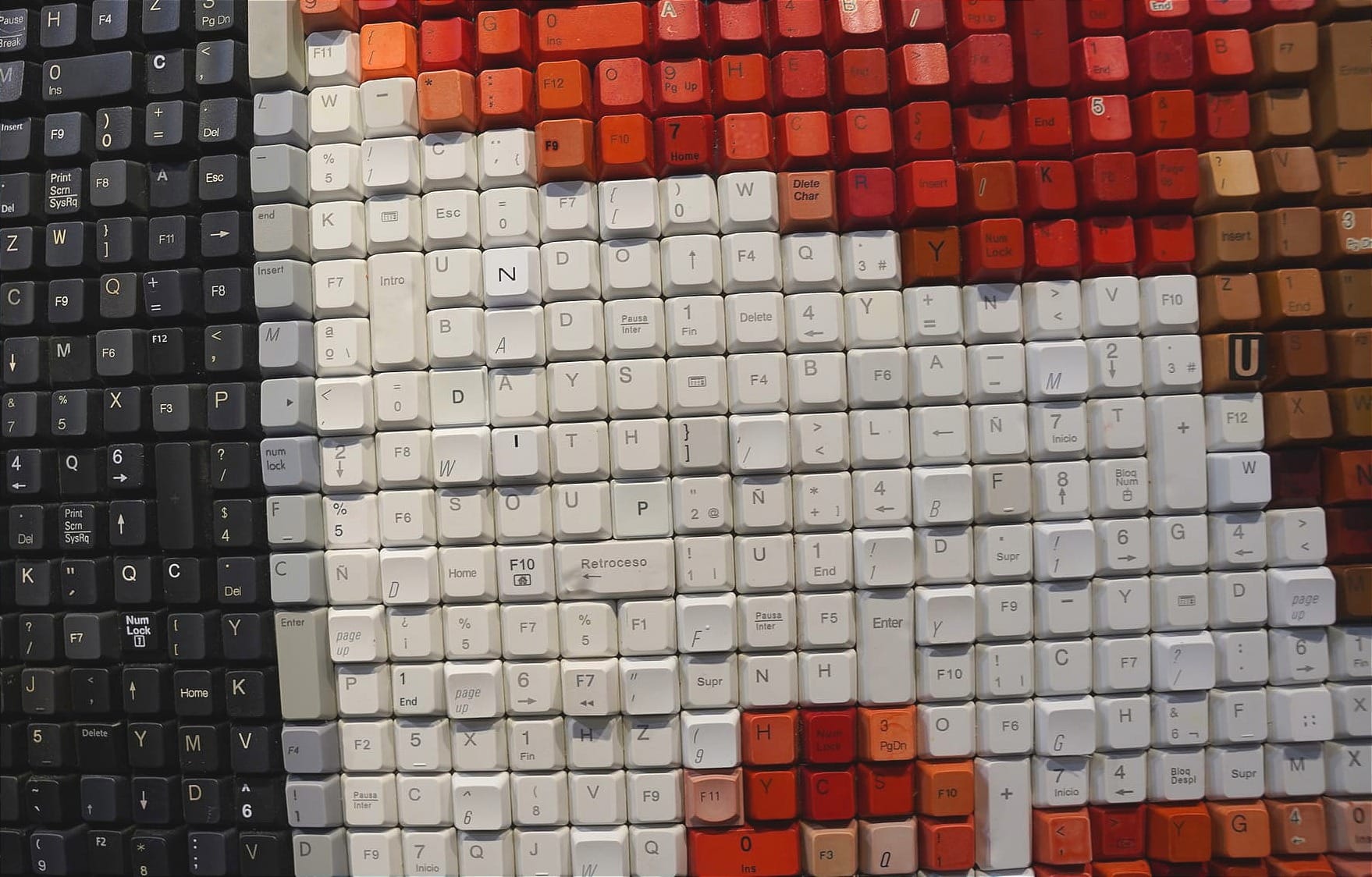
The hidden messages are the signature touch. Worked into the mosaic of thousands of individual keys, words reveal themselves only to viewers who lean in — a reward for the patient eye, and a reminder that Jensen's medium was once itself a tool for communication.
"That's my trade secret — the coloring," he said with a grin.
The idea came from a college assignment: take something people no longer want and make it into something again. Jensen grabbed a discarded keyboard and fashioned a small face. His professor's reaction — "that's so cool, you have to do more" — sent him down a research rabbit hole. He discovered that practically nobody was recycling keyboards, and certainly nobody was making fine art from them. He saw the opening and took it.
That was about eleven years ago. Jensen spent five years as a high school art teacher before leaving to pursue his work full time eight years ago. The gamble paid off. He has since converted 1.4 million individual keys into artwork, sold pieces to collectors in 35 U.S. states and 16 countries, and counts the tech industry among his biggest buyers — fitting, perhaps, for art made from the tools of the trade.
Every key tells a story. Jensen sources keyboards primarily from the 1990s, dyeing the beige and tan keys through a proprietary process he spent nearly a year developing. The result is a palette that ranges from deep reds to creamy whites, achieved not with paint, but with plastic and chemistry.
"Most of my stuff ends up in tech," he said.
Just before the Salt Lake show, Jensen returned from Amsterdam, where he completed a commissioned piece for Logitech at their European offices. He was heading to New York for another major show the following Tuesday.
Not bad for a kid from West Valley.
Where Every Bead Is a Mountain: Mosgaadace Casuse
Not every artist at the Salt Lake Art Show brought work that could be called sacred. Mosgaadace Casuse did.
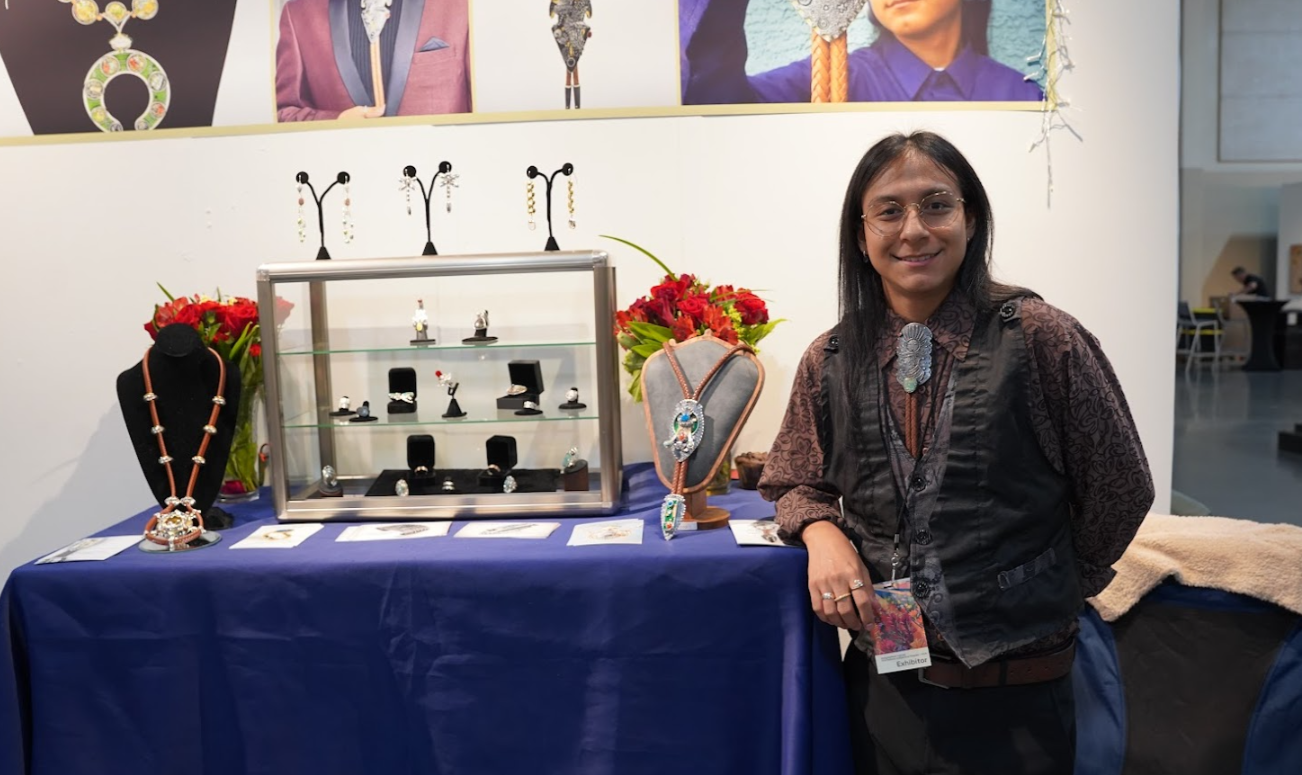
Casuse, who is of Navajo (Dene) and Ojibwe (Anishinaabe) heritage, grew up in Santa Fe and now splits his time between there and Phoenix. He has been making art in the most literal sense since he was five years old, when his mother and father first sat him down to learn lapidary and jewelry-making. Two small pieces on his table at the show were from that period. Made using tufa casting with sterling silver, they were among the last two works he still has from childhood.
Mosgaadace Casuse at his booth at the Salt Lake Art Show, wearing one of his own bolo ties. Of Navajo (Dene) and Ojibwe (Anishinaabe) heritage, Casuse has been making jewelry since the age of five, taught by both parents. Find him on Instagram at @mastermukwa.
"My mom and my dad taught me jewelry when I was five years old," he said. "I started with lapidary and painting."
Tufa casting is a technique primarily practiced by Navajo artists. The artist carves a design into soft tufa stone — a porous volcanic rock — then pours molten silver directly into the mold. The result carries a distinctive organic texture impossible to replicate by other means. Casuse's work is represented at Malouf on the Plaza, with locations in Santa Fe and New York, as well as through Four Winds Gallery on consignment. His Instagram handle is @mastermukwa.
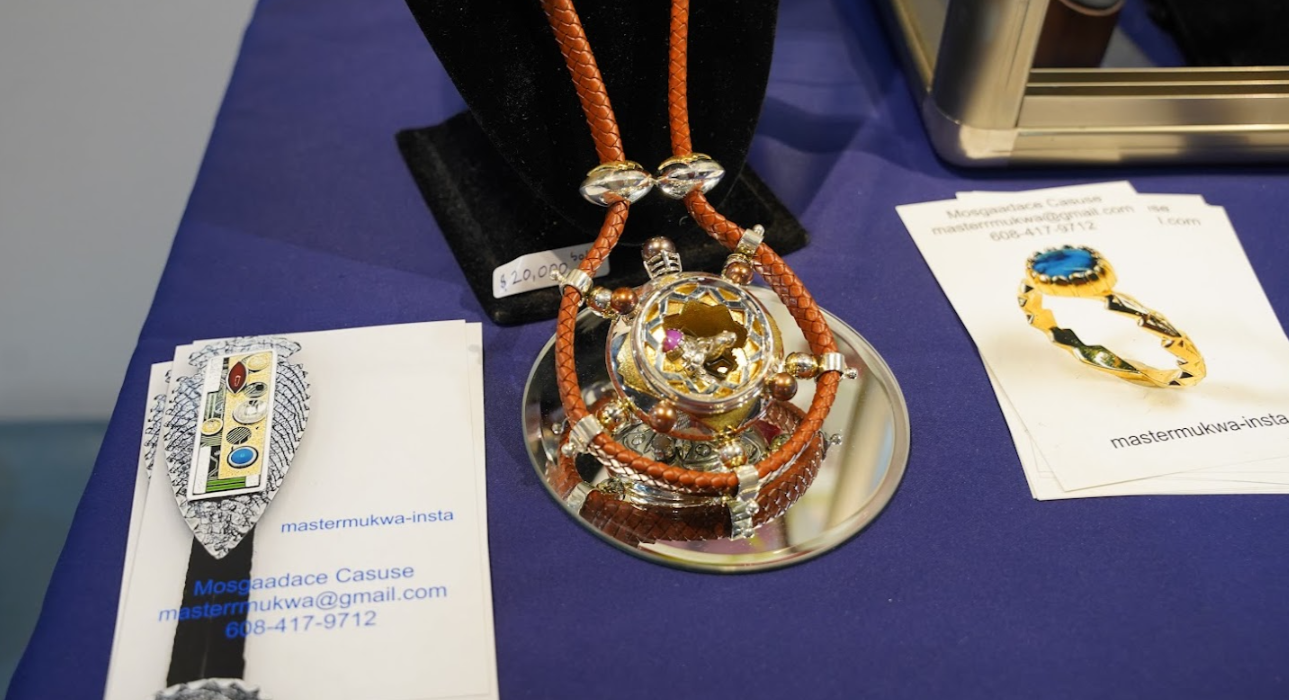
Mosgaadace Casuse's table at the Salt Lake Art Show, anchored by an extraordinary $20,000 pendant — a complex spherical piece in silver, gold, and braided leather. The range of work on this single table spans traditional Navajo tufa casting, Anishinaabe-influenced metal smithing, and wholly original innovations that defy easy categorization.
But the piece that stopped visitors in their tracks was one he did not make alone.
Casuse described a beadwork and silversmithing piece created together with his mother and father as a family work. It carries an oral story: long ago, a turtle came and took the songs from the Native people. As he walked away into the mountains, he left them with a message — when you learn silence, I will return song. The piece traces that journey. Each bead represents one of the mountains of North America, moving southward until arriving at the Four Corners region of the Navajo nation. Hidden inside, worked into a silver band, are those words: when you learn silence, I will return song.
"As our people travel through each mountain, trying to find the turtle and find our songs, we learn to be silent with the land," Casuse said.
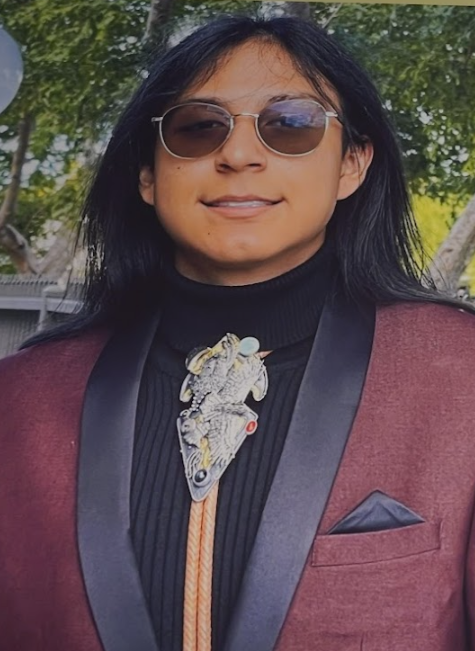
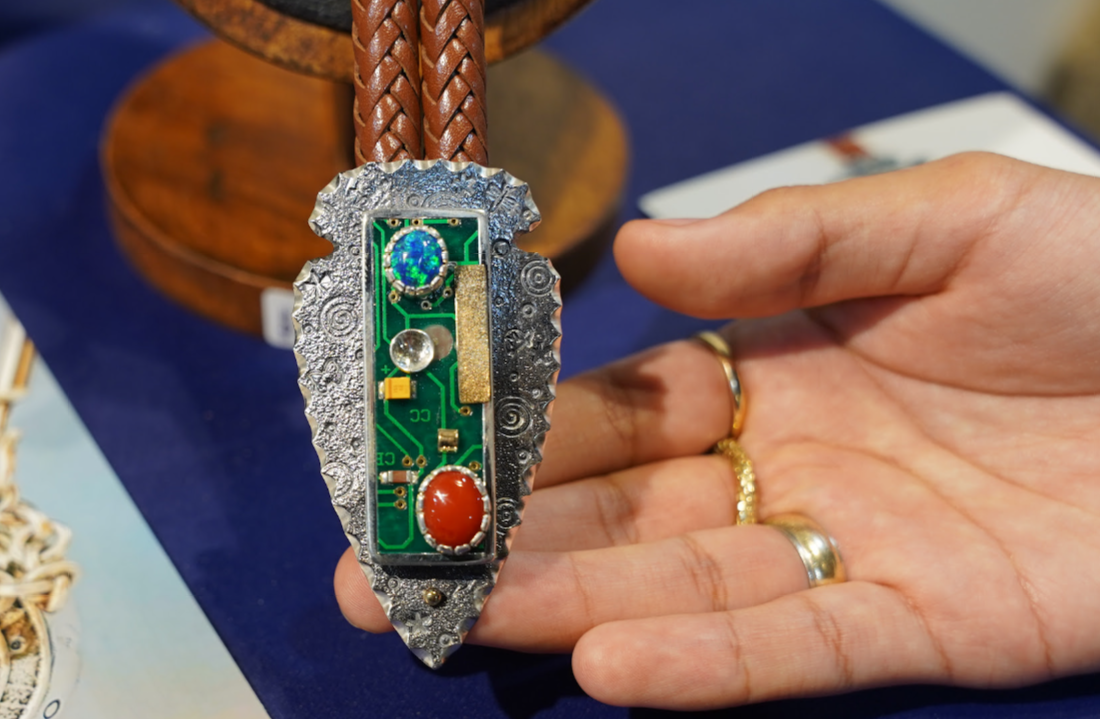
Mosgaadace Casuse, whose Navajo and Anishinaabe heritage infuses every piece he creates, wears one of his signature bolo ties — a hand-cast sterling silver arrowhead piece incorporating stone and intricate surface work. Casuse has been making jewelry since age five, taught by both parents, and today his work reaches collectors in sixteen countries.
Another piece carried a different ceremony: the Night's Way, observed in early winter for elders. Casuse rendered it in a progression of color: blue sky giving way to coral, then to the deepening dark of night, anchored finally by a black star sapphire. A week after Malouf on the Plaza purchased that piece, a visitor from London acquired it and brought it to a museum there.
Casuse also showed bowl ties incorporating something unexpected: circuit boards. That innovation traces directly to his mother, who is Anishinaabe from the Great Lakes region of Minnesota. The Anishinaabe people traditionally work with birch bark, using it for canoes, dwellings, and intricate artwork. His mother was a pioneer in translating those birch bark techniques into metal smithing. Casuse adapted the same methods to incorporate circuit boards, creating a conversation between ancient material culture and the present.
The convergence of ancient and modern in a single object: a bolo tie by Mosgaadace Casuse set in a hand-cast sterling silver arrowhead, with a functioning circuit board inlaid alongside an opal and coral stone. Casuse adapted the circuit board technique from his mother, an Anishinaabe artist from Minnesota who pioneered the use of birch bark methods in metal smithing. The result is jewelry that belongs to two worlds simultaneously.
"She was the first person to innovate that and bring it into metal smithing," he said. "I use those techniques for circuit boards."
Clinton Lesh makes art built to survive a crowd. Literally.
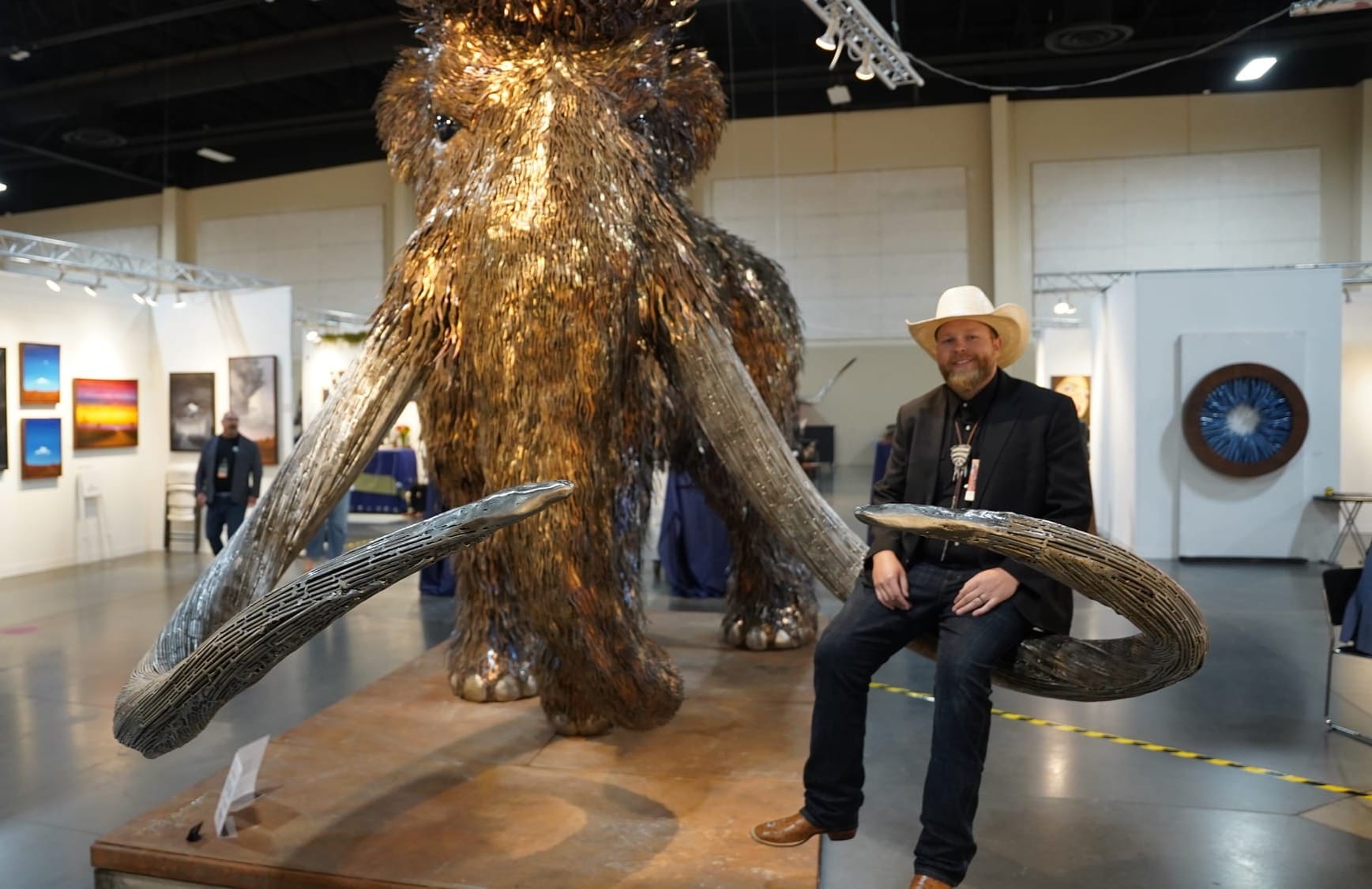
The Bozeman, Montana sculptor brought a life-sized stainless steel woolly mammoth to the Salt Lake Art Show. It is the same piece he debuted at Burning Man last year, where festival-goers climbed on it, sat on it, and posed with it across the alkaline flats of the Nevada desert. It held up fine.
"We got some good pictures of people sitting on it," Lesh said with a laugh.
The mammoth was a Burning Man grant project, conceived around last year's festival theme of futuristic technology. Where other artists went predictably forward — robots, spaceships, chrome abstractions — Lesh went the other direction, into deep time.
Clinton Lesh of Bozeman, Montana, takes a seat on the tusk of his life-sized woolly mammoth at the Salt Lake Art Show. The massive sculpture, fabricated entirely from stainless steel and heat-treated to produce its golden, shimmering coat, stands as both a technical feat and a conceptual provocation: the mammoth is simultaneously the most ancient and most futuristic animal in the room. Lesh debuted the piece at Burning Man under last year's futuristic technology theme. It was, by all accounts, the hit of the show.
"I looked into the past, at dinosaurs and ice age animals," he explained. "And I found out they are cloning the mammoths. So they're a futuristic animal; they're just not here right now."
It's a sharp conceptual hook. Colossal Biosciences and other biotech firms are working to resurrect the woolly mammoth by splicing its genes into Asian elephant embryos. Lesh saw that and recognized a sculpture waiting to be made.
The execution is as impressive as the concept. The piece is fabricated entirely from stainless steel, then heat-treated to produce its warm, otherworldly coloring. Stainless steel begins turning gold at around 600 degrees, Lesh explained. Keep heating, and it shifts through amber into blue and purple. The result is a surface that looks almost organic, glowing at dusk in a way that plain steel never could. At Burning Man, on the Playa at golden hour, it stopped people in their tracks.
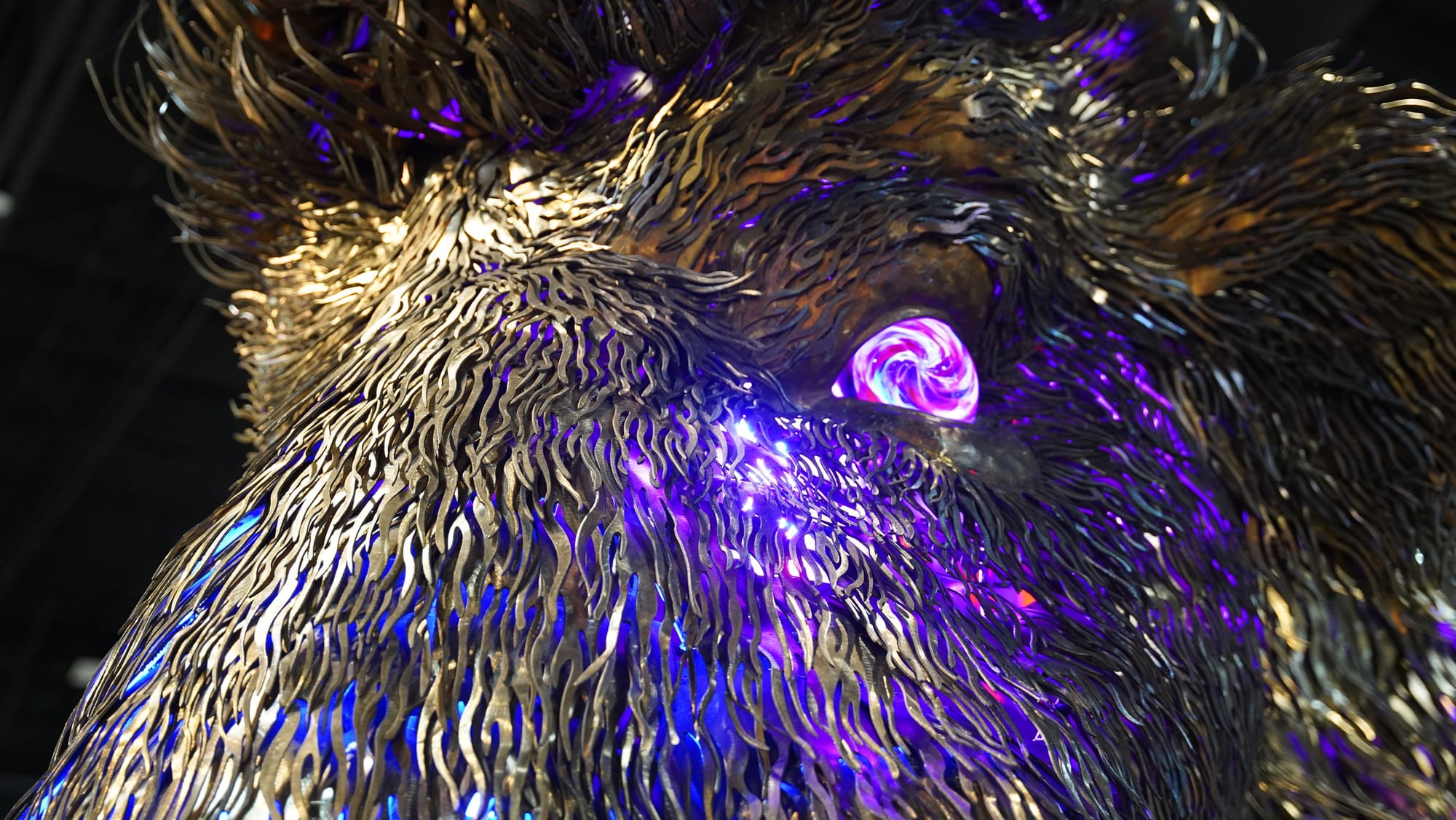
The eyes are hand-blown glass, made by an artisan in Montana, chosen because Lesh wanted them slightly imperfect — realistic rather than pristine.
The hand-blown glass eye of Clinton Lesh's woolly mammoth glows from within, illuminating the heat-treated stainless steel "fur" that surrounds it in waves of hammered metal. At Burning Man on the Nevada Playa at dusk, this is what stopped people in their tracks. Up close, the effect is equally arresting — ancient creature, modern craft, lit from the inside like something just waking up.
The mammoth is not his only large-scale festival piece. The year before, he brought a giant wolf sculpture to Burning Man. He applied for a grant this year with a proposed 15-foot Pegasus. His work has also traveled to the Loveland Sculpture in the Park show in Colorado, billed as the largest outdoor sculpture show in America.
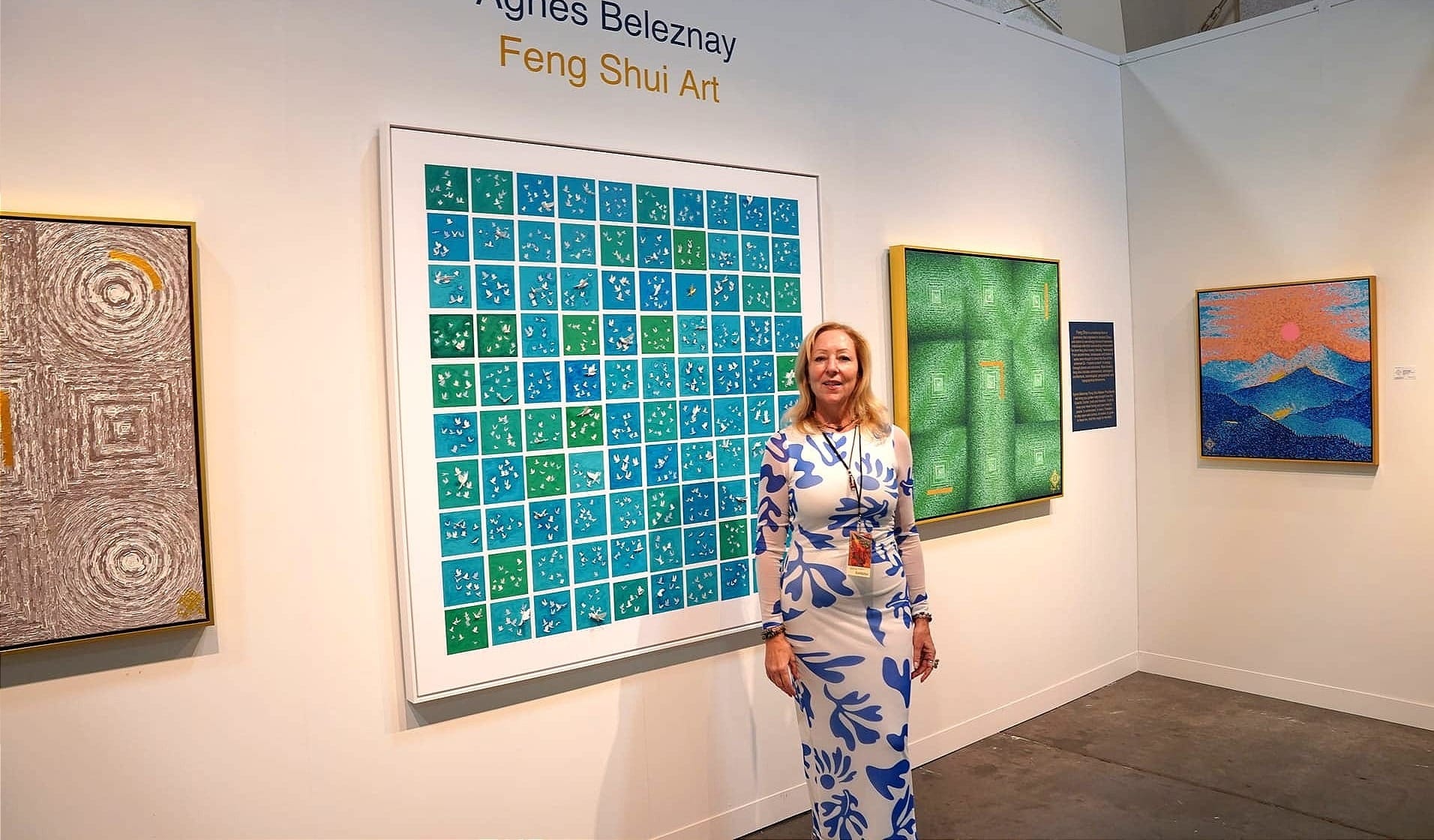
Agnes Beleznay, an artist from Florida, originally from Budapest, Hungary, brought a unique perspective to the Salt Lake Art Show: thirty years as a Feng Shui consultant, trained by master practitioners in Hong Kong, recently translated into visual art. Her paintings are designed to facilitate positive energy flow in spaces — a natural extension of her consulting practice. It was her first time exhibiting in Salt Lake City, and a very successful one: she arrived with 200 business cards and left with 13. Between show days she squeezed in throwing snowballs in May at Snowbird and hiking Ensign Peak — firsts for this Floridian.
A Vision Bigger Than the Show
Walking the floor of the Salt Lake Art Show, past keyboard-key portraits, beaded oral histories, heat-patinated steel, it was easy to see what X5's founders are reaching for. The artists who came to Sandy that weekend were not an afterthought to the platform's technology and capital ambitions. They were, as Steenhoek put it, the foundation.
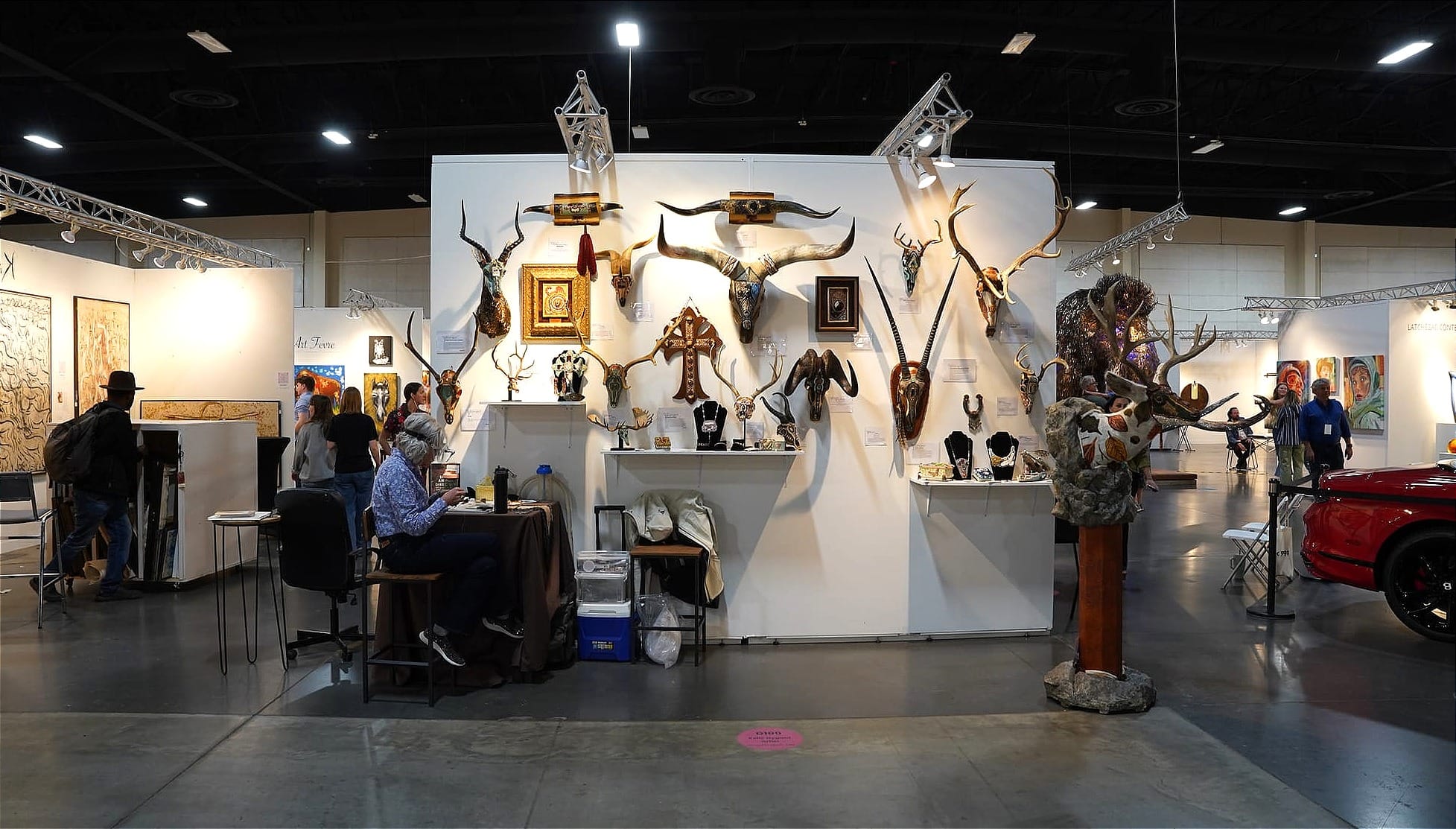
Longhorn skulls, antlers, ornate crosses, and intricately decorated animal mounts fill one of the show's more dramatically staged booths, evoking the American West in full. The Salt Lake Art Show drew artists working across a wide range of traditions — contemporary, Indigenous, Western, and everything in between.
The building that hosted the X5 launch party the night before the show opened tells a version of the same story. The B'nai Israel Temple was built in 1891 by early Utahns who wanted to create something lasting, a community institution that would outlive its founders, adapt to new purposes, and remain standing long after the circumstances of its creation had changed. It has done exactly that.
X5 is making a similar bet. The silhouettes drawn on those museum walls that Thursday evening will eventually be painted over, invisible beneath whatever the Salt Lake Art Museum becomes. But they will still be there, an early layer, a founding mark, a reminder that something began here.
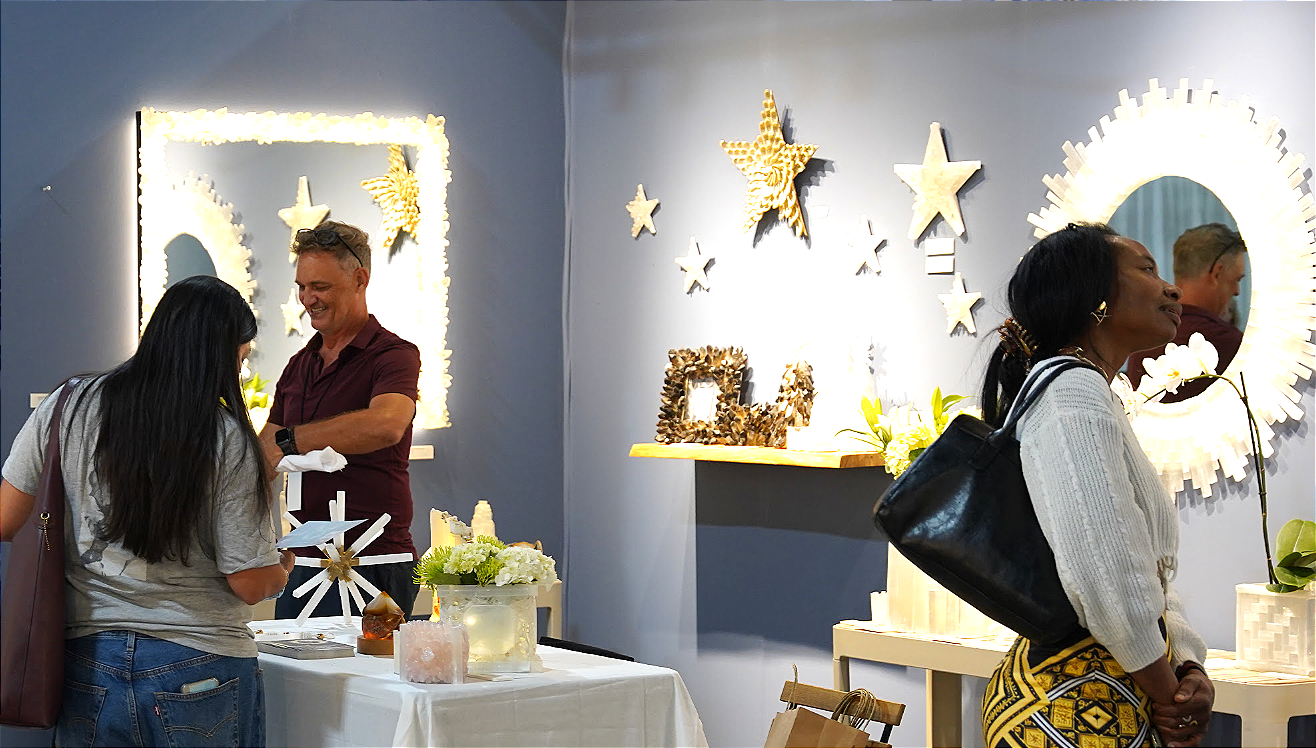
Moments like these — artist and collector in direct conversation — were exactly what Kevin O'Keefe, Briana Dolan, and the X5 organizers envisioned when they put creators at the center of the platform.
"We don't want to create unicorns," Steenhoek said that night. "We want to create supernovas."
The art show that followed suggested they might be onto something.
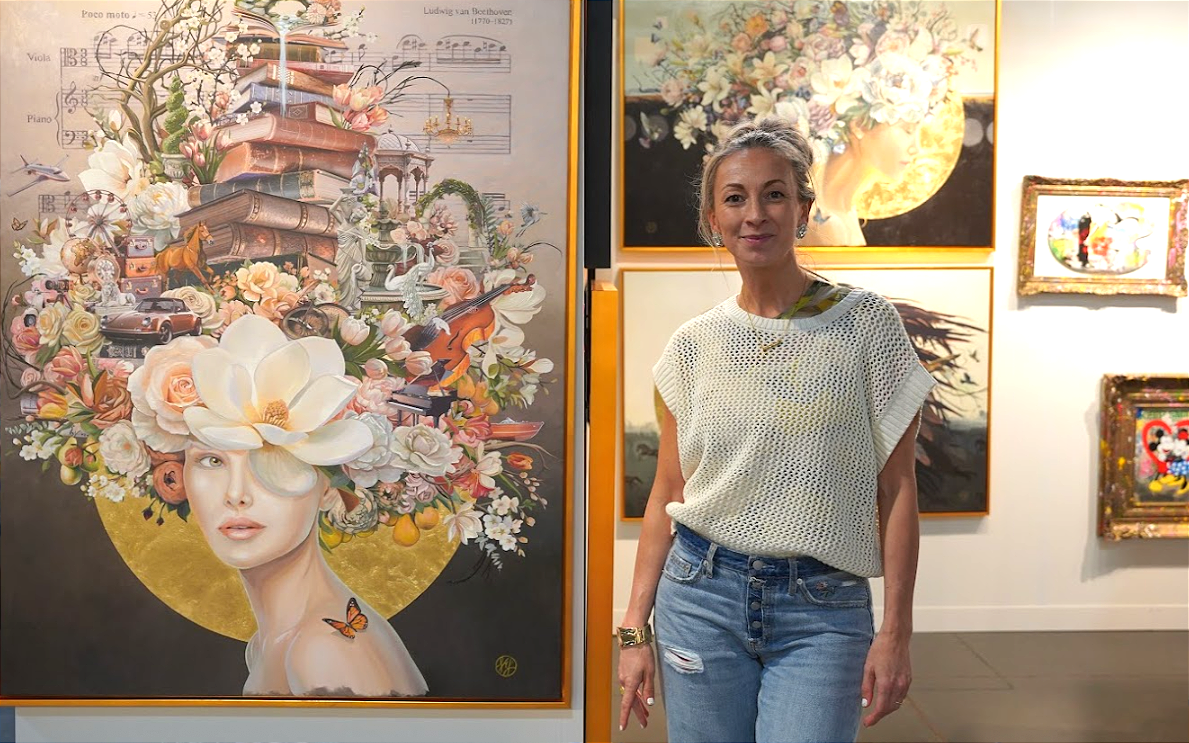
Contemporary oil painter Lindsey Erin stands beside one of her signature works at the Salt Lake Art Show. Represented by Park City Fine Art on Main Street in Park City, Erin's meditative painting process draws on the idea that "we all have a story to tell," with figures surrounded by colorful flora and fauna to evoke themes of growth, reflection, and human potential. The large-scale piece behind her, set against Beethoven sheet music, is a vivid example of her fusion of classical technique and symbolic storytelling. Erin told TechBuzz the Salt Lake Art Show was a fantastic networking experience.The X5 banner at the Salt Lake Art Show maps the platform's ambition across the state of Utah — from Ogden in the north to St. George and Moab in the south, with Salt Lake City, Park City, Sandy, and Provo at its core. The banner announces the next milestone: a full Global Convergence Platform event in Fall 2027. More at www.x5fest.com.
Share this article
The link has been copied!
Your link has expired. Please request a new one.
Your link has expired. Please request a new one.
Your link has expired. Please request a new one.
Great! You've successfully signed up.
Great! You've successfully signed up.
Welcome back! You've successfully signed in.
Success! You now have access to additional content.