"We're Not Being Replaced. We're Being Subordinated."
The final plenary session of the American Causal Inference Conference tackled the question everyone in AI is asking. Then a UVU professor, Dr. Brian Knaeble, convened a meeting of a smaller group of Utahns to figure out what the answer meant for them.
What the World's Top Causal Researchers Said in Salt Lake City — and What Utah Plans to Do About It
Salt Lake City, Utah — May 15, 2026
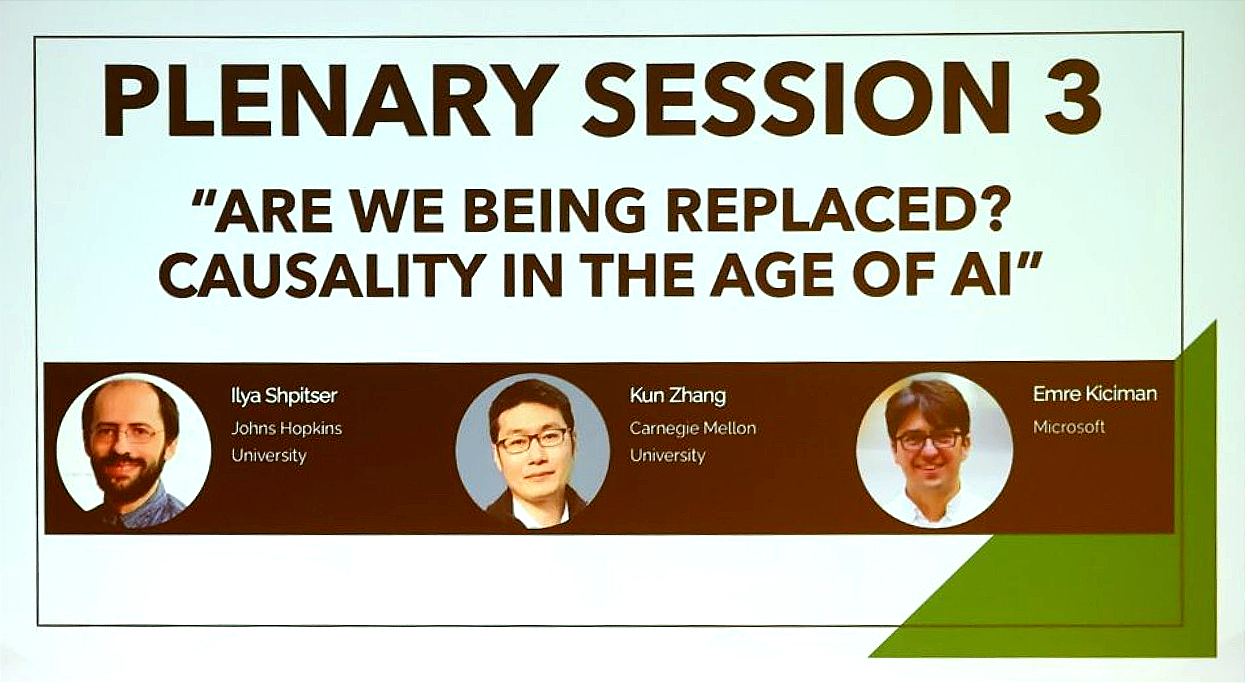
The last major session of the 2026 American Causal Inference Conference was titled "Are We Being Replaced? Causality in the Age of AI." It ran Thursday morning in Salon E-F of the Salt Lake City Creek Marriott, and by the time it ended, the audience had heard three very different answers to that question from three of the field's leading researchers.
Then a UVU professor, Dr. Brian Knaeble, held a meeting for a group of Utahns to figure out what the conference meant for them.
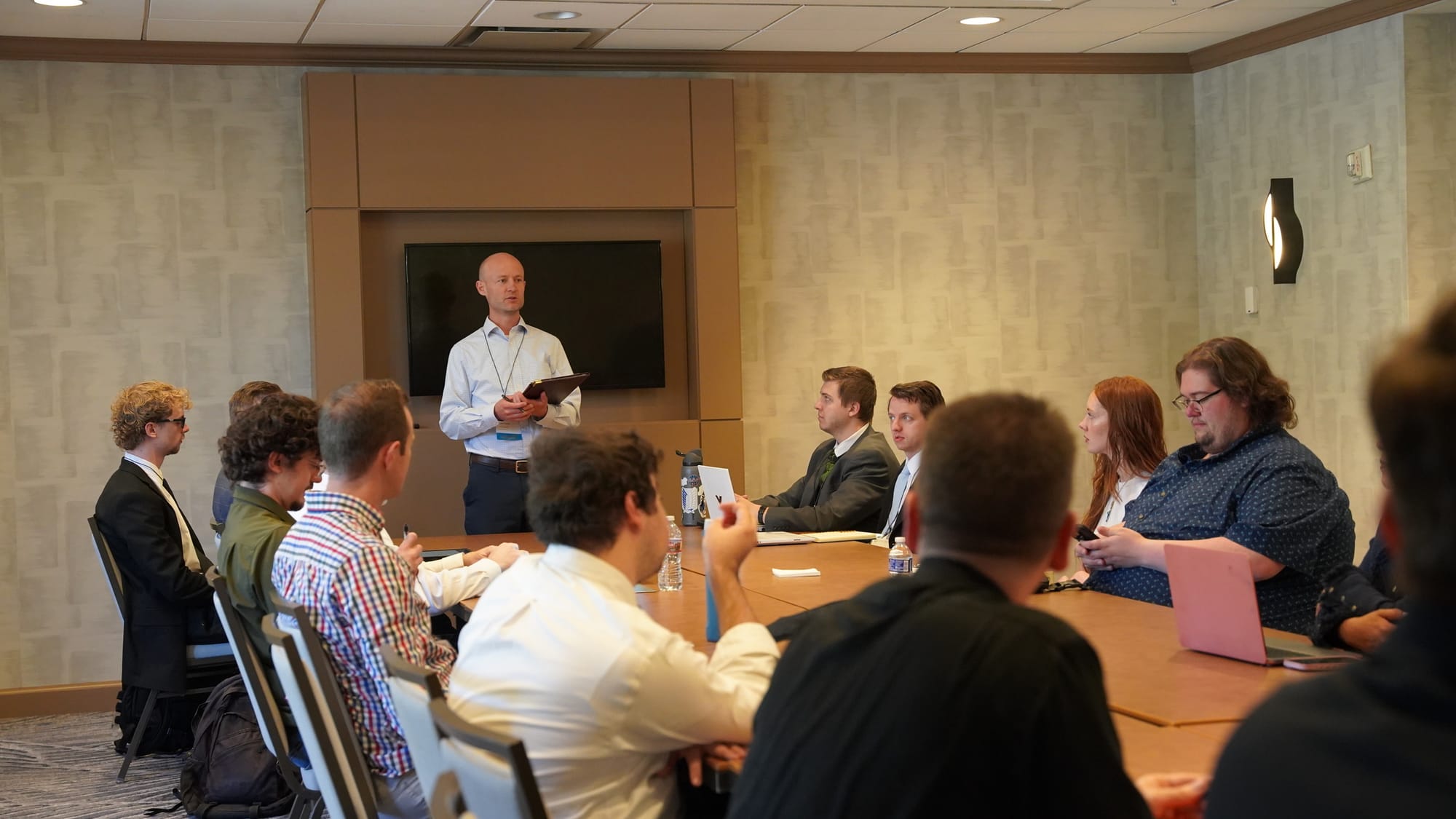
Knaeble, UVU professor of computer science and president-elect of the Society for Causal Inference (SCI), opened a free networking session he had organized for Utah's broader tech and data science community. Graduate students sat next to working engineers. A health IT specialist described a feedback loop problem in EMS care. A recent data science grad wondered aloud how to bring what he'd just learned back to his company. A UVU undergraduate asked where to even begin. A BYU team showed up to weigh in and share their perspectives.
It was a sincere conversation: people without tenure or speaking slots trying to figure out what four days of doctoral-level mathematics actually meant for them.
What had just happened in the final plenary session was worth understanding.
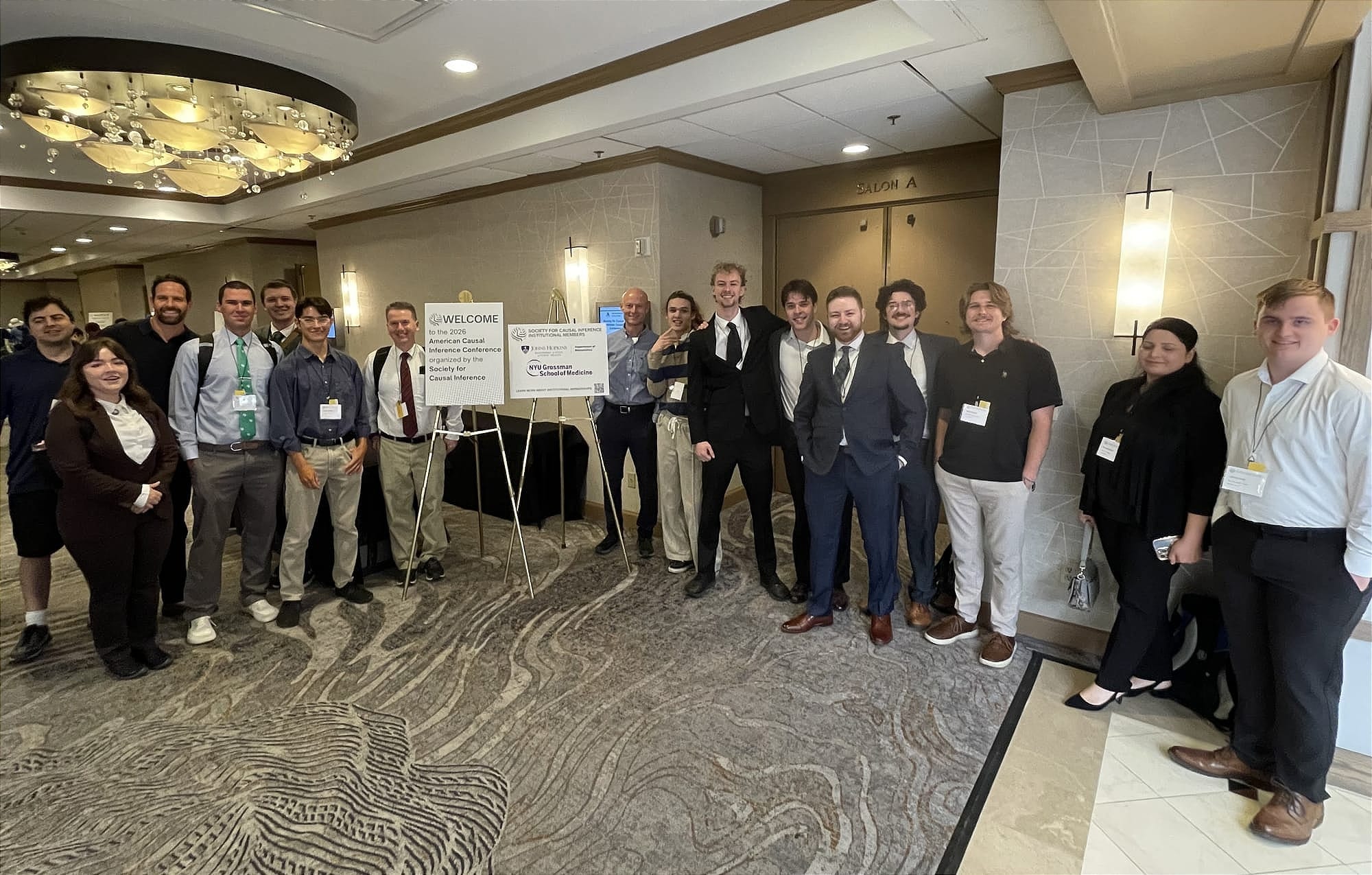
Dr. Brian Knaeble and a group of UVU students attending the 2026 American Causal Inference Conference, City Creek Marriott, downtown Salt Lake City, May 2026 Photo: Brian Knaeble
What Is Causal Inference
Causal inference, the focus of the conference, is the process of determining whether and to what extent an action causes a specific outcome. It goes beyond standard statistics and correlation, aiming to answer "what if" questions and isolate cause and effect in complex systems. The distinction matters most when organizations have to decide between options rather than simply predict an outcome.
"If you're wanting to make a decision on whether to do X or not, causal inference can help," one meetup attendee told the group. "A lot of machine learning has become very, very good at forecasting and predicting. When the question turns into a 'what if' question — like 'what would happen if we double the cost of our product?' — that question becomes a causal inference problem."
The field is growing fast. Knaeble said UVU's course enrollment tells the story plainly: "UVU had zero causal inference students a few years ago. Now we've got three or four sections of the course. It just keeps exploding."
Three Researchers, Three Answers
Moderator Rohit Bhattacharya of Williams College, a former PhD student of one of the panelists, now an assistant professor, opened the session with a challenge. Before worrying about whether AI will replace us, he said, it's worth asking what we even mean when we say AI "solved" a problem. He described two researchers who had recently used LLMs in wildly different ways: one to prove a mathematical lower bound, another simply to get a book recommendation that led to a solution. Both called it AI assistance. Neither experience was the same.
He also noted who, precisely, is most worried about replacement. Not the tenured faculty in the room. It's younger people — undergraduates staring down a job market being reshaped faster than any curriculum can adapt. He cited a commencement speaker at the University of Central Florida who called AI the defining tech revolution of the generation. The crowd booed. When she referenced a time before AI, they applauded.
That detail set the emotional temperature for everything that followed.
Emre Kiciman: More Problems, Not Fewer
Emre Kiciman, Partner Research Manager at Microsoft, opened with an argument that was deliberately optimistic. AI isn't narrowing the scope of causal work, he said. It's expanding it into territory the field has never reached before.
Emre Kiciman, Partner Research Manager, Microsoft Photo: Joseph Jorgensen
His central insight: enormous amounts of human reasoning are implicitly causal but have never been treated that way. Business strategy documents, policy impact assessments, legal briefs, financial analyses — all of these make causal claims. They assert that X caused Y, that a policy change will produce a specific outcome, that a trend will continue because of identifiable forces. And all of them make the same kinds of errors that formal causal analysis is designed to catch: missing confounders, implicit assumptions left unexamined, competing hypotheses evaluated by instinct rather than rigorously.
Kiciman's team has been developing tools that apply causal methods to these narrative documents. The process extracts an implied causal graph from the text, critiques it for structural problems, and then runs simulations — using LLMs to fill in values — to test how sensitive the document's central claims are to what it left out.
He demonstrated the approach using a financial podcast in which an analyst argued that AI infrastructure investment is fundamentally demand-driven and sustainable. When his team pulled in outside sources, they found significant pathways the analyst had ignored — financial fragility from bank lending, rapid hardware obsolescence, structural risks to the investment thesis — that measurably shifted the range of likely outcomes.
"I'm not worried about AI replacing this anytime soon," Kiciman said. "I think it's more expanding our scope and the places where the work we do can be applied."
Kun Zhang: AI Needs Causality to Grow Up
Kun Zhang, who holds appointments at Carnegie Mellon University and the Mohamed Bin Zayed University of Artificial Intelligence, agreed that causal methods can strengthen AI. However, his argument ran just as forcefully in the other direction. AI, as currently built, has deep structural problems that only causal thinking can fix.
He opened with a demonstration that landed immediately. Ask a leading image-generation model to produce "a peacock eating ice cream," and you get something that fails in revealing ways: beautiful peacocks with no ice cream, or the two elements awkwardly forced together. The models know peacocks. They know ice cream. What they cannot reliably do is combine concepts they haven't seen combined, because they've learned to map inputs to outputs rather than to reason about how things relate at the level of underlying structure.
Image from slide presentation provided by Dr. Kun Zhang, Carnegie Mellon University
The controllability problem is related. Zhang showed a leading AI image tool being asked to add a mustache to a generated face: the mustache doesn't appear, or the entire face changes. Asked to make a smiling girl in a garden look surprised: the expression shifts but so does her hair, her clothing, the scene's lighting. These aren't aesthetic glitches. They reveal something structural. Current models cannot isolate an intervention on one variable while holding others fixed, because they have no explicit representation of which features are causally independent of which others.
Zhang's lab has developed approaches built on causal representation learning that address exactly this — decomposing images and text into structured, independent concepts and learning the relationships between them, rather than brute-force mapping prompt to pixel. The results, which he demonstrated side by side against leading commercial models, showed his method changing precisely what the user asked to change while leaving everything else intact.
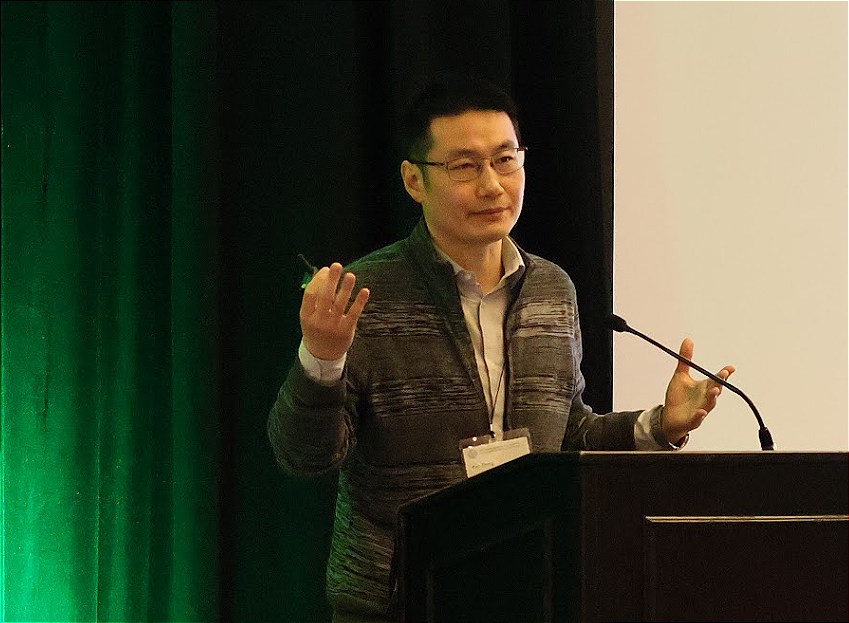
Kun Zhang, PhD, Professor, Carnegie Mellon University and Mohamed Bin Zayed University of Artificial Intelligence Photo: Joseph Jorgensen
The deeper point extended from images to society. Zhang presented a structured analysis of AI's likely impact over the next two decades, with hard numbers: 72% of enterprises currently have AI in production, but only 18% report real productivity gains. That 54-point gap between capability deployment and realized value, he argued, is the defining fact of the current moment.
His timeline projects three phases: sharp near-term declines in entry-level hiring and early signs of skill atrophy, followed by a difficult adaptation period in which deeper risks become visible, an expertise pipeline crisis, growing inequality between those who use AI to amplify genuine knowledge and those who simply depend on it. A new equilibrium arrives eventually, but only if we navigate the transition well. Historical technology shifts have typically required 15 to 25 years of adaptation. AI, Zhang warned, may compress that into 5 to 10.
His most pointed warning concerned human cognition. Long-term, he argued, society risks bifurcating: AI-complementary experts who use the technology to amplify deep knowledge, and AI-dependent workers who can no longer function without machine assistance.
"We need to come up with a way to force students and everyone to try to be independent users of AI," Zhang said, "instead of being slaves of AI."
Ilya Shpitser: The Warning Nobody Wanted to Hear
Johns Hopkins' Ilya Shpitser delivered the session's sharpest remarks, and the ones that resonated longest in the Solitude Room afterward. The title he had given his talk was "Living With Blockhead," a reference to a thought experiment in philosophy of mind: a "blockhead" is a hypothetical system that passes every behavioral test for intelligence without any genuine understanding behind it. As a title for what became a pointed argument about AI and institutional power, it was either very dry or very apt.
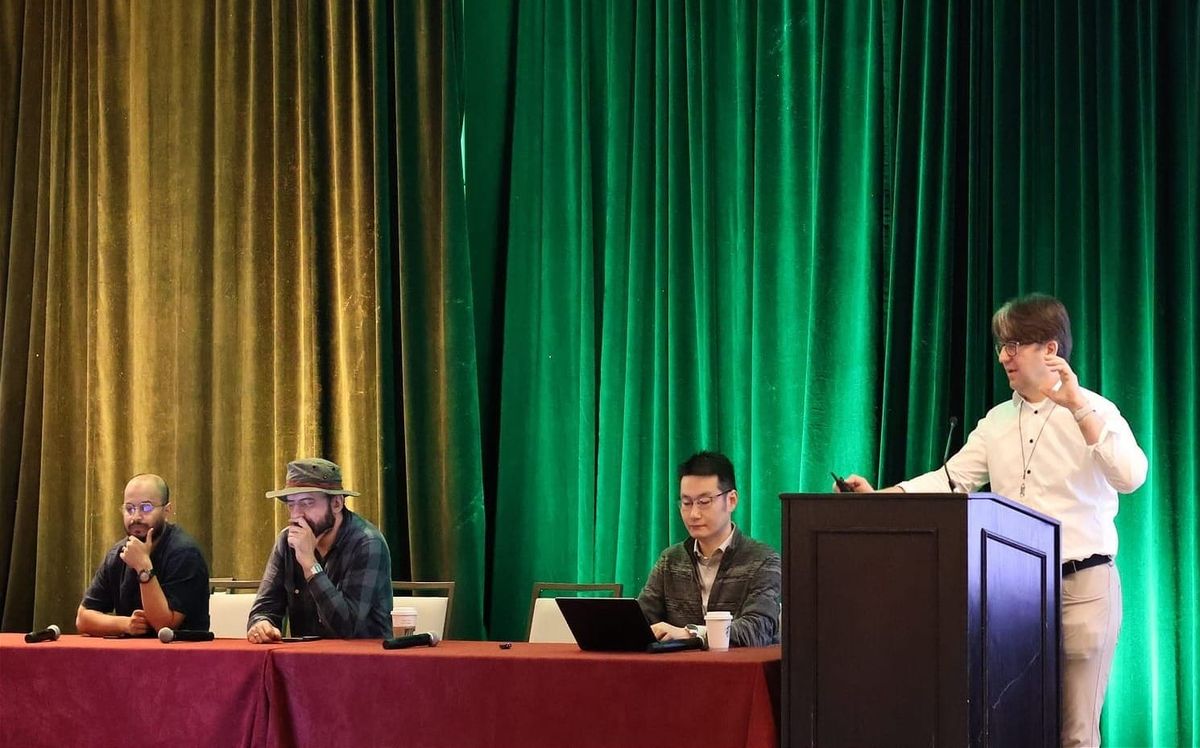
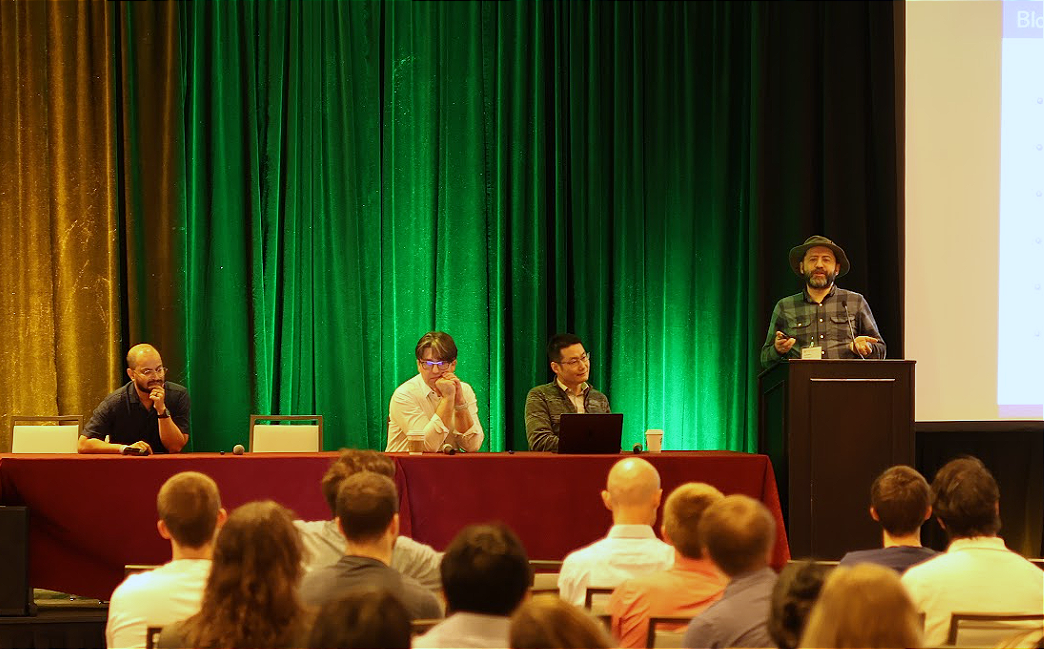
Plenary Session 3 — American Causal Inference Conference 2026 — Ilya Shpitser (John C. Malone Associate Professor, Johns Hopkins University) speaks at the podium, with panelists (left to right) Rohit Bhattacharya (Williams College), Emre Kiciman (Microsoft), and Kun Zhang (CMU) seated at the panel table. Photo: Joseph Jorgensen
He began on technical ground. Hallucinations — plausible but false outputs from LLMs — are not, in his view, a fixable bug. They are a fundamental property of systems built to predict. Predictors produce wrong outputs. Identifying those wrong outputs requires expertise. People who lack that expertise are at serious risk of a false sense of security, and the consequences scale with the stakes of the domain. Some tasks, he argued, are simply inappropriate for LLMs, not because the models are immature, but because of what they are. NP-complete problems won't yield to statistical pattern matching. High-stakes decisions where an incorrect output is catastrophic create accountability problems that don't disappear just because the model improves.
But Shpitser's most pointed argument was not technical. It was historical.
"I don't think we're being replaced," he said. "I think we're potentially being subordinated."
His claim: the real threat of AI in academia is not that it will do our jobs. It is that it will become one more instrument in a longer trend, the corporatization of the university, that weakens the independence on which scientific credibility depends. Pressure to adopt AI tools is arriving simultaneously with pressure to adopt corporate governance models, to prioritize donors and industry partnerships, to operate on administrative timelines that have nothing to do with how knowledge is produced.
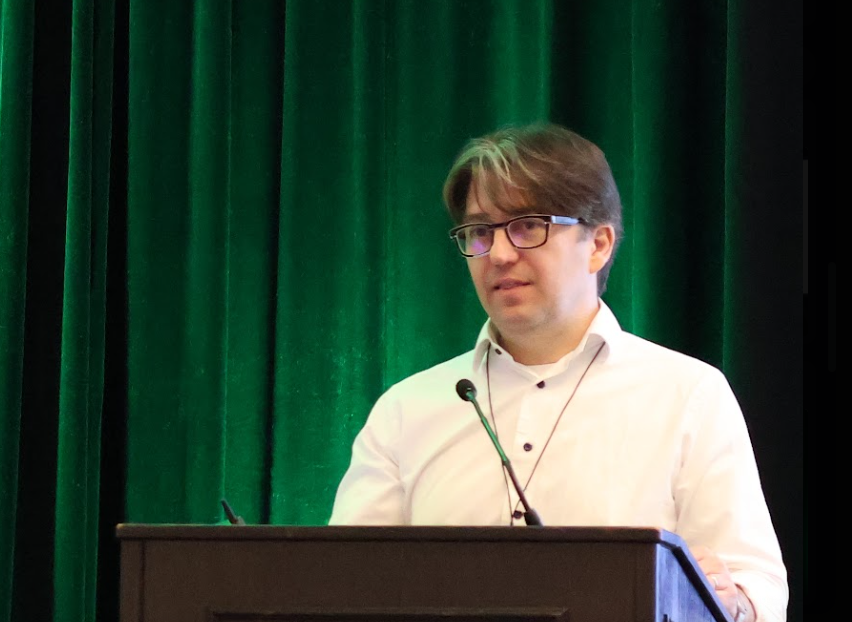
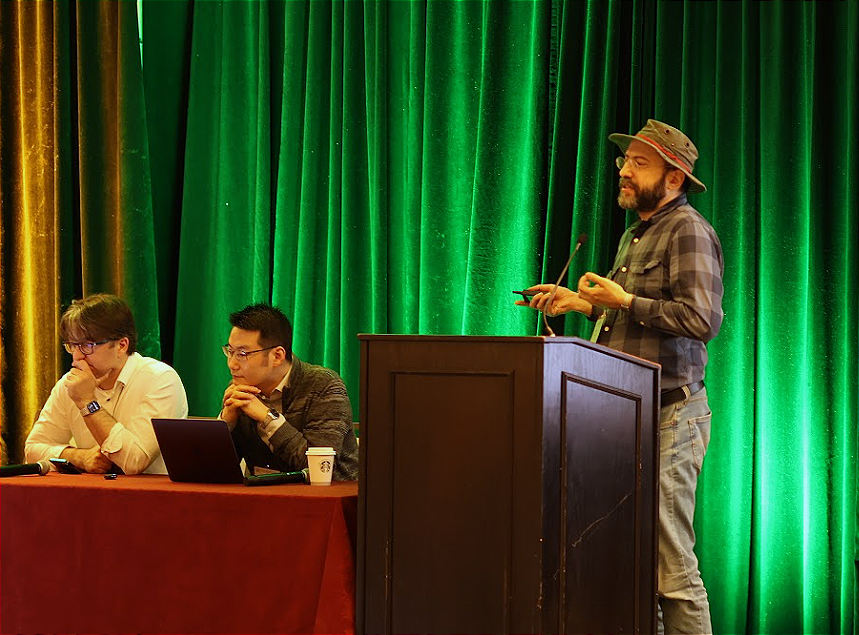
Ilya Shpitser (John C. Malone Associate Professor, Johns Hopkins University) speaking at Plenary Session 3 of the American Causal Inference Conference 2026, with panelists Emre Kiciman (Microsoft), and Kun Zhang (Carnegie Mellon) seated at the panel table. Photo: Joseph Jorgensen
He traced the stakes of that independence through a personal story that stopped the room. He had recently been at Cambridge for a causal inference event. One evening he attended evensong, the traditional choral service held in the college chapels. As the clergy processed in, he noticed their robes, and then had a moment of recognition. Those weren't clergy robes that looked like academic robes. They were the same robes. The hood, the cut, the whole garment, are identical to what academics wear at graduation ceremonies and PhD defenses. They are the same robes, inherited directly.
The modern university, Shpitser argued, did not emerge from nowhere. It grew out of medieval cathedral and monastic schools, institutions that derived their authority precisely from being independent of the two great centers of power in medieval Europe: the nobility and the powerful merchant families. The scholarly guilds that eventually organized themselves into universities carried that independence forward as a structural feature, not an accident. It was the condition of possibility for everything the academic project has since accomplished.
The robes are a remnant of that history. So, he argued, are peer review, tenure, and the norm of publishing results regardless of who funded the research. These aren't merely traditions. They are the institutional skeleton of independence, built over centuries to keep inquiry free from the distorting pressure of whoever holds power at a given moment.
"At the end of these trends," Shpitser said, "is the end of science as an independent human enterprise."
His prescription was blunt: faculty need to organize politically, not just academically. Coordinate across institutions. Push back against corporate capture. He acknowledged that STEM faculty are not historically good at this. His view is that this has to change.
The Room Pushed Back
The Q&A was among the liveliest of the conference.
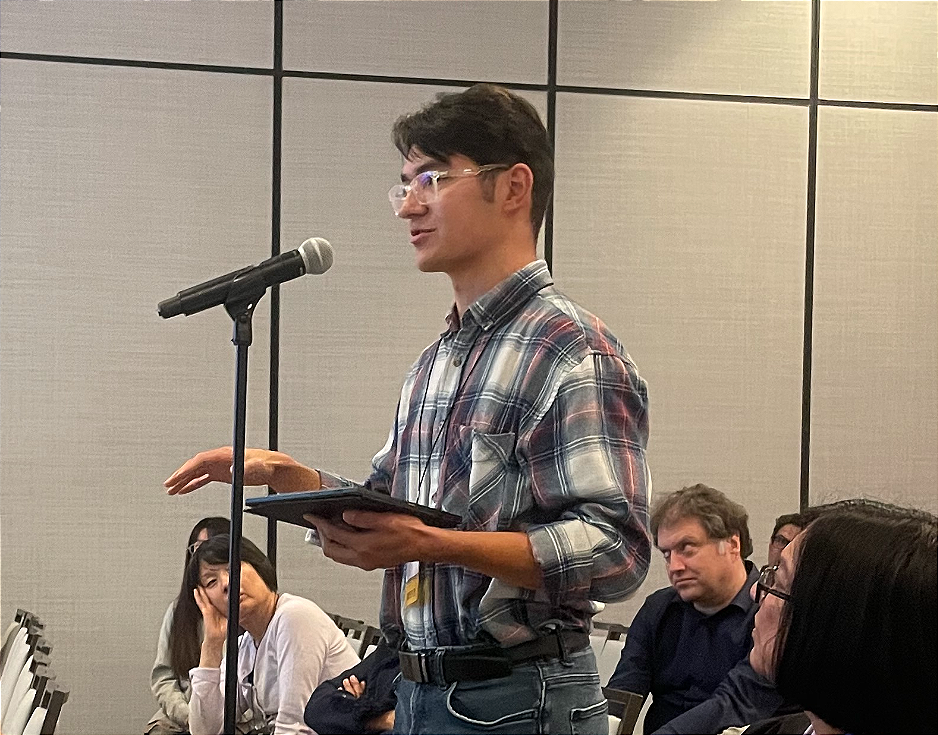
Samuel Whitlock, former UVU computational data science student, asking a question in the Q&A session after the final plenary session Photo: Brian Knaeble
One audience member pointed out that LLMs are themselves causal systems. Their training is a causal process. Their outputs can be intervened upon. Their internal representations can be studied with exactly the tools this community has developed. Was that an opportunity rather than a threat? All three panelists agreed it was, though Shpitser observed that the causal structure inside a large language model and the causal structure of the natural language it was trained on are two different things, and confusing them could be disastrous.
Another audience member challenged Shpitser directly: humans make mistakes too, often for the same reasons as LLMs, such as insufficient information, cognitive overload, systemic bias. At least with a model, you can measure the error rate. Shpitser's response was pointed: you can sue a doctor for malpractice. Accountability structures exist for human decision-makers in ways they do not yet exist for AI systems, and that asymmetry matters enormously in domains where errors cause real harm.
A diverse group of locals meets after the conference
Then the session ended, and a smaller room tried to figure out what to do next.
The Solitude Room gathering reflected how broadly this field's implications now reach. UVU undergraduates finishing degrees in software engineering and data science sat alongside a Westminster professor, an NYU professor of data science originally from Salt Lake City, BYU and University of Utah faculty, a Chief AI Officer, and working industry professionals. Someone mentioned the Great Salt Lake. Someone mentioned the 2034 Olympics. Someone mentioned manufacturing.
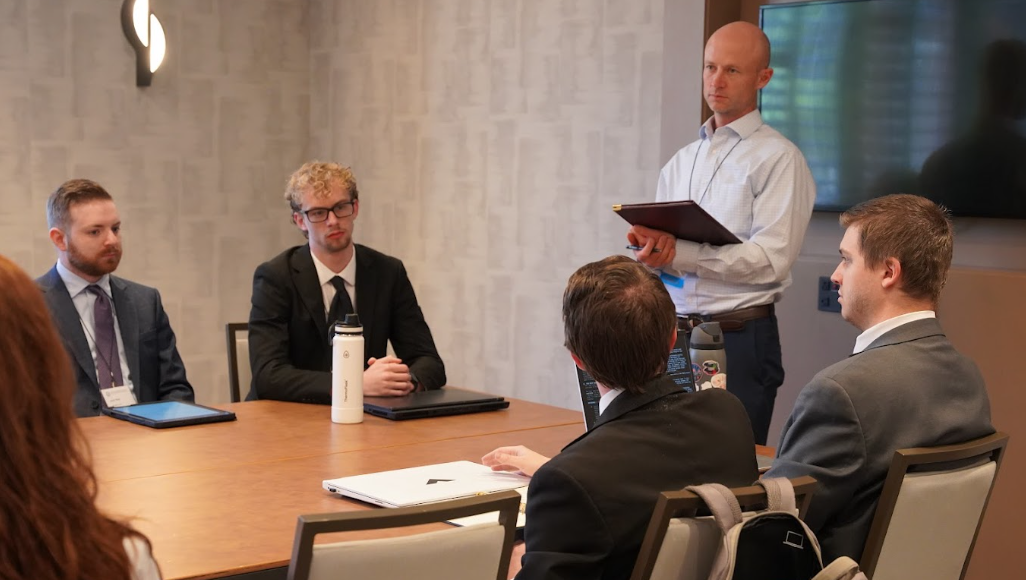
Dr. Brian Knaeble discussing with a local group how Utah can benefit from knowledge gained at the conference, Solitude Room, City Creek Marriott, Salt Lake City. Photo: Greg Tullis
Dr. Knaeble is supportive of mutually beneficial partnerships between Utah's universities and its industrial sector. While artificial general intelligence requires causal reasoning, many machine learning practitioners in Utah are unaware of causal inference as a discipline. That gap, in his view, is an opportunity.
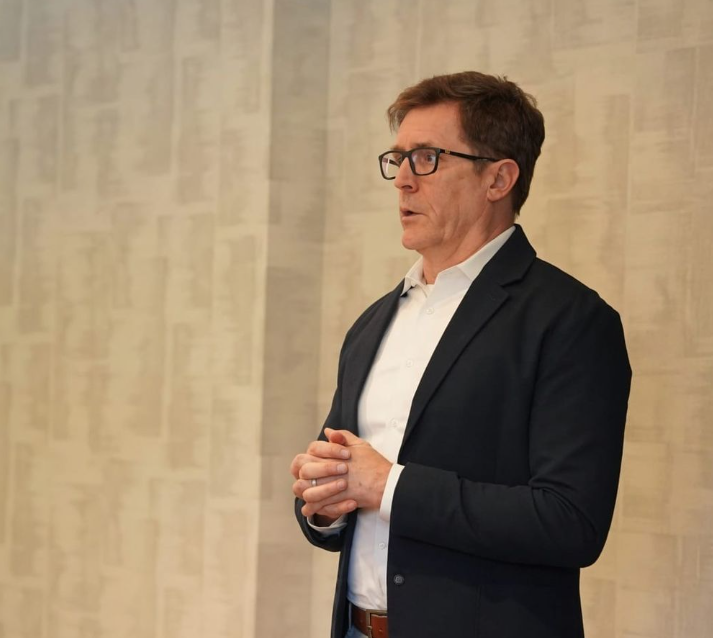
Barclay Burns, UVU's Chief AI Officer and Assistant Dean of the Smith College of Engineering and Technology, framed the stakes in foundational terms.
Barclay Burns, Chief AI Officer and Assistant Dean of the Smith College of Engineering and Technology, UVU, addressing the post-conference networking session, Solitude Room, City Creek Marriott, Salt Lake City Photo: Greg Tullis
"We need to move much more to the core model — building, understanding the behavior of the models, and improving the models," Burns said. "If you can utilize math and causal inference to improve the behavior of the models themselves, particularly the behaviors within agents and between agents — that would position Utah as a foundational contributor."
Jingpeng (JP) Tang, Master of Computer Science Program Director at UVU, raised the possibility of pairing master's capstone projects with industry partners on causal inference problems — a way to close the loop between the conference's ideas and Utah's actual industry needs.
Dr. Knaeble listens and records suggestions for how Utah can benefit from knowledge gained at the conference, Solitude Room, City Creek Marriott, Salt Lake City. Photo: Greg Tullis
What This Can Look Like
Attendees offered concrete examples of where causal methods could matter right now.
David Balcombe, a UVU undergraduate and University of Utah graduate working in health IT, described a prototype he is building for emergency medical services that uses causal AI to address a problem he encounters constantly. Paramedics arrive on scene, form a primary and secondary diagnosis, administer treatment, and transport the patient to the emergency room. Once they hand off the patient, their involvement ends. And they almost never learn whether their field impression matched the hospital's final diagnosis.
"EMS doesn't have a feedback loop," Balcombe said. "They're clueless about anything that happens in the hospital."
His prototype would close that loop, eventually allowing agencies like Unified Fire to run their own quality improvement programs and compare patient outcomes across different equipment used in the field. It is precisely the kind of application Knaeble has in mind: a real industry problem, a genuine causal question, and a solution that requires more than prediction.
The discussion also surfaced harder questions. One participant, drawing on experience at a Stanford event connecting academics with Bay Area companies, raised the issue of compensation: if industry profits substantially from academic knowledge, what's the fair mechanism for sharing that value? No one had a clean answer. But the question itself suggested how seriously the group was thinking about building something sustainable
Several attendees discussed possible venues for a recurring meetup, interim spaces at various institutions, VC meeting rooms, co-working spaces such as Kiln, until ideally Convergence Hall, one of the planned buildings at The Point innovation campus on the former state prison site, opens in a few years.
Knaeble closed the meeting the same way he had opened it: with discipline about scope. "We should really settle on a niche and be really good at that small, narrow thing," he said.
Utah's Next Move
The contrast between the two rooms — the plenary and the Solitude Room — was instructive. In the Marriott's Salon E-F, three of the world's leading causal researchers debated whether AI will replace, subordinate, or simply redirect scientific work. In the Solitude Room, people who had just heard those arguments tried to translate them into something actionable.
Shpitser's warning carries particular weight in that context. The tools are genuinely powerful. The questions about who controls them, and to what ends, are genuinely open. Burns's call for Utah to become a foundational contributor — not just a consumer of AI tools built elsewhere — is one answer to those questions. Knaeble's instinct to pick a narrow problem and compound credibility slowly is another.
If causal AI is, as industry analysts project, on track for significant annual growth over the coming decade, Utah's proximity to this week's conference, and to its incoming Society for Causal Inference president, may matter more than the state currently realizes.
The answer to "are we being replaced?" may depend less on what the researchers decide than on whether the people in rooms like Thursday's Solitude Room, the ones willing to stay after the session ends and actually work on the problem, decide to keep showing up.
The American Causal Inference Conference was held May 11–14 at the Salt Lake Marriott Downtown at City Creek. The next conference will be held in Pittsburgh. The annual meeting of the international Society for Causal Inference draws researchers from around the world. Brian Knaeble can be reached at bknaeble@uvu.edu.
Share this article
The link has been copied!
Your link has expired. Please request a new one.
Your link has expired. Please request a new one.
Your link has expired. Please request a new one.
Great! You've successfully signed up.
Great! You've successfully signed up.
Welcome back! You've successfully signed in.
Success! You now have access to additional content.