Converge AI at UVU Links Industry Challenges With Human-Centered Learning
At Nucleus Institute’s Converge AI forum at UVU, Utah companies and UVU educators connected practical AI adoption with human judgment, classroom evidence and cross-disciplinary collaboration.
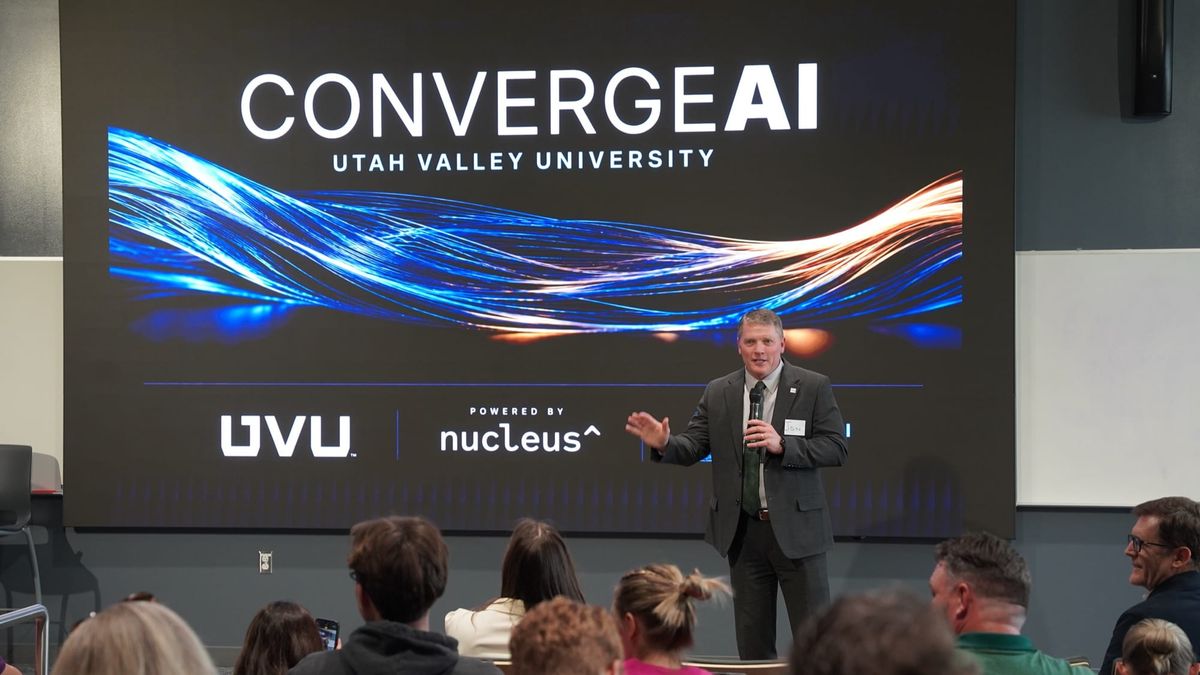
Attendees listen to the opening welcome at Converge AI at Utah Valley University on November 5, 2026. The Nucleus Institute series brings companies and university communities together to discuss AI applications and research needs. Photo: Mark Tullis, TechBuzz.
Attendees listen to the opening welcome at Converge AI at Utah Valley University on November 5, 2026. The Nucleus Institute series brings companies and university communities together to discuss AI applications and research needs. Photo: Mark Tullis, TechBuzz.
Orem, Utah — November 6, 2026
Artificial intelligence is helping Utah companies build software, manage online sales and surface information for teachers. At Utah Valley University on November 5, the companies using those tools returned to a common challenge: faster production does not, by itself, answer whether a product is useful, trustworthy or helping people learn.
That question connected industry presentations with discussions about education at Converge AI, a statewide university forum series developed by the Nucleus Institute. UVU was the series’ second stop, bringing company representatives together with faculty, researchers and students to exchange practical experience and explore opportunities for collaboration.
The organizer’s agenda listed 11 company presenters and two UVU presenters, in addition to the opening welcomes and introduction. The program ranged from e-commerce and construction software to building controls and classroom tools. Across those different settings, speakers described a need for human expertise, better evaluation and clearer decisions about where AI belongs.
A two-way exchange between companies and campuses
UVU Chief AI Officer Barclay Burns opened the gathering before turning the welcome over to President Jon Anderson. Anderson emphasized the university’s commitment to access and applied learning: students should leave not only with theoretical knowledge, but with the ability to use it.
Jackie Borget, the Nucleus Institute’s community outreach manager, described Converge AI as a response to Gov. Spencer Cox’s Pro-Human AI Initiative. The aim, she said, is to help university communities understand what industry needs and how companies are using AI, while giving businesses a clearer view of the research and teaching happening on campus.
That exchange is intended to work in both directions. A company can bring a difficult problem or an emerging application; a university can contribute research, evaluation and students preparing to work in those fields. Borget described five-minute company presentations, followed by university presentations and time for participants to connect.
The forum is one part of Nucleus’s broader work convening, educating and funding Utah’s innovation community. Borget also pointed to support for federal research grants, early-stage investment and commercialization. At UVU, however, the immediate opportunity was more direct: let people working on different pieces of the AI transition hear one another’s questions.
AI that works without becoming the main attraction
Jacob Miller, Pattern’s vice president of platform intelligence, offered a distinction between AI that customers interact with directly and AI operating behind the scenes. A chatbot or another conversational product puts AI in the customer’s experience. Systems that improve advertising, pricing, content and inventory can deliver value without making AI the centerpiece.
For brands selling across online marketplaces, Miller said, the central concern is business performance rather than the novelty of the technology. He described combining subject-matter expertise with machine learning to manage the many operational decisions involved in e-commerce. In that setting, an AI feature matters because of the problem it helps solve.
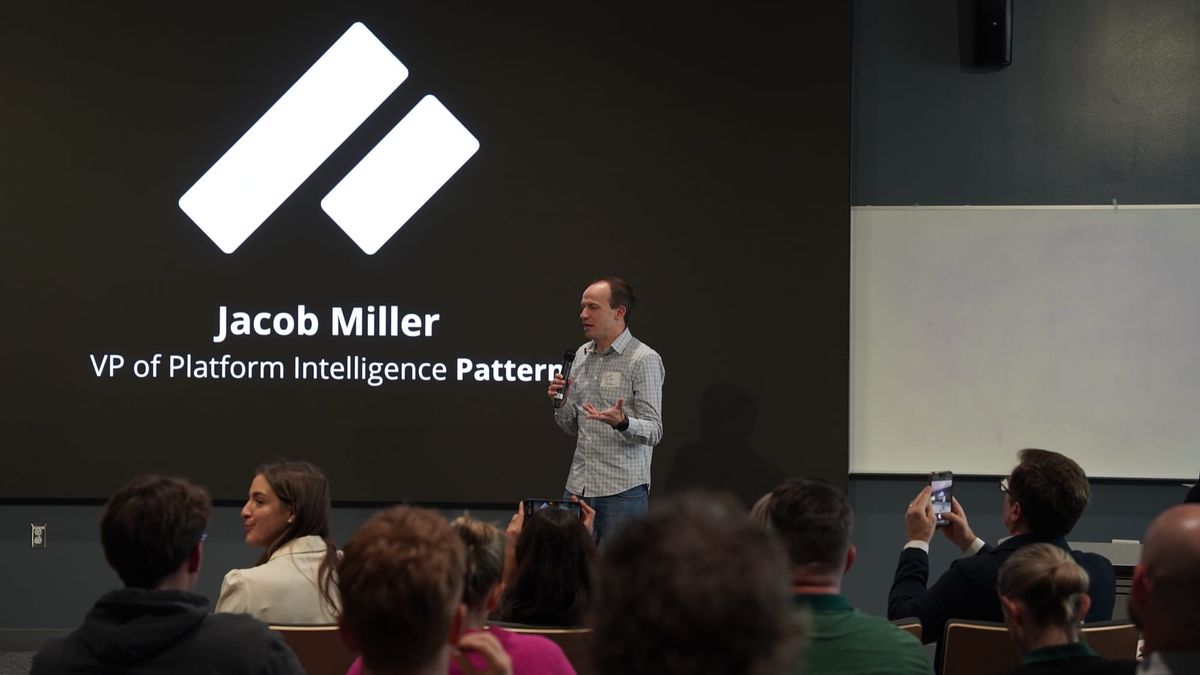
Jacob Miller, Pattern’s vice president of platform intelligence, presents at Converge AI. He distinguished customer-facing AI from systems working behind the scenes on pricing, advertising and other e-commerce operations. Photo: Mark Tullis, TechBuzz.
Robert Cowles, senior AI product manager at JobNimbus, made a related argument about software for contractors. Product managers, designers and engineers increasingly use overlapping AI tools, he said, but that does not make their roles interchangeable. The judgment and specialized skills each brings become more important as routine production becomes easier.
Cowles cautioned against building an AI experience simply because a technology team finds it exciting. Contractors need software that helps them do their work, not another interface to navigate.
“It needs to be a footnote, not a headline,” he said of AI’s place in the product.
He pointed to less conspicuous opportunities, such as making a software migration easier and handling frustrating administrative work. The question was not how to make customers spend more time talking to AI, but how to give them more time for the skilled work their own customers need.
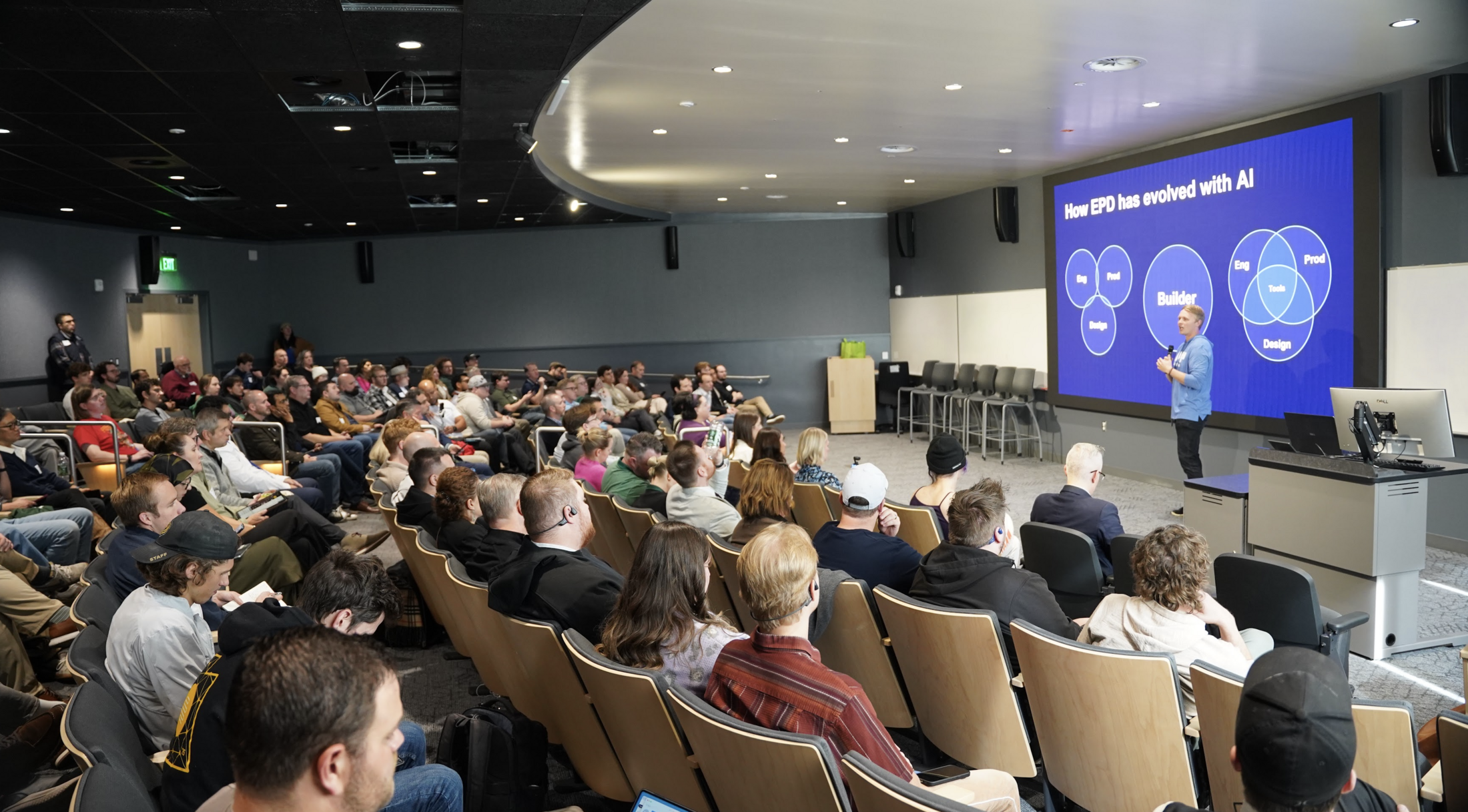
Attendees listen to a presentation on how AI is changing engineering, product and design work during Converge AI at Utah Valley University on November 5, 2026. The side-angle view captures the audience and the forum’s classroom setting. Photo: Mark Tullis, TechBuzz.
Entrata’s Mattie Langford, director of engineering, data science, described the difficulty of introducing AI into a large, established software operation. In her account, early adoption of coding tools increased output without improving quality. Her team responded by turning internal expertise into reusable skills, prompts and engineering safeguards that other teams could use.
Langford said that approach gave AI tools more of the context needed to work within Entrata’s codebase and helped teams outside the central AI group build their own applications. Her example underscored the difference between enabling more people to build software and establishing a process for them to build dependable software.
Other presenters brought similar tensions into different industries. Daniel Sellers, Voze’s vice president of engineering, described turning field sales representatives’ spoken notes into organized information, reminders and potential next steps. He also raised a concern about how employees experience that capability: a tool meant to support a representative should not feel like a mechanism for a supervisor to watch every move.
Majid Karami, PassiveLogic’s vice president of autonomy, discussed applying AI to building controls, where mistakes can have physical consequences. He described the company’s use of physics-based models to account for differences among buildings and reduce reliance on collecting years of training data for each setting. His presentation put safety and domain knowledge alongside speed as requirements for an AI application.
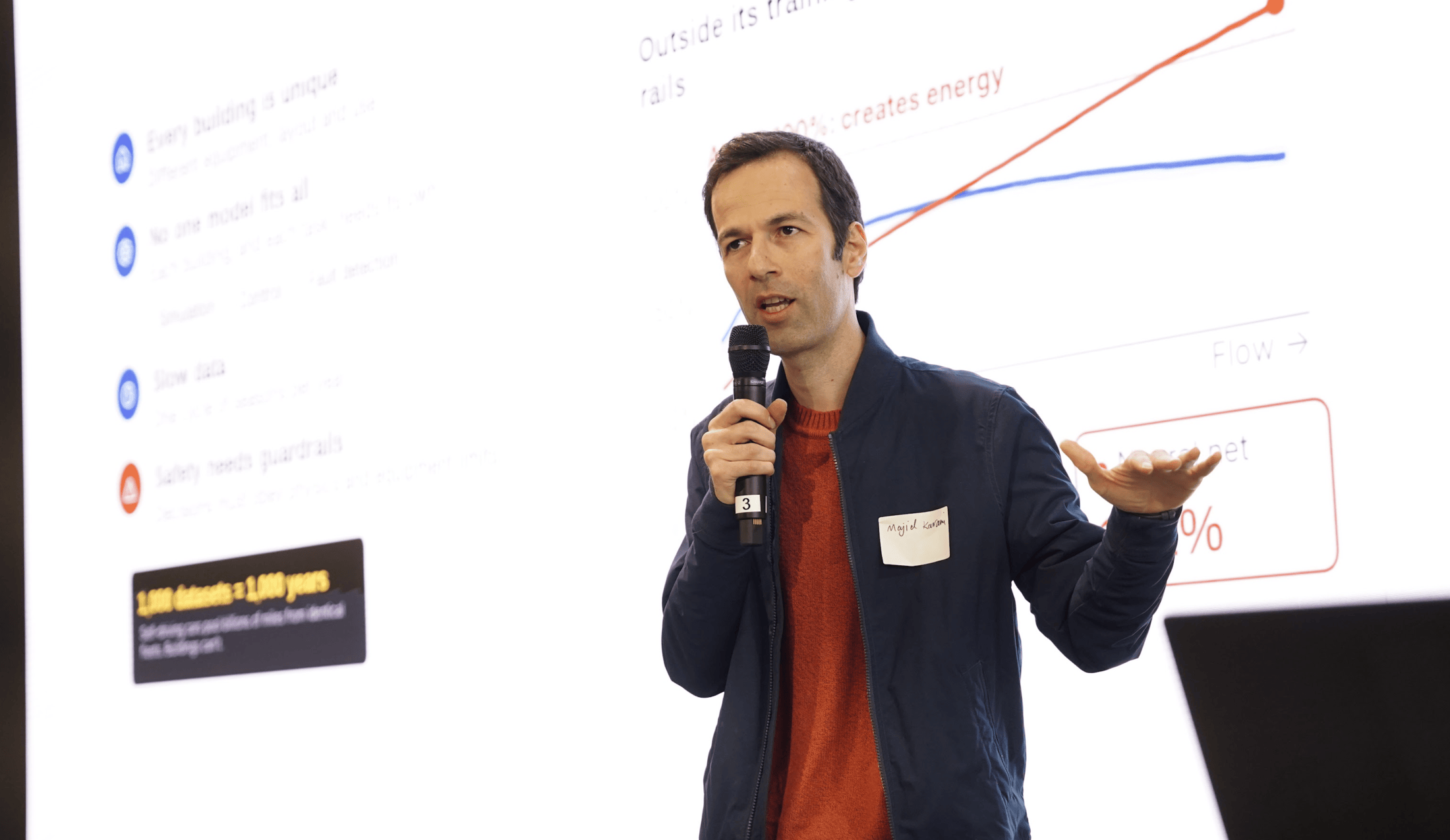
Majid Karami, PassiveLogic’s vice president of autonomy, discusses physics-based AI for building controls at Converge AI at Utah Valley University on November 5, 2026. He described using physical models to account for differences among buildings and guide control decisions. Photo: Mark Tullis, TechBuzz.
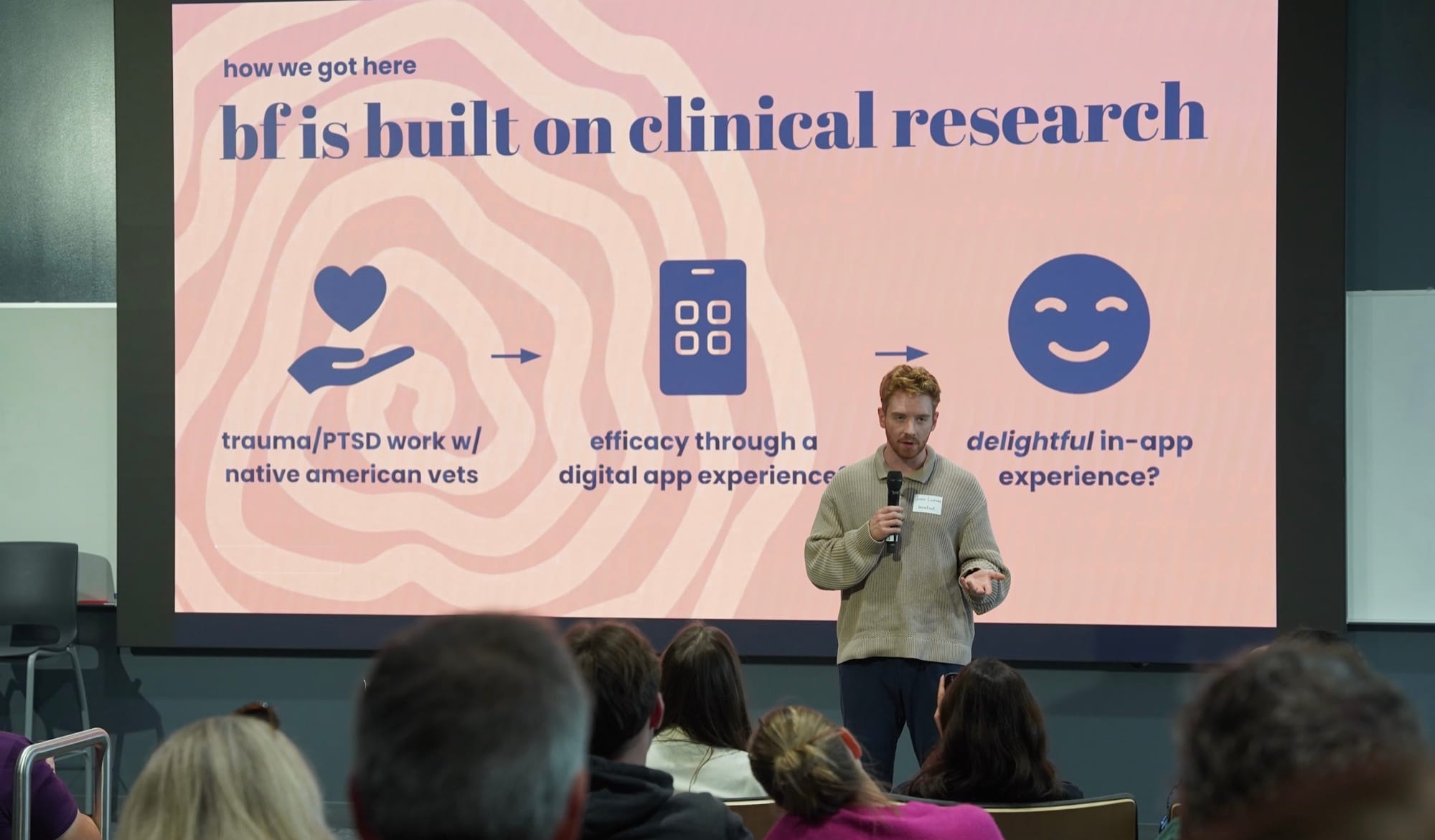
John Linford, head of product at barefoot, brought that human-centered question into mental wellness. AI can accelerate software development, he said, but understanding how people use a product still requires time for testing, feedback and refinement. A team may be able to build quickly while the people it hopes to serve need a different pace.
Linford described privacy, clinical oversight, evaluation of AI conversations, and plans for escalation and crisis resources as important design considerations. He also raised a practical challenge: making a wellness tool appealing when it competes with more immediately engaging apps. “How do you sell broccoli in a candy shop?” he asked. His presentation connected technical capability with the harder work of earning trust and sustained use.
John Linford, head of product at barefoot, speaks at Converge AI at Utah Valley University on November 5, 2026. He contrasted the speed of AI-assisted software development with the slower work of testing how people use a mental wellness product. Linford emphasized clinical oversight, privacy, clear rules and evaluation for AI conversations, along with escalation plans and crisis resources. His presentation asked how a team can build an experience people want to use while keeping human needs at the center. Photo: Mark Tullis, TechBuzz.
In the classroom, anecdotes are not enough
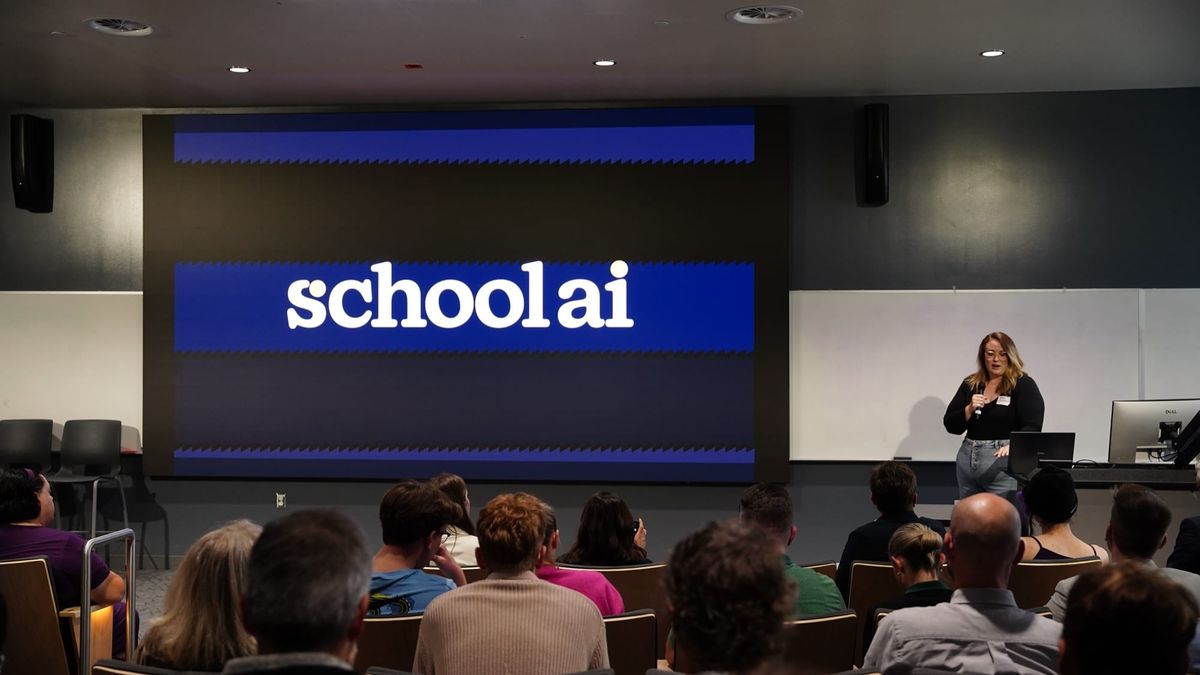
For Kasey Chambers, SchoolAI’s customer success lead, the limits of time and information were familiar long before generative AI became a classroom topic. She said she spent 15 years teaching, including managing a classroom of about 35 ten-year-olds while tracking their progress across seven subjects.
Her exhaustion did not come from disliking teaching. Chambers described knowing what individual children needed but lacking enough time, resources or timely information to respond as effectively as she wanted. In 2023, she met SchoolAI founder Caleb Hicks, a former secondary teacher, and began using the company’s tools with students.
Chambers described SchoolAI Spaces as environments where students can learn, practice and ask questions at an intentionally chosen point in a lesson. The system surfaces information about who needs help and who is ready for more challenging work. In her account, that information returns to the teacher, who remains responsible for deciding what to do with it.
Kasey Chambers, SchoolAI’s customer success lead and a former classroom teacher, describes using AI to surface information for educators. She invited researchers to help assess student learning, privacy, safety and the quality of AI-supported teaching. Photo: Mark Tullis, TechBuzz.
She said SchoolAI is also developing tools for administrators and working with districts to understand their information needs. But she drew a distinction between enthusiastic accounts from teachers and evidence that students are learning.
“We want proof. What counts as evidence a student is actually learning?” Chambers asked.
She identified research, trust and evaluation as challenges the company wants to address with the education community. Privacy, safety and accessibility require particular care when children are involved, she said, and there is no simple benchmark for a strong tutoring or teaching interaction.
Her invitation to researchers and students made the forum’s collaboration goal concrete. Classroom users can describe a promising experience; universities can help investigate what it means, how to evaluate it and where a tool may need to improve. Chambers asked participants interested in that work to connect with SchoolAI.
UVU’s response reaches across disciplines
Matt North, UVU professor and department chair for Information Systems, IT, and Cybersecurity, described how the university is approaching the same questions. North is also serving as interim director of the Kahlert Applied AI Institute, an assignment he said he had held for seven weeks at the time of the forum.
The institute began developing about two years earlier. Rachael Hutchings served as a temporary executive director during its startup. Funding support came from Heather Kahlert through the Kahlert Foundation. UVU announced the foundation’s $5.2 million gift in 2025; Heather Kahlert, the foundation’s executive vice president, described the partnership as aligned with accessible, relevant education.
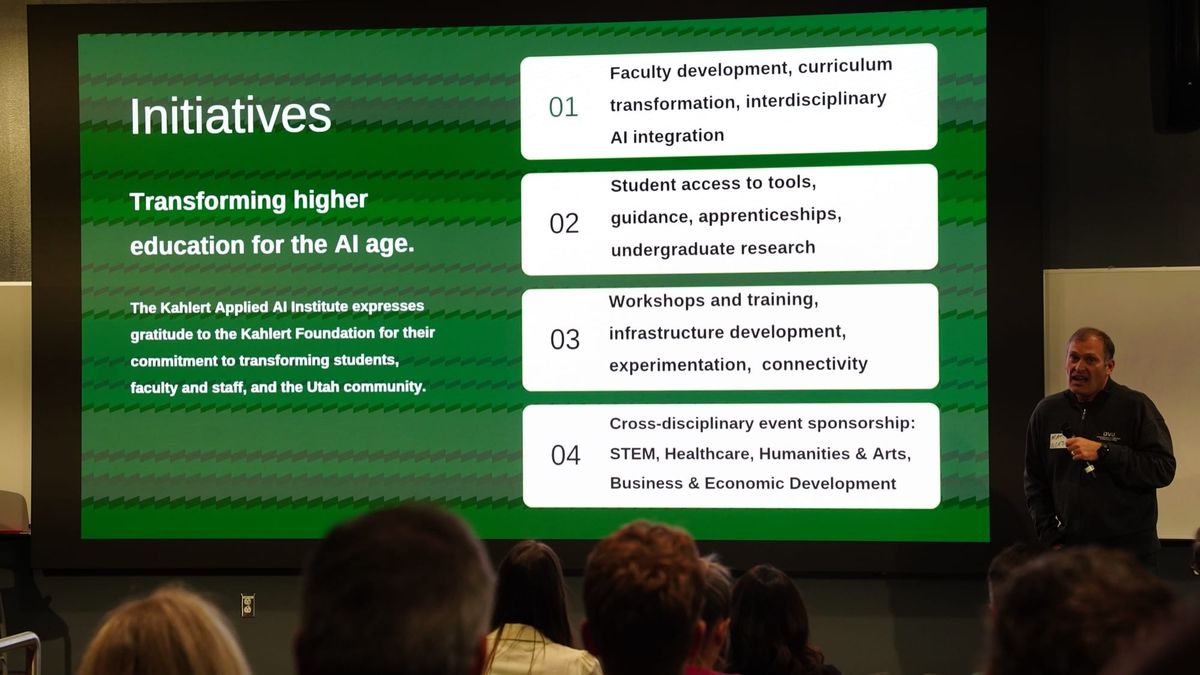
North outlined four priorities: faculty and curriculum development; student access to tools, guidance and research opportunities; workshops and safe experimentation; and connections across disciplines. The institute’s stated mission is to serve as a living laboratory for applied AI in higher education.
“We don’t necessarily need to change what we’re teaching, but we do have to change how we’re teaching it because AI has changed the way that students are learning it,” North said.
According to North, the institute trained 139 faculty members during the previous 12 months, and a count completed that week found applied AI components in 45 UVU degree and certificate programs. He said platforms had been developed for faculty and staff, with expanded access to multiple language models and other AI tools for students planned next.
Matt North, UVU professor and department chair for Information Systems, IT, and Cybersecurity, outlines the Kahlert Applied AI Institute’s priorities. North is also serving as the institute’s interim director. Photo: Mark Tullis, TechBuzz.
North offered a specific example of how that work can spread. Chemistry professor Daniel Scott received a small institute grant to build an AI tutor for an introductory chemistry course. North said Scott made it available to his General Chemistry I students that semester, with a General Chemistry II expansion planned for the following spring.
Scott then held a workshop for 18 faculty members from six of UVU’s seven colleges and schools, according to North, sharing how he had approached the project. The example showed a path from a small faculty experiment to broader collaboration. North did not provide comparative grades or pass-rate data in the presentation.
The institute is also developing a workshop created and delivered by students about when AI use constitutes cheating. North said the answer can depend on the assignment, instructor, course and department, leaving students to navigate different expectations rather than one universal rule.
Bringing students into that discussion is part of the institute’s broader emphasis on responsible and explainable AI. North described a need for space to experiment safely and for people in the sciences, arts, humanities and technology to work together rather than treating AI as the concern of a single department.
Those university priorities echoed the problems companies had brought into the room. Builders were seeking better ways to preserve expertise, evaluate results and make AI useful to the people expected to adopt it. Educators were asking how to prepare students for that work without outsourcing the judgment they need to develop.
Converge AI gave both groups a place to compare those questions. The next step, reflected in the invitations for research and collaboration, is to turn the conversation into work they can do together.
The Nucleus Institute will continue its Converge AI series in the coming weeks. The next Converge AI event will take place at Utah State on November 10, 2026. Learn more about the series and upcoming events through the Nucleus Institute.
Share this article
The link has been copied!
Your link has expired. Please request a new one.
Your link has expired. Please request a new one.
Your link has expired. Please request a new one.
Great! You've successfully signed up.
Great! You've successfully signed up.
Welcome back! You've successfully signed in.
Success! You now have access to additional content.