Odys Aviation and the Hybrid VTOL Bet: Why One AAM Exec Thinks Batteries Alone Won't Cut It
Odys Aviation (Long Beach, CA) produces hybrid VTOL for multiple uses, with cargo certification expected this year and a possible Utah factory on the horizon.
This article is part of series of interviews TechBuzz is conducting with companies participating in the upcoming Project Alta Summit, hosted by 47G on May 26–27 at the Ken Garff University Club at Rice-Eccles Stadium in Salt Lake City. The two-day event will convene nearly 200 companies at the forefront of advanced air mobility, bringing together manufacturers, infrastructure partners, regulators, and policymakers at what many in the industry are calling a critical inflection point for AAM deployment.
While much of the advanced air mobility (AAM) industry has staked its future on all-electric propulsion, Odys Aviation is charting a different course, and Bob Ellithorpe, the company's SVP of Operations, makes no apologies for it.
"We're not counting on advances in electric battery technology that a lot of the eVTOL makers are counting on," Ellithorpe said in a recent interview with TechBuzz. "Hybrid propulsion technology exists today. We can deliver the performance that our customers need right now."
Bob Ellithorpe, SVP, Operations, Odys Aviation
It's a pointed statement in an industry that has generated enormous excitement — and enormous investment — around the promise of all-electric vertical takeoff and landing aircraft. But as some of the sector's most celebrated players continue to push certification timelines and grapple with real-world range limitations, Odys Aviation's hybrid approach is starting to look less like a contrarian bet and more like a pragmatic roadmap.
Meet Laila: Built for the Horizon
Long Beach, California-based Odys Aviation is developing a dual-use VTOL platform — dual-use in two distinct senses of the word. The aircraft are designed for both civil and defense applications, and for both cargo logistics and personnel transport.
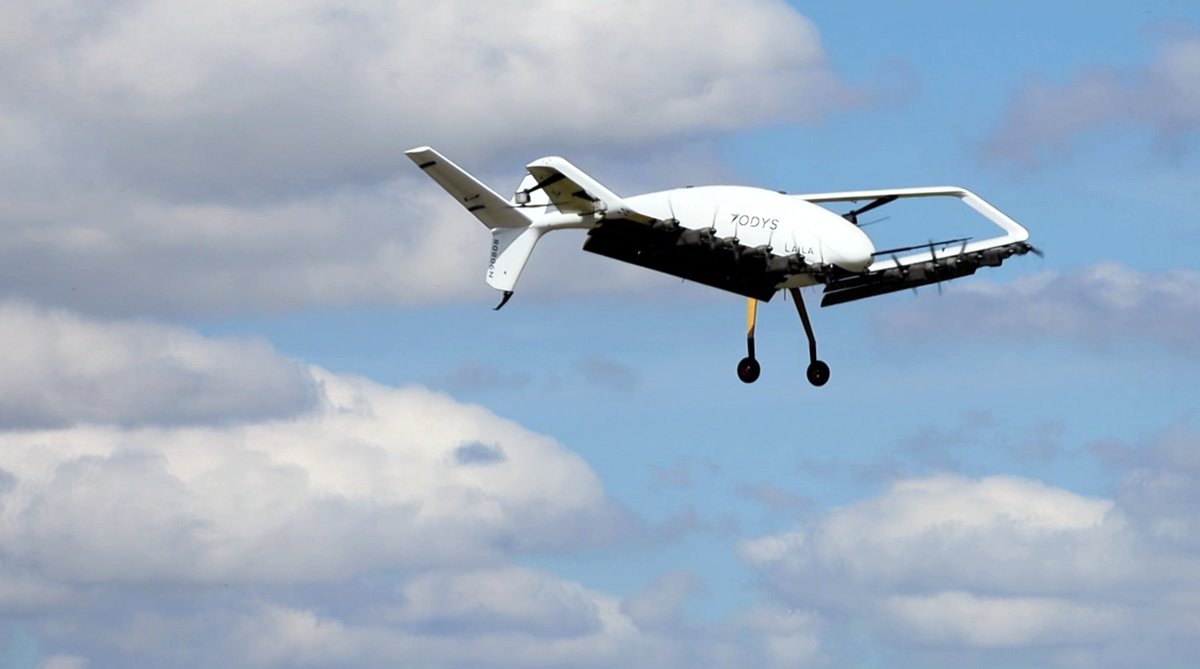
The lead aircraft coming to market is the Laila — an unmanned VTOL with a 14-to-15-foot wingspan, eight hours of endurance, and a 450-mile range. At its heart is a 100kW high-speed generator that does double duty: powering the aircraft's electric motors while simultaneously running a full suite of onboard systems. In its primary defense configuration, that onboard power feeds a comprehensive counter-UAS defeat package — designed, as Odys puts it, to "move the engagement zone to the horizon."
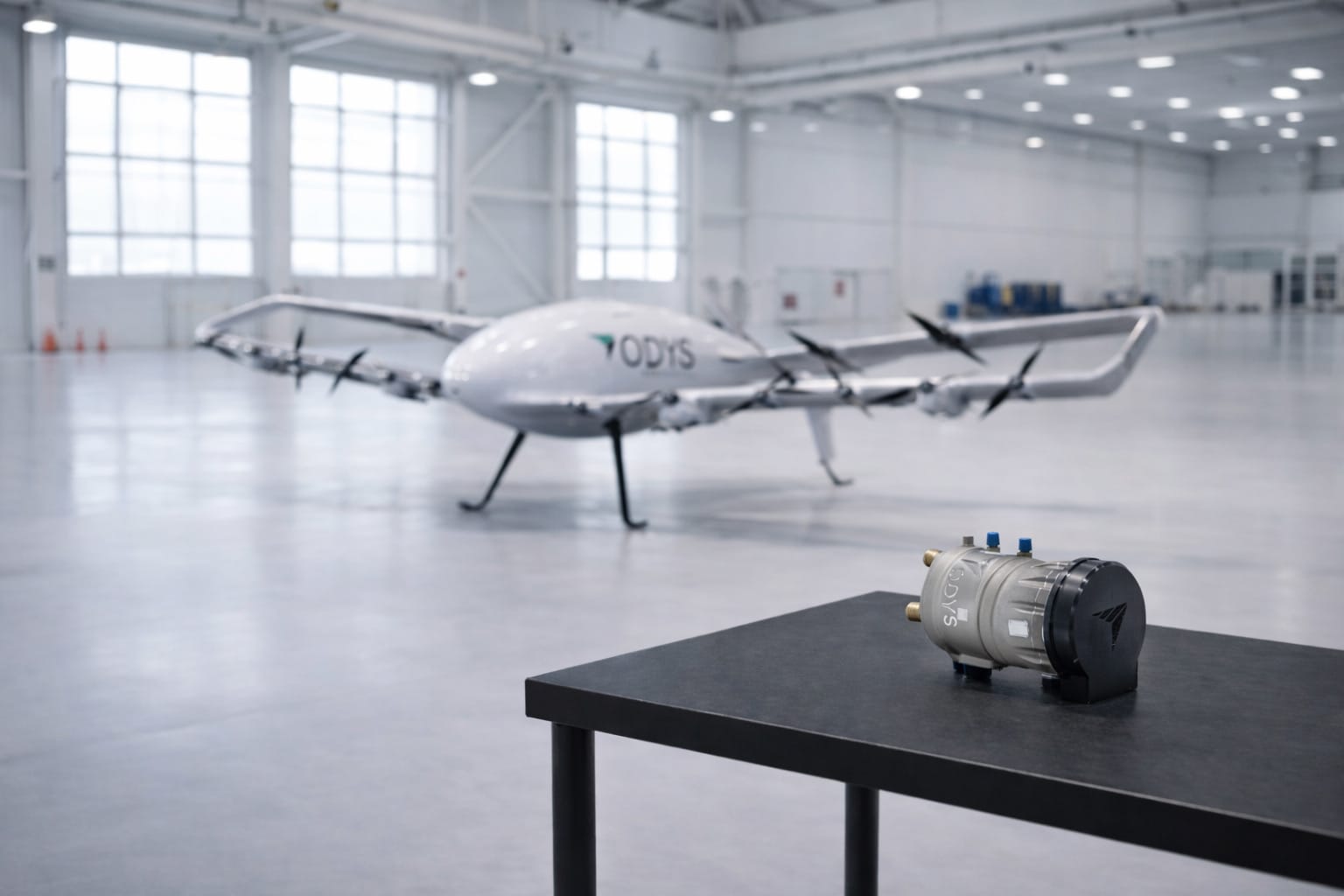
A 100kW Odys Aviation electric motor sits in the foreground as the company's Laila unmanned cargo VTOL aircraft occupies the hangar behind it — a deliberate composition that tells the whole story in a single frame: compact, powerful hardware enabling a capable, full-scale aircraft. The Laila 100, with its distinctive multi-rotor configuration and fixed-wing design, is Odys Aviation's lead platform to market, capable of carrying 130 pounds of cargo across 450 miles. SVP of Operations Bob Ellithorpe expects the aircraft to achieve certification later this year under the internationally recognized SAIL II regulatory framework. Image courtesy Odys Aviation.
The threat environment that Laila was built for is unambiguous. Modern inbound drone threats arrive with onboard intelligence, coordinated multi-drone deployment, and continuously evolving tactics. Laila's combination of range, endurance, and onboard power generation positions it as a persistent airspace security platform capable of operating far beyond the perimeter of whatever it is protecting.
In its civil configuration, the same platform pivots to cargo logistics, carrying approximately 130 pounds of useful payload — with that same onboard generator providing power for climate-controlled or otherwise energy-dependent cargo, from medical tissue samples to radioactive isotopes.
The second platform, a piloted aircraft carrying a pilot and up to nine passengers, will follow, with a projected range of 750 to 1,000 miles.
The sequencing is deliberate, and Ellithorpe is candid about why. The Laila will pursue certification under an already-existing regulatory framework known as SAIL II, which will allow the aircraft to operate in more than 50 countries upon certification — expected later this year.
"Our first aircraft to market will use rules that are already written," Ellithorpe explained. "It's a lower-risk business strategy with a higher probability for success."
The manned passenger aircraft will follow the traditional FAA and EASA certification path. But here is where Odys Aviation's sequencing becomes genuinely clever: because both aircraft share the same core hybrid propulsion technology, operational data gathered from the Laila 100 can be applied directly to the manned aircraft certification process.
"We will have data from our unmanned aircraft that we can port over to the manned aircraft to demonstrate reliability, safety, and performance," Ellithorpe said. "That absolutely explains the sequence."
Alta: Unlocking 5,000 Forgotten Airports
If Laila is built for the horizon, Alta is built for the heartland.
There are more than 5,000 underserved regional airports across the United States, facilities with existing runways and fueling infrastructure but limited connectivity to the broader aviation network. Alta, Odys Aviation's piloted follow-on platform, is designed to change that equation entirely.
In passenger configuration, Alta carries up to nine passengers and luggage over a range of 750 miles, utilizing existing fueling infrastructure rather than requiring the buildout of new vertiport charging networks. In cargo configuration, the numbers become remarkable: up to 3,500 pounds of payload over a range of 1,200 miles, figures that reposition Alta not just as an air taxi but as a serious regional logistics platform.
The medical transport application may be the most immediately compelling. Rural communities across the country remain dangerously underserved by emergency medical infrastructure — not because of a lack of will, but because traditional ground transport simply cannot bridge the distances involved. Alta's medical configuration is designed to close that gap, bringing emergency care access to communities that conventional aviation has never economically served.
The defense applications are equally broad. Alta supports intelligence, surveillance and reconnaissance (ISR) missions, troop transport, and rapid deployment of critical supplies. A modular design philosophy ensures compatibility with leading sensor suites and mission-specific hardware — making Alta reconfigurable for an evolving threat environment without requiring a new airframe.
Critically, Alta is described by Odys Aviation as an evolution of the Laila platform — meaning the operational data, certifications, and real-world flight hours accumulated by Laila flow directly into Alta's development and certification pathway. It is a deliberate, compounding strategy: each aircraft making the next one faster, cheaper, and lower risk to bring to market.
"We will have data from our unmanned aircraft that we can port over to the manned aircraft to demonstrate reliability, safety, and performance," Ellithorpe said. "That absolutely explains the sequence."
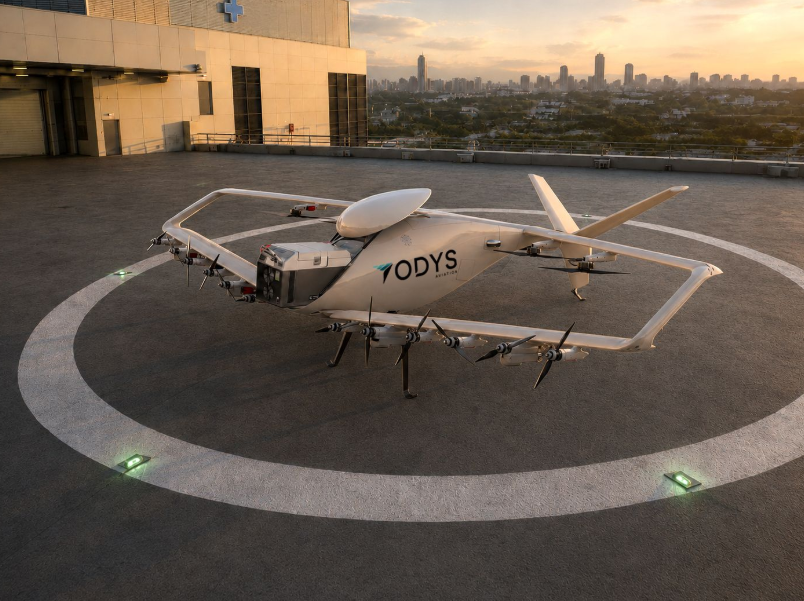
Odys Aviation's hybrid-propulsion unmanned cargo VTOL sits on a hospital rooftop helipad in this rendering, illustrating one of the aircraft's most compelling use cases: delivering high-value medical cargo — from tissue samples to radioactive isotopes — directly to healthcare facilities. Unlike all-electric competitors, the Odys platform generates onboard power to maintain climate-controlled payloads in flight. The Long Beach, California-based company expects to certify the aircraft later this year. Image courtesy Odys Aviation.
The Hybrid Advantage: More Than Just Range
At the heart of Odys Aviation's differentiation is its hybrid propulsion system — a turbine-based architecture that generates power for onboard electric motors without relying solely on battery storage.
The performance gap between hybrid and all-electric is stark, particularly on the metrics that matter most to commercial and defense customers: range, endurance, and payload capacity. Ellithorpe describes the endurance advantage of hybrid over all-electric as "order of magnitude better," and attributes it entirely to the fundamental limitations of current battery technology — limitations he notes are well understood and not unique to aviation.
But the hybrid advantage goes beyond just keeping the aircraft in the air longer. Because Odys Aviation's system doesn't require a traditional gearbox — a component common in larger rotorcraft — the aircraft is simpler to build, cheaper to maintain, and less prone to unscheduled downtime.
"Simpler oftentimes is better from a maintenance perspective and a performance perspective," Ellithorpe said. "If your aircraft is sitting on the ground for maintenance, it's not generating revenue."
There's also a less obvious but potentially significant advantage: the hybrid system generates onboard electrical power that can be consumed directly by the payload. For applications like medical transport—where tissue samples, radioactive isotopes, or climate-controlled cargo require continuous power—this capability is a meaningful differentiator.
"The system not only generates the power for the electric motors, but it provides onboard power to be used by the payload," Ellithorpe noted. "That's very attractive for customers who have high-value cargo that requires some onboard electric power."
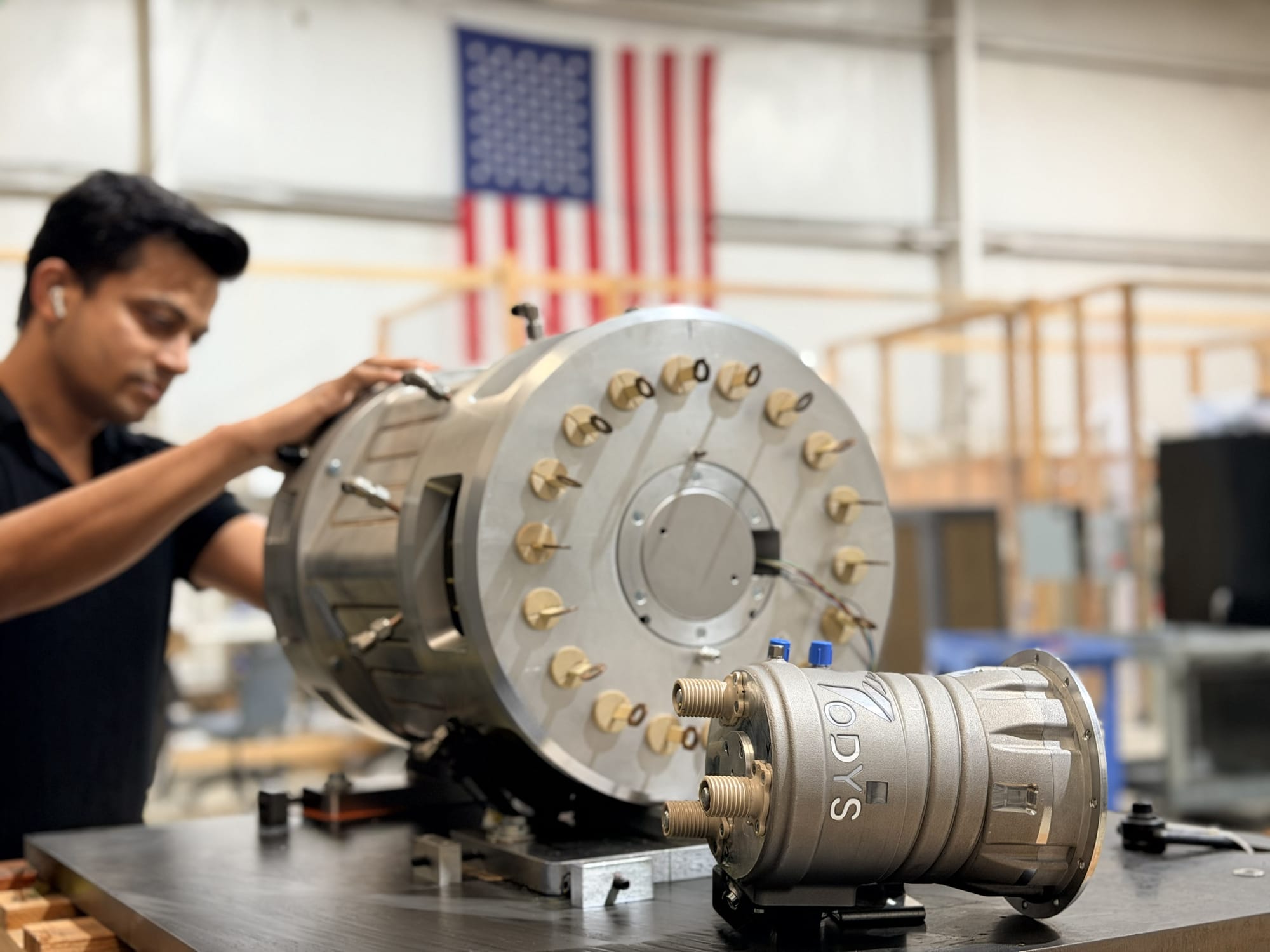
An Odys Aviation technician showing two proprietary electric motors — a 1kW and 1MW unit — at the company's Long Beach, California facility. The size contrast illustrates the range of power requirements across Odys Aviation's dual-use platform family, from precision systems to primary propulsion. Both motors are central to the hybrid propulsion system that SVP of Operations Bob Ellithorpe argues delivers the reliability and endurance that battery-only systems cannot yet match. Image courtesy Odys Aviation.
Infrastructure Freedom and Operational Flexibility
One of the less-discussed drawbacks of all-electric VTOL aircraft is their dependence on charging infrastructure — a network of vertiports that, in most markets, simply doesn't exist yet at meaningful scale. Odys Aviation's hybrid system sidesteps that constraint entirely.
"We're not going to be tied to improvements in the electric infrastructure grid," Ellithorpe stated. "We can operate from airfields, from heliports that already exist, or from unimproved areas."
That flexibility opens up use cases that are simply not viable for battery-dependent aircraft — border security patrols, oil platform cargo delivery, infrastructure inspection in remote terrain. It also positions Odys Aviation well for defense applications, where operating from established logistics hubs is rarely guaranteed.
The Industry's Coming Supply Chain Shock
Ellithorpe is also candid about the challenges ahead, not just for Odys Aviation, but for the entire AAM sector.
One issue that doesn't get enough attention, he argues, is rate production. The numbers are striking: approximately 925 civil helicopters, piston and turbine combined, across all manufacturers worldwide, were produced in 2025. A single AAM company with one platform is projected to exceed that figure.
"Rate production at volume is going to be a challenge for our industry," Ellithorpe said. "We're going to be above aviation standards but below automotive standards in terms of volume. Our supply chain is going to need to adapt."
Electric motor reliability and cost present a related challenge. "The electric motors themselves — we need them to perform at higher levels with greater reliability at a better price point," he said. It's an industry-wide issue, but one that will need to be resolved for any VTOL manufacturer to hit meaningful production targets.
Utah, 47G, and a Rare Ecosystem
Ellithorpe will be in Salt Lake City for the Project Alta Summit, and he's effusive about what Utah has built, and what it represents for the broader AAM industry.
"They've been able to do something that's pretty rare in AAM," he said. "They combined state resources — the Utah Inland Port Authority, the Utah Department of Transportation, 47G — all coming together around a single vision for advanced air mobility. That's starting to pay off."
The FAA's recognition of Utah's eVTOL integration pilot program is one concrete example. For Ellithorpe, who has spent decades in aerospace and defense, Utah's approach represents something genuinely uncommon: public-private alignment that the industry can actually build on.
"When you think about Project Alta in Utah, it's one of the few real ecosystems where people are coming together to collaborate and say, 'How can we do this?' — not 'How do we stop this?'" he said.
Odys Aviation is also in the midst of selecting a U.S. factory location, having narrowed the search to eight states. Ellithorpe declined to name them—we asked—but noted, with a knowing tone, that his upcoming visit to Salt Lake City is not purely social.
Utah's AAM ambitions extend well beyond the summit. With the 2034 Winter Olympics on the horizon and high-profile developments like The Point — the mixed-use project rising on the former state prison site in Draper — state leaders are actively looking for opportunities to demonstrate AAM technology at scale, in front of a global audience.
A Pragmatic Path in a Field Prone to Hype
The AAM industry has never lacked for bold visions. What it has sometimes lacked is a clear-eyed accounting of what's achievable with technology that exists today, on a timeline that investors and customers can actually rely on.
Odys Aviation's approach — hybrid propulsion, strategic certification sequencing, dual-use economics, and infrastructure-agnostic operations — reflects a company that has thought carefully about execution, not just aspiration.
Certification of its unmanned cargo aircraft is expected later this year. A significant LOI backlog signals real customer demand. And with the Project Alta Summit bringing nearly 200 companies to Salt Lake City on May 26–27, the moment for moving AAM from theory to deployment may be arriving faster than skeptics expected.
For Bob Ellithorpe and Odys Aviation, that's exactly the point.
The Project Alta Summit takes place May 26–27 at the Ken Garff University Club at Rice-Eccles Stadium in Salt Lake City, hosted by 47G. The event will feature strategic discussions, industry innovators, and an AAM showcase highlighting cutting-edge aircraft, infrastructure systems, and enabling technologies. TechBuzz will be on the ground throughout the summit.
Share this article
The link has been copied!
Your link has expired. Please request a new one.
Your link has expired. Please request a new one.
Your link has expired. Please request a new one.
Great! You've successfully signed up.
Great! You've successfully signed up.
Welcome back! You've successfully signed in.
Success! You now have access to additional content.