Operation Gigawatt Summit: Utah's Blueprint for American Energy Abundance
Utah's Operation Gigawatt Summit convened federal officials, legislators, and energy founders at Deer Valley to accelerate nuclear, storage, and frontier energy development — producing a concrete federal permitting agreement the same day.
Today at Deer Valley, Utah, Governor Spencer Cox convened Operation Gigawatt Summit, what he called a "working session." The sold-out event included a diverse group of innovators and visionaries who are actively building the energy future of both Utah and the US. Founders, utility executives, federal officials, legislators, investors, and engineers gathered under the banner of Operation Gigawatt, Utah's coordinated push to accelerate energy production, modernize infrastructure, and establish the policy foundation for long-term energy abundance.
The venue was fitting. The Grand Hyatt Deer Valley, opened just six months ago as the first hotel at Deer Valley's newly expanded East Village, sits on the site of the historic Mayflower Star Mine, which once produced more silver, gold, lead, and zinc than all the rest of the Park City area combined. The property is developed and managed under the Military Installation Development Authority, or MIDA, a Utah state land use agency that has become the institutional backbone of the state's most ambitious energy and technology projects. The same authority that financed the roads, lifts, and infrastructure of the East Village ski expansion approved a development agreement in April for the Stratos Project — a 40,000-acre hyperscale data center campus in Box Elder County that at full buildout could consume up to 7.5 gigawatts of power, nearly double Utah's current average energy use. MIDA also has a uranium enrichment equipment site at Camp Williams on its docket. A building boom, in other words, hosted a conversation about a building boom — and the agency that made the room possible is also helping build what comes next.
The guest list read like a who's who of the American energy moment: U.S. Secretary of Energy Chris Wright, EPA Administrator Lee Zeldin, NRC Chairman Ho K. Nieh, White House Science and Technology Policy Director Michael Kratsios, and Vivek Ramaswamy, who delivered the lunch keynote. Joining them were the CEOs of Oklo, TerraPower, Fervo Energy, Torus, CoreWeave, and a roster of Utah legislators who, by most accounts in the room, have spent the last three years quietly writing the most forward-looking energy policy framework in the country.
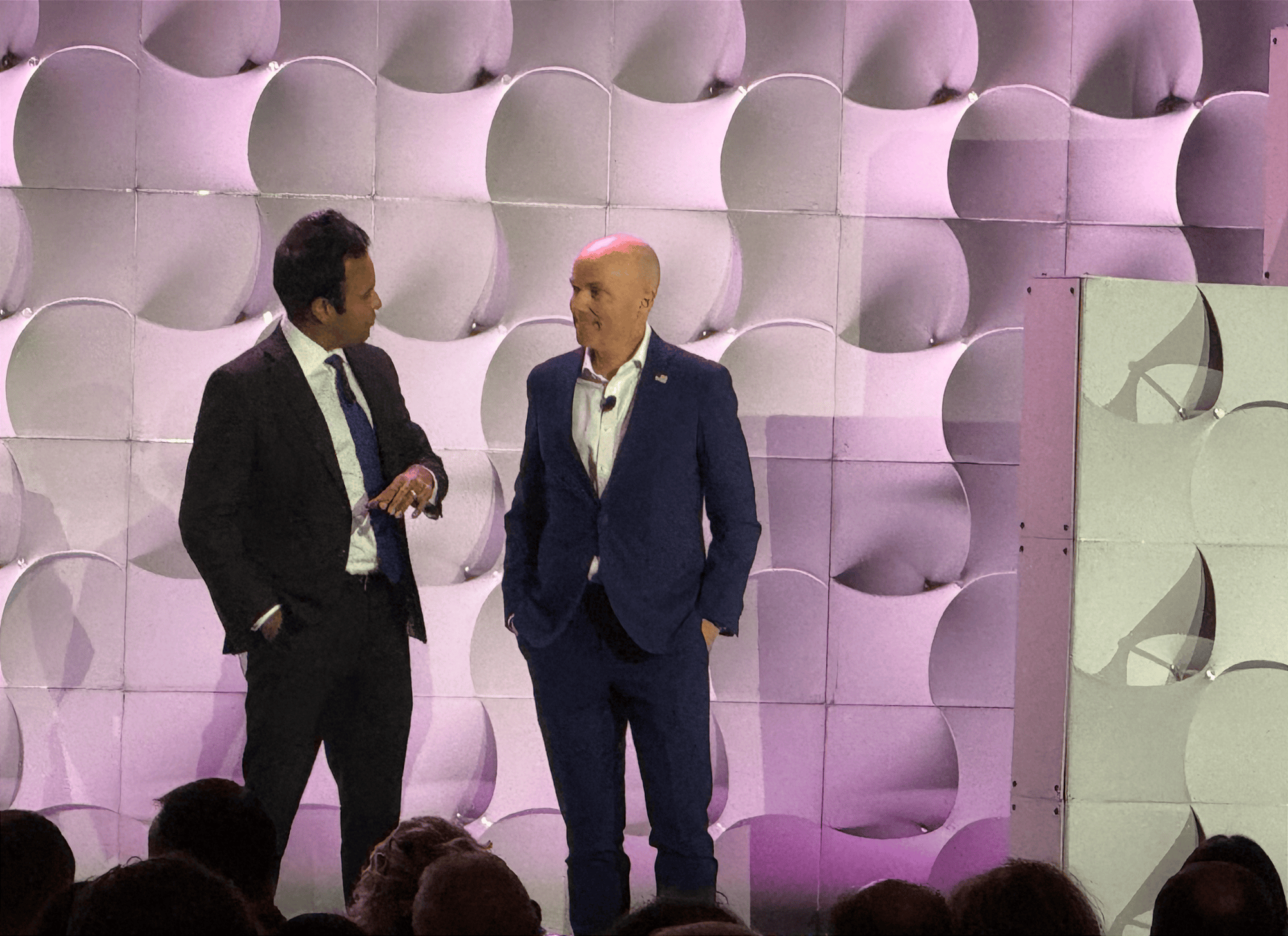
Vivek Ramaswamy speaks with Governor Spencer Cox during the Lunch Main Stage session "Seizing the Energy Moment" at the Operation Gigawatt Summit, Grand Hyatt Deer Valley, May 22, 2026. Ramaswamy — biotech entrepreneur, bestselling author, former 2024 presidential candidate, brief co-head of the Department of Government Efficiency under President Trump, and now the Republican nominee for Governor of Ohio — delivered the summit's lunch keynote.
The message that emerged from the day was consistent and urgent: Utah isn't waiting. And if the rest of America is paying attention, it shouldn't wait either.
The Legislative Head Start
Utah House Speaker Mike Schultz didn't mince words when asked about the state's position relative to the rest of the nation.
"Our legislation was passed and done, and other states are playing catch up to us now," Schultz said. "We started talking about these things two to three years before everybody else did."
He credited Utah's citizen legislature model as a structural advantage — pointing out that the current legislature includes both an electrical engineer and a former power company CEO. "That's one of the reasons why you saw Utah get ahead of everything else," he said.
The legislation Schultz is most proud of includes SB 132, which addressed a problem that most energy conversations overlook entirely. While the national debate fixates on power generation — how many gigawatts of solar, wind, nuclear, or gas can be brought online — Schultz argued the real bottleneck is distribution: getting power from where it's generated to where it's needed.
SB 132 tackled this in two ways. First, it required large new load users — data centers and advanced manufacturers that are driving Utah's explosive growth — to either bring new power to the system or generate their own, rather than simply drawing from existing capacity. Second, it created tiered rate flexibility within the Public Utilities Commission, allowing large load users to voluntarily pay higher rates, with that premium revenue directed specifically toward transmission lines, substations, and transformers.
The scale of what's coming makes the urgency plain. And the debate it's generating makes the stakes equally clear. The Stratos Project, a MIDA-approved hyperscale data center campus in Box Elder County backed by investor Kevin O'Leary, would at full buildout consume up to 7.5 gigawatts of power, nearly double Utah's current average energy use. Box Elder County commissioners approved the project on May 4 after contentious public meetings, and the development still faces years of permitting reviews and unresolved environmental questions around air quality and water use. Supporters argue it would generate $108 million annually at full buildout and create thousands of jobs. Critics argue the rural desert site raises serious environmental concerns that haven't been adequately addressed. Both sides agree on one thing: a project of that scale requires an energy infrastructure framework capable of handling it. Which is precisely what Utah has been building.
"Right now everybody's just focused on the power generation," Schultz said, "but you have to think, how do you actually distribute that power once it happens? That's what that big part of SB 132 did."
Looking ahead, Schultz was unambiguous about Utah's next move: nuclear. "We've created the regulatory framework here in the state of Utah. We're ready to start building nuclear, we're ready to start producing energy, and that's where we would like to move next. We can't move fast enough."
He also flagged AI-driven job displacement as a coming challenge that energy production is uniquely positioned to address. "AI is going to have a disruption inside the job market, significantly. There's going to be a lot of jobs eliminated. So we're looking at energy and energy production as one of those industries that can backfill some of those jobs."
The Federal Logjam — And a Rare Bipartisan Signal
If Utah's state-level story is one of momentum, the federal story is more complicated, though perhaps more hopeful than the headlines suggest.
Rep. Celeste Maloy, who represents Utah's 2nd Congressional District offered one of the day's most candid assessments of why Washington keeps stumbling on permitting reform despite near-universal agreement that it's necessary.
"When you ask people if they want permitting reform, almost universally people do," she said. "Until you start doing permitting reform."
Her diagnosis: decades of regulatory layering have created a system so opaque that the public has lost track of what any given regulation is actually protecting. Congress passes laws. Those laws get interpreted, reinterpreted, and overinterpreted. New regulations get added on top of failing ones instead of replacing them. Eventually, as Maloy put it, "nobody knows why these permits are so important, or what we're keeping ourselves safe from anymore."
Her proposed reframe: start every permitting reform conversation by asking a simple question. "Who are we keeping safe, and what are we keeping them safe from? If we're keeping ourselves safe from building infrastructure, then we've got to revamp it."
She was also unusually self-critical about the legislative tendency to get ahead of the public. "Sometimes for people in my position, it's tempting to just sit in an ivory tower, feel like we have the answers, write a bill, put it out there, and then we can't figure out why people aren't excited about it." She paused. "Guilty."
On the political outlook, Maloy offered a pragmatic forecast: if Republicans hold the House in the midterms, she expects significant permitting reform in the 120th Congress. The ideas are written. Many have bipartisan support. They're just waiting for political bandwidth in a city perpetually distracted by, as she put it, "whatever dumpster fire is happening this week."
The bipartisan signal she offered was notable. Maloy co-chairs the Build America Caucus, a caucus started by Democrats that invited her in as Republican co-chair. She described blue-state members who have traditionally been the most defensive of regulation now asking a different question entirely: "We can't build things in this country anymore. Why is that? What do we have to fix?"
A Policy Outcome Before the Day Was Over
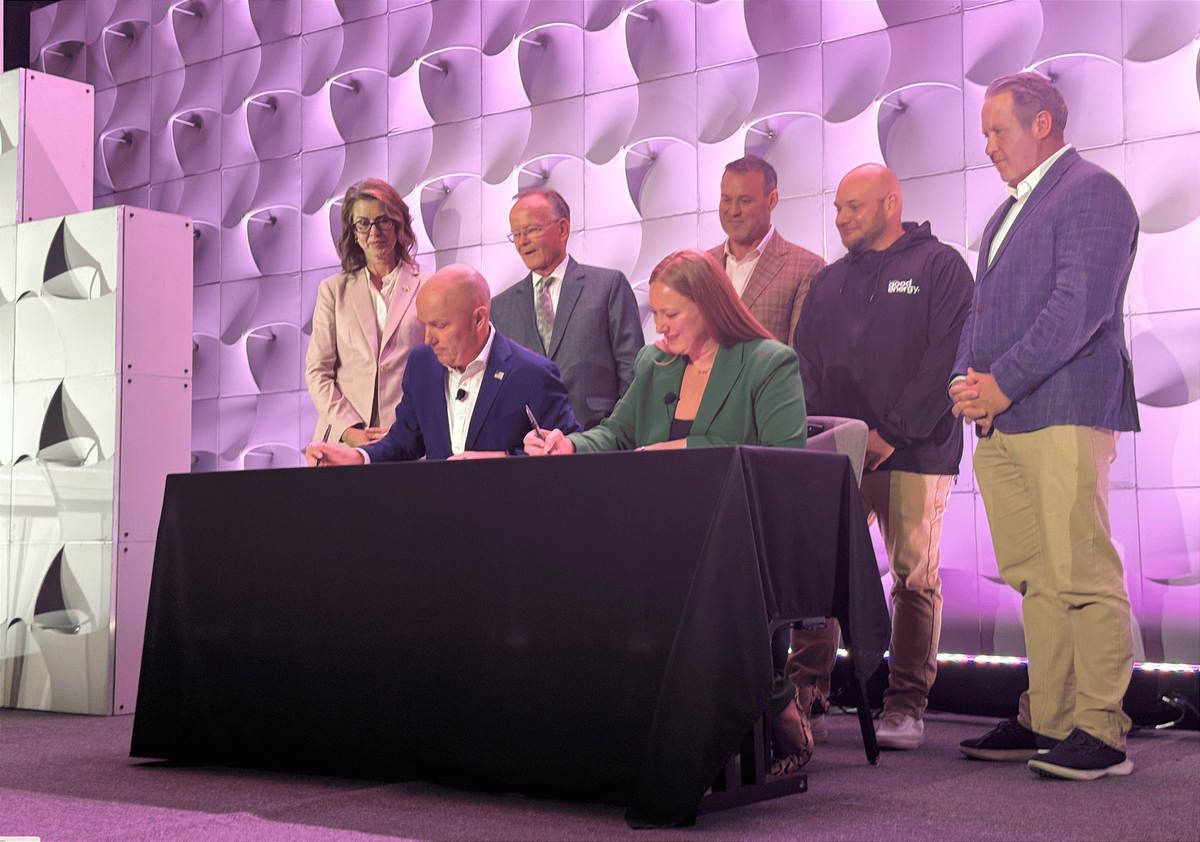
The summit didn't just generate conversation — it generated action. Governor Cox signed a formal agreement with the White House Federal Permitting Improvement Steering Council to better align state and federal permitting timelines for critical infrastructure and energy projects.
Governor Spencer Cox and White House Permitting Council Executive Director Emily Domenech sign a state-federal permitting agreement during the Operation Gigawatt Summit, Grand Hyatt Deer Valley, May 22, 2026. Looking on, from left: Lt. Governor Deidre Henderson, Senate President Stuart Adams, House Speaker Mike Schultz, Torus CEO Nate Walkingshaw, and Jefferson Moss, Executive Director of the Governor's Office of Economic Opportunity.
"Utah is serious about building, and that means making permitting more transparent, accountable, and predictable," Cox wrote on LinkedIn immediately after the summit. The agreement, reached in partnership with Executive Director Emily Domenech and the Federal Permitting Improvement Steering Council, is designed to reduce unnecessary delays, strengthen domestic supply chains, and support more reliable and affordable energy for Utahns, while ensuring, in Cox's words, that Utah can "continue to responsibly steward the land, air, and water that make Utah special."
It was exactly the kind of tangible, same-day outcome the summit was designed to produce.
The Nuclear Moment
If permitting reform was the policy theme of the day, nuclear was its emotional center.
John Wagner, Director of the Idaho National Laboratory, offered the summit's most direct articulation of why energy abundance is ultimately a humanitarian argument. "I believe in energy abundance to prosperity and to longevity of human lives," he stated. "Any metric you look at that improves the quality of life and energy — they're directly correlated."
Energy Secretary Wright was equally direct. He said Utah is one of the top leaders in nuclear technology development in the country, and the state's welcoming business environment, focus on safety, and policy alignment with the Trump administration's energy agenda position it to draw billions in investment. "Utah's policies, the leadership, the philosophies, just perfectly aligns with President Trump's energy agenda," Wright stated. "Utah is going to be key in the future of nuclear energy."
The timeline is closer than most realize. Wright noted that Utah is on track to host this summer, ideally by the July 4th 250th national commemoration, one of the first small modular fission reactors to achieve a steady, self-sustaining chain reaction. The state has also applied to host one of three federal "nuclear lifecycle innovation" campuses, which would support activities across the full nuclear fuel lifecycle including enrichment, reprocessing, and waste disposition. Wright called Utah's application "outstanding."
Cox, for his part, acknowledged the weight of that history in a state that lived with the consequences of nuclear weapons testing and uranium mining. "That's not what we're doing," he said. "We're not blowing up nuclear in the desert anymore." What Utah is doing, he argued, is building the next generation of smaller, cheaper, safer reactors — and doing it faster than anyone else.
Left: Dr. Rick Springman, President of Holtec International, a global nuclear energy technology company specializing in small modular reactors, spent fuel storage, and plant decommissioning, speaking during a panel at Utah's Operation Gigawatt Summit at the Grand Hyatt Deer Valley, May 22, 2026. The summit convened federal officials, legislators, and energy founders to accelerate the state's nuclear and clean energy ambitions.
Google, Base Power, and the Grid Citizenship Question
Perhaps the most reframing moment of the day came from Kaitlin Savage of Google, who pushed back against the dominant narrative that hyperscale data centers are a burden on the grid.
Google's stated daily objective, she explained, is to ensure that when a Google data center comes to a community, it makes the grid stronger, more reliable, and more affordable, not weaker. The company calls this its "grid citizenship commitment," and Savage argued it's more than a PR posture.
She pointed to edge transmission technologies as a concrete example, arguing that the pace of deploying grid modernization infrastructure would simply not happen without the capital urgency that data centers bring. "The speed of deployment will be dramatically accelerated because of data center investments," she said.
Her broader vision was integrative: rather than treating AI as a threat or a monolith, she described it as a common thread woven through a reindustrializing America: connecting shipbuilding, defense technology, advanced manufacturing, and energy into a coherent national strategy. "This is a more optimistic vision for America's future," she said.
Justin Lopas Co-Founder and COO of Base Power (Austin, TX) brought the session's most concrete deployment numbers. His company has installed tens of thousands of distributed home battery units — each roughly the size of an air conditioning unit — across Texas and Illinois, and is approaching half a gigawatt-hour of total deployed capacity, on track for a full gigawatt-hour this year. They are installing more than 100 units per day.
His counterintuitive argument: distributed battery systems are more effective than grid-scale batteries, not less. Aggregated home batteries, he explained, collectively exceed grid-scale storage in both size and effectiveness, and their distribution is itself the strategic advantage.
But Lopas identified a friction point that rarely makes it into energy policy conversations: municipal permitting fragmentation. Base Power operates across hundreds of cities, each with its own permitting regime. "One house across the street from another is on a totally different permitting regime," he said. The company has built custom software to manage each municipality's process — a workaround that works, but shouldn't be necessary.
His wish for Utah and other states: standardization of the regulatory regime at the state level, preserving local community relationships while eliminating the absurdity of hundreds of incompatible permitting systems within a single metro area.
The Vision: Energy as the Foundation for Everything
A memorable moment came when Governor Cox asked the 11:00am Frontier Tech panel to share their vision for America over the next decade.
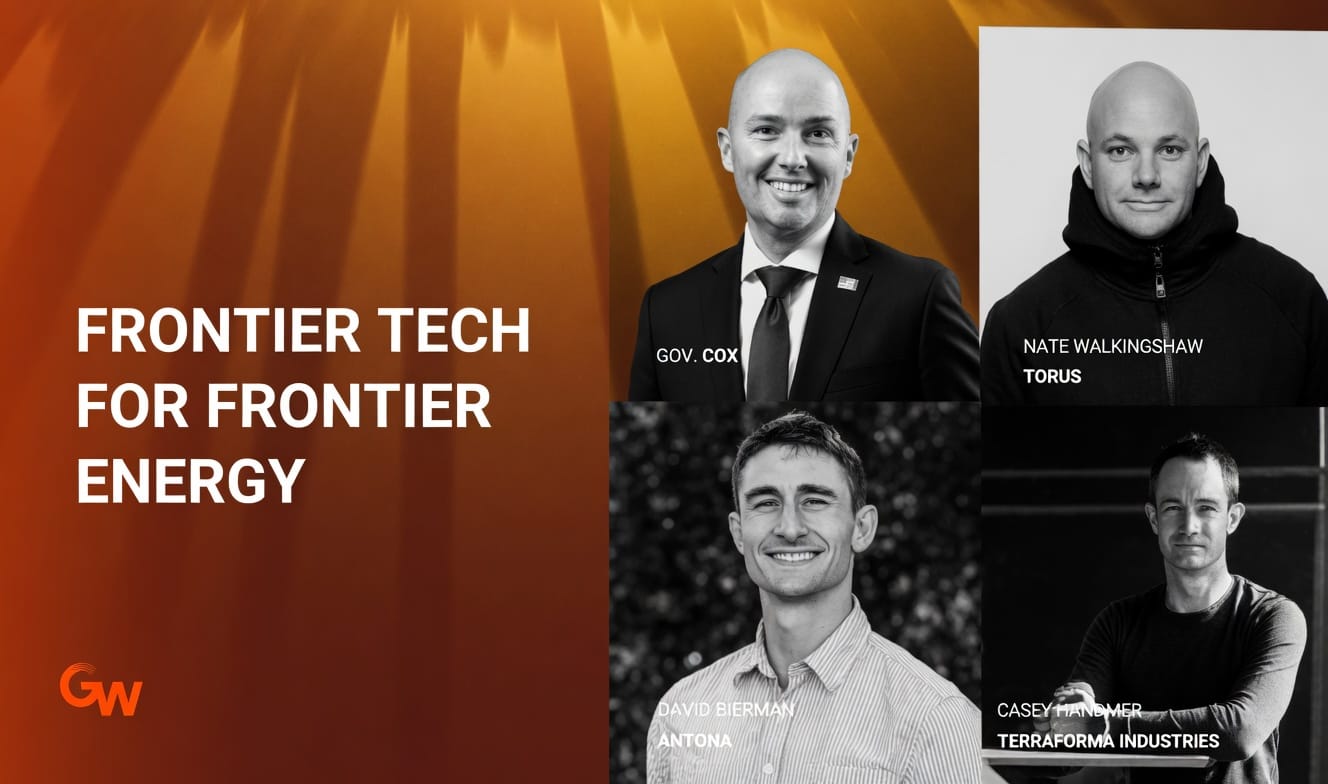
The Frontier Tech for Frontier Energy panel (Power Session 2) at the Operation Gigawatt Summit, Grand Hyatt Deer Valley, May 22, 2026. Clockwise from top left: Governor Spencer Cox; Nate Walkingshaw, co-founder and CEO of Torus; Casey Handmer, founder of Terraform Industries; and David Bierman, co-founder and Chief Commercial Officer of Antora Energy.
David Bierman, co-founder and Chief Commercial Officer of Antora Energy, set the stage. His Sunnyvale, California-based company makes thermal batteries that convert intermittent renewable electricity into reliable industrial heat and power, storing energy in superheated carbon blocks that can hold a charge for over 100 hours at a fraction of the cost of lithium-ion alternatives. Antora recently expanded its US factory and has already shipped gigawatt-hours of storage to industrial customers in the Midwest. For the Operation Gigawatt audience, his presence was a reminder that the energy transition is not just about generation. It is also about making stored, reliable energy available to the manufacturers and data centers that anchor the American economy.
Nate Walkingshaw, co-founder and CEO of Torus, provided the moment to remember. He got emotional — visibly, unapologetically so — in a room full of executives, federal officials, and engineers. Torus, the South Salt Lake company that pairs mechanical flywheels with battery storage into modular hybrid power plants that respond to grid signals in milliseconds, raised $200 million from Magnetar last September and is scaling toward GigaOne, a 540,000-square-foot manufacturing campus in Salt Lake City slated to produce more than a gigawatt per quarter within three years. TIME named the Torus Spin one of the best inventions of 2024. None of that was what he wanted to talk about.
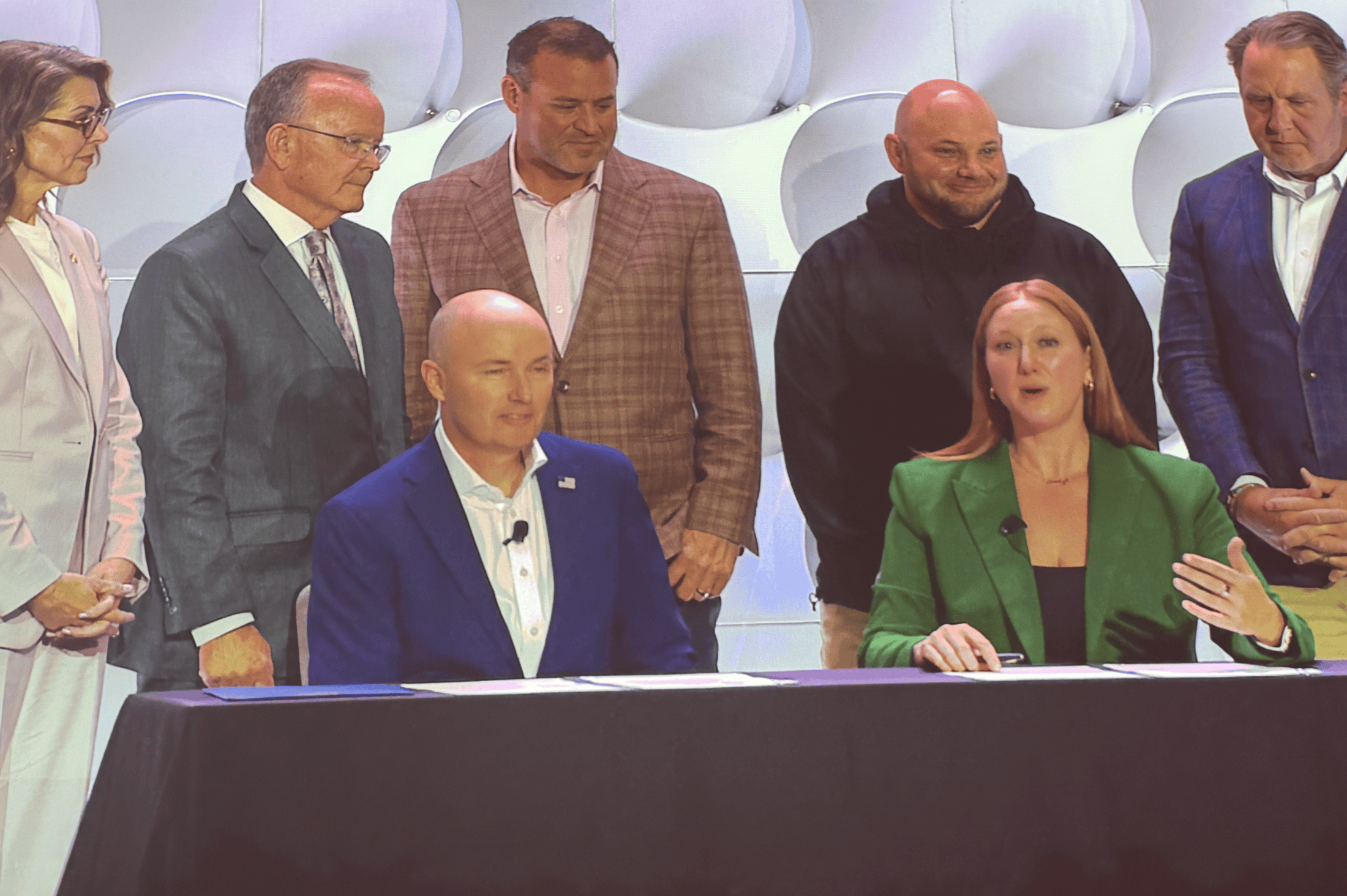
Governor Spencer Cox; David Bierman, co-founder and Chief Commercial Officer of Sunnyvale-based Antora Energy; Casey Handmer, founder of Burbank-based Terraform Industries; and Nate Walkingshaw, co-founder and CEO of South Salt Lake-based Torus (with microphone), during the Frontier Tech for Frontier Energy panel at the Operation Gigawatt Summit, Grand Hyatt Deer Valley, May 22, 2026.
A Utah native who built his company with 88% of its bill of materials sourced within 150 miles of its facility, Walkingshaw talked about his four sons and the America he grew up in during the 1970s and 80s — backyard barbecues, no anxiety about energy or security, just the quiet confidence of a country that knew how to build things.
"We have got to give it everything we have to build a better version of the thing that I grew up in," he said.
He told a story about a woman who came to work at Torus a few months after experiencing homelessness. She progressed through multiple manufacturing roles and now works in advanced energy storage production, earning a strong wage with significant career growth opportunities.
"We need to be able to take anyone from any walk of life and bring them into our facilities and give them a safe place to go work, to go build, to use their imagination," he said. "I have hope and ambition and optimism that we're back on track."
Casey Handmer, founder of Terraform Industries, offered the session's most sweeping and surprising vision: the American Southwest is not water-scarce, he argued — it is energy-scarce. With sufficient cheap energy, desalination from the Pacific Ocean could eliminate the water constraints holding back growth across Utah, Nevada, Arizona, and New Mexico.
"All it takes is energy to convert that water," Governor Cox offered.
"Which is free," Handmer replied. "It falls from the sky, and the crust is made of rocks that will fission."
It wasn't an abstract argument. Handmer's Burbank-based company is already doing something that sounds equally impossible: making pipeline-grade natural gas from sunlight and air. Terraform's Terraformer machines use solar power to pull carbon dioxide directly from the atmosphere and convert it into synthetic methane — the same molecule as fossil natural gas, but with no new carbon extracted from the ground. As of this month, the company has deployed 1.8 megawatts of solar at its Muroc desert test site, produced and sold thousands of cubic feet of pipeline-grade natural gas, and is actively hiring a desalination lead engineer. The water vision, in other words, isn't a talking point. It's already on the roadmap.
That exchange with Cox may be the best single encapsulation of what Operation Gigawatt is actually about. Not just power plants and transmission lines and permitting reform — though all of those things matter enormously — but a fundamental belief that energy abundance unlocks everything else. Industries we haven't imagined yet. Jobs for people we haven't met yet. Water for cities that don't exist yet.
Barclay Burns, assistant dean in UVU's Smith College of Engineering and Technology, attended the summit and came away with a clear impression of what set it apart.
"What struck me is that the Governor and the other speakers are being very thoughtful about their approach to energy policy and that they are focused on a wide range of energy solutions to meet Utah's and the nation's energy challenges," Burns said. "There was no single silver bullet being promoted in that room. You heard serious conversations about nuclear, advanced geothermal, distributed storage, solar, natural gas, and frontier technologies all in the same breath — not as competing agendas but as complementary tools. The underlying message was that abundance requires all of it, and Utah is serious about pursuing all of it."
Utah, it seems, has decided to find out.
The Operation Gigawatt Summit was hosted by Governor Spencer Cox and powered by the Abundance Institute. Tickets sold out early. The one-day summit was held May 22, 2026 at the new Grand Hyatt Deer Valley, part of the Mayflower Mountain Resort development, designed by OZ Architecture for Extell Development and Utah's Military Installation Development Authority (MIDA) — making it the only MIDA facility at a US ski resort. The site sits on the former Mayflower Star Mine, which once produced more silver, gold, lead, and zinc than all the rest of the Park City area combined.
Share this article
The link has been copied!
Your link has expired. Please request a new one.
Your link has expired. Please request a new one.
Your link has expired. Please request a new one.
Great! You've successfully signed up.
Great! You've successfully signed up.
Welcome back! You've successfully signed in.
Success! You now have access to additional content.