Living Computers, AI Coaches, and Thirty-Second Pitches Packed the House at Silicon Slopes in Lehi
Four Utah startups — building living computers, AI health coaching, topical pain relief, and eye-based anemia detection — pitched at Silicon Slopes' Third Thursday, drawing a standing-room crowd of investors and entrepreneurs.
Inside the Silicon Slopes office in Lehi, a quote from Theodore Roosevelt greets visitors on a wall near the entrance:
"It is not the critic who counts: not the man who points out how the strong man stumbles or where the doer of deeds could have done better. The credit belongs to the man who is actually in the arena..."
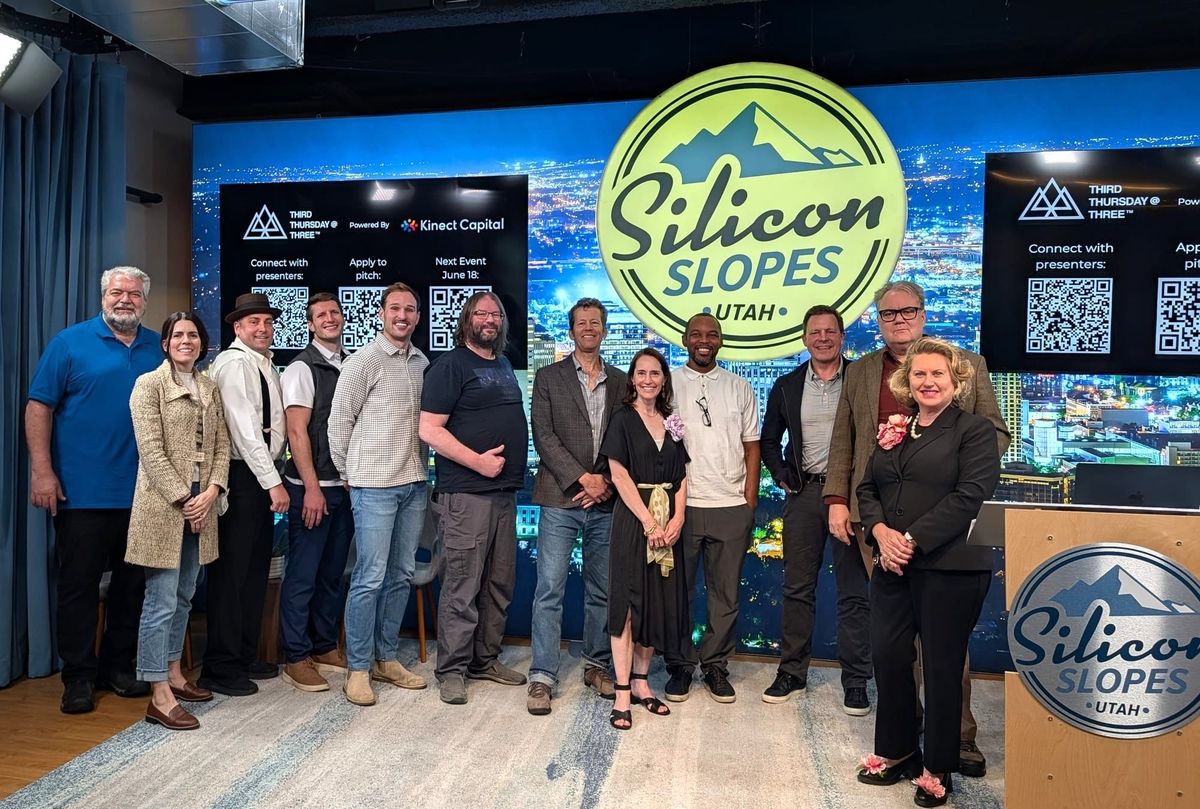
It's an apt introduction to Third Thursday @ Three a monthly event where investors, business owners, and entrepreneurs show up to pitch, network, and occasionally change the direction of a company in the span of three minutes.
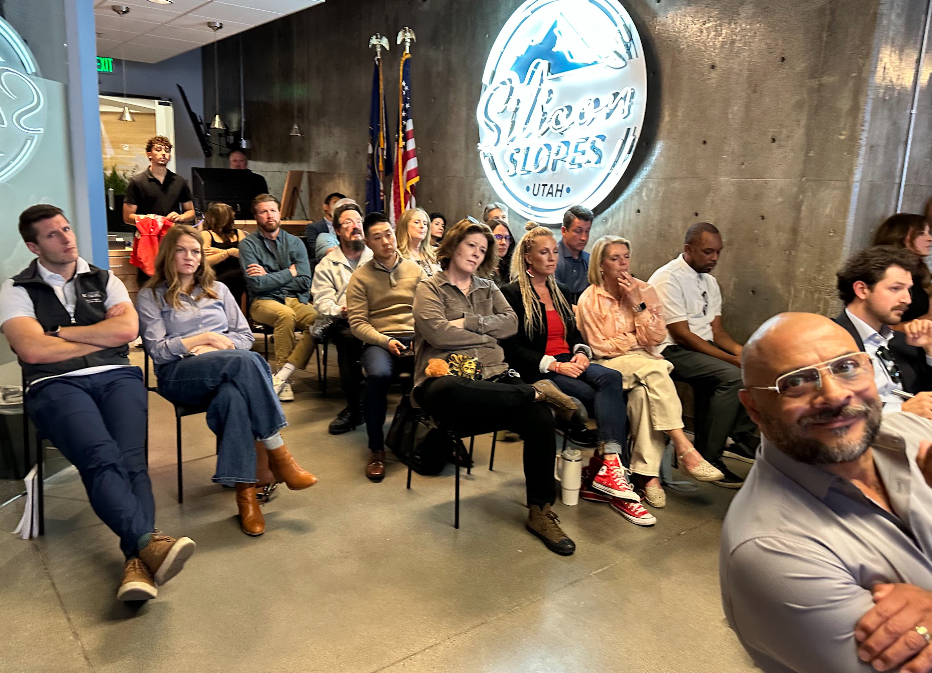
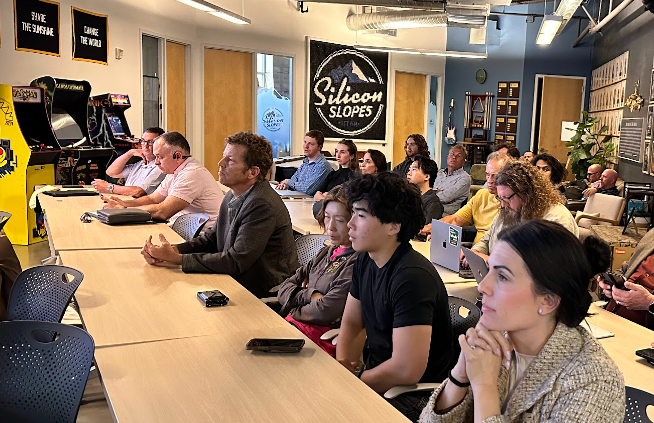
The April 21 event ran from 3:00 to 5:00 p.m., and the house was packed.
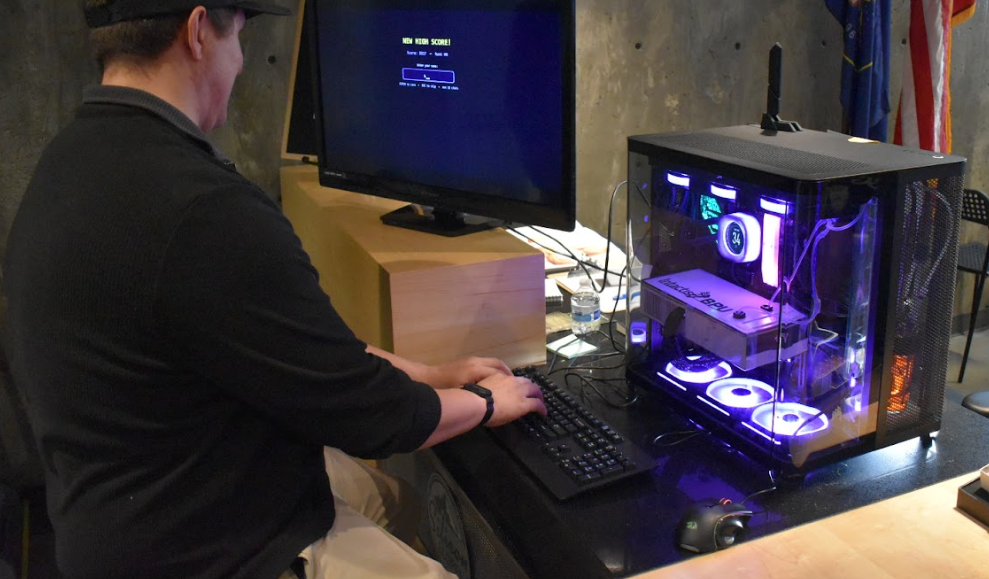
As you walk into this Third Thursday @ Three event, you're immediately greeted by a massive tower computer playing something that looks like Tetris, and a small crowd admiring it. Inside is a large, custom-built graphics card (A component that takes raw code and converts it into visual information you see on a screen, like animations, visuals, and graphics).
Except it isn't a graphics card at all. Meet the owner: Daniel Rodriguez-Granrose, who says that not only did he build the computer, he also built the large card hanging inside it. And it's made of the same material that makes up your brain.
Vanessa Perez, president of MakeUtah, opened the event, repeatedly inviting people to come in, sit down, and asking those with empty chairs beside them to raise their hands. Dozens of crowd members sat and listened intently. Others stood in the back rather than miss a word.
This month featured four pitch groups, one more than the usual three. Each startup had three minutes to present, followed by a three-minute Q&A.
The Four Pitches
Intactis Biocorp — Daniel Rodriguez-Granrose
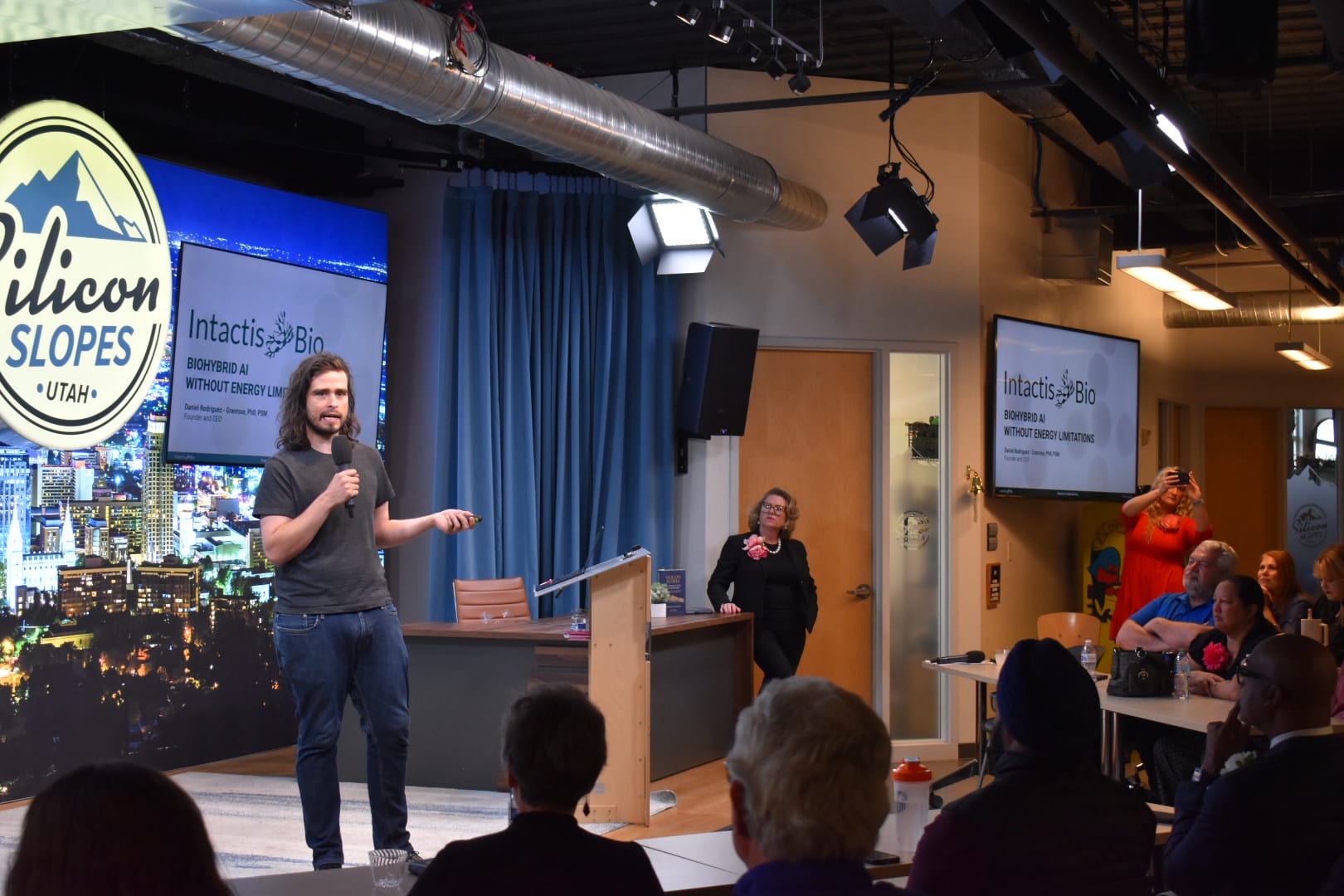
Rodriguez-Granrose is the founder and CEO ofIntactis Biocorp, a Salt Lake City startup incubated atAltitude Labs that is building bio-hybrid computers with living neurons at their computational core.
Daniel Rodriguez-Granrose, CEO of Intactis Bio, speaking at the May Third Thursday @ Three, Silicon Slopes, Lehi Utah, with Vanessa Perez, MakeUtah President, looking on.
Rodriguez-Granrose has been featured twice before on TechBuzz — first in September 2025, when Intactis Bio was pioneering energy-efficient AI with living neural tissue, and again in March 2026, when lab-grown neurons successfully performed math and transmitted "Hello, World!" for the first time. The April event marked his next chapter: a working bio LLM with a paying customer.
"We are in an AI energy crisis. Companies today cannot scale their data centers to match business demands, because nobody can power them. At the same time, each of your brains are still vastly more capable than our best data centers, despite the fact that they consume roughly a million times less energy."
To put that in perspective: a human brain performs roughly 10,000 times more operations per second than a supercomputer, while consuming one million times less energy per day.
His solution: living computers, with real neurons at their core.
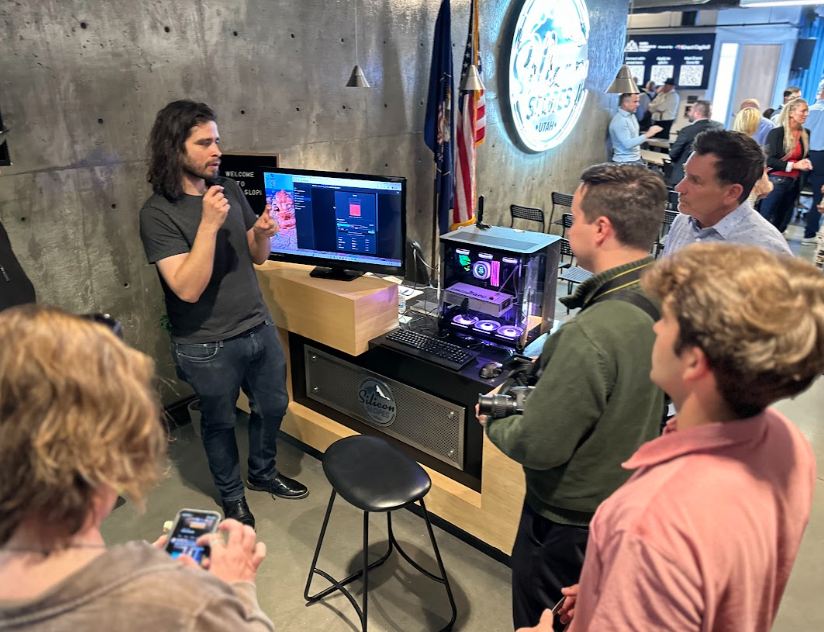
"The human brain is the most energy-efficient processor possible under the laws of physics. So, to take advantage of this energy efficiency, we have builtbio-hybrid computers with living neurons at their computational core. We just recently unveiled our bio-hybrid processing unit, which is a rack-mountable unit that allows us to use existing AI infrastructure to scale up and scale out the product."
Daniel Rodriguez-Granrose, CEO of Intactis Bio, demonstrating his company's tech at the May Third Thursday @ Three, Silicon Slopes, Lehi Utah,
The Tetris machine in the corner of the room wasn't decoration. It was evidence.
"We have a bio computer that actually works. There's one right back there. It'll kick your butt in Tetris. We've got abilities in language and math, and we've successfully developed a bio LLM with a paying customer for the first time today."
The initial commercial product is Cloud Bio Compute as a service, currently offered out of Intactis's lab atAltitude Labs in downtown Salt Lake City, with plans to expand into data center partners including GTR and Helios. Rodriguez-Granrose sees particular value in adaptive AI applications like gaming and AI development.
"The discrepancy between demand and availability is so large that we have a structured funnel, which we think is going to get us to $500 billion ARR by 2032."
During the Q&A, an audience member asked how Intactis would handle public trust — a pointed question for a company asking people to accept computers made of human tissue.
Rodriguez-Granrose didn't flinch. "Hopefully better than everyone else. I think the bar is pretty low." The crowd laughed. He continued: "We're being very proactive in terms of what we think is necessary to make this in an ethical way. But to the first order, one of the largest problems is the AI energy crisis, as the world is warming up, so we actually see this as a very net positive for current trends."
Someone else asked where the living neurons come from.
"Adult consenting donors give their blood cells, and then they turn those into stem cells," Rodriguez-Granrose said. "There's no underwriting in terms of ethical review or concerns, because they're just generic commercially available adult stem cells."
In practice, the process begins withpluripotent stem cells derived from human blood samples, which are then guided into becoming neurons.
The bio-chips slot in and out and last at least three to four months — with one lasting as long as nine months in testing. What keeps them alive is a bioreactor, which Rodriguez-Granrose compared to a yeast machine used in brewing beer. The chips can even be transported alive without a bioreactor for up to four hours.
Intactis is currently aiming to raise $5 million to bring the BPU to data center partners and continue product development. The company projects a 95% reduction in energy costs and a 90% reduction in total costs compared to traditional silicon systems, along with an 88% reduction in physical data center footprint.
The April 21 event marked the first day the prototype was online — and Rodriguez-Granrose had already secured early momentum: $100,000 from Convoi and an additional $150,000 from a second investor group who requested anonymity.
Qonscious Health — Dr. Jarik Conrad
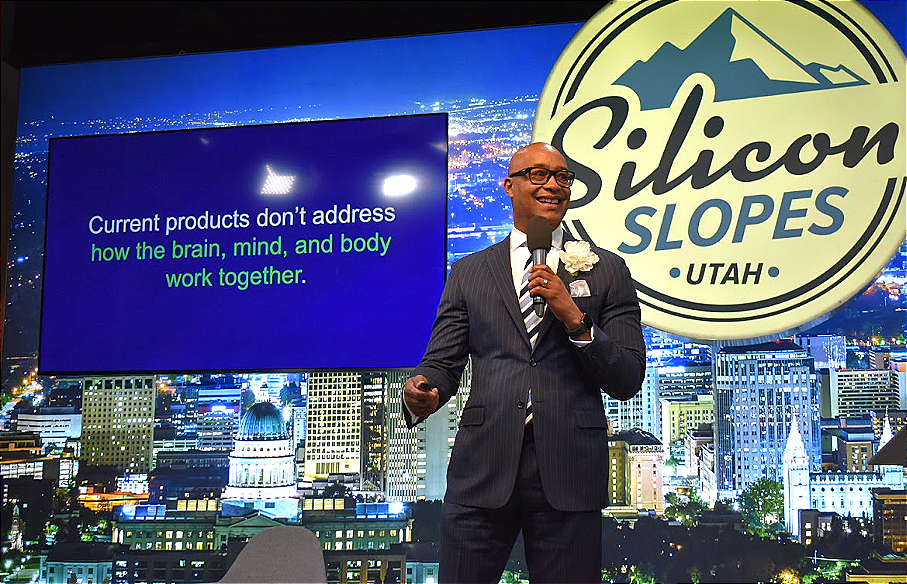
Dr. Jarik Conrad, founder and CEO of Qonscious Health, laid out a problem with uncomfortable precision: 40 million Americans have type 2 diabetes. Around 399,000 die from it each year. It is the seventh leading cause of preventable death in the United States.
His response is the Qonscious Behavioral Operating System — QBOS — an AI coach designed to address not just what patients know, but how their brains, minds, and bodies actually work together.
Dr. Jarik Conrad, founder and CEO, Qonscious Health, on stage at May Third Thursday @ Three, hosted by Silicon Slopes, Lehi, Utah
"Current products don't address how the brain, mind, and body work together," Conrad said. The AI is meant to give real-time feedback at any hour, "three in the morning," as he put it, and it's designed not to be agreeable, but to challenge users into making actionable lifestyle changes.
The app integrates emotional intelligence, life coaching, and executive coaching training — certifications Conrad has earned across more than two decades in human resources. A study at the Mayo Clinic explored how nutritional, coaching, and emotional intelligence-centered strategies can significantly impact cardiometabolic health in overweight adults, the science that helped inform the product's design.
But the development wasn't only professional. It was personal.
"I've lost all my siblings, both parents, and really all my immediate family to chronic health issues. Most recently my sister died from diabetes, and so I've been for years trying to figure out how to help. I used to think it was just an educational thing. If people only understood that they need to do X, Y, and Z, and this stuff is reversible, they'll do it, but they couldn't do it."
That gap between knowing and doing is what QBOS is built to close.
"I want to say it's my life's work, right? I didn't know I was developing it, even when I was, because I've been in this area now for 20-plus years. But the company is relatively new. We just launched in July."
The app is currently available in app stores, but Conrad is holding off on a push to scale until after a clinical trial scheduled for next month. "We feel it's really important to move aggressively on this, because so many people are dying every day from these avoidable issues."
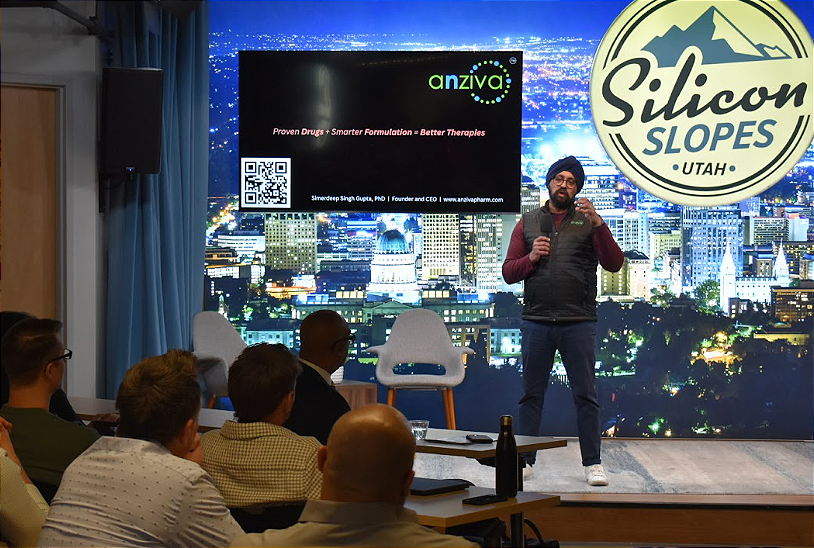
Anziva Pharmaceuticals — Simerdeep Singh Gupta
Dr. Simerdeep Singh Gupta, founder and CEO of Anziva Pharmaceuticals, drew a laugh early in his pitch, before he had even finished his origin story.
Dr. Simerdeep Singh Gupta, founder and CEO of Anziva Pharmaceuticals, on stage May Third Thursday @ Three, hosted by Silicon Slopes, Lehi, Utah
When asked how he came to develop J'Neura, a topical knee patch designed to relieve pain in around an hour, he explained that when he was conceptualizing Anziva a couple of years ago, his Australian wife had some advice for him. She told him to break a leg. Gupta said he took her literally: he completely tore his ACL, MCL, and hamstring. The crowd laughed. From that injury, and from his frustration with existing pain management options, the idea for J'Neura was born.
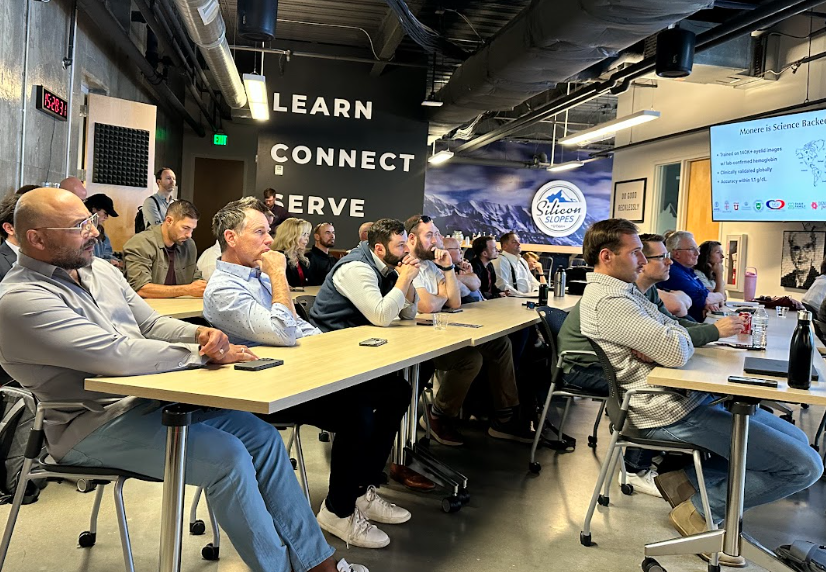
Audience at the May Third Thursday @ Three, hosted by Silicon Slopes, Lehi, Utah
Monere — Mou Nandi
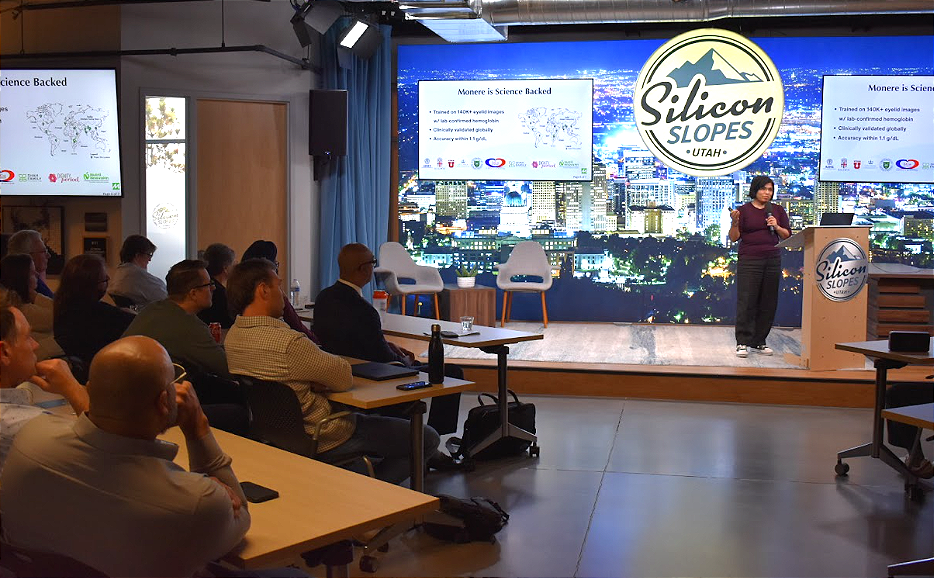
Mou Nandi, CEO and co-founder of Monere, presented an app built around a surprisingly accessible diagnostic: a photo of your eye.
The mission became personal when two of Nandi's close friends were affected by anemia — one needed a blood transfusion after dismissing warning signs like fatigue and dizziness.
"Hemoglobin is the fuel of your life. It's a protein that is the host of 70% of iron in your body, and it actually drives your productivity and your cognitive power. It also drives your performance as an athlete."
Mou Nandi, CEO and co-founder of Monere, onstage at Silicon Slopes-hosted Third Thursday @ Three, Lehi, Utah
Drawing on a dataset of over 120,000 data points, Monere's technology is designed to measure hemoglobin levels in women from anywhere in the world using only a smartphone — no lab required.
"We built our AI platform that takes an image of your eye and converts it to hemoglobin level, and it takes seconds to talk to our AI platform, and you can take steps like better nutrition and talking to your doctor."
Low hemoglobin, or anemia, can cause fatigue, complications during pregnancy, and in severe cases, serious health risks — conditions that often go undetected in areas without easy access to medical testing.
"Low hemoglobin can have maternal and generational risk. Women are disproportionately affected."
The platform has demonstrated more than 92% accuracy for women and children. Anemia affects over two billion people worldwide, and Monere has already completed over 82,000 screenings globally, selling more than one million tests across studies in the U.S., Canada, Brazil, Nepal, and India.
Nandi's pitch positioned Monere as a tool to close that gap at scale. She was previously featured on TechBuzz in March 2026, where she spoke about the company's origins and her vision for accessible health monitoring.
Audience at the May Third Thursday @ Three, hosted by Silicon Slopes, Lehi, Utah
Thirty Seconds at a Time
After the four main pitches, around ten entrepreneurs were invited to the front for thirty-second pitches — a rapid-fire round that ranged from wellness apps to recruiting tools to sports technology.
One of the most memorable came from Danjuma Alcala, a self-described opportunity advocate, who pitched Sporting-U: an AI coaching app for young athletes.
"AI provides a motivational and technical coach for the athlete, where they can focus on skill development. As they develop, the AI will use a reference video, watch the athlete do the skill, and tell them what they need to do. The goal is to help parents who are not athletes in the sport to be the motivational coach for their kid."
The system is also designed to recognize when athletes are tiring or losing confidence, then shift into a motivational mode using mindfulness techniques to help them recenter.
Alcala has a longer vision for the platform. His long-term goal is for Sporting-U to become the gold standard for college recruiting — a way for coaches to evaluate athletes not just on highlights, but on documented skill development over time. And he wants to bring it to Roblox, where kids could earn points and virtual currency for being physically active, meeting young athletes where they already spend their time.
Audience at the May Third Thursday @ Three, hosted by Silicon Slopes, Lehi, Utah
About MakeUtah and Connect Capital
Vanessa Perez, president of MakeUtah, introduced the organization's Connect Capital program, which she described as the oldest venture accelerator in the world. Connect Capital helps startups raise venture capital without requiring them to relocate, is staffed entirely by volunteers, and offers opportunities for mentors to sign up. The organization's website is also currently undergoing a relaunch.
After the Pitches
The formal event wrapped up around 5:00 p.m. — the hard deadline for vacating the building — but the conversations didn't stop. Entrepreneurs, investors, and audience members spilled into the hallways, still trading cards and ideas as the lights dimmed on another Third Thursday @ Three.
The man in the arena, Roosevelt said, is the one who counts. On April 21st in Lehi, the arena was standing room only.
Share this article
The link has been copied!
Your link has expired. Please request a new one.
Your link has expired. Please request a new one.
Your link has expired. Please request a new one.
Great! You've successfully signed up.
Great! You've successfully signed up.
Welcome back! You've successfully signed in.
Success! You now have access to additional content.