Zero-Day-Q: Silicon Slopes Quantum Chapter Tackles the "Quantum Cliff"
Silicon Slopes Quantum hosted its second chapter meeting on post-quantum cryptography readiness, featuring an SBA regional advocate and Utah blockchain leaders discussing Q-Day risks, encryption timelines, and the state's opportunity to lead in quantum-resilient technology.
Silicon Slopes Quantum held its second chapter meeting to address what organizers are calling the "quantum cliff" — the point at which quantum computers become powerful enough to break the encryption standards that currently protect most digital data.
The session—titled Zero-Day-Q: Navigating the Quantum Cliff—and co-hosted by chapter chair Sumit Parashar and Russ Simon of Leadership Solutions, combined a technical primer on post-quantum cryptography with a policy discussion and a panel on blockchain risk. The core message: Quantum disruption isn't a decades-away problem—it's a 2029 deadline.
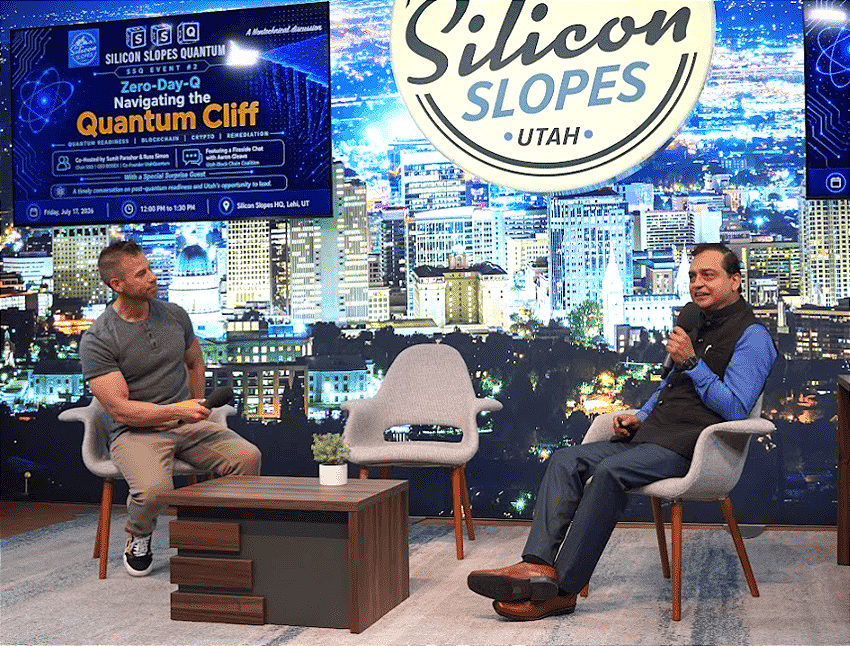
Russ Simon, Leadership Solutions, and Sumit Parashar, Founding Chair of Silicon Slopes Quantum, CEO of BODEX and Co-Founder of UtahQuantum.org, on stage at the "Quantum Cliff" briefing, Silicon Slopes, July 17, 2026, Lehi, Utah. Photo: Mark Tullis, TechBuzz
The non-technical briefing tackled practical readiness, emerging NIST guidance, post-quantum security, and how quantum disruption impacts digital trust, critical infrastructure, blockchain systems, and long-term data security.
The event also featured a fireside chat with Trent Staggs, former Riverton Mayor (who served 2018–2026) and current Regional Advocate for the U.S. Small Business Administration’s (SBA) Office of Advocacy covering Region 8 (Utah, Colorado, Montana, North Dakota, South Dakota, and Wyoming).
The session also included a conversation with Aaron Gleave, leader of the Utah Blockchain Coalition, on how Q-Day specifically impacts blockchain networks and crypto assets.
Y2K vs. Q-Day: A Capability Milestone, Not Just a Calendar Date
The session repeatedly drew a parallel to Y2K, when widespread remediation work — not luck — prevented major failures when two-digit date fields rolled over in 2000. "With Y2K, nothing major broke because companies spent billions of dollars behind the scenes fixing two-digit dates into four-digit dates," Parashar explained. "Q-Day is a similar problem, but with one key difference: it’s defined by a capability threshold rather than a fixed calendar year."
Parashar said he worked directly on Y2K date-conversion fixes earlier in his career. Organizers displayed a timeline estimating that quantum progress will accelerate through 2026–2028, with Q-Day arriving around 2029 and data at heightened risk from 2030 onward.
Sumit Parashar, Founding Chair of Silicon Slopes Quantum (SSQ), CEO of BODEX and Co-Founder of UtahQuantum.org, leading the "Quantum Cliff" briefing at Silicon Slopes, July 17, 2026 in Lehi, Utah. Photo: Mark Tullis, TechBuzz
Parashar and the panelists discussed how major industry leaders—including Google (Willow), IBM, Cloudflare, and Microsoft—have accelerated their projections, pointing toward mid-2029 as the target window when quantum computers become powerful enough to break legacy public-key encryption (such as RSA-2048 and ECC-256) at scale.
The presentation defined "Q-Day" (also referred to as Y2Q or ZDQ) as the anticipated point when quantum computers become capable of breaking current encryption methods such as RSA and ECC.
The 2029 estimate cited during the presentation reflect's Google estimate. Google publicly moved up its own post-quantum cryptography migration deadline to 2029, citing faster-than-expected progress in quantum hardware, error correction, and factoring resource estimates — a timeline the company says is more aggressive than the U.S. federal government's own target.
Parashar framed the "quantum cliff" as a sudden security breakpoint rather than a gradual decline: encryption security holds steady until a threshold is crossed, then collapses rapidly.
Harvest now, decrypt later
A significant portion of the discussion focused on "harvest now, decrypt later" — the practice of adversaries copying encrypted data today with the expectation of decrypting it once quantum computing makes that possible. Parashar said this activity is already occurring based on open-source intelligence reporting. [FACT-CHECK: identify and cite the specific OSINT reporting referenced, rather than presenting the claim as an unattributed given.] Asked whether anything could be done to protect already-harvested data, Parashar said the only real defense is preventing the data from being copied in the first place.
The Invisible Threat: "Harvest Now, Decrypt Later" (HNDL)
While 2029 may still sound distant to some executive boards, Parashar warned that the threat is actively unfolding today through Harvest Now, Decrypt Later (HNDL) attacks.
Sumit Parashar, "Quantum Cliff" briefing, Silicon Slopes, July 17, 2026, Lehi, Utah. Photo: Mark Tullis, TechBuzz
Foreign adversaries and threat actors are actively intercepting and archiving encrypted government, healthcare, financial, and voter data files today. While they cannot read the stolen files right now, they are storing them in data warehouses until quantum computing capabilities go live around 2029 to retroactively decrypt them.
"If your data has already been harvested in its current encrypted state, there is no going back to protect it once Q-Day arrives," Parashar noted. "That's why procrastination means losing the battle in real time."
Federal Mandates & Small Business Capital
The conversation shifted to regulatory action when Trent Staggs joined the stage.
Staggs, an entrepreneur, executive, and public servant, who in May 2025, was appointed as the SBA Region 8 Regional Advocate within the U.S. Small Business Administration’s Office of Advocacy, representing small business interests across Utah, Colorado, Montana, North Dakota, South Dakota, and Wyoming. He served two terms as Mayor of Riverton, Utah (2018–2026), following four years on the Riverton City Council. During his tenure, he prioritized a business-minded approach to municipal management, lowering property taxes and cutting administrative fees. He was a candidate in the 2024 U.S. Senate race in Utah, winning the state Republican Party convention endorsement. He previously ran as the Republican nominee for Salt Lake County Mayor in 2020.
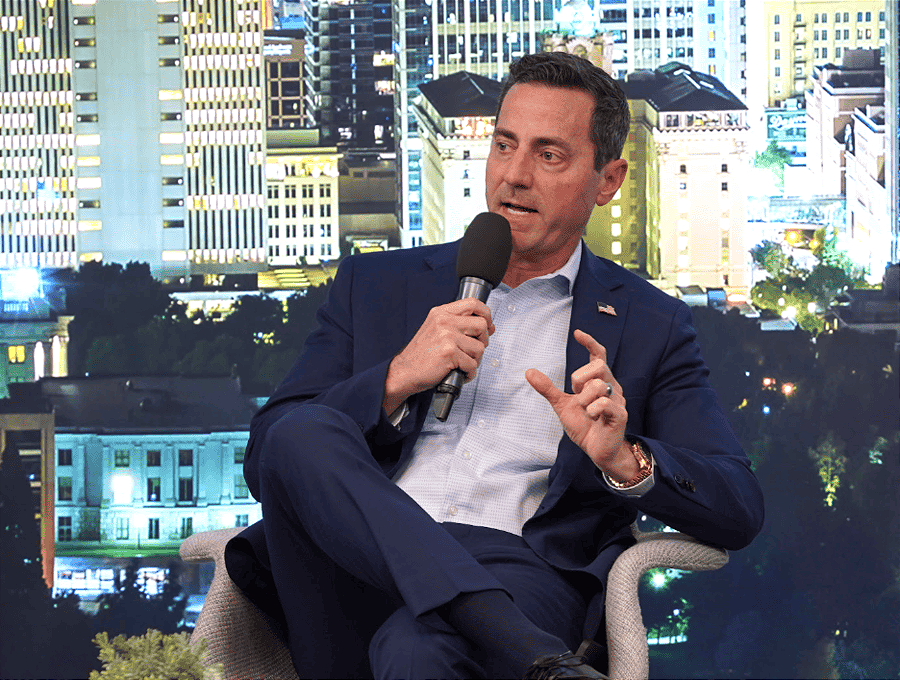
Trent Staggs, former Riverton Mayor (2018–2026) and current Regional Advocate for the U.S. Small Business Administration’s Office of Advocacy covering Region 8 (Utah, Colorado, Montana, North Dakota, South Dakota, and Wyoming). Photo: Mark Tullis, TechBuzz
He highlighted federal momentum, including recent presidential Executive Orders on quantum leadership and post-quantum cryptography mandates (such as Executive Order 14413 and Executive Order 14412) requiring federal agencies, healthcare infrastructure, and government contractors to transition to Post-Quantum Cryptography (PQC) standards.
Staggs emphasized that while federal procurement will strictly require quantum-resilient systems, this shift creates a prime economic growth driver for Utah's startup ecosystem.
"This is a massive opportunity to solve a massive problem—particularly for startups in our community," said Staggs, highlighting his role in helping small businesses cut red tape across federal agencies like War, Energy, and HHS. "We’ve got such a robust entrepreneurial ecosystem here at Silicon Slopes, and capital programs like SBIC (Small Business Investment Company) licenses can help venture groups back early-stage teams tackling post-quantum migration."
Staggs also proposed hosting a dedicated Quantum Pitch Competition down the road to connect local cybersecurity founders with venture capital and federal transition resources.
Blockchain & Crypto Risks under Quantum Threats
In the fireside chat featuring Aaron Gleave, the discussion centered on how quantum capabilities pose a unique threat to cryptographic proof systems and public ledger architectures. Aaron Gleave is Executive Director of the Utah Blockchain Coalition and a dedicated ecosystem builder focused on advancing blockchain, emerging technologies, and practical tech adoption across Utah.
Aaron Gleave, Executive Director, Utah Blockchain Coalition, speaking at the "Quantum Cliff" briefing, Silicon Slopes, July 17, 2026, Lehi, Utah. Photo: Mark Tullis, TechBuzz
"Our role at the Coalition is to bridge the gap between technical experts, policymakers, and the public," Gleave noted regarding Utah's blockchain ecosystem. "When looking at quantum disruption, decentralized networks present a distinct challenge because security updates can't simply be pushed down from a central IT department."
Key Takeaways on Blockchain & Crypto Security:
Vulnerability of Elliptic Curve Cryptography (ECC): Standard public-key algorithms—specifically ECC-256—underpin key ownership, wallet signatures, and transaction verification across Bitcoin, Ethereum, and major decentralized networks. Quantum algorithms like Shor's Algorithm are mathematically suited to crack these specific cryptographic structures once fault-tolerant quantum computing scales.
Protocol Governance & Hard Forks: Unlike centralized enterprise software where security patches can be deployed overnight, updating decentralized blockchain networks to Post-Quantum Cryptography (PQC) standards requires consensus among miners, validators, developers, and node operators, making early planning essential.
Enterprise Ledger Readiness: Beyond digital assets and crypto tokens, enterprise blockchain applications—such as Utah’s pilot programs for property record tracking and smart contract execution—must begin evaluating NIST-compliant quantum-resistant signatures to maintain long-term data integrity.
Practical Action Items for Utah Organizations
The session concluded with actionable recommendations for enterprise IT leaders, software startups, and data center operators preparing for the post-quantum transition. Navigating the "Quantum Cliff" requires moving from theoretical awareness to systematic, phase-based execution.
1. Build a Cryptographic Bill of Materials (CBOM)
Organizations cannot defend or upgrade what they cannot see. The foundational step in post-quantum readiness is creating a comprehensive inventory of all public-key cryptographic assets across enterprise infrastructure.
Map Key Algorithms: Audit internal applications, cloud environments, network appliances, and databases to catalog every instance of RSA, ECC, Diffie-Hellman, and ECDSA in use.
Audit Third-Party & SaaS Dependencies: Inspect vendor-provided libraries, APIs, web certificates (TLS/SSL), and software supply chains to identify underlying cryptographic dependencies.
Identify Data Subject to "Harvest Now, Decrypt Later" (HNDL): Classify data based on its required longevity. Financial records, intellectual property, healthcare data, and critical municipal infrastructure logs that must remain confidential for 5–10+ years should be tagged as immediate high-priority migration targets.
2. Transition to NIST-Standardized Post-Quantum Algorithms
With the National Institute of Standards and Technology (NIST) finalizing initial Post-Quantum Cryptography (PQC) standards, organizations should begin evaluating and implementing specific primitives:
ML-KEM (FIPS 203): Adopt Module-Lattice-Based Key-Encapsulation Mechanism (formerly CRYSTALS-Kyber) to replace RSA and Elliptic Curve Diffie-Hellman (ECDH) key exchanges in TLS handshakes and network tunnels.
ML-DSA (FIPS 204): Implement Module-Lattice-Based Digital Signature Algorithm (formerly CRYSTALS-Dilithium) to secure identity tokens (SAML, JWT), code signing, and digital authentication.
SLH-DSA (FIPS 205): Evaluate Stateless Hash-Based Digital Signature Algorithm (formerly SPHINCS+) as a secondary hedge for high-assurance signing environments.
3. Engineer for "Cryptographic Agility"
Replacing cryptographic algorithms across an enterprise is rarely a single, quick patch. To prevent future systemic lock-in, software engineering and infrastructure teams must build systems that are cryptographically agile.
Decouple Cryptography from Core Code: Abstract security protocols into modular microservices or middleware libraries so encryption algorithms can be swapped out without tearing down core application logic.
Deploy Hybrid Cryptography Models: Test dual-mode protocols that pair classical algorithms (e.g., ECDH) with new post-quantum algorithms (e.g., ML-KEM) simultaneously. This maintains current regulatory compliance while establishing quantum resilience.
4. Align with Federal Mandates & Commercial Opportunities
For Utah’s technology ecosystem, post-quantum compliance is a regulatory requirement for government contractors and a major commercial opportunity for cybersecurity startups.
Prepare for Federal Procurement Requirements: Ensure all software, cloud architecture, and data center services comply with Executive Orders 14412 and 14413 requiring post-quantum readiness across federal supply chains.
Leverage Regional SBA Advocacy: Utah startups building PQC migration tools, automated discovery scanners, or quantum-safe hardware should connect with the SBA Office of Advocacy (Region 8) to explore federal grant pathways, SBIC venture funding, and regulatory sandbox programs.
Quantum readiness is no longer a hypothetical exercise. Just as tech workers rallied in the late 1990s to secure global computing infrastructure ahead of Y2K, Utah's business leaders, founders, and developers must take proactive steps today to safeguard digital trust for the quantum era.
Share this article
The link has been copied!
Your link has expired. Please request a new one.
Your link has expired. Please request a new one.
Your link has expired. Please request a new one.
Great! You've successfully signed up.
Great! You've successfully signed up.
Welcome back! You've successfully signed in.
Success! You now have access to additional content.