UVU Launches Quantum Business eXchange to Explore Commercial Applications
UVU’s emerging Quantum Business eXchange plans to connect students and industry through research, training and applied projects, exploring quantum computing’s business potential while advancing practical cybersecurity readiness.
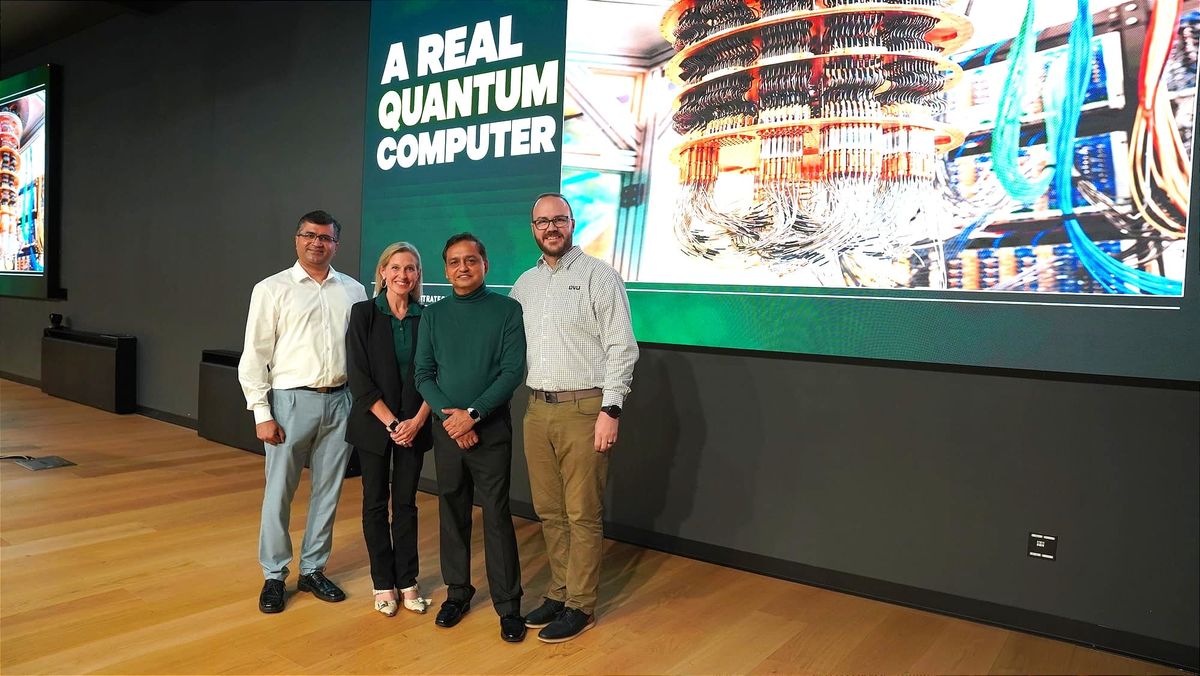
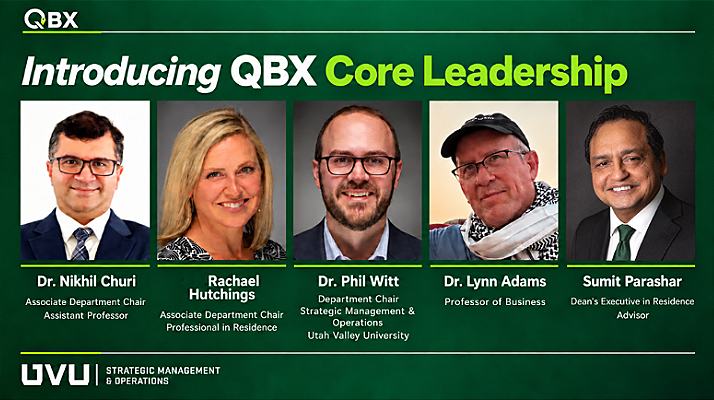
QBX core leadership members pose during the Quantum Business Exchange event at Utah Valley University. From left are Dr Nikhil Churi, Associate department chair; Rachael Hutchings, Associate department chair and Professional in residence; Sumit Parashar, Dean’s executive in residence;; Rachael Hutchings, associate department chair and professional in residence; Sumit Parashar, dean’s executive in residence; and Dr. Phil Witt, department chair of Strategic Management and Operations. The Woodbury School of Business initiative aims to connect students, faculty and industry to explore practical business applications for quantum technologies. Vallejo Auditorium, Keller Building, UVU, October 7, 2026. Photo: Mark Tullis, TechBuzz
QBX core leadership members pose during the Quantum Business Exchange event at Utah Valley University. From left are Dr Nikhil Churi, Associate department chair; Rachael Hutchings, Associate department chair and Professional in residence; Sumit Parashar, Dean’s executive in residence;; Rachael Hutchings, associate department chair and professional in residence; Sumit Parashar, dean’s executive in residence; and Dr. Phil Witt, department chair of Strategic Management and Operations. The Woodbury School of Business initiative aims to connect students, faculty and industry to explore practical business applications for quantum technologies. Vallejo Auditorium, Keller Building, UVU, October 7, 2026. Photo: Mark Tullis, TechBuzz
Orem, Utah — October 16, 2026
Utah Valley University is developing the Quantum Business eXchange (QBX), a business-school-based community intended to bring students, faculty and industry together to examine where quantum technologies could solve practical business problems.
The initiative is taking shape within UVU’s Woodbury School of Business, where the Strategic Management and Operations Department is supporting faculty involvement, speaking events and potential student projects. An October 7 event introduced the concept and opened a discussion about how businesses and students might prepare for emerging quantum applications.
“We’re pursuing QBX because quantum is moving from the lab toward real business use,” said Phil Witt, chair of the Strategic Management and Operations Department. “We need industry, academic faculty, and students to join forces to shape this exciting development.”
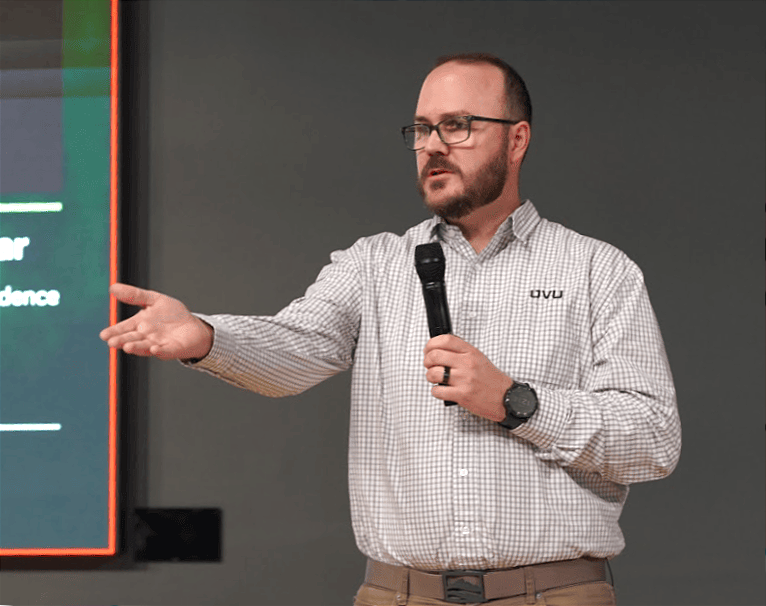
Phil Witt, Chair of the Strategic Management and Operations Department, UVU and Co-Founder of QBX. Photo: Mark Tullis, TechBuzz
Witt said the department wants students to understand potential business applications, rather than limiting quantum discussions to the underlying physics. The department is already hearing from colleagues across campus, students and industry representatives interested in participating, he said.
That interest provides a starting point for building the community, although QBX’s organizational structure and formal industry partnerships remain under development.
Connecting quantum technology with business problems
Sumit Parashar, a dean’s executive in residence in the Strategic Management and Operations Department, is helping advance the effort. Parashar is also CEO of BODEX.
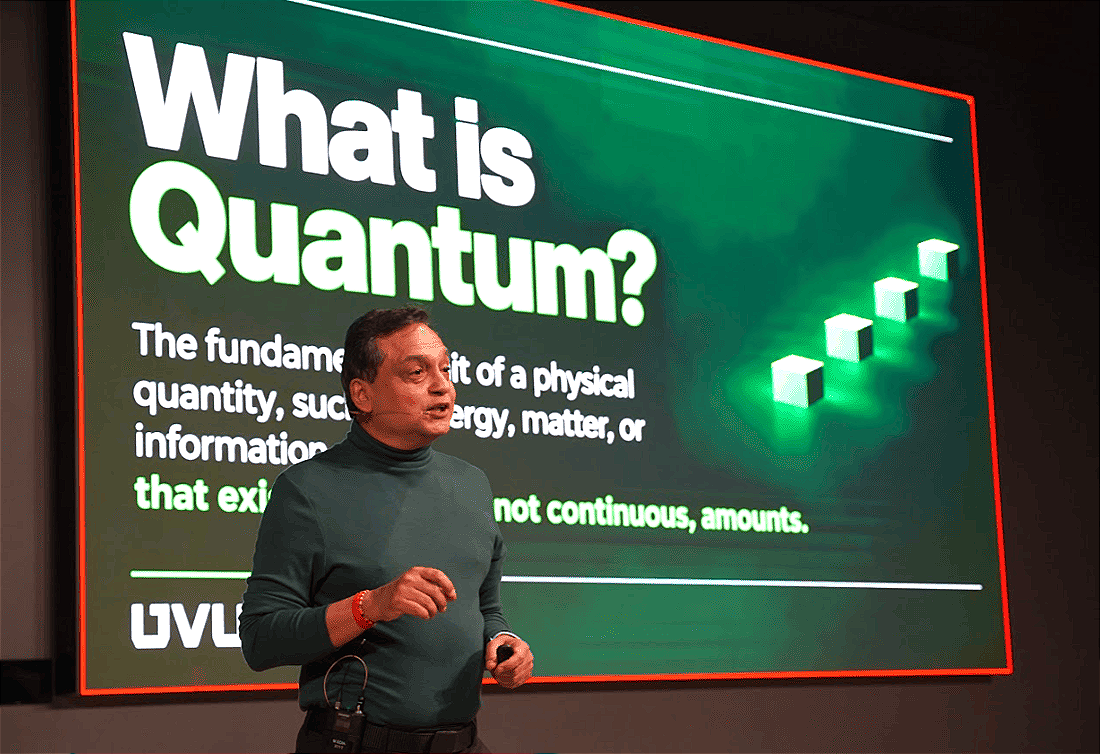
Sumit Parashar, dean’s executive in residence at Utah Valley University’s Woodbury School of Business, presents the emerging Quantum Business eXchange (QBX), an initiative designed to connect students, faculty and industry to explore practical business applications for quantum technologies. The presentation identified healthcare and life sciences, supply chain and logistics, and other industries as potential areas for exploration. Photo: Mark Tullis, TechBuzz
“Don’t let the word ‘quantum’ intimidate you,” Parashar said. “You don’t need to be a physicist to join the conversation. Bring your business experience, your curiosity and a problem worth solving.”
The central question for QBX is not simply whether quantum computers are powerful, but whether quantum technologies can produce measurable value in a specific business setting.
Quantum computing uses quantum-mechanical effects to process information in ways that differ from conventional computing. Its potential applications include certain complex optimization and simulation problems, but practical advantages depend on the task, the technology and the availability of suitable hardware. Quantum computers do not automatically outperform conventional computers, and many proposed business applications remain experimental.
QBX’s initial exploration could focus on supply chain and logistics optimization, where organizations face complex decisions involving routing, capacity, scheduling and resource allocation. Faculty and potential industry participants have not yet selected a specific problem or committed to a project.
QBX aims to help students translate emerging quantum capabilities into business opportunities - identifying useful applications, evaluating costs and benefits, and developing viable business models.
These proposed activities provide a framework for QBX’s first year, with priorities and timing to be refined through faculty, student and industry participation.
Parashar said the group would need to evaluate potential quantum applications against conventional and hybrid approaches using the same requirements, data and constraints. Measures could include solution quality, processing time, cost and reliability.
The objective would be to determine whether a quantum-based approach offers a demonstrable advantage under defined conditions—not to assume that it does.
Parashar brings more than 18 years of enterprise-architecture experience working with large corporations. He sees QBX as a way to connect that kind of business analysis with emerging technology research and student learning.
Potential participants could include Woodbury School of Business faculty, MBA candidates and industry professionals. The format and scope of any applied projects will depend on further faculty and industry input.
Sumit Parashar, Dean’s Executive in Residence, Strategic Management and Operations Department, UVU and CEO, BODEX, speaking at the QBX launch at UVU, Photo: Mark Tullis, TechBuzz
Proposed research, training and student projects
A preliminary plan developed by Nikhil Churi, an associate chair in the Strategic Management and Operations Department, outlines research and educational activities that QBX could pursue during its first year.
The proposed targets include four white papers on quantum technologies within nine months and two industry-focused applied research papers within 12 months. The plan also calls for a repository of student ideas, more opportunities for internships and sponsored projects, and training designed for business professionals who do not have a physics background.
The white papers and applied research would give faculty and students a way to investigate potential use cases, assess business implications and identify questions that warrant further study. The student repository could collect ideas for possible projects and help connect them with relevant faculty or industry interests.
The plan identifies several areas for exploration, including cybersecurity, supply chains, healthcare, finance, manufacturing, energy, government, defense and quantum sensing. These are potential areas of inquiry, not a list of established QBX projects or demonstrated commercial applications.
The proposed program also includes a four-part event series covering “Why Quantum?,” “Understanding the Quantum Cliff,” “Quantum + Business” and “Building Utah’s Quantum Future.” Such events would give students and business leaders opportunities to discuss the technology, its limitations and the questions companies should be asking as the field develops.
These activities remain a plan for building the initiative, rather than a record of completed research or formalized partnerships. QBX’s progress will depend on faculty participation, student interest and the development of relationships with industry.
Post-quantum cybersecurity is a near-term consideration
One area of particular business relevance is preparation for post-quantum cryptography (PQC), which refers to cryptographic methods designed to resist attacks from sufficiently capable quantum computers.
Many systems rely on public-key cryptography, including methods such as RSA and elliptic-curve cryptography. A sufficiently powerful, fault-tolerant quantum computer could threaten some of these widely used methods. The timing of that capability remains uncertain, but organizations can begin assessing their exposure before such machines become practical.
Parashar advises businesses to assign clear responsibility for the issue, inventory their digital assets and cryptographic systems, and identify critical applications, infrastructure, vendor dependencies and data that must remain confidential over long periods. Organizations can then prioritize their preparation according to risk and the sensitivity and lifespan of the information involved.
His guidance is consistent with the broader transition toward post-quantum cryptographic standards, including recommendations developed by the National Institute of Standards and Technology (NIST).
BODEX has separately developed and internally tested a post-quantum cryptographic remediation plan informed by NIST guidance, according to Parashar. That work is part of BODEX’s own business activities, not an established QBX project. Potential collaboration or student assignments related to the subject remain under discussion.
For QBX, cybersecurity could provide a concrete way to help business students understand how an emerging technology can affect risk management and operational planning even before quantum computing becomes commercially useful for a particular application.
Building access and participation
Parashar intends to develop a proposal for internal consideration to expand students’ and businesses’ access to quantum-computing capabilities.Options could include cloud-based access, shared infrastructure, industry partnerships or private funding.
He said the idea emerged during the October 7 discussion, but it has not been formally presented to UVU or the Utah Department of Technology Services. No funding, institutional commitment or implementation timeline has been established.
More broadly, QBX is beginning outreach to potential industry participants. The group has contacted prospective partners and students have researched quantum companies, but no formal partnerships have been announced. Possible activities include guest speakers, sponsored projects, internships, demonstrations and workforce training.
Parashar’s work at UVU builds on other efforts to develop Utah’s quantum ecosystem. He founded BODEX in 2015, launched UtahData.org in 2024 and UtahQuantum.org in 2025, and helped establish the Silicon Slopes Quantum chapter in April 2026. He also co-hosts the Entangled Show podcast with Pete Codella.
The next QBX session is planned for before the end of 2026, although its date and topics have not been finalized.
For UVU, the immediate opportunity is to give students and businesses a place to examine quantum technology with a practical lens: define a real problem, assess available approaches and determine whether the technology can deliver measurable value.
Share this article
The link has been copied!
Your link has expired. Please request a new one.
Your link has expired. Please request a new one.
Your link has expired. Please request a new one.
Great! You've successfully signed up.
Great! You've successfully signed up.
Welcome back! You've successfully signed in.
Success! You now have access to additional content.