LVT's New Survey Puts a Number on Where Americans Draw the Line on AI Surveillance
LVT's 2026 Harris Poll survey of 2,089 Americans finds broad support for targeted AI surveillance with strict guardrails. It also documents a measurable safety-driven chilling effect on civic engagement ahead of midterms.
LiveView Technologies (LVT) has released what it's calling the 2026 Public Safety & Privacy Benchmark, a Harris Poll survey of 2,089 U.S. adults designed to map where public opinion actually lands on AI-powered security cameras, license plate readers, and facial recognition in public spaces. The findings complicate the usual "privacy vs. safety" framing — and in some cases, flip it entirely.
The data isn't where most people assume it is
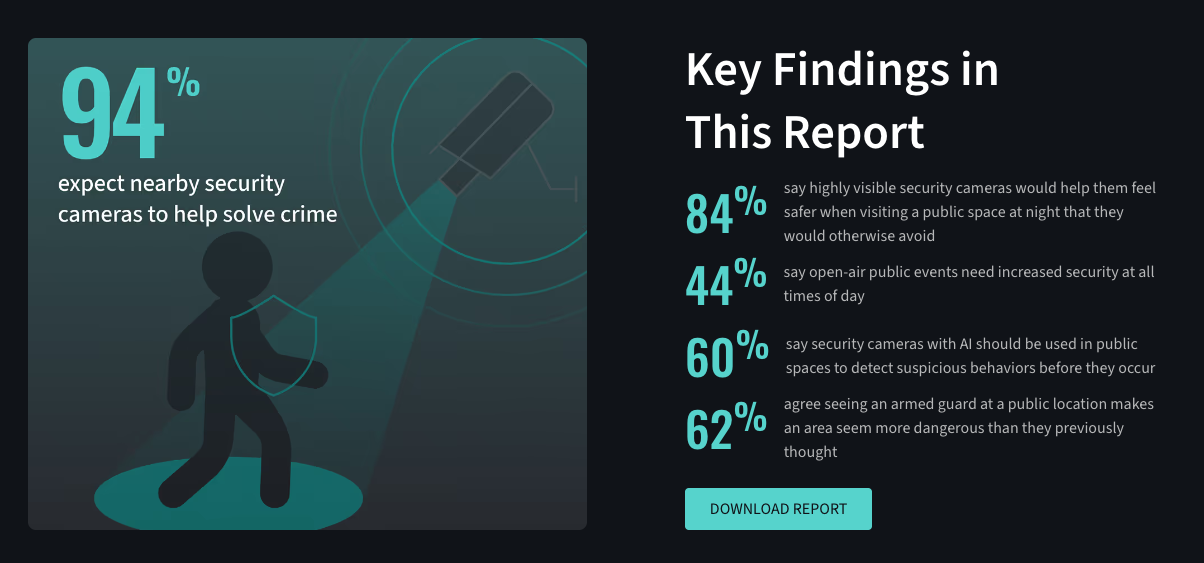
The headline finding isn't that Americans distrust surveillance. It's that 94% of Americans would expect nearby security cameras to help solve the case if they became a crime victim in a public space. That number holds across party lines (95% of Democrats, 96% of Republicans), geographic divides, and generations. There is no demographic cohort that doesn't want the technology to work on their behalf when it counts.
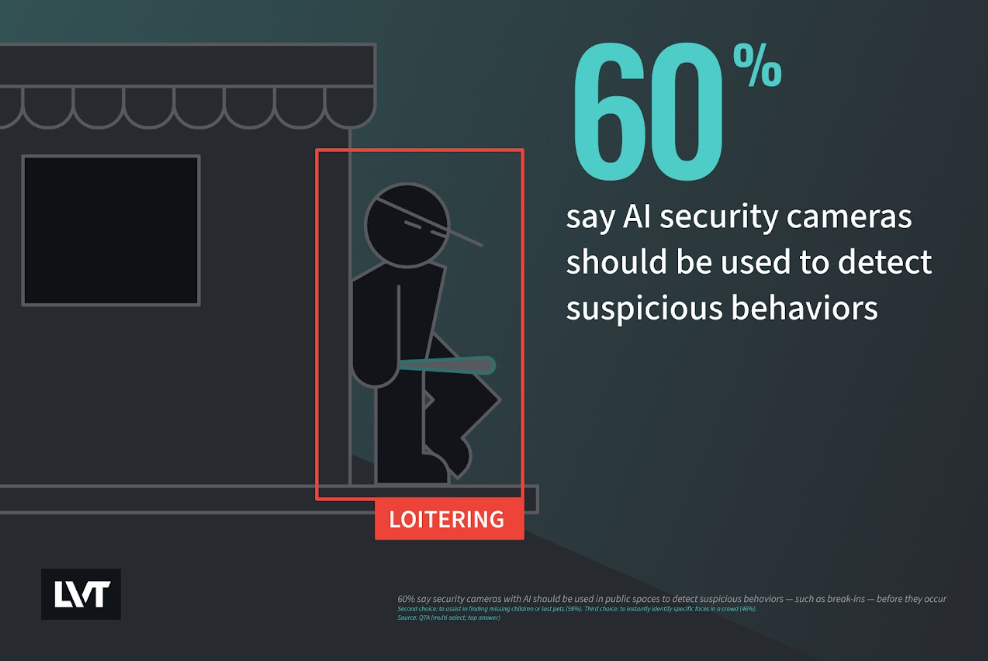
At the same time, 60% support AI cameras in public places to detect suspicious behavior before crimes occur — and 79% say it's acceptable for businesses to use facial recognition to match against a list of known violent offenders. Only 12% say AI should never be used in public spaces for safety purposes at all.
What Americans oppose is blanket, indiscriminate surveillance. The report draws a clear line: behavioral detection and identification of known offenders are broadly acceptable; tracking ordinary citizens going about their lives is not. Sixty-three percent say they're concerned that facial recognition could be used to monitor them for simply attending a protest, town hall, or political rally. It is a concern shared by 72% of Democrats and 55% of Republicans.
The civic engagement finding is the most urgent number in the report
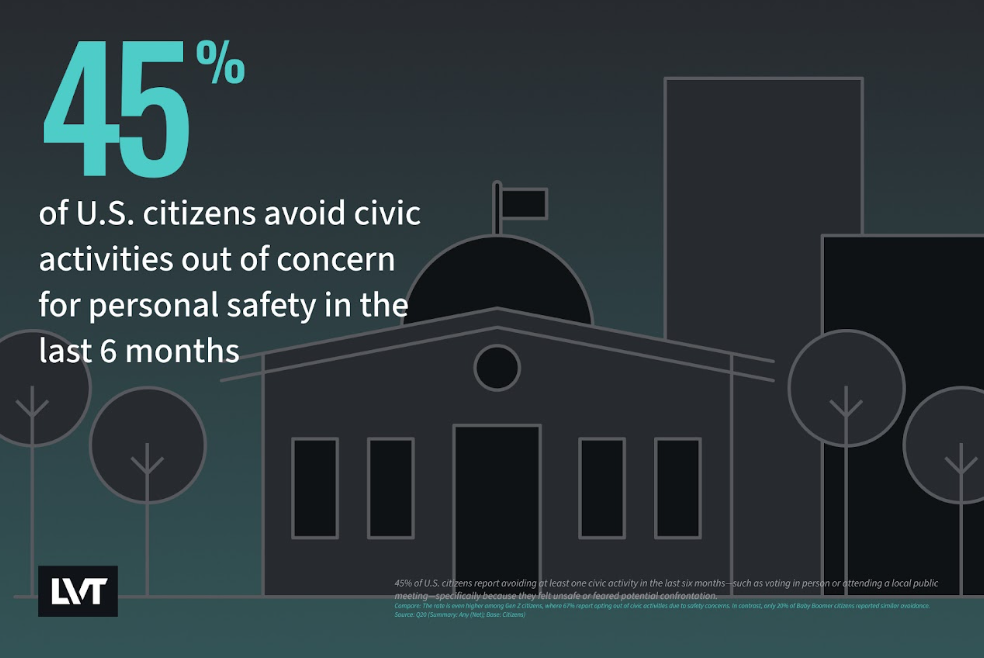
Forty-five percent of U.S. citizens say they avoided at least one political or civic activity in the past six months because they felt unsafe or feared confrontation or intimidation. The breakdown: 24% avoided discussing politics publicly, 19% skipped a political rally or protest, 15% didn't attend a local public meeting, and 13% avoided dropping a ballot at a designated drop box.
That ballot box number doubles in cities: 20% of urban residents avoided drop boxes, compared to 9% each in rural and suburban areas. With midterms approaching, that's a data point worth watching.
The avoidance is heavily generational: 67% of Gen Z and 60% of Millennials reported opting out of civic activities due to safety concerns. Only 20% of Baby Boomers reported similar behavior.
On the specific guardrails, the public is precise
The survey doesn't just surface vague privacy anxiety; it outputs specific policy thresholds. Eighty-seven percent say visible signage must be posted wherever automated license plate readers (ALPRs) are in use. Sixty-seven percent believe non-suspicious plate data should be deleted within 30 days or immediately — 22% want it wiped on the spot. Only 16% support indefinite retention.
For general video security footage, 47% say a mandatory 30-day deletion window for footage with no detected crime would increase their trust in how municipalities and companies use cameras. Seventy-four percent agree that operators should be able to toggle specific AI features on or off based on need — an operational flexibility point LVT has emphasized in its own product architecture.
Armed guards make people feel less safe
One counterintuitive finding: 62% of Americans say seeing an armed guard at a public location makes them feel the area is more dangerous than they previously assumed. That effect is highest among Millennials (70%). Simultaneously, 62% say they'd prefer receiving a traffic ticket by mail over a face-to-face roadside stop by a police officer. This number jumps to 73% among Millennials and 65% among Gen Z.
The report frames this as a preference for objective, technology-mediated interactions over human ones. Ninety-four percent say they'd give video footage equal or greater weight than a human eyewitness account when documenting a crime.
Context for LVT
LVT has been on a product expansion run over the past several months. The company launched GuardGate for access control earlier this year, followed by Live Unit Surround — a building-mounted system targeting perimeter coverage gaps — and an integration with Axon Fusus to connect its units with real-time crime center networks.
The company's 2026 benchmark report reads like market research both justifying and reflecting the company's platform direction: if public trust requires visible cameras, localized AI controls, and rapid data deletion, LVT's configurable, visible-by-design hardware is positioned to benefit.
The survey was conducted online within the United States by The Harris Poll on behalf of LVT from March 23–25, 2026, among 2,089 adults ages 18 and older, among whom 2,035 are citizens of the U.S. The sampling precision of Harris online polls is measured using a Bayesian credible interval. The sample data is accurate to within +/- 2.7 percentage points using a 95% confidence level.
Share this article
The link has been copied!
Your link has expired. Please request a new one.
Your link has expired. Please request a new one.
Your link has expired. Please request a new one.
Great! You've successfully signed up.
Great! You've successfully signed up.
Welcome back! You've successfully signed in.
Success! You now have access to additional content.