LoanPro's Chief Product Officer Colin Terry discusses the Farmington fintech's MCP-based AI Gateway, built on layered compliance guardrails that restrict AI agent actions to regulatory boundaries, plus the company's deliberate choice to stay out of deposit core banking.
As lenders race to bolt AI agents onto servicing and collections, LoanPro's approach is less about the chatbot and more about the guardrail. Chief Product Officer Colin Terry describes the Farmington-based fintech's new MCP-based AI Gateway as a system built on layers of compliance guardrails, regulatory boundaries an AI agent physically cannot act outside of, no matter what it has been asked to do.
It's a telling emphasis for a company that has spent the last several years expanding well beyond its original footprint as a loan servicing platform. LoanPro now supports card products, works directly with banks and credit unions rather than only their fintech partners, and is preparing international expansion. But in a recent conversation, Terry was just as focused on where the company draws the line as on where it's growing.
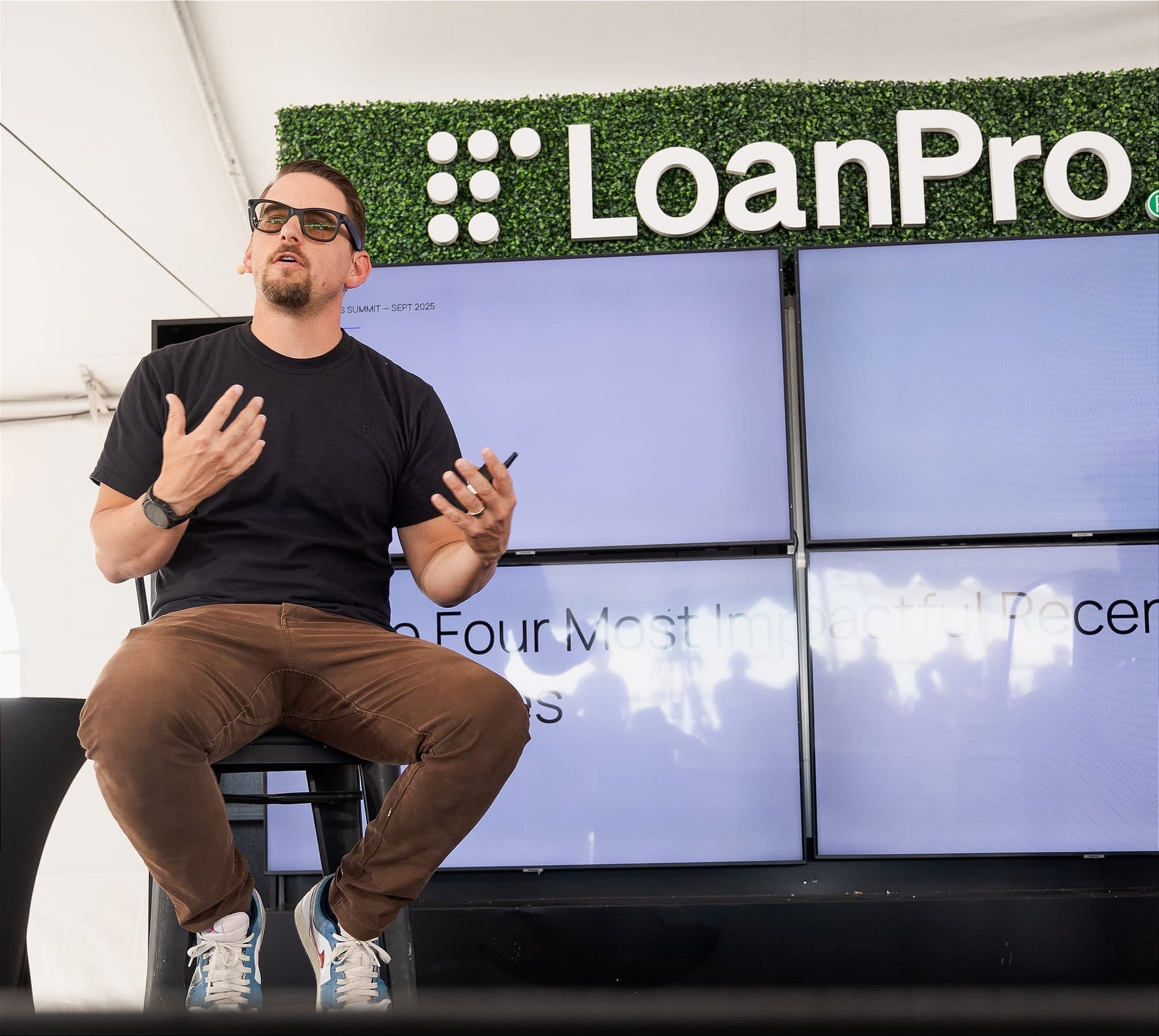
Colin Terry, Chief Product Officer, LoanPro on stage at the 2025 LoanPro Salt Flats Summit. Photo: LoanPro
The overhead projector problem
Terry's explanation of how LoanPro thinks about AI and compliance leans on an unexpected metaphor: the overhead projector.
"You had an overhead projector in school, you could see that transparency on the wall," Terry shared with TechBuzz. "You lay a transparency down with a circle on it, then you put another transparency on top with a triangle... it's this sort of Venn diagram of where you're allowed to operate."
Each transparency represents a different layer of regulatory obligation, such as the CFPB, the OCC, the FDIC, card network rules, sponsor bank requirements, internal compliance policy. Stack them all together, Terry said, and what's left is the narrow, overlapping space where a lender is actually allowed to act. LoanPro's compliance guardrail system, he said, encodes that overlap directly into the API layer, so an AI agent attempting to execute a servicing action, such as adjusting an interest rate, offering a hardship plan, proposing a settlement, gets stopped the moment it tries to operate outside that space.
"Even if they think they're doing something great for the client," Terry said, the system won't let an agent "color outside the lines."
That framing matters because it reframes what LoanPro's MCP-based AI Gateway is actually for. Rather than layering a chatbot on top of existing workflows, Terry described a system meant to let AI agents take real action — running hardship plans, offering settlements, executing servicing decisions that would normally require a human agent — with the compliance boundaries built into the infrastructure itself rather than left to the judgment of the model.
Staying in the credit lane
That same instinct for boundaries showed up when Terry was asked directly where LoanPro won't expand. The company has grown aggressively since raising $100 million in 2021, moving from a pure servicing tool into card products, direct originations work with banks and credit unions, and now agentic AI tooling. But Terry drew one clear line: LoanPro will not build deposit cores. (Deposit cores are the underlying software infrastructure banks and credit unions use to manage deposit accounts — handling balances, transactions, and the ledger of record for money on deposit, as distinct from lending or credit products.)
"What I'm saying is off limits is deposit cores — the partnerships we're building with core providers are genuinely important to us, and that's a long-term view, not a temporary one," Terry said.
It's a deliberate choice, not a resource constraint. LoanPro has built relationships with core providers including Nymbus and Synctera, and is deepening ties with legacy providers like Jack Henry and FIS. Terry described these relationships as increasingly collaborative rather than adversarial. Asked why the company doesn't compete more directly with the deposit-side infrastructure it integrates with, Terry described those integrations as a foundation the company intends to build on, not a position it intends to move against.
Instead, Terry said LoanPro is staying "squarely in the lane of credit products, both installment line of credit and credit card," pointing to shifts in how younger consumers build relationships with lenders. Buy-now-pay-later products from companies like Affirm and Klarna, he argued, have shown that credit products, not deposit accounts, are increasingly becoming the entry point of the borrower relationship. That shift, in his telling, is exactly why LoanPro sees more room to grow within its existing lane rather than a need to expand outside it. International expansion adds further runway: staying in credit isn't a ceiling, Terry suggested, it's a deliberate focus on a market with plenty of growth still ahead.
Rhett Roberts, CEO and Co-Founder of LoanPro, and Carl Pascarella, Former CEO of Visa, speaking at the 2025 LoanPro Salt Flats Summit, September 18-19, 2025. Photo: LoanPro
Built for builders, not just operators
LoanPro's expansion hasn't been limited to product lines. It has also visible in the growing range of companies running on the platform, from large fintechs to banks building card programs from scratch. Terry pointed to Intuit as the clearest example of what that growth can look like at scale.
Intuit first came to LoanPro to migrate a single loan portfolio, mainly to regain full control over its own data rather than viewing it filtered through a third-party servicer. Once live on the platform, Intuit's innovation team ran a small pilot — an installment loan program offered to a handful of preferred customers — before scaling that program to 100 customers, then 1,000. From there, Intuit built the product directly into QuickBooks Capital, and eventually into its tax platform as well. Today, Terry said, that tax-season lending product originates anywhere from 10 to a peak of 50,000 loans a day, depending on the volume of tax filings on a given day.
Supporting that range of customers, from large, highly technical engineering teams to smaller, less tech-forward lenders, is itself a design challenge, Terry stated. LoanPro builds around three categories of user: the frontline human agents who operate inside the platform's UI, sophisticated technical teams who treat LoanPro as backend infrastructure to build on top of, and lenders in between who need to see AI-powered workflows in action before they'll adopt them. The AI Gateway, in Terry's framing, is meant to serve as a bridge for that last group. It gives them a working example of what's possible before asking them to build on the API themselves.
What's next
LoanPro's international push is similarly incremental rather than a flag-planting exercise, Terry said, driven largely by existing partners with international presence asking LoanPro to follow them into new markets. The company already operates in Australia, Canada, and has customers in Mexico, with additional markets under consideration for 2027.
Terry also confirmed the company is expanding relationships with payment infrastructure partners as its card business grows. For now, LoanPro's stated strategy is narrower than its growth might suggest: stay inside the credit lane, build the compliance guardrails deep enough that AI agents can be trusted to operate inside them, and let expansion follow wherever partners and client demand lead next.
Attendees of the LoanPro 2025 Salt Flats Summit, September 18-19, 2025. Photo: LoanPro
LoanPro's Salt Flats Summit
Terry's conversation with TechBuzz also touched on a company tradition that's become central to LoanPro's culture: the company's annual Salt Flats Summit, an invite-only executive forum held out at the Bonneville Salt Flats. Last year's event drew more than 200 industry leaders, and organizers say this year's gathering is expanding further.
The format mixes standard conference programming with something considerably less conventional. Attendees board buses for a two-hour drive out to the Bonneville Salt Flats themselves, where LoanPro sets up a full tent city, a stage for product announcements, live entertainment, helicopter and monster truck rides, and more.
The setting does most of the work: there is nowhere else in financial services where executives ride helicopters over a prehistoric salt lake, walk through fire, and watch product announcements from a stage in the middle of a tent city in some of the most remarkable scenery in the country. Terry acknowledged the remoteness and scale of the Bonneville Salt Flats lends the whole thing a faint Burning Man quality and, he suggested, deliberately unlike anything else on the fintech conference calendar.
Details of the event, taking place this year September 16-18, are available at saltflatssummit.com.
Monster Truck rides at the 2025 Salt Flats Summit, September 18-19, 2025. Photo: LoanPro
Share this article
The link has been copied!
Your link has expired. Please request a new one.
Your link has expired. Please request a new one.
Your link has expired. Please request a new one.
Great! You've successfully signed up.
Great! You've successfully signed up.
Welcome back! You've successfully signed in.
Success! You now have access to additional content.