“No One Sane Goes Into Healthcare for the Money”: A Hackathon Panel on Mission and Grit
Two healthcare founders at a Utah hackathon discussed motivation, stress-focused medicine, and regulatory friction. They emphasized resilience, incremental validation, and contrasting views on innovation adoption in clinical systems.
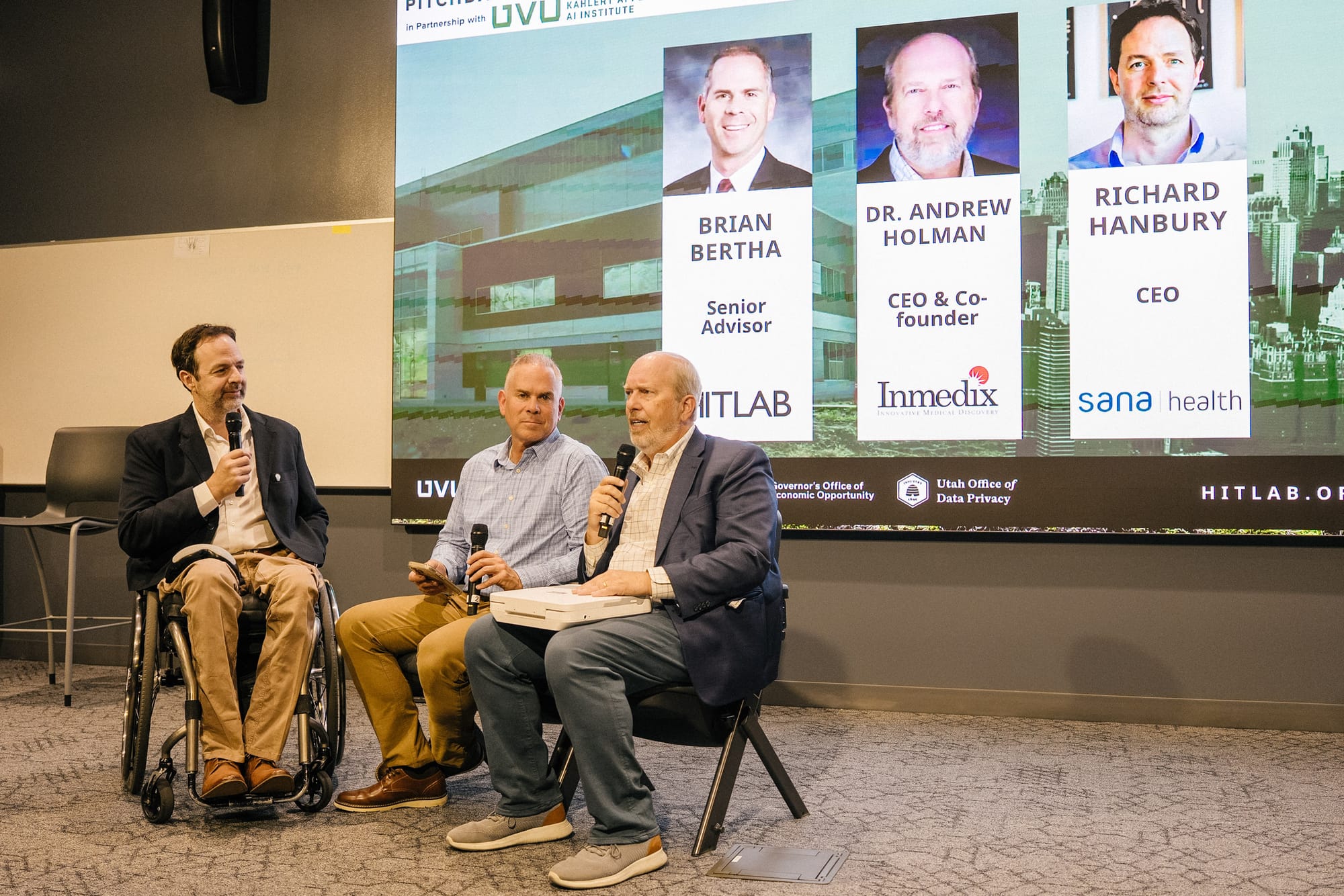
At the Strategic Guidance Panel during theHITLAB (New York, NY) x UVU World Cup Innovation Pitchday & Hackathon, held June 17-18 atUtah Valley University's (Orem, UT) Smith Engineering Building, moderator Brian Bertha, a senior advisor at HITLAB, asked two healthcare entrepreneurs a simple question: why enter healthcare at all?
Richard Hanbury, CEO of Sana Health, responded bluntly.
“No one who is sane and knows what they're doing goes into healthcare for money.”
Hanbury has previously described a formative injury in his early adulthood that led him to explore neuromodulation approaches to pain management. He said that experience ultimately shaped the direction of his company.
“Every single person you talk to in healthcare has a story about why they chose to do it… and if it's making money, quit, because you're in the wrong business,” he said.
Andrew Holman, MD, CEO and co-founder of Inmedix, came at the question from the perspective of a long clinical career before entrepreneurship. He practiced rheumatology for decades before founding his company later in life.
“My problem, and healthcare’s problem in general, is not getting enough successful outcomes quickly enough to take care of patients,” Holman said. “We’re starting to understand the multifactorial nature of illness, and particularly how stress drives disease expression.”
He added that improved outcomes also have a system-level effect.
“If you apply more effective care, better outcomes, you reduce cost and you free up capacity so patients can be seen sooner,” he said.
Two Sides of the Same Signal
Holman’s Inmedix focuses on measuring heart rate variability as part of assessing stress physiology. Sana Health uses a related feedback-based approach aimed at guiding users into relaxation states. While the companies operate differently, both engage with the same physiological signal from opposite directions—measurement versus intervention.
Richard Hanbury, Brian Bertha, and Dr. Andrew Holman discussing healthcare at the HITLAB + UVU Hackathon Healthcare Panel. Photo: Juan Escudero, Kahlert Applied AI Institute, UVU
Hanbury argued that multimodal approaches to pain and mental health are becoming increasingly viable as data tools improve.
“In pain and mental health, multimodal care is the future… AI is making it easier to interpret that data,” he said.
Healthcare’s Resistance to Change
Hanbury described health systems and payers as structurally cautious toward new technologies.
“Health systems and payers are set up to be resistant to expensive or unproven interventions,” he said. “They are designed to prioritize safety and cost control.”
He argued that adoption depends on whether innovations demonstrate measurable economic benefit.
“The organizations that figure out how to quantify savings are the ones that are going to survive,” he said.
Holman offered a contrasting view of regulatory structure, describing the FDA process as predictable and useful when engaged early and carefully.
The Credibility Ladder
Holman compared building a healthcare startup to a long and unpredictable renovation project.
“Being an entrepreneur is like doing a home remodel—it takes longer and costs more than expected,” he said. “You need people who believe in the vision and can challenge you along the way.”
Hanbury reflected on early-stage entrepreneurship and the misconception that credibility must arrive all at once.
“I originally believed credibility was a single threshold. That wasted years,” he said. “It’s actually a ladder.”
He described starting with small datasets and incremental validation rather than waiting for large-scale proof.
“You start with the smallest, simplest evidence you can get, and build from there,” he said.
Time and Clinical Reality
Holman returned to the physician’s perspective, emphasizing the balance between speed and communication in care delivery.
“It takes seconds to decide what to do, but far longer to explain it properly to patients,” he said. “That conversation is what medicine really is.”
Inmedix CEO and Co-founder Dr. Andrew Holman speaking at the HITLAB + UVU Hackathon about a portable EKG alongside Tyler Small, the Senior Director of the Kahlert Applied AI Institute. Photo: Mason Butler, Kahlert Applied AI Institute, UVU
Resilience and Tradeoffs
Hanbury closed with a reflection on motivation and endurance in demanding fields.
“Anger can drive resilience, but it’s not a sustainable fuel,” he said.
He suggested that long-term performance depends more on incremental improvement than intensity.
“If you can make each day slightly more effective and more balanced, that compounds over time.”
Attendees relaxing at the June 23-24 HITLAB + UVU Hackathon, Smith Engineering Building, UVU Photo: Juan Escudero, Kahlert Applied AI Institute, UVU
This panel was one part of a two-day hackathon event focused on healthcare innovation, where participants explored clinical, regulatory, and commercial pathways for emerging technologies.
Organizers indicated that insights from the hackathon may inform future policy discussions in Utah related to healthcare innovation and data governance. A follow-on HITLAB x UVU event is planned for mid-November, with additional details expected later this year.
Share this article
The link has been copied!
Your link has expired. Please request a new one.
Your link has expired. Please request a new one.
Your link has expired. Please request a new one.
Great! You've successfully signed up.
Great! You've successfully signed up.
Welcome back! You've successfully signed in.
Success! You now have access to additional content.
Andrew Holman, Richard Hanbury, Sana Health, Inmedix, Brian Bertha, HITLAB, Utah Valley University, healthcare innovation, stress physiology, multimodal care, FDA regulation, digital health, neuromodulation, entrepreneurship, clinical outcomes, healthcare systems, hackathon, Orem Utah