The Physics of Trust: Matt Memmott Brings His Nuclear Case to Weber County
AlphaTech Research Corp (American Fork, UT) CEO Matt Memmott delivered the keynote at Weber County's nuclear symposium, using safety data, a radiation-as-weightlifting analogy, and a deep-aquifer desalination case study to build public support for molten salt reactors in Utah.
Ogden Eccles Conference Center, left, was the venue for the Weber County's community nuclear symposium in Ogden, August 5, 2026. Photo: Mark Tullis, TechBuzz
Ogden Eccles Conference Center, left, was the venue for the Weber County's community nuclear symposium in Ogden, August 5, 2026. Photo: Mark Tullis, TechBuzz
Ogden, Utah — August 5, 2026
In January, TechBuzz profiled Matt Memmott, CEO of American Fork-based AlphaTech Research Corp, as he promoted a compact, factory-built molten salt reactor design toward commercial reality. He argued this technology could sidestep the cost overruns and construction delays that have plagued conventional nuclear for decades. Seven months later, Memmott delivered the keynote at Weber County's community nuclear symposium in Ogden, making largely the same case, but to a different audience: not investors or regulators, but the residents of a county just beginning to ask what an advanced reactor might mean for their community.
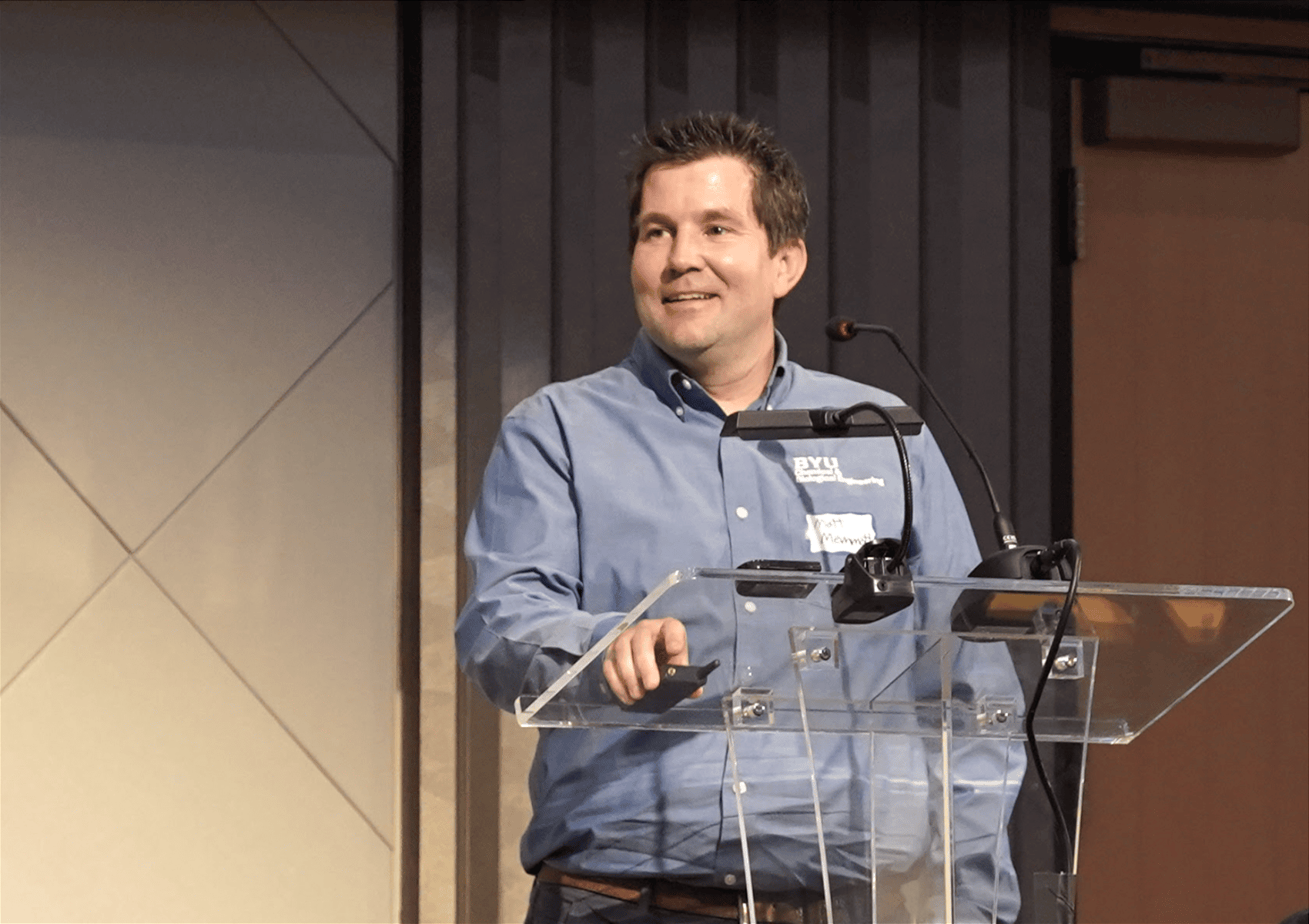
Matt Memmott, CEO of AlphaTech Research Corp and BYU professor of chemical engineering, delivers the keynote at Weber County's community nuclear symposium in Ogden. Photo: Mark Tullis, TechBuzz
The keynote followed two panels of industry executives and academics — coverage of which TechBuzz has reported separately — and served as the evening's public-education centerpiece: a physics-first primer on what nuclear power actually is, why it scares people, and why Memmott believes that fear is largely unfounded.
A Word-Association Experiment
Memmott opened not with slides, but with an audience exercise. He asked the crowd to silently think of the first thing that came to mind when he said a single word — then walked through a list: nuclear... nuclear waste... nuclear weapons... Pluto and Neptune... medical technology. By his account, this Weber County crowd skewed more informed than most audiences he addresses, with hands going up for the deep-space and medical associations as often as for waste and weapons. Nationally, he said, roughly 80% of people default to waste or weapons when they hear the word "nuclear" — a gap he attributed less to the physics itself than to how nuclear power was introduced to the public. "The way it was introduced was tragic," Memmott said. "Wartime destruction was an awful way to introduce this power to the public."
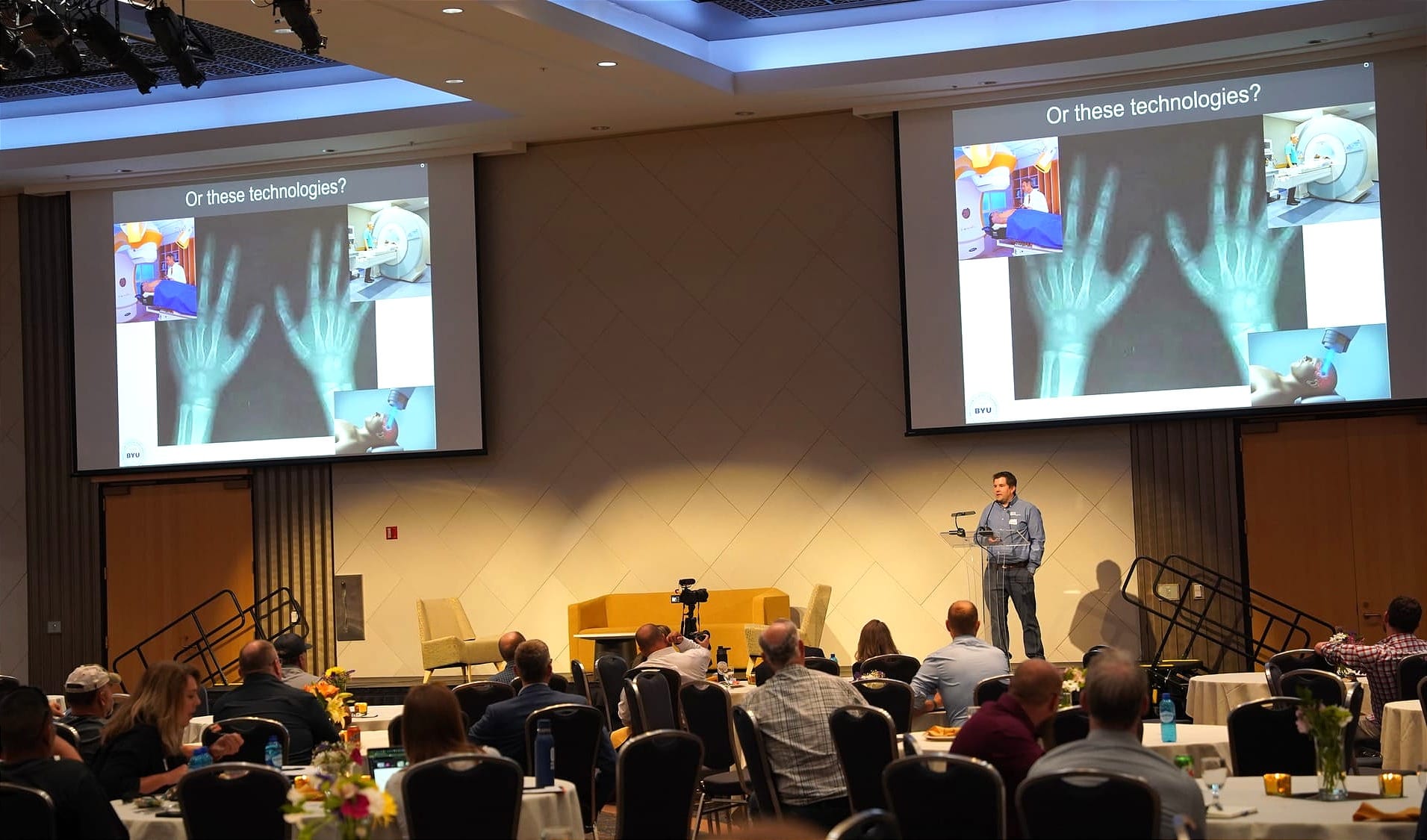
Matt Memmott talks about nuclear medicine, walking Weber County's audience through X-ray, MRI, and radiation therapy technologies that trace back to the same physics powering nuclear reactors. Photo: Mark Tullis, TechBuzz
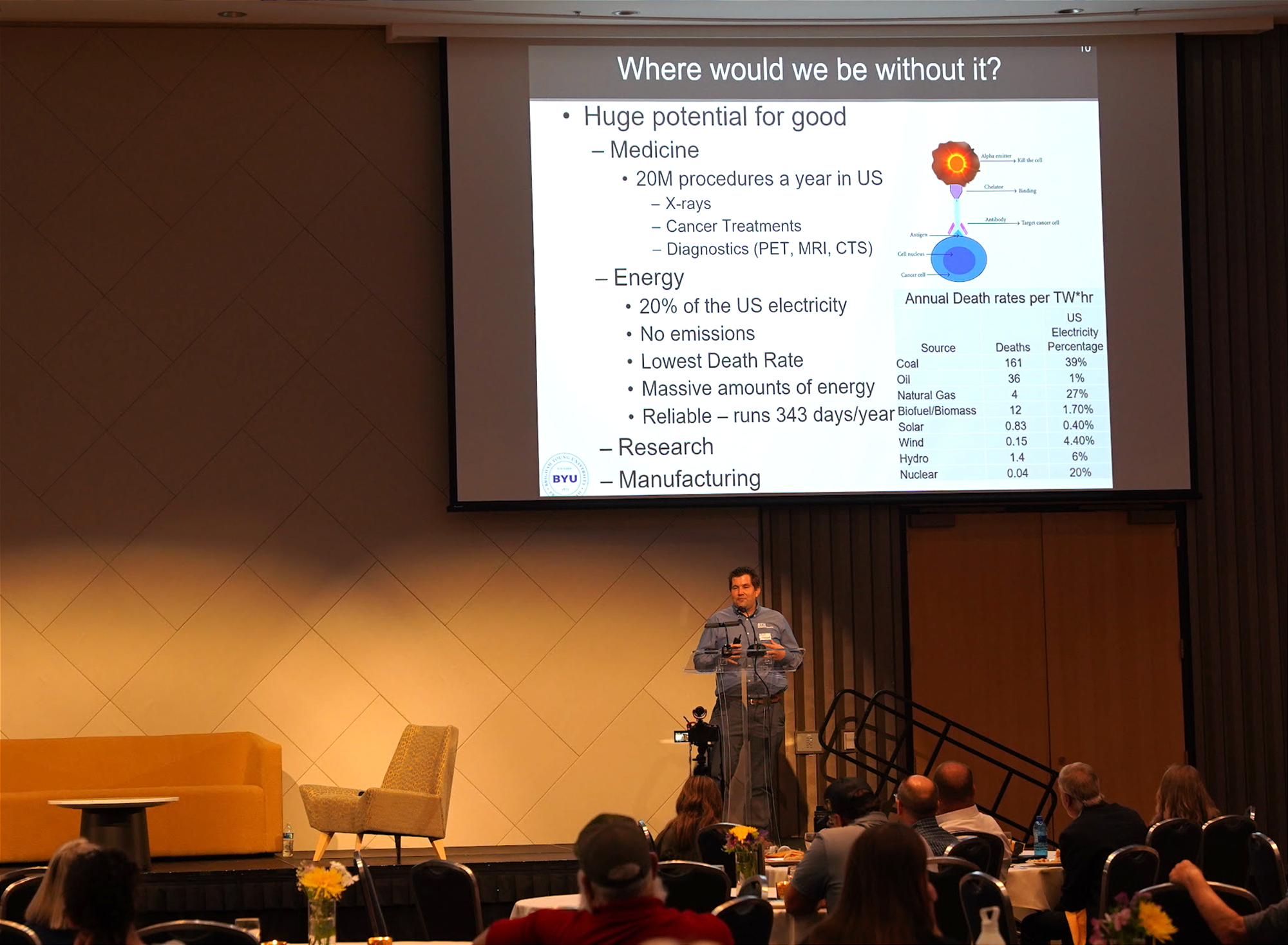
From there, he pivoted to the safety data he considers the industry's strongest, least-appreciated argument: a chart, compiled from studies dating to the early 2010s, that tracks annual deaths per terawatt-hour across major power sources, weighing accidents, mining, and disposal against each source's share of U.S. electricity generation. On the version Memmott presented, nuclear came in lowest at 0.04 deaths per terawatt-hour — behind wind at 0.15, solar at 0.83, hydro at 1.4, and natural gas at 4, with coal topping the list at 161. Nuclear supplies roughly 20% of U.S. electricity on that same chart, according to Memmott, with no direct emissions and what he described as a 343-day-a-year run rate — a reliability figure well above the intermittent output of wind or solar. He extended the argument to medicine, noting that the technetium-99 isotope used in roughly 20 million U.S. diagnostic procedures a year — including X-rays, cancer treatments, and PET and MRI diagnostics — exists only because of nuclear fission.
Memmott's keynote outlined nuclear's case: a 0.04 deaths-per-terawatt-hour rate, the lowest of any major power source, alongside its role in medicine and roughly 20% of U.S. electricity. Photo: Mark Tullis, TechBuzz
Radiation as Weightlifting
Asked repeatedly throughout the evening about safety, Memmott returned to an analogy he uses with his students: radiation exposure, he argued, behaves less like a binary poison and more like exercise. Small amounts of radiation damage cells in ways the body actively repairs and strengthens against, he said, while overwhelming exposure — like overwhelming physical strain — causes real and sometimes permanent harm. "If you really lift too much, you're in danger of serious injury or even death," Memmott said. "How does this correlate to radiation? Radiation has a very similar mechanism."
The theory Memmott is describing, radiation hormesis, holds that low doses of radiation may stimulate beneficial cellular repair responses rather than simply accumulating harm. It's a real and long-studied hypothesis, but a contested one: the U.S. Nuclear Regulatory Commission continues to rely on the linear no-threshold model, which treats any radiation exposure as carrying proportional risk with no beneficial floor, and an NRC advisory committee reviewing hormesis-related petitions in 2015 concluded there wasn't compelling evidence to change that standard. Memmott didn't frame hormesis as settled science during his talk, but he leaned on it to make a broader point about thresholds: living near an operating nuclear plant, he said, exposes a person to radiation levels roughly 50 to 100 times below where measurable harm begins — lower, in most cases, than a single chest CT scan.
He also addressed the Fukushima accident directly, walking through the actual failure sequence — a reactor that shut down correctly during the earthquake, followed by a tsunami that disabled the diesel generators needed to keep cooling water circulating through the shutdown core. The lesson he drew wasn't that nuclear power failed, but that a foreseeable single point of failure went unaddressed. It's a distinction that also came up in Memmott's interview with TechBuzz following Nuclea Energy's own MOU with the state — a separate advanced reactor developer working through many of the same historical case studies from a different angle.
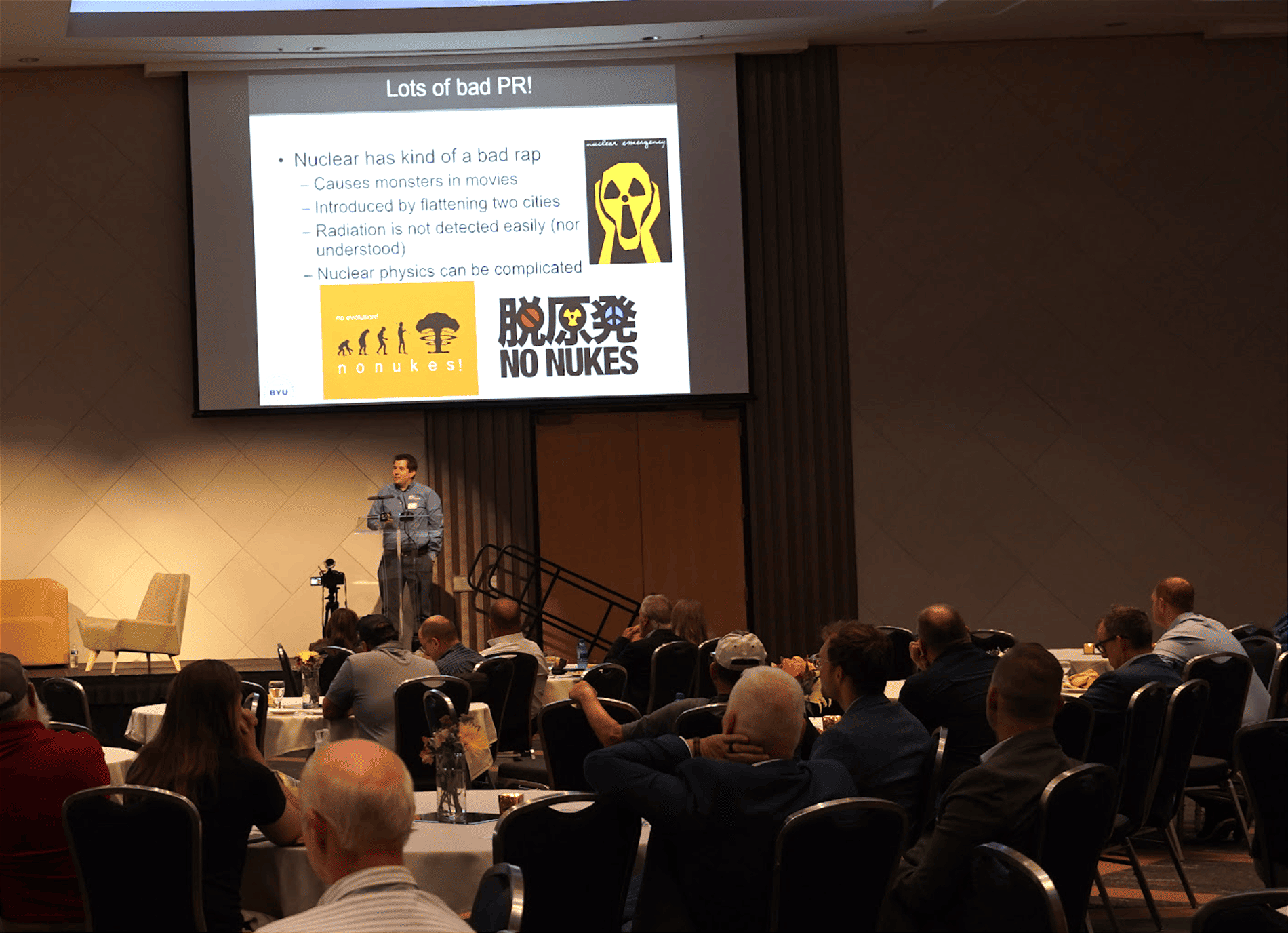
Matt Memmott walks Weber County's nuclear symposium audience through nuclear power's image problem, from monster-movie tropes to its introduction via wartime destruction, before pivoting to the safety data he says tells a different story. Photo: Mark Tullis, TechBuzz
The Hardware: ARC Reactor Specs
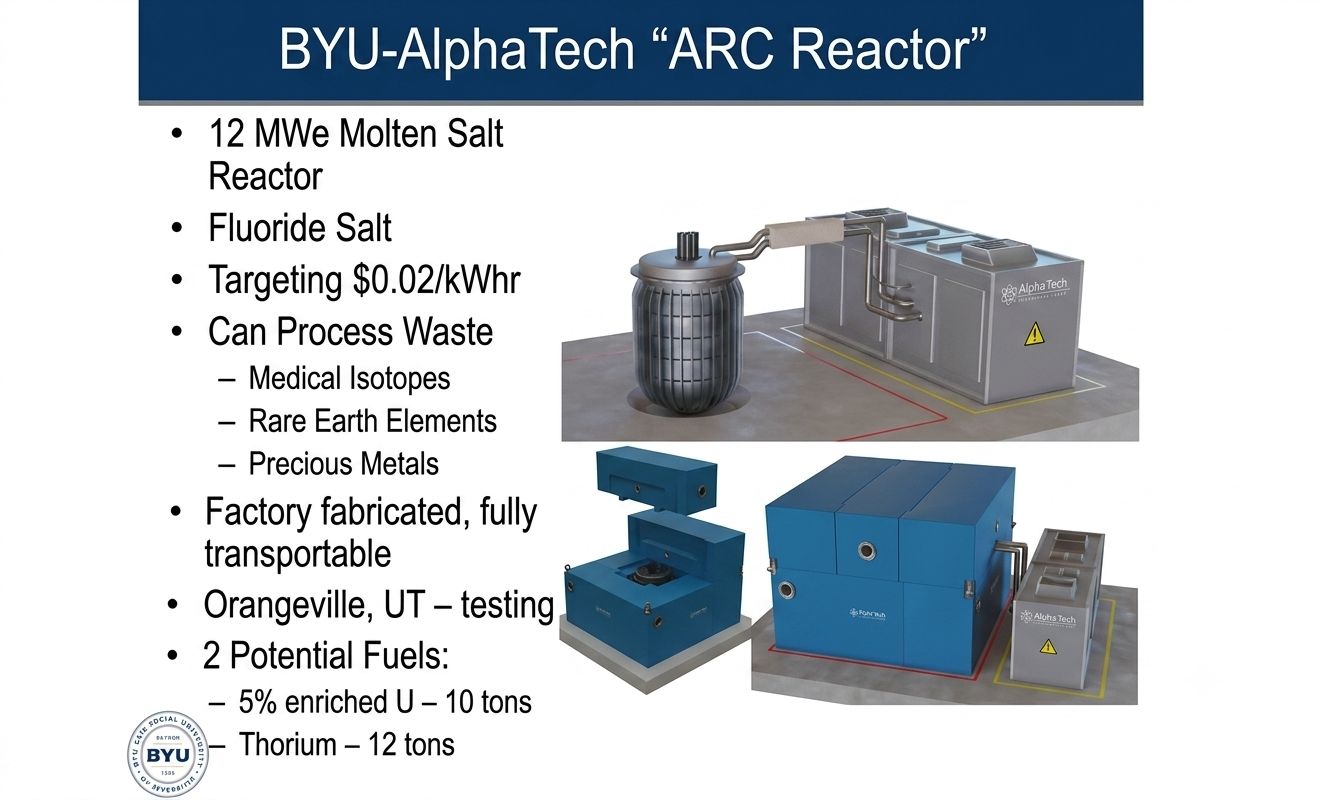
Memmott put real numbers behind AlphaTech's design during the talk, branded internally as the BYU-AlphaTech "ARC" reactor. The unit is a 12 MWe molten salt reactor using fluoride salt as both fuel carrier and coolant, with AlphaTech targeting a cost of $0.02 per kilowatt-hour, a figure well below typical U.S. residential and industrial electricity rates. The design is engineered to run on either of two fuel pathways: roughly 10 tons of 5%-enriched uranium, or 12 tons of thorium, depending on which fuel cycle a given site or customer prefers.
Beyond generation, Memmott said the reactor is also designed to process spent nuclear waste from other sources, recovering medical isotopes, rare earth elements, and precious metals in the process. It is the same "waste as revenue" argument TechBuzz covered in AlphaTech's January profile, now attached to a specific device rather than a general concept. The reactor is factory-fabricated and fully transportable, consistent with the truck-and-C-17-deliverable design Memmott described in January.
Notably, Memmott identified Orangeville, Utah, an Emery County town not far from the Utah San Rafael Energy Lab, as an active AlphaTech testing site. That puts three distinct advanced reactor technologies in various stages of testing or siting within the same county: AlphaTech's fluoride-salt ARC reactor in Orangeville, Valar Atomics' helium-cooled Ward 250 at USREL, and Nuclea Energy's proposed lead-cooled Morpheus test reactor, also planned for USREL under its recent MOU with the state, as recently covered by TechBuzz. Whether that reflects a deliberate regional cluster strategy from the state or simply reflects Emery County's existing energy-industry infrastructure and regulatory relationships, Emery County is emerging as the place where more than one unproven Western reactor technology is being tested first.
Graphic shown by Matt Memmott in his August 5th presentation at Weber County's nuclear symposium.
The Land-Use Argument
One of Memmott's more visually striking points concerned land. To generate a gigawatt of power using wind and the battery storage needed to smooth its intermittency, he estimated a facility would require roughly 99,000 acres. Solar could do it in about 3,000. Stacked microreactors, such as the kind AlphaTech is developing, could do it in seven, according to Memmott, assuming full compliance with existing NRC emergency-planning-zone regulations. He added that much of that footprint could be built underground, leaving the surface available for other use. "You'd just see this beautiful park that would be 70 degrees year-round because of the leftover heat," he said.
An Unexpected Utah Advantage: Water
Perhaps the most novel material in Memmott's keynote centered on water. Working with an oil-drilling contact, Memmott said his team identified what he described as massive deep saline aquifers roughly 15,000 feet beneath parts of Utah, remnants of ancient Lake Bonneville, isolated enough from surface water that using them wouldn't affect existing reservoirs or aquifers people currently depend on.
That specific claim is Memmott's own, and it doesn't precisely match the Bonneville-linked aquifer that University of Utah geoscientists have documented in peer-reviewed research this year. That academic work, published Scientific Reports (Nature.com), identified a large freshwater reservoir beneath the Great Salt Lake at roughly 10,000 to 13,000 feet — shallower than the depth Memmott cited, and freshwater rather than saline, though researchers there likewise suspect some of that water dates back to the Bonneville era.
Memmott's team modeled a hypothetical scenario using the leftover heat from 86 molten salt microreactors, after the reactors had already generated electricity, with the salt still around 450°C, to desalinate the deep water he described and supply growing communities like St. George and Las Vegas. The result, he said, was enough desalinated water to fill Lake Powell from bottom to top in about 14 months.
It's an intriguing though hypothetical figure rather than an actual funded project, but it illustrates the kind of secondary use case — industrial heat recovery, not just electricity — that Memmott's January profile also emphasized as central to AlphaTech's commercial thesis.
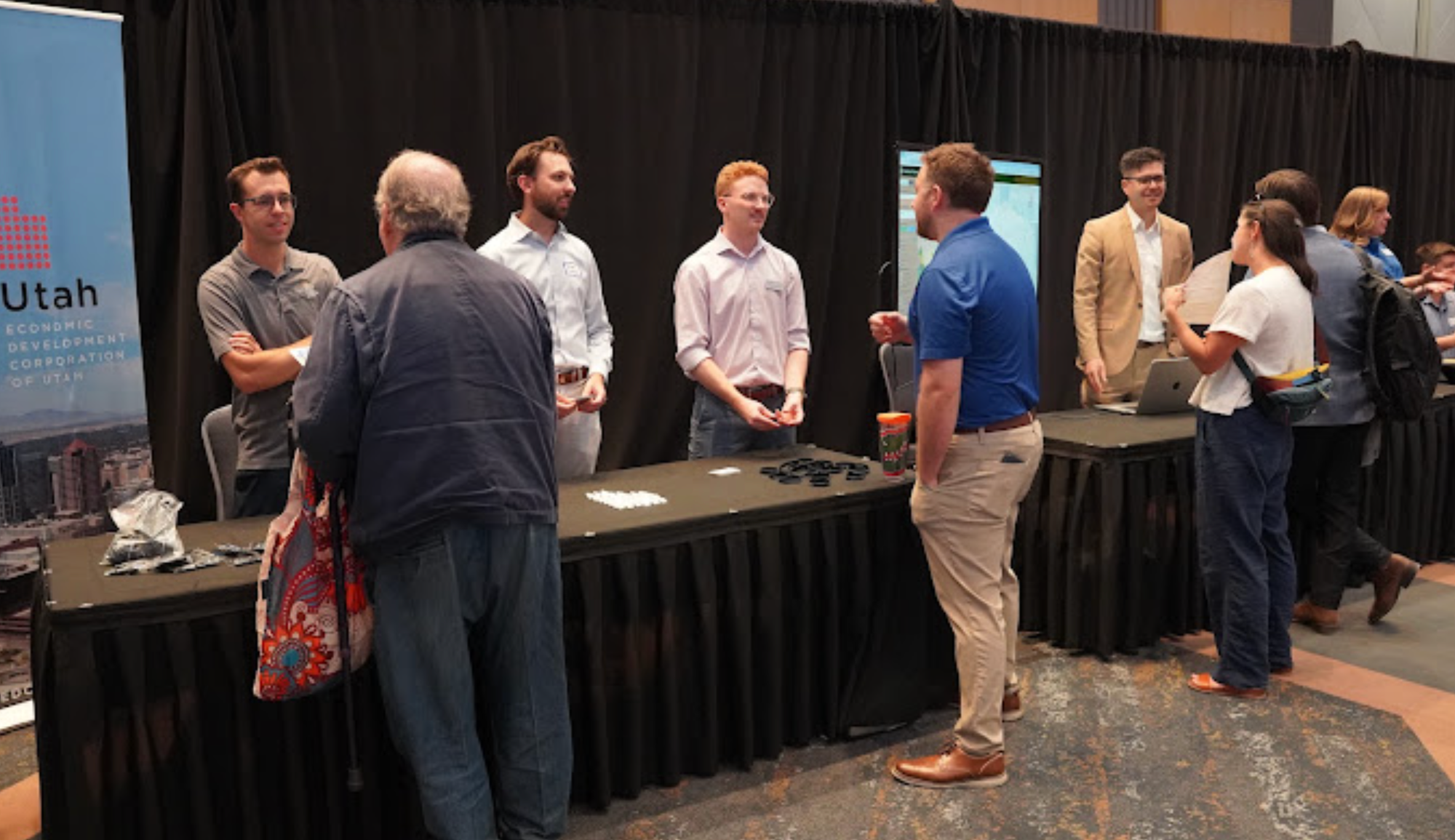
Attendees browse the community energy expo ahead of Weber County's nuclear symposium in Ogden, talking with representatives at booths including the Economic Development Corporation of Utah. The expo, held before the evening's panels and keynote, gave residents a chance to ask informal questions of industry and state representatives in a lower-pressure setting. Photo: Mark Tullis, TechBuzz
Answering the Renewables Question
During Q&A, an audience member pressed Memmott on what he called the "duck curve" problem. It is the dip and steep evening ramp in electricity demand created by heavy solar adoption, which has historically been difficult for baseload nuclear to accommodate. Memmott argued molten salt reactors are uniquely suited to closing that gap: because the reactor's core physics are temperature-dependent, the reaction naturally slows as the salt heats up and speeds up as it cools, allowing the reactor to track demand fluctuations within minutes without external control systems. He noted TerraPower's Natrium reactor — under development in Kemmerer, Wyoming, using a sodium coolant rather than molten salt — achieves a similar load-following effect through a separate molten-salt thermal storage system.
Asked about waste transport, specifically, the prospect of nuclear materials moving on Utah roads if the state becomes a manufacturing and processing hub, Memmott didn't dismiss the concern. He pointed instead to existing spent-fuel storage technology: reinforced concrete casks designed to survive train collisions, plane crashes, and other worst-case scenarios without breaching. Whether Utah chooses to become a waste-processing hub, he said, remains an open policy question the state doesn't have to answer to build reactors.
A separate audience question raised helium gas-cooled reactor technology, a design distinct from both Memmott's molten salt work and Nuclea's lead-cooled approach. Utah already has a company pursuing exactly that: Valar Atomics, whose helium-cooled, TRISO-fueled Ward 250 reactor reached criticality at the Utah San Rafael Energy Lab in Emery County earlier this year, becoming the first DOE-authorized advanced reactor built and operated outside the national laboratory system.
Five Years to Operational
AlphaTech's core commercial argument remains a compact, factory-built molten salt reactor, licensed at the production-facility level rather than reactor-by-reactor, aimed at data centers, industrial heat customers, and grid operators managing renewable intermittency. Where January's profile was aimed at TechBuzz's usual startup and investment readership, Wednesday's keynote was aimed at people who may soon be asked whether they want a reactor sited near their community — and Memmott, by his own account, is betting that a room armed with the same safety data he uses with his BYU students will reach a different conclusion than the "80% assume waste and weapons" crowd he says he usually faces.
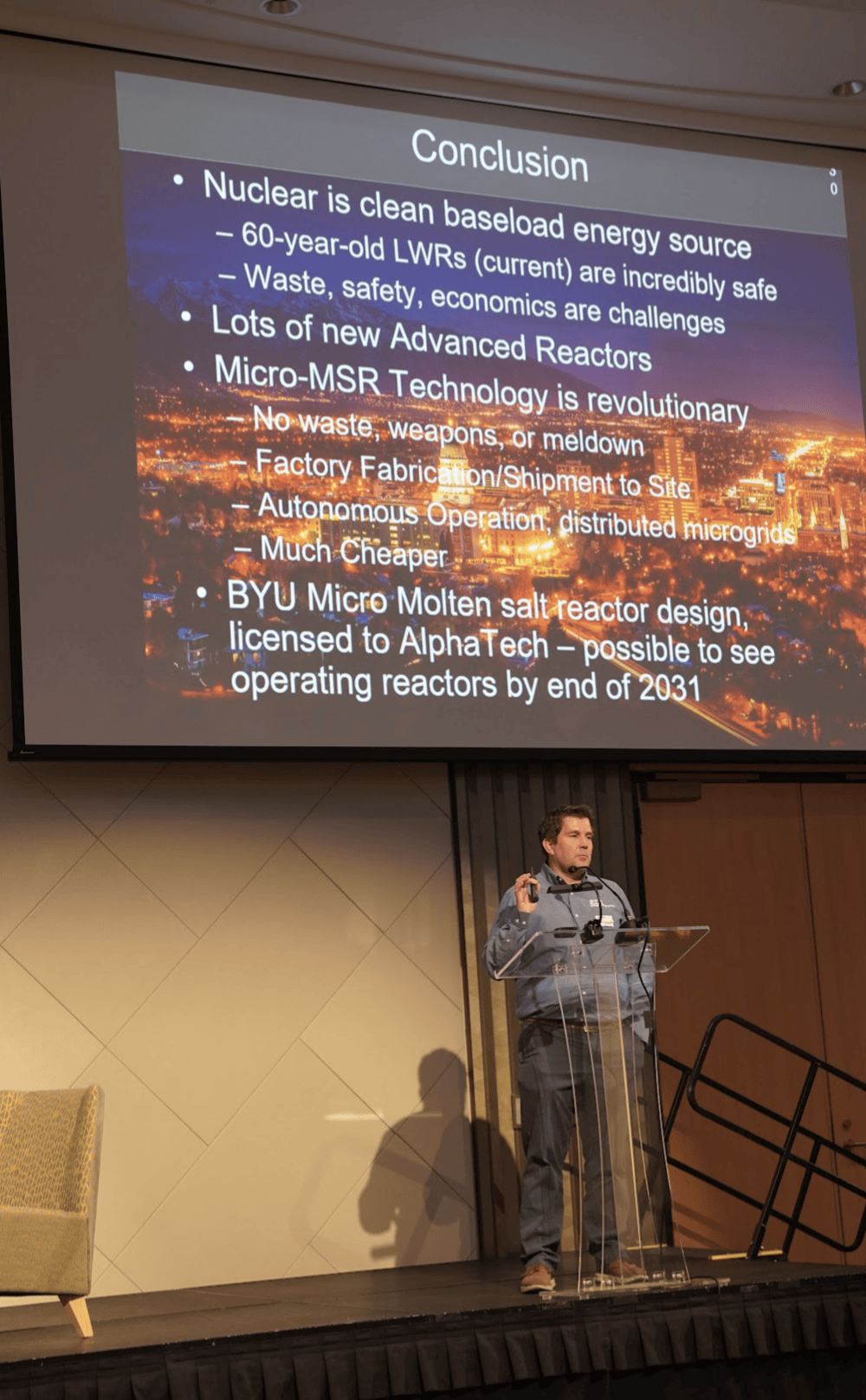
Matt Memmott closes his keynote at Weber County's nuclear symposium with a bet on timing — telling the audience it's "possible" to see AlphaTech's BYU-licensed micro molten salt reactors operating by the end of 2031. Photo: Mark Tullis, TechBuzz
Memmott closed by putting a date on that bet: he told the Ogden audience it's "possible to see operating reactors by the end of 2031," referring to AlphaTech's BYU-licensed micro molten salt reactor design. His closing slide summarized the pitch in absolute terms. He described micro-MSR technology as producing "no waste, weapons, or meltdown" which is language consistent with the Ogden presentation and yet goes further than the more qualified case AlphaTech has made elsewhere, including in TechBuzz's January profile, where the company's waste argument centered on reprocessing spent fuel into salable isotopes and materials rather than eliminating waste outright.
"I think we're going to have to build every source of power as quickly as possible," Memmott told the Ogden audience. "That includes nuclear, it includes advanced nuclear, it includes everything else."