What Comes Next for Silicon Slopes? Utah Founders Debate Scale, Culture, and the Age of AI
At a Cynosure Group–Silicon Slopes Founder Circle lunch, Utah tech leaders debated whether the state should chase Fortune 500 scale or lean into a more diverse, founder-friendly ecosystem, amid AI's disruption of enterprise software.
At an invitation-only Founder Circle lunch co-hosted by The Cynosure Group and Silicon Slopes, panelists wrestled with whether Utah's tech ecosystem should chase Fortune 500 scale — or whether that's the wrong question entirely.
Holladay, Utah — July 24, 2026
Utah's tech ecosystem has spent two decades proving it can build valuable companies. On Thursday, a small group of the state's leading founders gathered at the Holladay Kiln, opened in February 2026, to ask a harder question: what is Silicon Slopes actually for, now that it has largely accomplished what it set out to do?
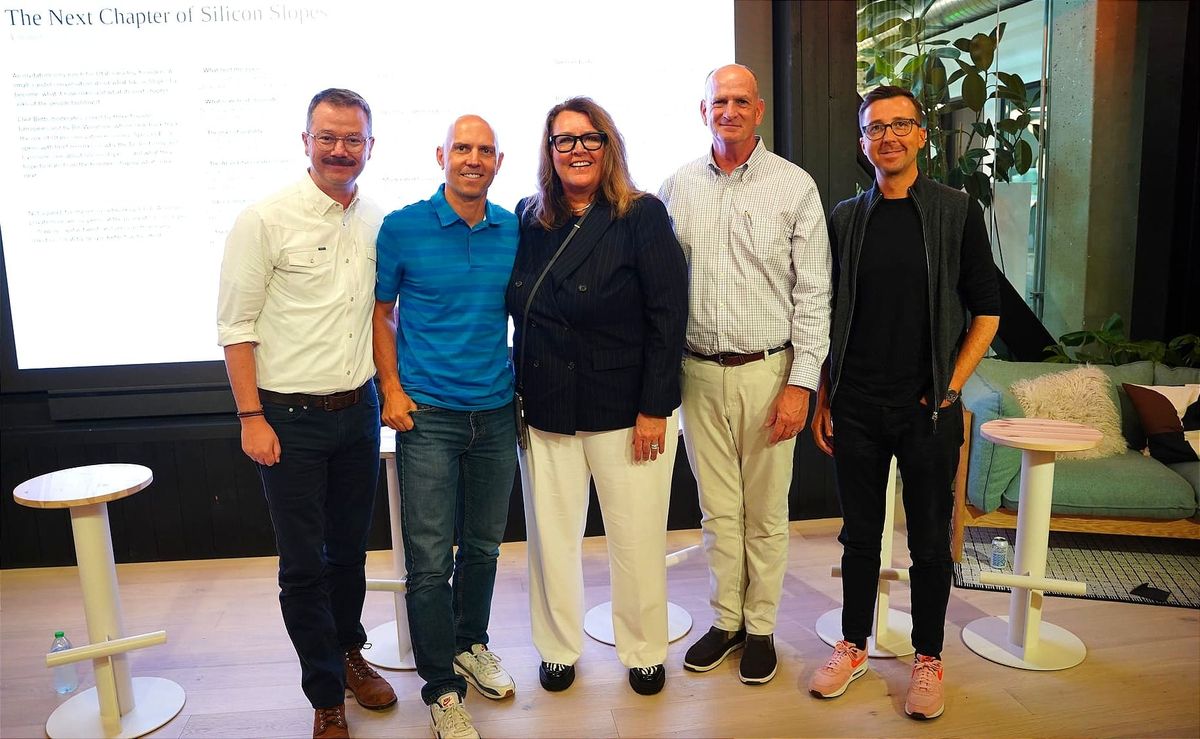
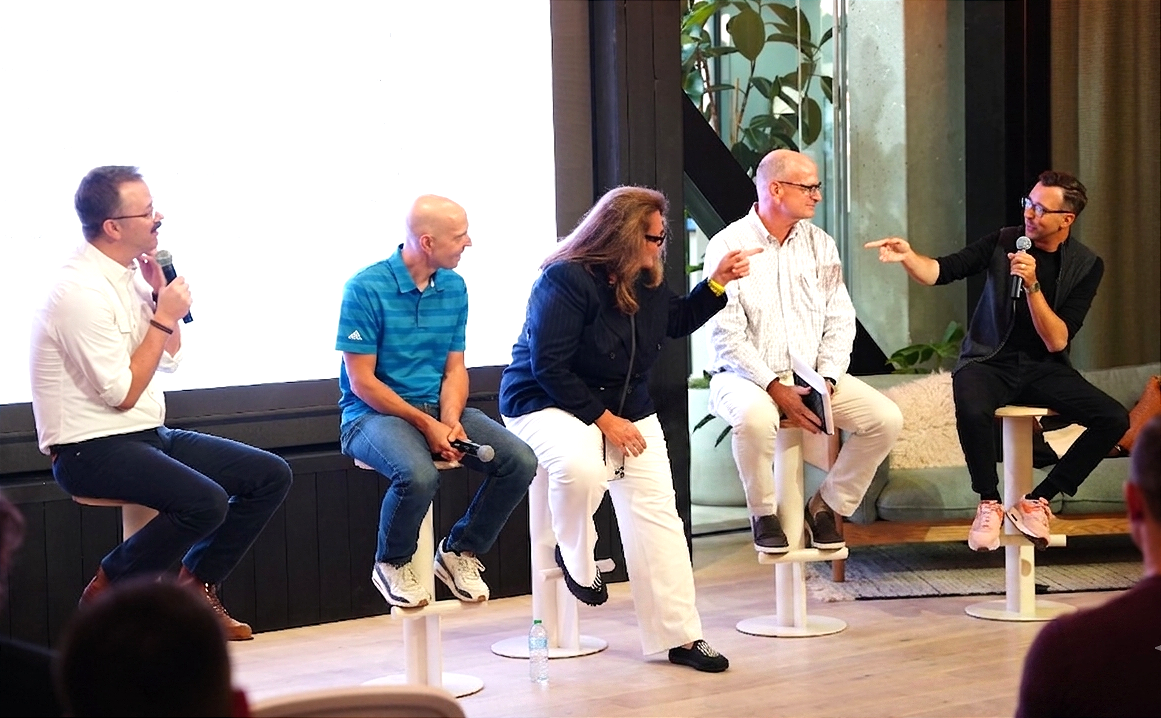
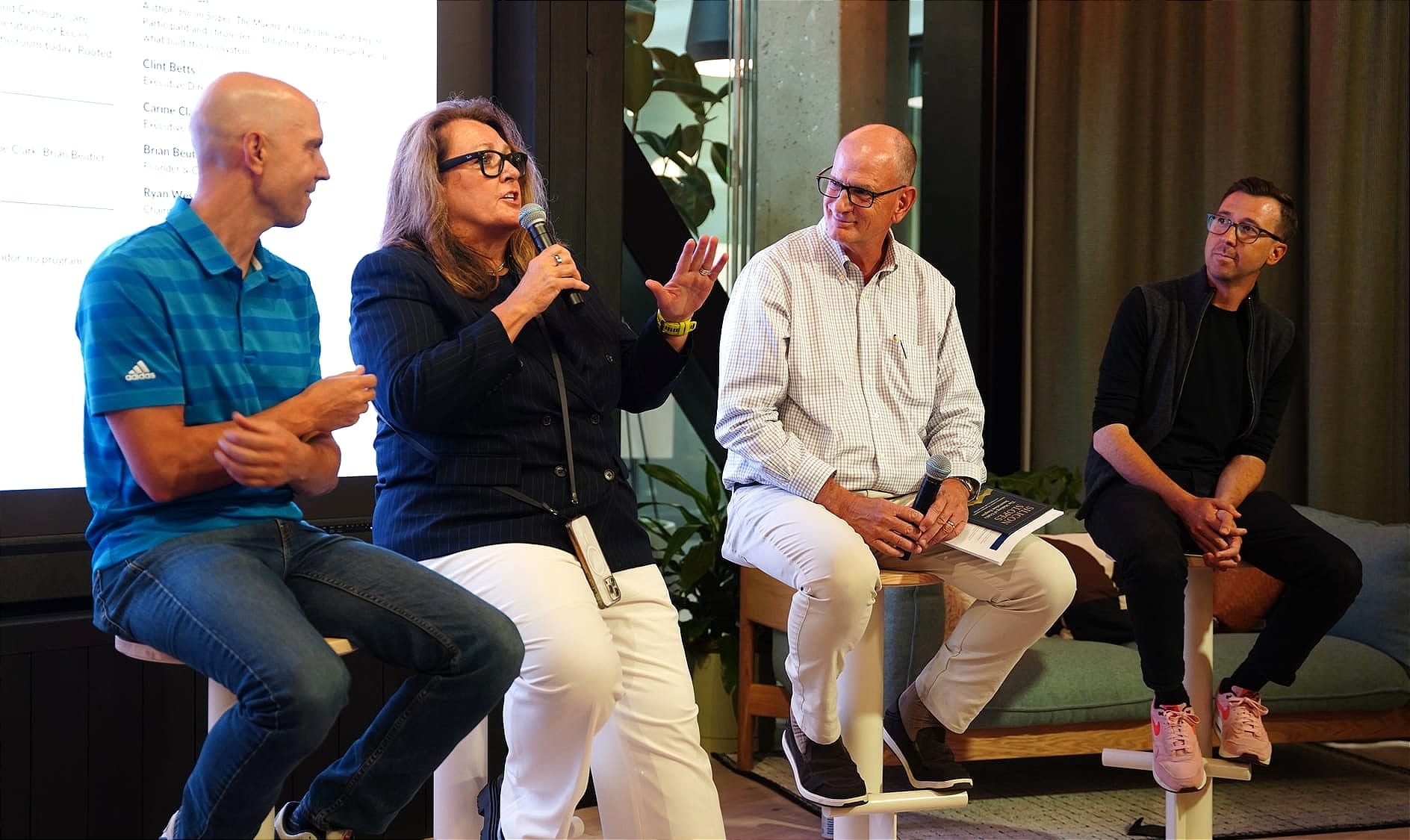
Clint Betts moderates a panel discussion featuring Brian Beutler and Carine Clark—playfully sparring with Ryan Westwood (right)—while Bill Woodson gets caught in the middle. Photo: Mark Tullis, TechBuzz
The Founder Circle lunch, co-convened by The Cynosure Group and Silicon Slopes, opened with remarks from Spencer Eccles and moved into a moderated conversation led by Clint Betts with Carine Clark, CEO of First Colony Mortgage (Pleasant Grove, Utah) and Executive Chair of Domo (American Fork, Utah); Brian Beutler, Founder and CEO of Alianza (Pleasant Grove, Utah); Ryan Westwood, Chairman and CEO of Fullcast (Lehi, Utah); and William I. Woodson, Managing Director of The Cynosure Group, whose new book, Silicon Slopes: The Making of Utah's Innovation Empire, edited by Clint Betts, traces the rise of Utah's innovation economy and was featured at the event and given to attendees.
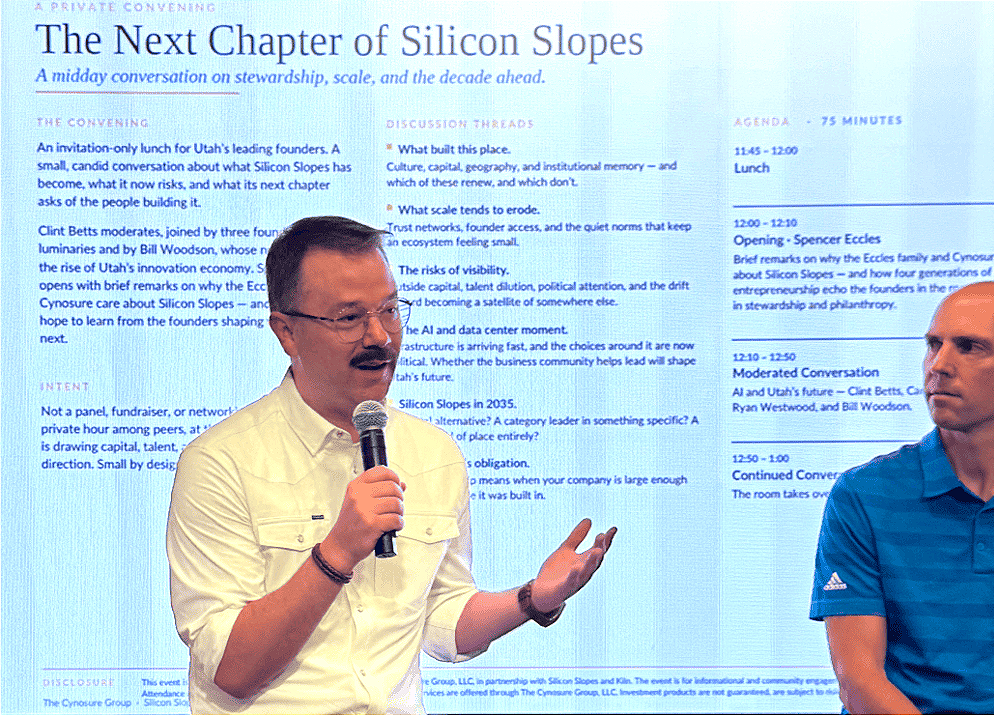
Clint Betts, CEO of Silicon Slopes setting the stage for the discussion of the Founder Circle lunch co-hosted by The Cynosure Group and Silicon Slopes, alongside, Brian Beutler, CEO of Alianza at Holladay Kiln. Photo: Amy Osmond Cook, Fullcast
A Family Story, and a Mantra
Spencer P. Eccles opened with the story of his great-great-grandfather David Eccles, who arrived in the United States from Scotland in 1863 at age 14 with his family of nine on the ship (and namesake of the family's company) Cynosure, part of a wave of immigrants aided by the Church of Jesus Christ of Latter-day Saints' Perpetual Emigration Fund. David Eccles went on to found or lead more than 50 businesses, often extending equity to employees by lending them money to buy stock, which they then paid down with dividends.
Spencer P. Eccles, Co-Founder & Managing Director, The Cynosure Group, welcoming the audience to the Founder Circle lunch co-hosted by The Cynosure Group and Silicon Slopes, Holladay Kiln. Photo: Mark Tullis, TechBuzz
Eccles shared a passage from a biography of his ancestor, in which David Eccles warned a son never to work for money alone, but to work for the success of the business and let the money follow. It's a philosophy Eccles said still animates The Cynosure Group's approach today, one he summarized as "helping good people do great things." The firm, whose name comes from the ship that carried the Eccles family to America and means "north star," runs wealth advisory, institutional money management, real estate, sports, and growth equity and private equity funds.
Eccles recounted how he stepped in to lead Utah’s Governor’s Office of Economic Development in August 2009—just as Governor Gary Herbert succeeded Jon Huntsman. At that time the state was staring down the barrel of the Great Recession. While lawmakers were tempted to tap the brakes, Eccles saw an opportunity to keep their foot on the gas. Supported by a healthy rainy day fund, Utah was well-positioned to aggressively recruit companies out of California.
Eccles recruited private-sector talent like Chris Connolly to bolster the state's efforts, but pitched companies often voiced a fundamental missing piece: Utah didn't have a mature tech ecosystem. While low taxes, cheap power, and a business-friendly regulatory climate were compelling, out-of-state companies worried about talent liquidity—asking, "When my employees come here, where will they get their next job?"
At the time, early initiatives like the Utah Fund of Funds—pioneered by vSpring founder Paul Ahlstrom and Governor Mike Leavitt—were attempting to fill capital gaps, but the ecosystem was still finding its footing, prompting leaders to question how state-backed venture efforts should evolve. Around this time Eccles said he was asked to represent the governor at an early, pivotal investment round for a then-small relatively unknown Utah startup named Qualtrics. The audience laughed.
Spence Eccles, Co-Founder & Managing Director of The Cynosure Group, speaking at the Founder Circle lunch co-hosted by The Cynosure Group and Silicon Slopes. Photo: Mark Tullis, TechBuzz
Start School
Lindsey Ivie, who leads partnerships for Silicon Slopes, gave an update on Start School, the nonprofit's free mentorship and resource program for founders. Since its February 2026 launch, Start School has drawn 450 applicant companies, organized into small "start squads" of four to six people, with weekly mentor sessions typically drawing 80 to 100 students. Sponsors, including Mountain America Credit Union, provide resources such as free checking accounts for participating founders.
Ivie also previewed two upcoming events: the Stack Summit in September, a new two-day conference focused on AI, data, and cybersecurity aimed at CIOs, CTOs, and CISOs, with day one at The Grid and day two at the Miller Campus; and the Slopes Cup golf tournament, pushed back to October 12, with sponsorship proceeds benefiting Start School.
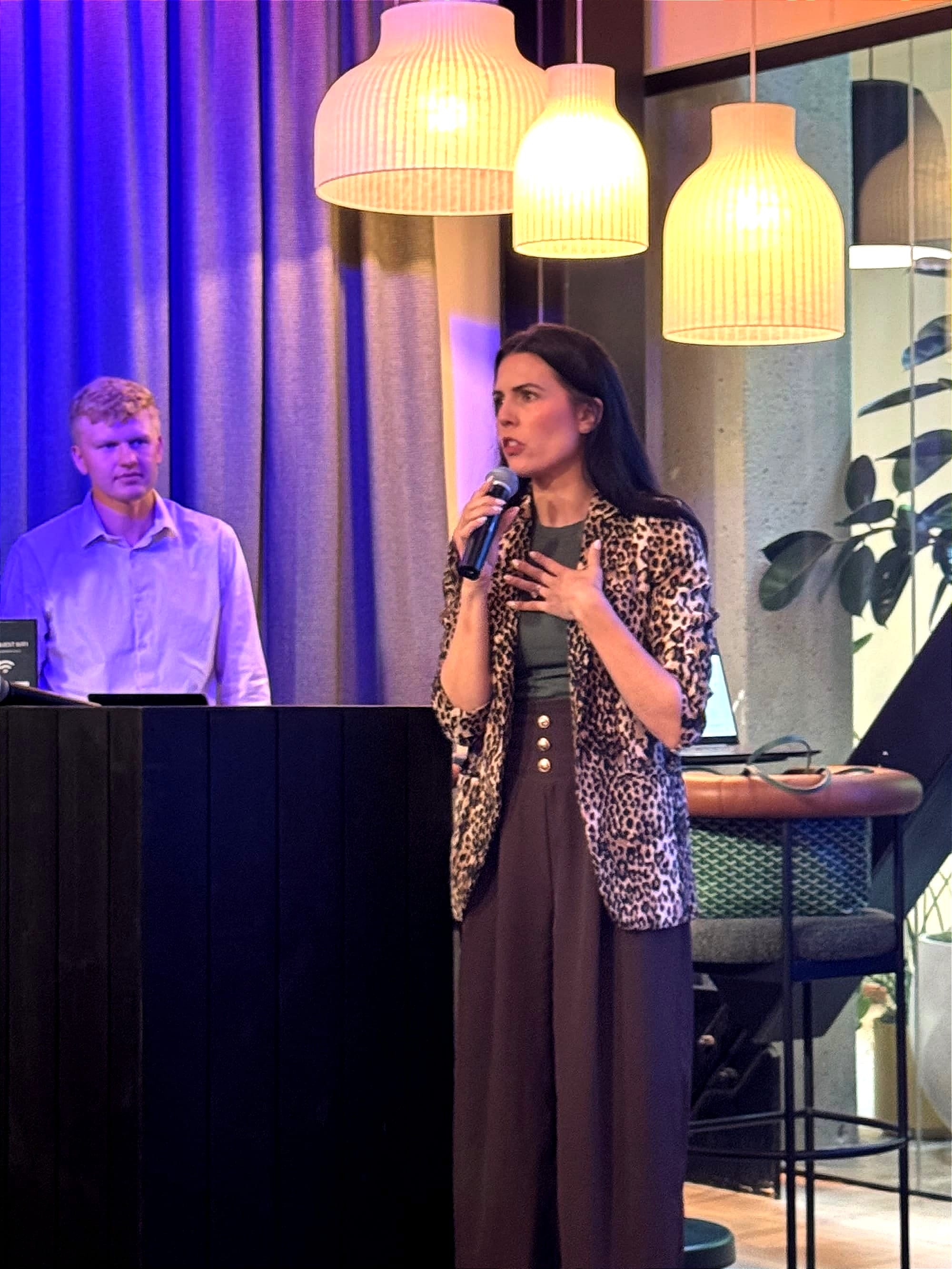
Lindsey Ivie, VP of Partnerships, Silicon Slopes, providing an update about Start School and other Silicon Slopes initiatives, at the Founder Circle lunch, co-hosted by The Cynosure Group and Silicon Slopes, Holladay Kiln. Photo: Amy Osmond Cook, Fullcast
The Historian's Question
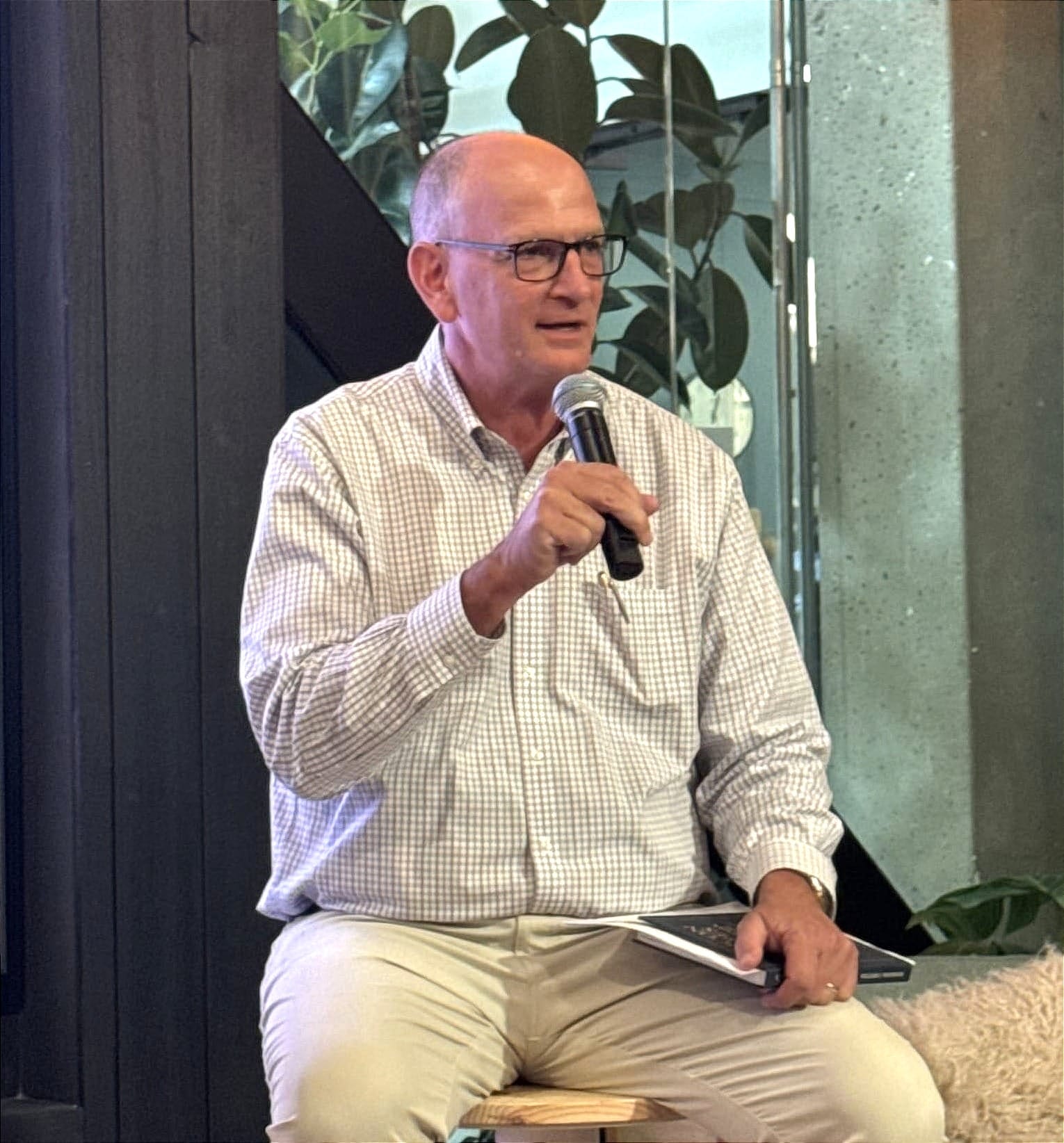
Bill Woodson framed his remarks around the research behind his recently published book on Utah's innovation economy, Silicon Slopes: The Making of Utah's Innovation Empire, edited by Clint Betts. A three-year Utah resident who spent his career in Silicon Valley, Woodson said he was struck by how much Utah "punches above its weight" relative to other tech hubs, citing the state's high return on invested capital and unicorns-per-capita figures, including a ranking that places the University of Utah among the top producers of unicorn founders nationally.
Woodson traced that performance to Utah's settlement history, known for the self-reliance required of communities that dug their own canals and built their own schools and libraries after 1847. He argued these early efforts produced a culture oriented around purpose, community, and commitment.
Bill Woodson of the Cynosure Group discussing his new book, Silicon Slopes: The Making of Utah's Innovation Empire, edited by Clint Betts, at the Founder Circle lunch, co-hosted by The Cynosure Group and Silicon Slopes, July 23, 2026. Photo: Amy Osmond Cook, Fullcast
He also posed the question that shaped the rest of the panel: Utah has proven skilled at building one-to-ten-billion-dollar companies and selling them. Should it instead try to build a hundred-billion-dollar company that stays?
Does Utah Need a Fortune 500 Company?
That question anchored the panel's central debate, and the group did not converge on an answer.
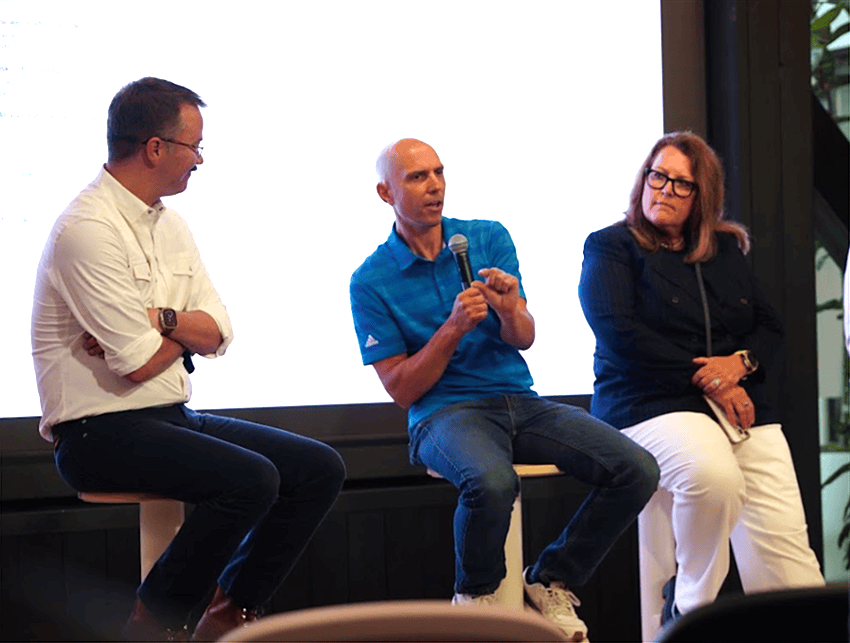
Beutler argued that healthy ecosystems, like healthy forests, need diversity rather than a handful of giants, and cautioned against measuring Utah's success purely against Silicon Valley's scale. He said Utah's relative youth as a tech hub — and a roughly 1-to-300 gap in cumulative enterprise value created compared with Silicon Valley — shouldn't obscure real opportunities to build more durable companies, provided founders find purpose beyond the financial outcome of a sale.
Brian Beutler, speaking at "Silicon Slopes: What Comes Next" Founder Circle, co-hosted by The Cynosure Group and Silicon Slopes. Also pictured Clint Betts and Carine Clark. Photo: Mark Tullis, TechBuzz
Westwood offered a more personal frame, describing the psychological toll of building a company over the 30- or 40-year timeline required to reach Fortune 500 revenue scale, and said most Utah entrepreneurs choose family stability over that level of sustained intensity — a tradeoff he characterized as reasonable rather than a failure of ambition.
Clark used Domo's recent transaction as a case study in navigating pressure on public SaaS companies. Domo announced on July 22 that it would sell substantially all of its operating assets to Progress Software Corporation (Bedford, Massachusetts) for $400 million in cash, while retaining more than $900 million in tax loss carryforwards in a separate, continuing public entity. Clark, who chairs Domo's board, described the structure as a clever way for founder and CEO Josh James to preserve value for shareholders while the company's platform continues under new ownership.
Panelists Brian Beutler, Carine Clark, Bill Woodson and Ryan Westwood at the "Silicon Slopes: What Comes Next" Founder Circle lunch, co-hosted by The Cynosure Group and Silicon Slopes. Photo: Mark Tullis, TechBuzz
Clark described the story of her taking the helm of a mortgage company. When Corey Shelley, owner and chairman of First Colony Mortgage, asked her to take over as CEO in June 2024, her first instinct was a firm no. First Colony was a 42-year-old Pleasant Grove staple handling 70% of Utah’s mortgages, but its process was anchored in an archaic past. Clark had recently endured the agony of a marathon home-closing session, sitting before a mountain of physical paperwork, and wanted nothing to do with a paper-bound industry. "I want to buy a house on my phone," she told the audience. Shelley saw the same flaw as an opportunity, and challenged her to bring modern technology into a paper-heavy business that had never truly been disrupted.
Clark accepted the challenge, setting out to eliminate the industry’s friction without expanding the company's 500-person headcount. Driving that change wasn't easy: "Everybody wants disruption; they just don’t want you to change anything to do it," Clark observed, triggering knowing chuckles in the audience.
Yet by pushing past internal resistance and implementing AI-driven workflows, she transformed the company’s trajectory. First Colony leaped from generating roughly $1.3 billion a year to an astonishing $2 billion a month, making it the fastest-growing mortgage bank in the nation—even in a high-interest-rate market. Her story highlights a broader truth for modern entrepreneurs: the greatest growth isn't in flashy new tech gimmicks, but in having the stomach to overhaul the bloated, everyday legacy systems everyone else has accepted as unchangeable.
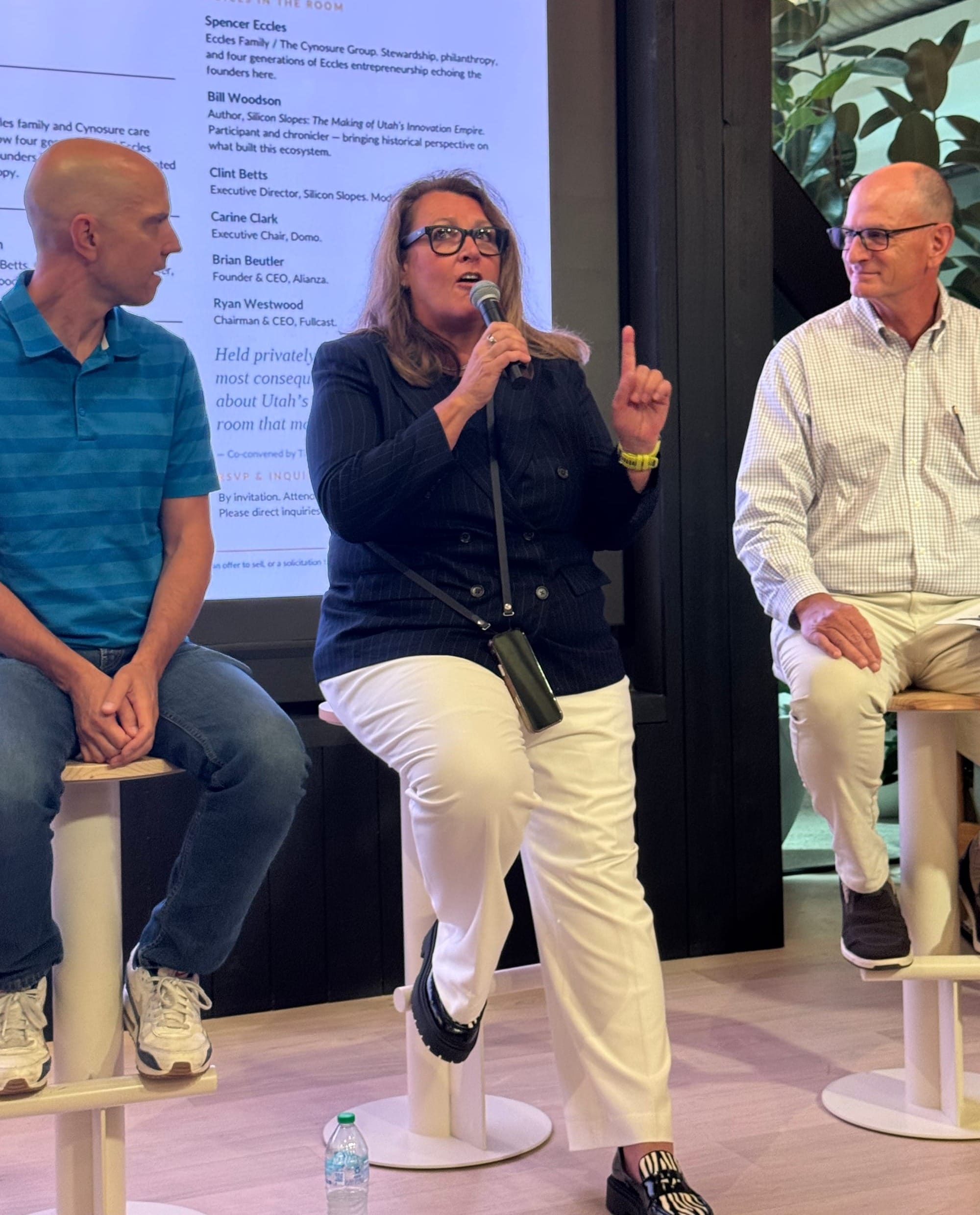
Carine Clark making a prediction at "Silicon Slopes: What Comes Next" Founder Circle, co-hosted by The Cynosure Group and Silicon Slopes. Photo: Amy Osmond Cook, Fullcast
In another memorable moment, Clark predicted the biggest company to ever emerge from Utah won't be another conventional software platform—it will be Torus, the energy storage and management pioneer founded by serial entrepreneur Nate Walkingshaw. She mentioned Walkingshaw's track record that includes building Strava and Pluralsight, and said he is now transforming energy storage. By pairing commercial-grade energy storage—like the 80 kW battery bank Clark relies on for her own home—with an intelligent power management software stack, Torus is tapping into an unprecedented global demand across residential, commercial, and utility sectors. Clark said Walkingshaw’s vision for decentralized energy storage positions Torus well to capture what may be the largest wealth-generation cycle in history—and eventually become Utah’s next massive public market success.
Growth, and Who Gets Left Behind
The conversation shifted when Betts and others raised a tension underlying the entire discussion: national polling showing broad public skepticism of AI and data center growth, and a concern that most Utahns may not actually want the kind of rapid tech expansion the panel was discussing. Betts argued that any push toward "what's next" for Silicon Slopes needs to include non-tech Utahns in the conversation, rather than treating growth as self-evidently good.
Carine Clark pointed to more immediate civic concerns, arguing that the ecosystem's attention and resources should extend to addressing gaps in basic needs alongside its economic ambitions. Roughly one in five Utah children currently live in food-insecure households, according to Utah Food Bank, which reported in 2026 that 445,000 Utahns overall face food insecurity, an increase of nearly 100,000 people in a single year.
Connecting Silicon Slopes and Park City
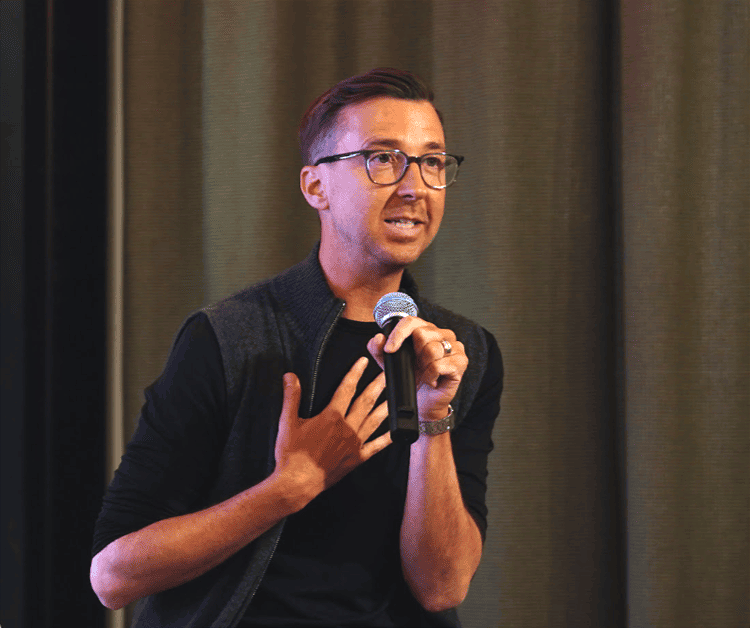
Ryan Westwood speaking at "Silicon Slopes: What Comes Next" Founder Circle, co-hosted by The Cynosure Group and Silicon Slopes. Photo: Mark Tullis, TechBuzz
As the event was about to wrap, an audience member asked how Silicon Slopes might better connect Utah County, Salt Lake City, and Park City's business communities. Westwood said he has casually compiled a list of 106 venture capitalists, private equity leaders, and CEOs who own second homes in Park City. He said this group has largely stayed disconnected from Silicon Slopes events because the properties function as retreats rather than working bases.
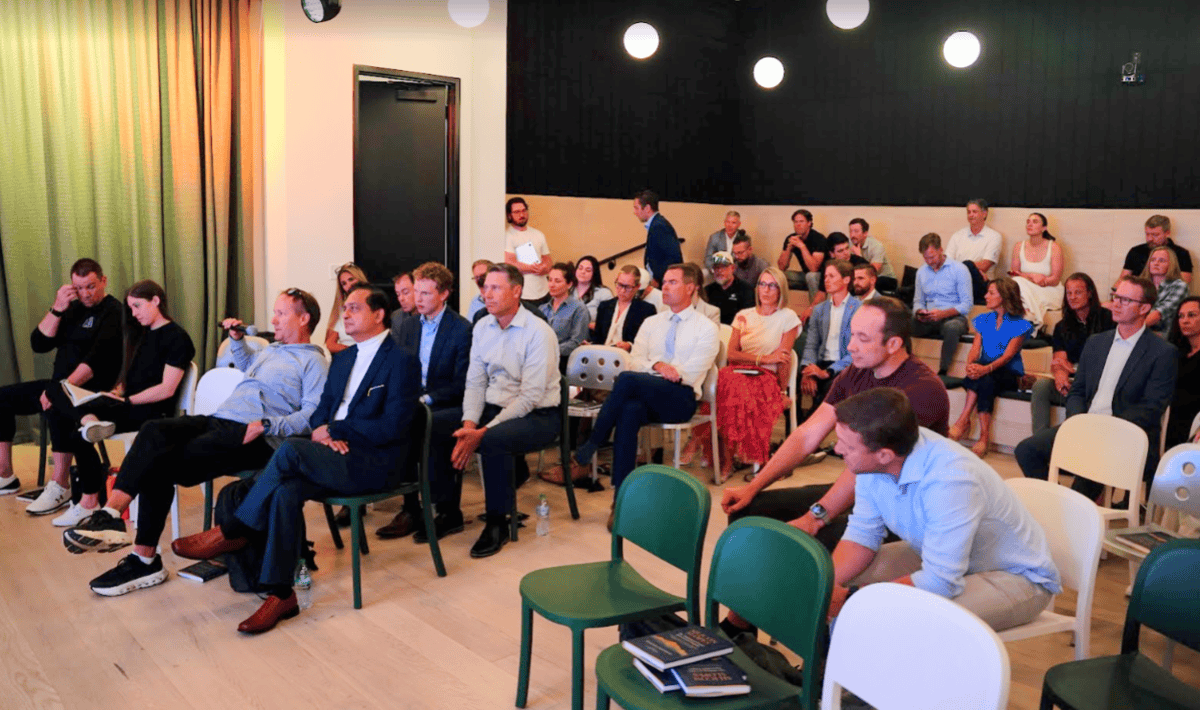
Audience Q&A at "Silicon Slopes: What Comes Next" Founder Circle, co-hosted by The Cynosure Group and Silicon Slopes. Photo: Mark Tullis, TechBuzz
Silicon Slopes plans to run a Park City chapter event in August aimed at drawing that group in.